How to Read Baby Sleep Cues (And What to Do About Them)
Quick Answer
Act on the quiet signals, not the loud ones. A glazed stare, slowing movement, a first yawn, or your baby turning their face away from you means the window is open now; start the wind-down inside ten to fifteen minutes. Eye rubbing, back arching, and shrieking are late signs — by then cortisol is up and settling takes far longer.
Our Verdict
Learning to read your baby's early sleep cues — staring into space, decreased activity, first yawn — and acting within the 10-15 minute window is the single most impactful sleep skill you can develop.
Key Takeaways
- ✓Learning to read your baby's early sleep cues — staring into space, decreased activity, first yawn — and acting within the 10-15 minute window is the single most impactful sleep skill you can develop.
- ✓Watch for early sleep cues — staring into space, decreased activity, yawning, and turning away from stimulation — and begin your wind-down routine within 10-15 minutes of spotting them. Missing thi...
- ✓Once you can spot the sleepy window, the next step is practice. Here is the contact-nap to crib transition ladder.
💬 Real Talk from Parents
Every baby sleep book contradicts the last one you read. That's normal.
Sleep training is 50% technique and 50% parental willpower.
You'll google 'baby sleep regression' at least once a month for the first year.
The bassinet-to-crib transition feels scarier for you than for the baby.
The secret nobody tells you: most babies figure out sleep eventually. The books just help you survive until they do.
Paraphrased community consensus — not a direct quote.
Babies should sleep in complete silence.
The womb is roughly 80-90 decibels — about as loud as a vacuum cleaner. White noise at 60-65 dB actually helps babies sleep by mimicking the familiar uterine environment.
Sleep training damages your baby's attachment.
Multiple peer-reviewed studies (including a 2012 Pediatrics study following children for 5 years) found zero difference in emotional health, behavior, or parent-child attachment between sleep-trained and non-sleep-trained children.
As an Amazon Associate I earn from qualifying purchases. Product prices and availability are subject to change.
How to Read Baby Sleep Cues (And What to Do About Them)
Watch for early sleep cues — staring into space, decreased activity, yawning, and turning away from stimulation — and begin your wind-down routine within 10-15 minutes of spotting them. Missing this window leads to overtiredness, which triggers cortisol release and makes it paradoxically harder for your baby to fall asleep.
The AAP's sleep guidance emphasizes the importance of age-appropriate wake windows: newborns can typically only tolerate 45-90 minutes of wakefulness, while 6-month-olds manage about 2-3 hours. A 2017 study in Sleep Medicine Reviews found that infants whose caregivers consistently responded to early sleep cues had 40% fewer nighttime awakenings than those whose caregivers relied on fixed-schedule approaches alone.
Why are baby sleep cues so important?
Rule of thumb: Tired is a window, not a switch. Miss it and your baby becomes overtired, which triggers a cortisol and adrenaline response that paradoxically makes it harder to fall asleep.
Babies have narrow windows of optimal sleepiness. An overtired baby fights sleep rather than falling into it. An overtired baby will:
- Fight sleep
- Take shorter naps
- Wake more frequently at night
Learning to catch the early cues and act quickly is the single most impactful sleep skill you can develop.
Research published in Pediatrics (2018) demonstrates that overtired infants produce elevated levels of cortisol, which creates a hyperarousal state that interferes with sleep onset. The AAP notes that recognizing and responding to early drowsiness signals is one of the most effective strategies for reducing infant sleep difficulties.
What are the early sleep cues parents should watch for?
These are the first signs of sleepiness. When you see these, you have roughly 10-15 minutes to start your wind-down routine. Acting on early cues gives you the best chance of a smooth transition to sleep.
| Early cue | What it looks like |
|---|---|
| Staring into space | Gaze becomes unfocused, eyes may appear glazed — the first cue and the easiest to miss |
| Decreased activity | Kicking, reaching and babbling slow down; less engaged with stimulation |
| Yawning | One or two means start winding down now; multiple in quick succession means you are close to overtired |
| Turning away from stimulation | Deliberately looks away from toys, faces or bright lights |
| Subtle fussiness | Brief whimpers, minor squirming, coos turning plaintive |
A 2020 study in Infant Behavior and Development found that caregivers who received training in identifying early sleep cues put their infants down an average of 12 minutes earlier than untrained caregivers — and their infants fell asleep 8 minutes faster with less crying. The study concluded that sleep cue recognition is a learnable skill that significantly improves infant sleep outcomes.
Staring into space
Your baby's gaze becomes unfocused — they're looking at something but not really seeing it. Their eyes may appear glazed. This is often the very first cue and the easiest to miss.
Decreased activity
A baby who was happily kicking, reaching, or babbling suddenly becomes quieter and less engaged. Their movements slow down. They may stop responding to stimulation that was interesting moments ago.
Yawning
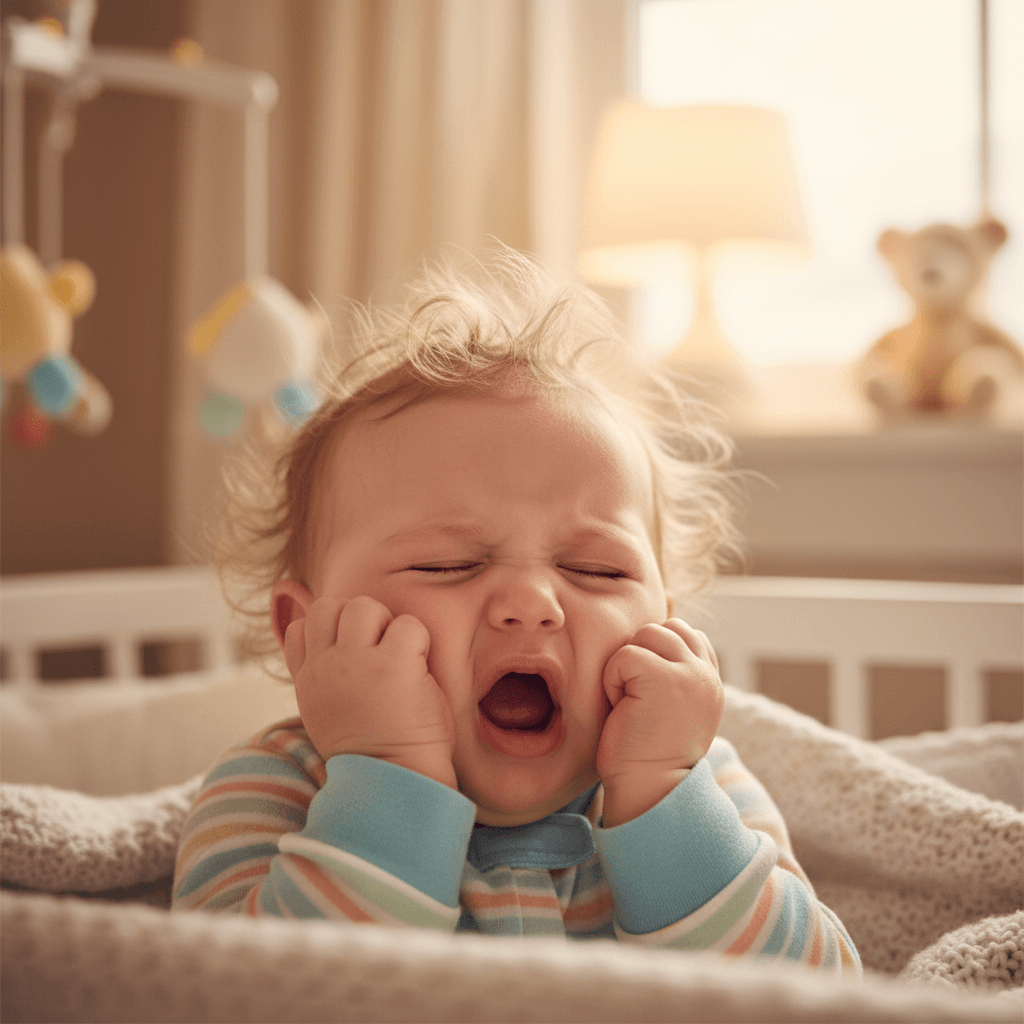
The classic signal, but by the time yawning starts, you're partway through the window. One or two yawns mean "start winding down now." Multiple yawns in quick succession mean you're close to the overtired zone.
Turning away from stimulation
Baby deliberately looks away from toys, faces, or bright lights. They may turn their head or close their eyes briefly. This is their way of reducing sensory input as their brain prepares for sleep.
Subtle fussiness
Not full crying, but small complaints. Brief whimpers, minor squirming, or a change in vocalization tone from happy coos to something more plaintive. This is baby's verbal version of "I need a break."
What are the signs that a baby is already overtired?
If you see these, act immediately. You may need a more intensive soothing approach to overcome the building stress response.
| Late cue | What it means |
|---|---|
| Eye rubbing | Uncomfortable and signaling fatigue clearly — also pulling at ears |
| Arching back | Looks like resisting being held; actually overstimulation and tiredness |
| Clinging | Burying their face in your chest, seeking comfort past the point of easy sleep |
| Full crying | Fully overtired — needs active soothing rather than a simple put-down |
| Hyperactivity | A burst of energy that reads as wide awake. The most counterintuitive cue |
The trap: Hyperactivity looks like a baby who isn't tired. Parents often think "I guess they're not tired after all" and delay bedtime further, making the problem worse.
Eye rubbing
Baby rubbing their eyes or pulling their ears is a classic late cue. By this point, they're uncomfortable and their body is signaling fatigue clearly.
Arching back
Baby arches away from you or stiffens their body. This looks like they're resisting being held, but it's actually a sign of overstimulation and tiredness.
Clinging
Conversely, some overtired babies become extra clingy — burying their face in your chest or clutching at your clothing. They're seeking comfort because they're past the point of easy sleep.
Full crying
By the time baby is crying hard, they've moved fully into overtired territory. Getting to sleep from here is possible but takes longer and more effort. You'll likely need active soothing (rocking, shushing, feeding) rather than a simple put-down.
Hyperactivity
This is the most counterintuitive cue. Some overtired babies get a burst of energy — laughing, bouncing, appearing wide awake. Parents often think "I guess they're not tired after all" and delay bedtime further, making the problem worse. If your baby is suddenly wildly active after showing early sleep cues, they're overtired.
How long should babies be awake between naps at each age?
Wake windows — the maximum time your baby can comfortably stay awake between sleeps — are a useful framework for anticipating when sleep cues will appear.
| Age | Wake window | What to watch for |
|---|---|---|
| Newborn (0-6 weeks) | 45-75 minutes | Cues are subtle — mainly stillness and the staring-into-space look |
| 2-4 months | 75-120 minutes | Yawning and turning away become more common |
| 4-6 months | 2-2.5 hours | Eye rubbing appears more frequently |
| 6-9 months | 2.5-3.5 hours | More alert and engaged, which can mask early cues; watch decreased activity |
| 9-12 months | 3-4 hours | Babies on two naps may show cues around the 3-hour mark |
| 12-24 months | 4-6 hours | Clumsiness, irritability, or demands for specific comfort items |
The AAP does not publish an official wake window chart, but pediatric sleep researchers at the Sleep Foundation and the National Sleep Foundation have established evidence-based ranges: 45-90 minutes for newborns (0-6 weeks), 1-2 hours for 2-4 months, 1.5-2.5 hours for 4-6 months, 2-3 hours for 6-9 months, and 2.5-3.5 hours for 9-12 months. The WHO recommends 14-17 hours of total sleep per day for newborns and 12-16 hours for infants 4-11 months.
Newborn (0-6 weeks)
Wake window: 45-75 minutes. Newborns tire very quickly. Their cues are subtle — mainly stillness and the staring-into-space look. When in doubt, assume a newborn who's been awake for an hour is probably getting tired.
2-4 months
Wake window: 75-120 minutes. Cues become more readable. Yawning and turning away are more common. By 4 months, you'll start recognizing your specific baby's pattern.
4-6 months
Wake window: 2-2.5 hours. Cues are clearer and more consistent. Eye rubbing appears more frequently. This is often when parents get good at catching the window.
6-9 months
Wake window: 2.5-3.5 hours. Babies are more alert and engaged, which can mask early cues. Watch for the decreased-activity signal — it's the most reliable indicator at this age.
9-12 months
Wake window: 3-4 hours. Babies on two naps may show cues around the 3-hour mark. The transition to one nap (usually between 12-18 months) can temporarily disrupt cue patterns.
12-24 months
Wake window: 4-6 hours (with one nap). Toddler cues are different — they may become clumsy, irritable, or demand specific comfort items. Verbal toddlers may directly say they're tired (or, more commonly, insist they're NOT tired while rubbing their eyes furiously).
What should you do when you notice your baby's sleep cues?
Step 1: Reduce stimulation immediately
- Lower the lights
- Reduce noise
- Stop active play
- If you're out and about, find a quiet corner or head home if possible
Step 2: Start your wind-down routine
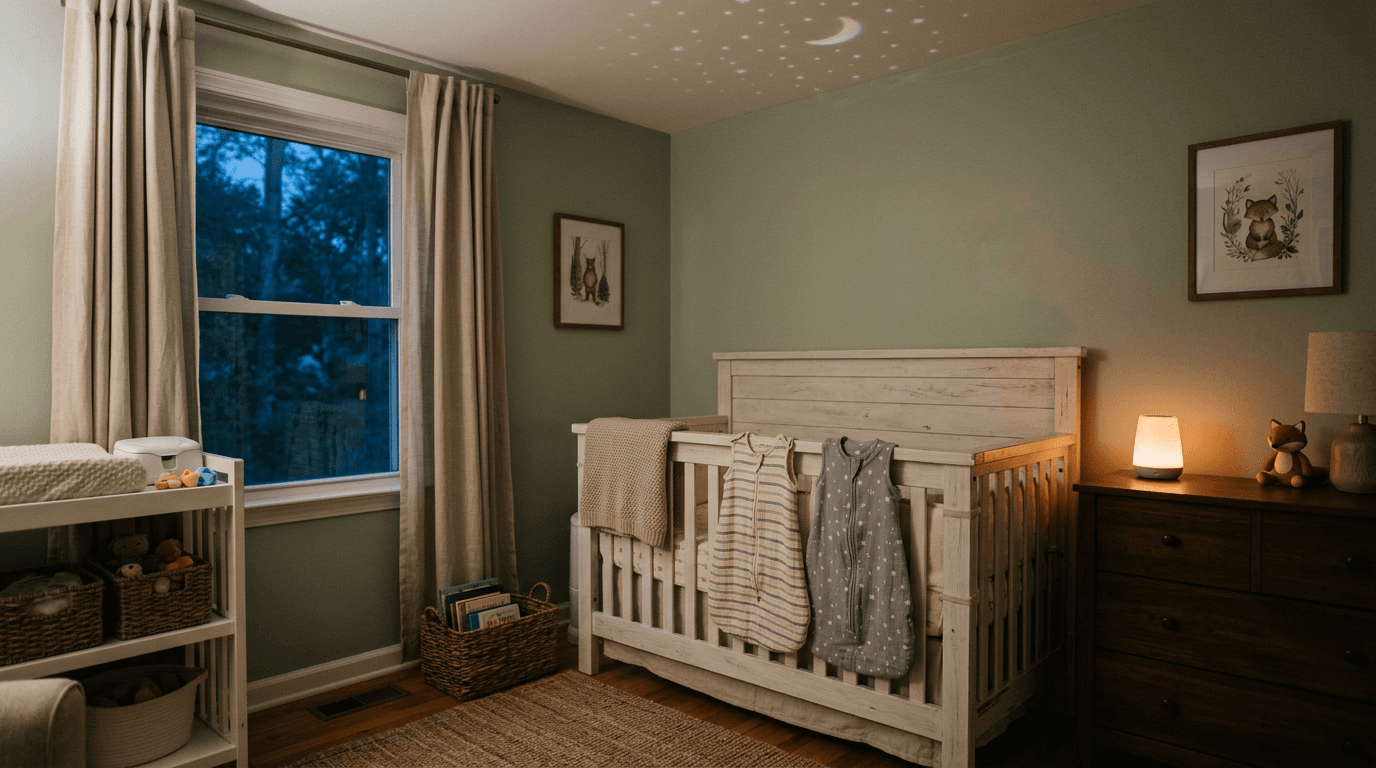
Every family's routine is different, but consistency matters more than specifics. A simple routine might be:
- Diaper change
- Sleep sack
- Close curtains
- White noise on
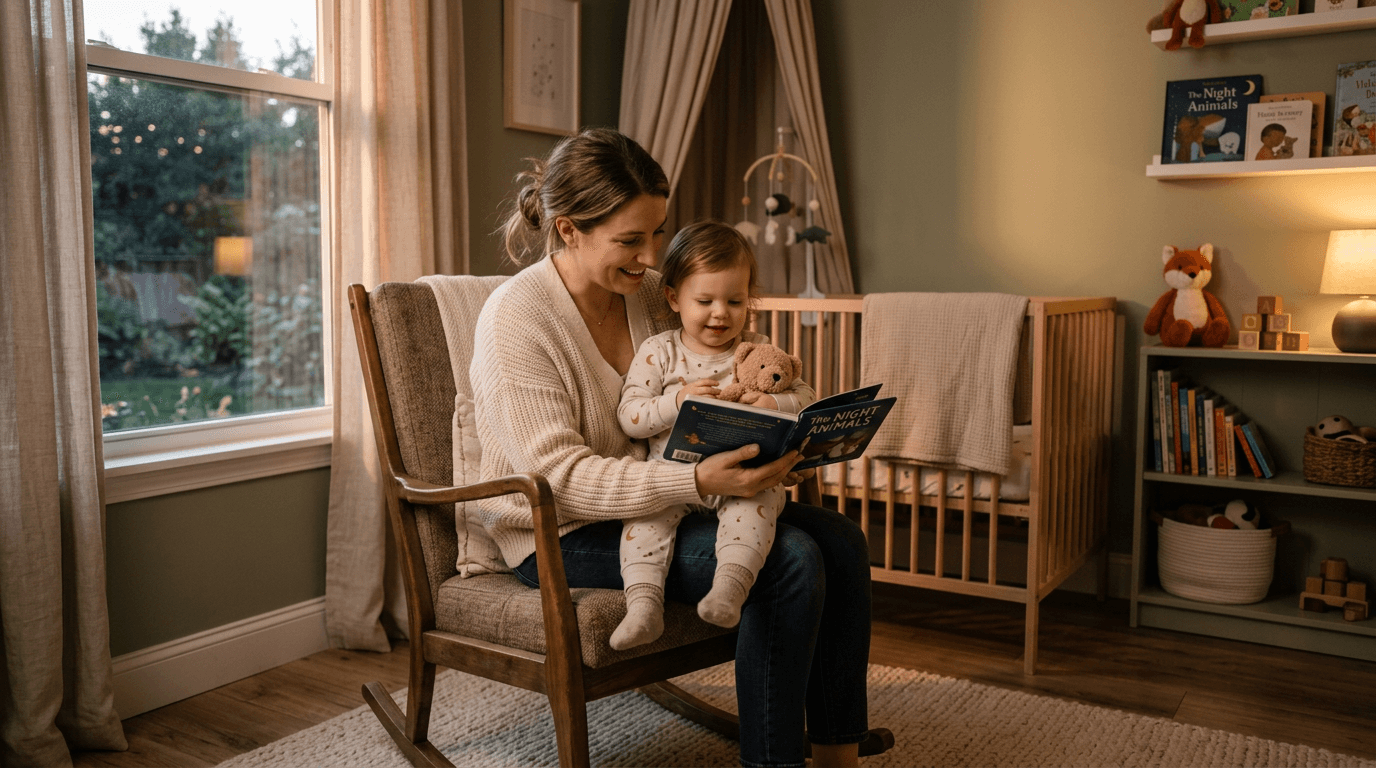
- Short book or song
- Into the crib
This should take 5-10 minutes for naps, 15-20 minutes for bedtime.
Step 3: Put baby down drowsy but awake (when possible)
This is the aspirational goal, not a rigid rule.
What "drowsy but awake" means: Baby is clearly sleepy — eyelids heavy, movements slow — but not fully asleep. This helps baby learn to bridge the gap between drowsy and asleep independently. If it doesn't work, it's okay to help them fall asleep with rocking, feeding, or holding. You can always practice again next time.
Step 4: Allow brief fussing (but not distressed crying)
Many babies fuss briefly (2-5 minutes) as they settle into sleep. This is normal self-soothing.
Settling fussiness — allow it:
- Intermittent
- Decreasing intensity
Distressed crying — respond to it:
- Escalating
- Continuous
What mistakes do parents commonly make with baby sleep cues?
The four that cost parents the most sleep:
- Waiting for "really tired" signs — by then you've missed the window
- Using screen time to tire them out — stimulation activates the brain rather than winding it down
- Keeping baby up longer hoping for a bigger nap — overtired babies take worse naps, not better ones
- Ignoring your baby's unique patterns — charts are guidelines, not rules
Waiting for "really tired" signs
By the time baby is rubbing eyes and crying, you've missed the window. Act on the early, subtle cues.
A 2016 study in the Journal of Clinical Sleep Medicine found that delaying bedtime by as little as 30 minutes past the initial sleep cue window increased sleep onset latency by an average of 20 minutes and was associated with more frequent nighttime awakenings. Pediatric sleep specialist Dr. Jodi Mindell's research at Children's Hospital of Philadelphia confirms that 'drowsy but awake' is the optimal state for putting babies down.
Using screen time to "tire them out"
Screen stimulation activates the brain rather than winding it down. The blue light suppresses melatonin. Avoid screens in the 30-60 minutes before intended sleep time.
The AAP recommends zero screen time for children under 18 months (except video chatting). A 2019 study in JAMA Pediatrics found that each additional hour of screen time in infants was associated with 16 fewer minutes of nighttime sleep, supporting the recommendation to avoid screens as a pre-sleep activity.
Keeping baby up longer hoping for a bigger nap
Counterintuitively, overtired babies take worse naps, not better ones. Respecting the wake window gives you the best chance of a quality nap.
Ignoring your baby's unique patterns
Wake windows and cue lists are guidelines, not rules. Some babies show cues earlier, some later. Your baby's specific patterns matter more than any chart.
What do parents ask most about baby sleep cues?
What if my baby doesn't show clear sleep cues?
Some babies have very subtle cues, especially in the newborn stage. If cues are hard to read, rely more on wake windows as a guide. After tracking timing for a few days, you'll start to see patterns even if the behavioral cues are faint.
My baby shows sleep cues but then fights sleep. What's happening?
This usually means they've tipped from tired into overtired, and the cortisol surge is fighting the sleep drive. Try catching them 10-15 minutes earlier next time. You may also need more active soothing (rocking, shushing, motion) to help an overtired baby bridge to sleep.
Do sleep cues change as baby gets older?
Yes. Newborn cues are very subtle (staring, stillness). By 4-6 months, cues are more obvious (yawning, eye rubbing). Toddlers may express tiredness through clumsiness, irritability, or paradoxical hyperactivity. Your observation skills will grow alongside your baby.
Should I wake my baby if they nap too long?
- For newborns, many pediatricians recommend waking after 2-2.5 hours to maintain feeding schedules
- For babies 4+ months on a solid schedule, a very long nap may interfere with nighttime sleep If your baby regularly naps 3+ hours and then struggles at bedtime, consider gently waking them after 2 hours. Otherwise, let sleeping babies sleep.
How do sleep cues work for night wakings?
Night wakings are different — baby has already been asleep and is cycling between sleep phases. Brief fussing during a sleep cycle transition doesn't mean they're "giving sleep cues." Wait a minute or two before responding to night sounds; many babies will resettle independently if given the chance.
So how do you get better at reading your baby's sleep cues?
Reading sleep cues is a skill that develops with practice. Start by watching for the early signs and act promptly:
- Staring into space
- Decreased activity
- The first yawn Within a few weeks, you'll develop an intuition for your baby's specific patterns that no chart can teach. For more sleep guidance, check our sleep essentials recommendations and our bedtime routine guide. For monitoring your baby's sleep, explore our baby monitors picks.
Further Reading
Once you can spot the sleepy window, the next step is practice. Here is the contact-nap to crib transition ladder.
Research Sources
Hilly Shore Inc.
Editorial teamIndependent product research team behind Cribworthy. Reviews are grounded in published AAP / CDC / NHTSA / CPSC pediatric guidance, JPMA / GREENGUARD GOLD / OEKO-TEX certification verification, and aggregated buyer sentiment.
115 products reviewed · 20 categories covered · cites AAP, CDC, NHTSA, CPSC, FDA, ACOG.
Safety claims are verified against published pediatric guidelines and CPSC databases. See our editorial standards.