Best Baby Sleep Essentials 2026: Sound Machines & Swaddles
Our #1 Pick
Three things build a workable infant sleep setup: white noise, a safe swaddle, and later a sleep sack. The Hatch sound machine at about $80 is the best single buy, doubling as a night light and toddler clock. The Love to Dream Swaddle UP near $35 suits arms-up sleepers, and Kyte's bag takes over once rolling starts.
Also Great
Budget Pick: Yogasleep Dohm Classic ($45) — Best Budget Sound Machine
Best Swaddle: Love to Dream Swaddle UP ($30) — Best Swaddle
Our Verdict
Start with the sound machine and add nothing else. Swaddles serve a two-to-three-month window, so buy two rather than six, and retire them the day your baby rolls. Yogasleep's mechanical Dohm is the cheaper, glitch-free alternative. A SlumberPod only makes sense if you share hotel rooms or bunk with relatives regularly.
Pick by situation
| If your situation is… | Pick | Why |
|---|---|---|
| Smart sound machine + app + nightlight in one device | Hatch Baby Sound Machine | Sound + light + toddler time-to-rise clock. The bedside device most parent reviewers end up replacing standalone gear with. |
| Pure white-noise machine, no app, no WiFi | Yogasleep Dohm Classic | Mechanical fan-based white noise (not a speaker). The honest no-tech pick that audiophile parents prefer for analog-only sound. |
| First 12 weeks, want arms-up swaddle (Moro reflex) | Love to Dream Swaddle UP | Arms-up design that supports the natural startle reflex. The AAP-safe-sleep swaddle most consistently recommended for self-soothers. |
| Post-swaddle transition (3-6 months) | Kyte Baby Sleep Bag | Bamboo TOG-rated sleep sacks; the post-swaddle graduation pick when arms come out. The most-recommended sleep-bag brand in r/sleeptrain. |
| Travel / sharing a room, need blackout privacy | SlumberPod Privacy Pod | Blackout tent that fits over standard pack-and-plays. The travel/co-sleeping pick that lets parents stay in the room without light disturbing baby. |
Each pick is one of the products ranked below — this row is for shortcutting based on your situation, not a separate recommendation.
#1Hatch Baby Sound Machine 4.8 | #2Yogasleep Dohm Classic 4.6 | #3Love to Dream Swaddle UP 4.6 | #4Kyte Baby Sleep Bag 4.7 | #5SlumberPod The Original Blackout Sleep Tent Travel 4.6 | |
|---|---|---|---|---|---|
| Verdict | The current-generation Hatch Baby Sound Machine + Night Light is the direct successor to the Rest line — app-controlled sound machine, night light, and toddler sleep trainer — live at ~$80. | Best Budget Sound Machine | Best Swaddle | Best Sleep Sack | This is the genuine SlumberPod (The Original Blackout Sleep Tent), the exact same product line refreshed and back in stock at ~$150 for travel/shared-room blackout sleep. |
| Price | ~$79.99Buy on Amazon | ~$49Buy on Amazon | ~$34.95Buy on Amazon | ~$52.99Buy on Amazon | ~$199.99Buy on Amazon |
| Brand | Hatch Baby | — | — | — | SlumberPod |
| Type | — | Sleep Essentials | Sleep Essentials | Sleep Essentials | — |
| Buyer sentiment | — | Sound Quality Sleep Quality Noise Cancellation Effectiveness Noise Level Durability Buyers praise sound quality, sleep quality, noise cancellation and effectiveness. Some flag noise level and durability. Based on 26,246 user mentions | Sleep Quality Quality Comfort Softness Buyers praise sleep quality, quality, comfort and softness. Mixed feedback on fit and effectiveness. Based on 6,034 user mentions | Softness Quality Sleep Quality Comfort Buyers praise softness, quality, sleep quality and comfort. Mixed feedback on zipper quality and durability. Based on 254 user mentions | — |
| Pros |
|
|
|
|
|
| Cons |
|
|
|
* Prices are approximate. Check the linked retailer for current pricing and availability.
Key Takeaways
- ✓Start with the sound machine and add nothing else. Swaddles serve a two-to-three-month window, so buy two rather than six, and retire them the day your baby rolls. Yogasleep's mechanical Dohm is the cheaper, glitch-free alternative. A SlumberPod only makes sense if you share hotel rooms or bunk with relatives regularly.
- ✓The most important baby sleep essentials for 2026 are a reliable white noise machine (we recommend the Hatch Baby Sound Machine), a safe swaddle (the Love to Dream Swaddle UP), and a quality sleep ...
- ✓The current Hatch is the sound machine that grows with your child. For babies, it offers a library of white noise, pink noise, and nature sounds that play all night. The night light has fully custo...
- ✓If you want a sound machine without the smart features, the Yogasleep Dohm Classic has been the gold standard for decades. It generates real fan-based white noise (not a recording), creating an aut...
- ✓The great swaddle debate usually comes down to arms-down versus arms-up. The Love to Dream Swaddle UP takes the arms-up approach, letting babies sleep with their hands near their face in a natural ...
💬 Real Talk from Parents
White noise machines are not for the baby. They're for your sanity.
You'll google 'baby sleep regression' at least once a month for the first year.
Every baby sleep book contradicts the last one you read. That's normal.
Sleep training is 50% technique and 50% parental willpower.
The secret nobody tells you: most babies figure out sleep eventually. The books just help you survive until they do.
Paraphrased community consensus — not a direct quote.
Babies should sleep in complete silence.
The womb is roughly 80-90 decibels — about as loud as a vacuum cleaner. White noise at 60-65 dB actually helps babies sleep by mimicking the familiar uterine environment.
Sleep training damages your baby's attachment.
Multiple peer-reviewed studies (including a 2012 Pediatrics study following children for 5 years) found zero difference in emotional health, behavior, or parent-child attachment between sleep-trained and non-sleep-trained children.
As an Amazon Associate I earn from qualifying purchases. Product prices and availability are subject to change.
Best Baby Sleep Essentials of 2026: Sound Machines, Swaddles, and More
The most important baby sleep essentials for 2026 are a reliable white noise machine (we recommend the Hatch Baby Sound Machine), a safe swaddle (the Love to Dream Swaddle UP), and a quality sleep sack for older babies (the Kyte Baby Sleep Bag). Together with room-darkening solutions, these three items create the optimal sleep environment that pediatric sleep specialists consistently recommend.
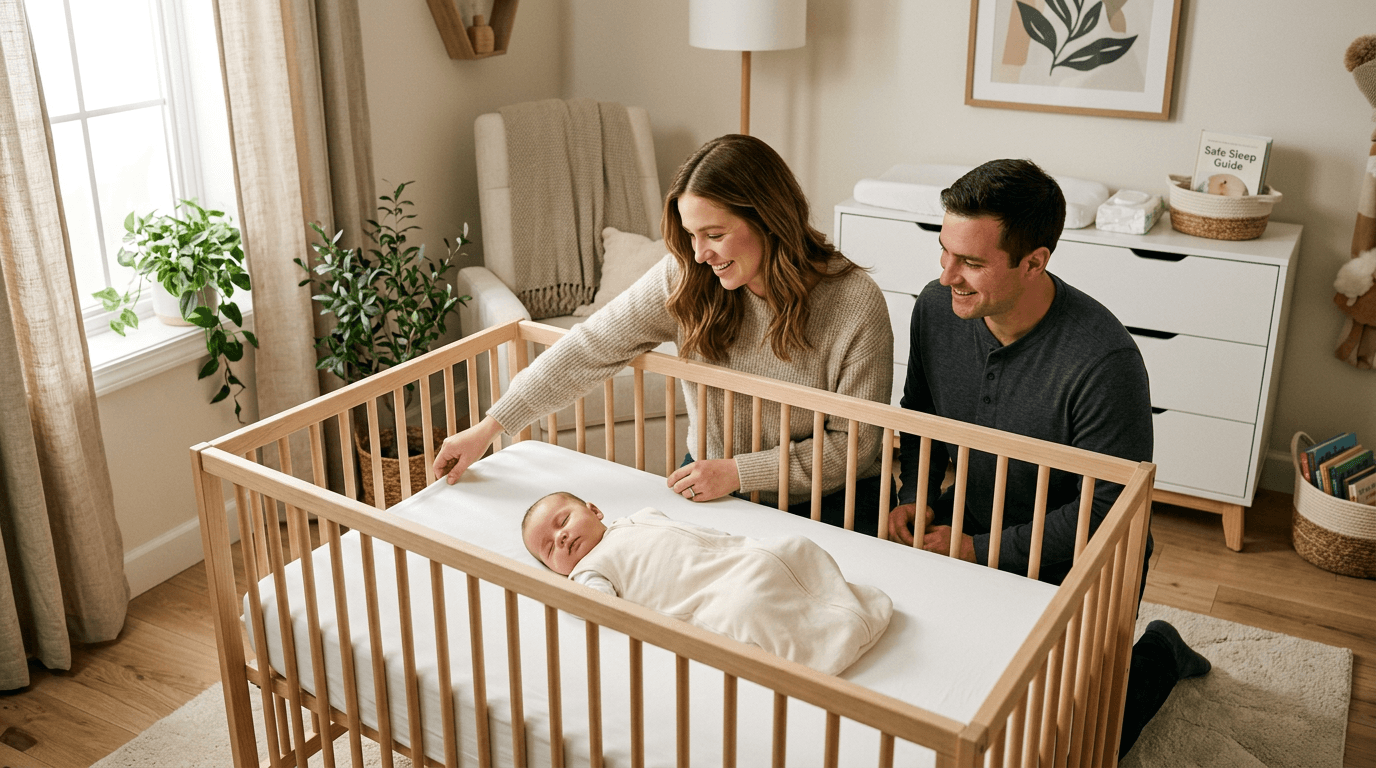
The AAP's 2022 safe sleepsafe sleepAAP guideline: baby sleeps Alone (no blankets, pillows, bumpers, or toys), on their Back, in a Crib or bassinet with a firm flat mattress. Room-sharing without bed-sharing is recommended for the first 6-12 months. guidelines emphasize that the ideal sleep environment is a dark, cool room (68-72°F) with a firm, flat surface and no loose bedding. Research published in the journal Sleep Medicine Reviews (2021) found that white noise reduces the time to sleep onset in infants by an average of 5-7 minutes and decreases nighttime wakings.
Best Sound Machine: Hatch Baby Sound Machine
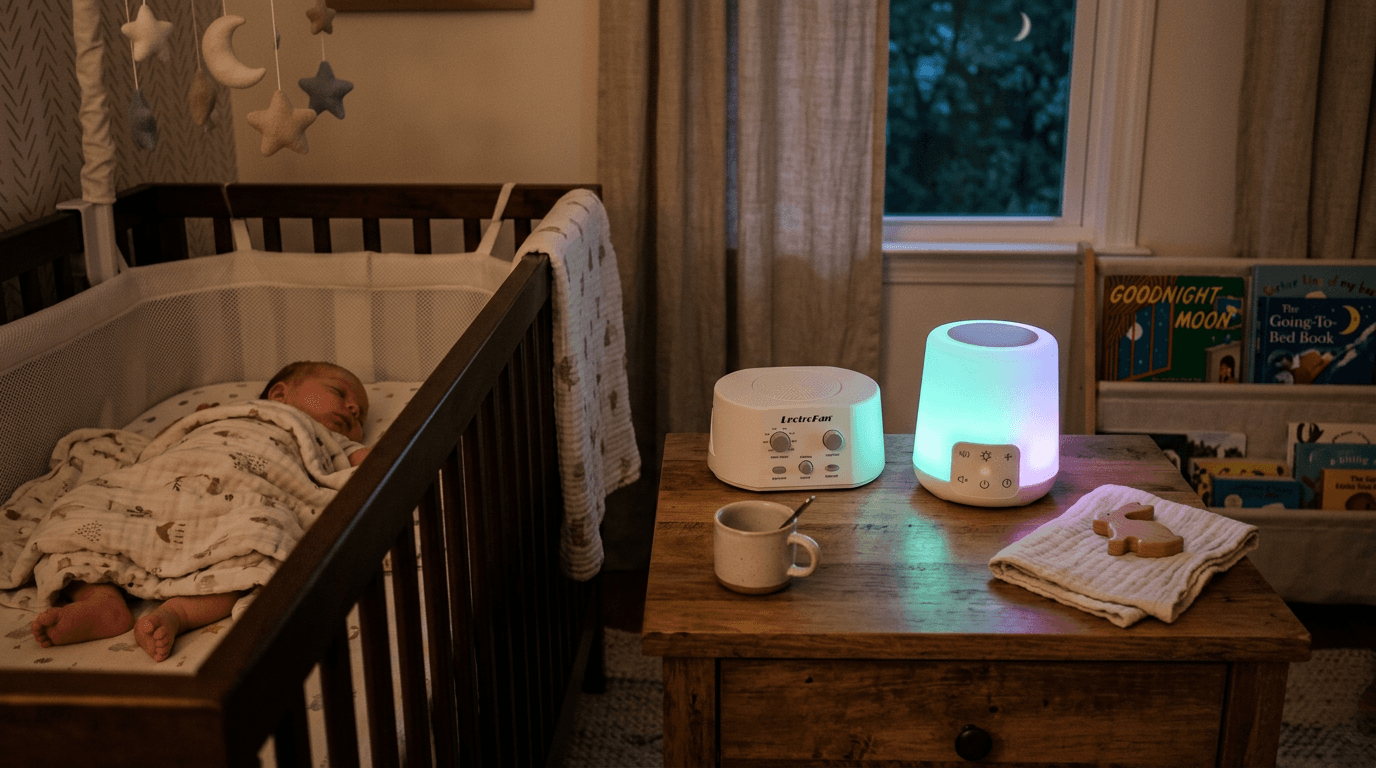
Buy on Amazon · $79.99 →The current Hatch is the sound machine that grows with your child. For babies, it offers a library of white noise, pink noise, and nature sounds that play all night. The night light has fully customizable colors and brightness. The app control means you never have to sneak into the nursery to adjust volume — a feature that sounds minor until you've accidentally woken a sleeping baby reaching for a button.
Distance is the whole rule: the AAP recommends that sound machines be placed at least 7 feet from an infant's sleep space and set to no louder than 50 decibels — roughly the volume of a quiet conversation.
A 2014 study in Pediatrics tested 14 popular infant sound machines at maximum volume and found that all exceeded 50 dB at close range, but at recommended distances, most fell within safe limits.
As your baby becomes a toddler, the Hatch transforms into a time-to-rise clock with programmable light cues that teach kids when it's okay to get up. At around $80, you're buying a product that stays useful for years. Read our full baby monitors roundup for more on the monitoring features.
Why every nursery needs one
- App-controlled sound and light from anywhere
- Grows from infant sound machine to toddler clock
- WiFi audio monitoring built in
- Beautiful design that fits any nursery
Best Budget Sound Machine: Yogasleep Dohm Classic
Buy on Amazon · $49 →If you want a sound machine without the smart features, the Yogasleep Dohm Classic has been the gold standard for decades. It generates real fan-based white noise (not a recording), creating an authentic, consistent sound that many parents and babies prefer. Two speed settings let you adjust the tone and volume.
At around $45, the Dohm is a simple, reliable workhorse. No app, no WiFi, no updates — just plug it in and it works. Some parents keep a Hatch in the nursery and a Dohm for travel, which is a solid combination.
Best Swaddle: Love to Dream Swaddle UP
Buy on Amazon · $34.95 →The great swaddle debate usually comes down to arms-down versus arms-up. The Love to Dream Swaddle UP takes the arms-up approach, letting babies sleep with their hands near their face in a natural starfish position. Many babies who fight traditional arms-down swaddles settle beautifully in the Swaddle UP.
Discontinue swaddling at the first signs of rolling. The AAP recommends discontinuing swaddling as soon as the baby shows signs of rolling, typically around 2-4 months.
A 2016 analysis published in Pediatrics found that swaddled infants placed on their backs had a lower risk of SIDSSIDSSudden Infant Death Syndrome: unexplained death of an otherwise healthy infant under 1, usually during sleep. The AAP's ABCs of safe sleep (Alone, on Back, in a Crib) cut the risk by more than half. than unswaddled infants, but the risk increased dramatically if a swaddled infant rolled to the stomach. The arms-up position of the Love to Dream design allows some startle reflex dampening while permitting hand access.
The dual-zipper design allows diaper changes without fully unswaddling, and the 1.0 TOGTOGA wearable-blanket warmth rating. 0.5 TOG is lightweight (summer/warm rooms), 1.0 TOG is all-season, 2.5+ TOG is for cold rooms. Match to the room temperature, not the season outside. weight works for most room temperatures. The transition version has detachable wings for when baby starts showing signs of rolling. At about $30, having two or three in rotation is easy on the budget.
Best Sleep Sack: Kyte Baby Sleep Bag
Buy on Amazon · $52.99 →Once baby outgrows the swaddle (when they start rolling, typically around 3-4 months), a sleep sack replaces blankets safely. Kyte Baby sleep sacks are made from bamboo rayon that's impossibly soft and naturally temperature-regulating. They come in multiple TOG weights for different seasons and room temperatures.
Sleep sacks are endorsed by the AAP as a safe alternative to loose blankets in the crib. A 2019 study in the Journal of Pediatrics found that sleep sack use was associated with a lower incidence of unsafe bedding in the crib and that parents who used sleep sacks were more likely to place infants on their backs for sleep.
Yes, they're pricey at around $40 each, but the quality is immediately apparent when you feel the fabric. They wash beautifully, stay soft, and the sizing runs generous so each one lasts a long time. The range of colors and prints is also extensive — these are sleep sacks you'll actually like looking at.
Best Blackout Solution: SlumberPod Privacy Pod
Blackout curtains are great, but they don't help when you're traveling or the nursery window lets in side light. The SlumberPod is a breathable, ventilated canopy that creates a dark sleep environment over a crib or Pack 'n Play. It's been a game-changer for families who travel or whose baby's room gets afternoon sun.
At around $180, it's not cheap for what's essentially a fancy tent. But parents who travel frequently consider it essential.
- Worth it if: you travel frequently, or the nursery gets afternoon sun — it packs down reasonably small and sets up in about a minute.
- Not worth it if: you only need darkness at home, where quality blackout curtains are usually sufficient.
Best Nightlight for Feeds: Hatch Rest Mini
Buy on Amazon · $79.99 →The Hatch Rest Mini is a portable, rechargeable night light that's perfect for middle-of-the-night feeds and diaper changes. The warm amber light doesn't disrupt melatonin production like white or blue light, helping everyone get back to sleep faster. It's app-controllable and small enough to take anywhere.
At about $30, it's an affordable addition to your nighttime setup. Many parents use it as their primary nursery nightlight and bring it along when traveling. The magnetic base sticks to the crib frame for hands-free lighting.
How should you set up the ideal sleep environment?
| Environment factor | What the guidance says |
|---|---|
| Temperature | 68-72°F (20-22°C); overheating is an independent risk factor for SIDS |
| Darkness | Blackout curtains plus covering any LED indicators — melatonin production is suppressed by light |
| Sound | White noise no louder than 50 decibels, machine at least 7 feet from the sleep space |
| Surface | Firm, flat, no loose bedding — a sleep sack instead of blankets |
Temperature matters
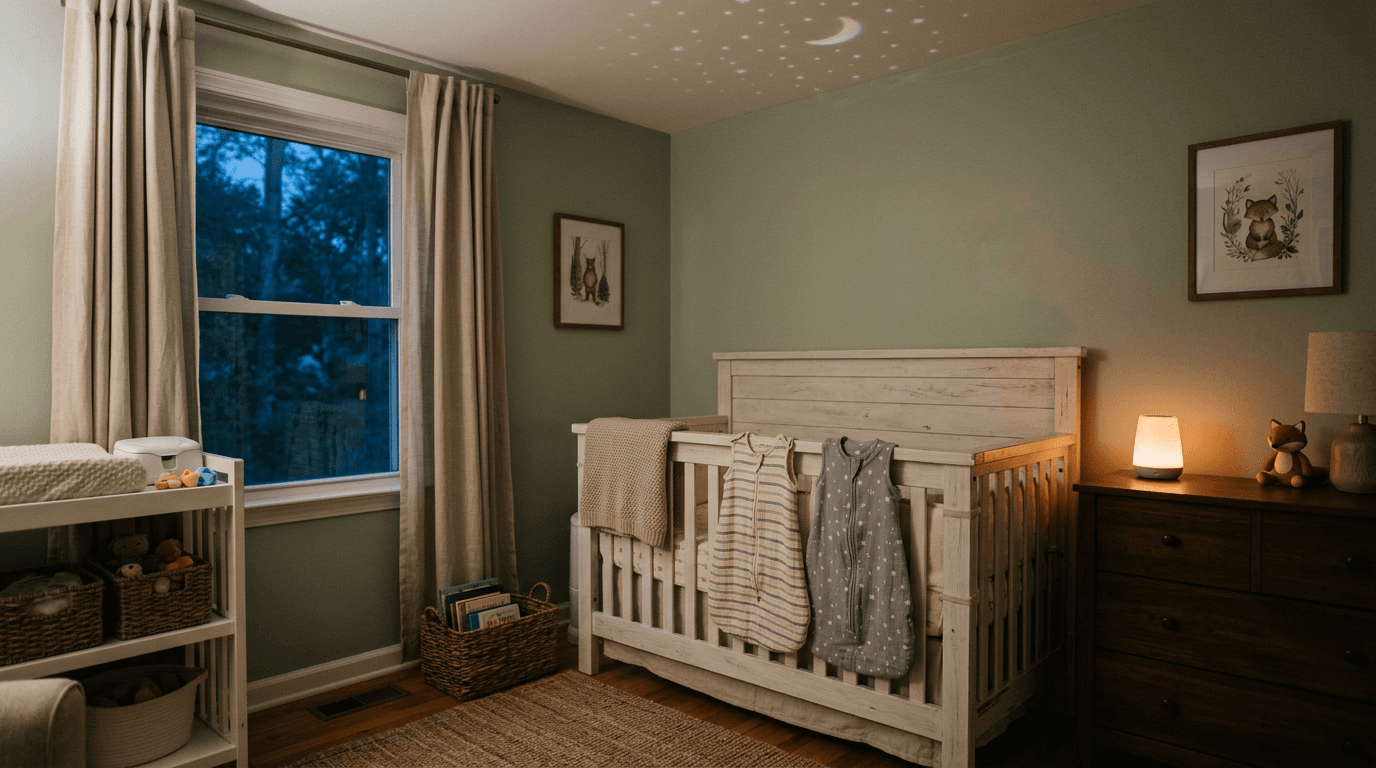
Keep the nursery between 68-72 degrees Fahrenheit. Babies sleep better when slightly cool, and overheating is a SIDS risk factor. Dress baby in one more layer than you'd be comfortable in.
The AAP recommends a room temperature between 68-72°F (20-22°C) for infant sleep. Overheating has been identified as an independent risk factor for SIDS in multiple studies, including a landmark 2002 study in the British Medical Journal that found a significant association between heavy wrapping, high room temperature, and sudden infant death.
Darkness is your friend
Melatonin production is suppressed by light.
A truly dark room — blackout curtains plus covering any LED indicators — helps babies differentiate day and night and sleep longer stretches.
Consistency over everything
The same sound machine, same darkness, same routine every night.
Babies thrive on predictability. A consistent sleep environment cues their bodies that it's time to rest.
So which sleep essentials should you buy?
If we could only recommend three sleep essentials:
- Hatch Baby Sound Machine — sound and light in one
- Love to Dream Swaddle UP — for the newborn weeks
- Kyte Baby sleep sacks — for swaddle transition onwards
These three products form the foundation of excellent baby sleep. Browse all our picks on the sleep essentials page.
Further Reading
Research Sources
Hilly Shore Inc.
Editorial teamIndependent product research team behind Cribworthy. Reviews are grounded in published AAP / CDC / NHTSA / CPSC pediatric guidance, JPMA / GREENGUARD GOLD / OEKO-TEX certification verification, and aggregated buyer sentiment.
115 products reviewed · 20 categories covered · cites AAP, CDC, NHTSA, CPSC, FDA, ACOG.
Safety claims are verified against published pediatric guidelines and CPSC databases. See our editorial standards.