White Noise Apps vs. Nursery Sound Machines: Which Wins?
Quick Answer
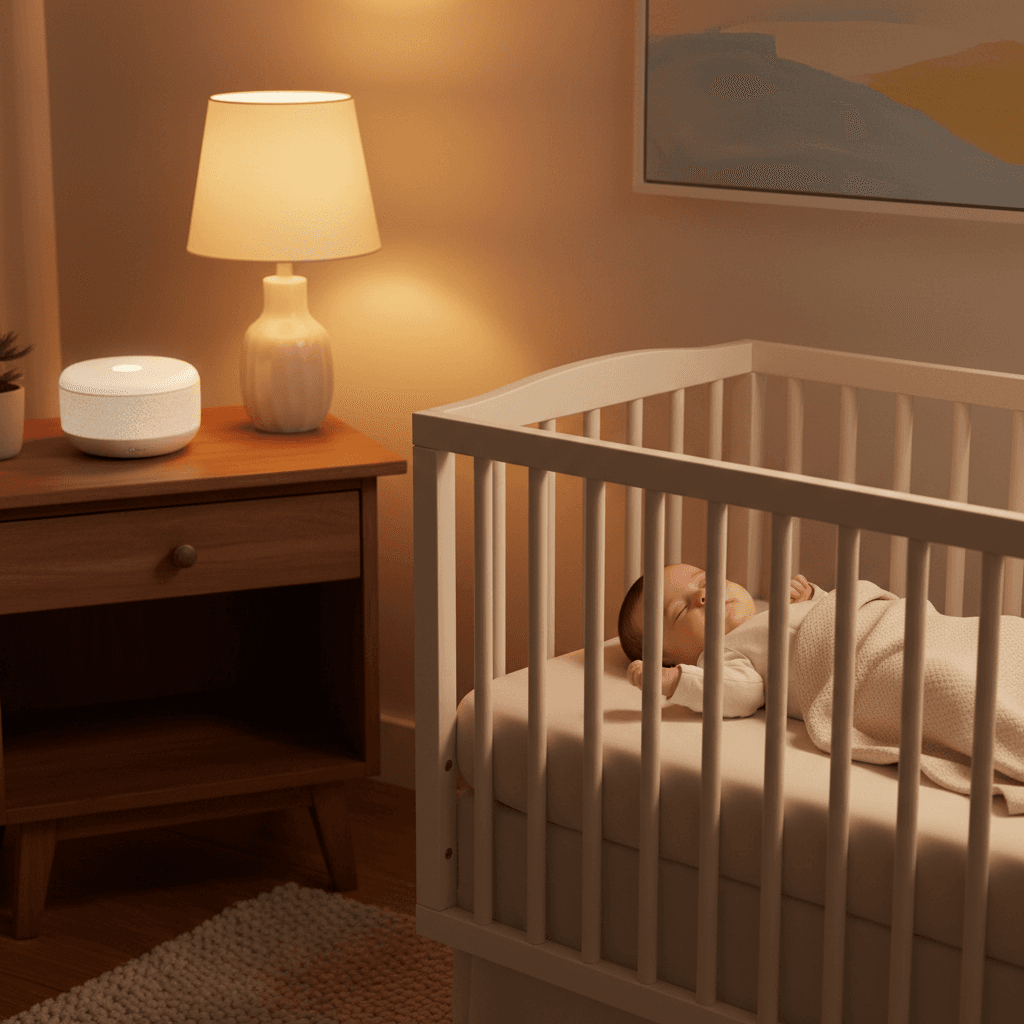
A white noise app is fine for travel, testing whether your baby responds to steady sound, or adult sleep. For an everyday nursery, a dedicated sound machine is more reliable. The advantage is not richer audio: it is that the box has no calls, ads, alarms, autoplay queue, battery anxiety, or reason to leave the room in your pocket. Whichever source you use, place it far from the baby's head and keep the volume low.
Our Verdict
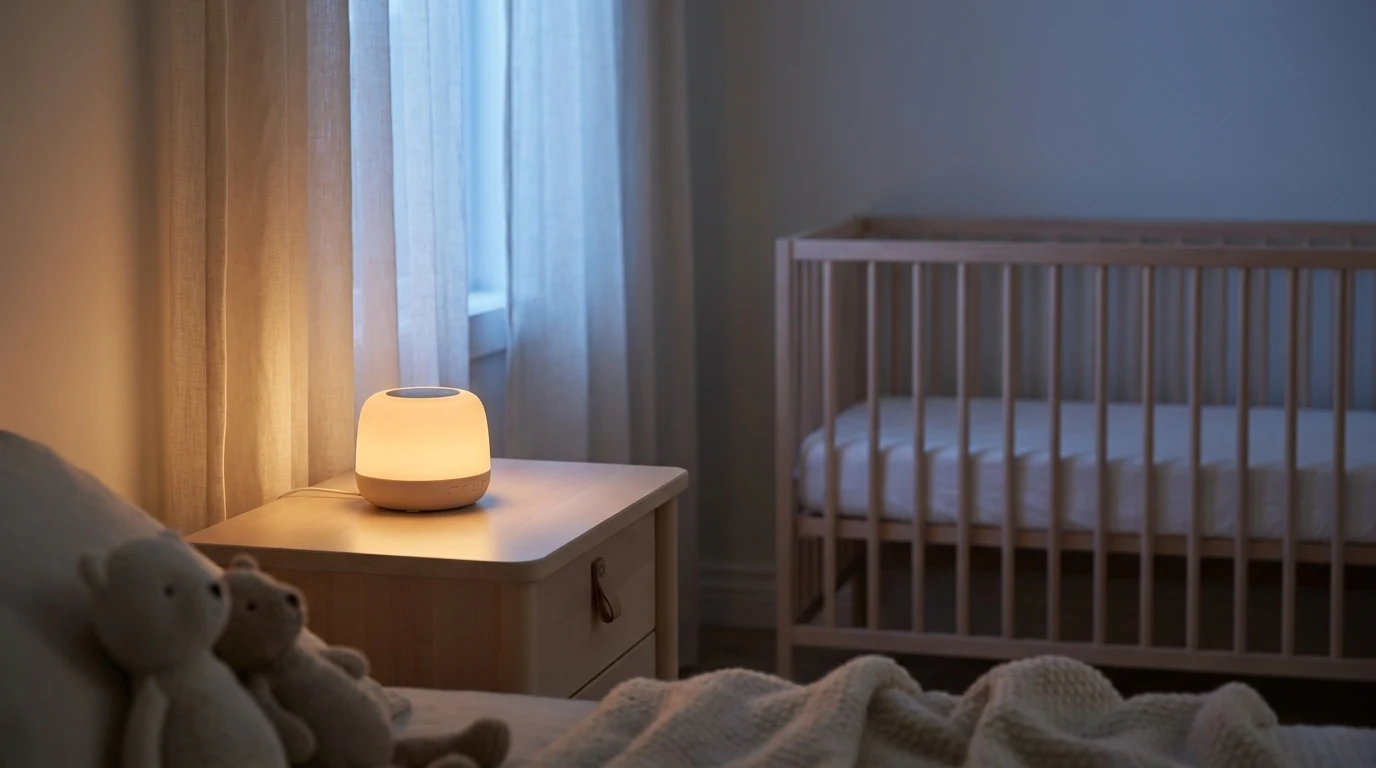
Use an app to prove the idea before buying hardware and to travel light. Use a dedicated machine for the nursery if white noise becomes part of every nap and night. You are buying a single-purpose appliance with fewer ways to stop at 3 a.m., not superior sound. Volume and distance still matter more than app versus box.
Key Takeaways
- ✓A phone app and a dedicated sound machine can play essentially the same steady noise. For nursery use, the dedicated machine wins because it has fewer unrelated jobs.
- ✓Most comparisons score “sound quality,” “portability,” and “price.” Those are not what wake a baby at 3 a.m. The useful comparison is how each setup fails.
- ✓A sound machine becomes worthwhile when the setup is permanent: every nap, every night, same room. At that point the phone's flexibility turns into friction.
- ✓An old phone with no active number can remove calls and the temptation to carry it away. But once you dedicate an entire phone to this job, you have recreated a sound machine with more software.
- ✓The 2014 Pediatrics study measured 14 infant sleep machines at maximum volume from 30, 100, and 200 centimeters. At 30 cm, every machine exceeded 50 A-weighted decibels; three exceeded 85 dB.
As an Amazon Associate I earn from qualifying purchases. Product prices and availability are subject to change.
Quick answer
A phone app and a dedicated sound machine can play essentially the same steady noise. For nursery use, the dedicated machine wins because it has fewer unrelated jobs. It cannot receive a call, play an ad, leave the room in your pocket, or stop because the charging cable was borrowed.
That reliability matters after white noise becomes part of every nap. An app remains a smart trial and travel tool. The reason to buy hardware is not sound quality. It is operational boredom: a box that does one thing, every night, without negotiation.
Key takeaways
- Try the app first: it is a free way to learn whether steady noise helps your baby settle.
- Buy hardware for reliability: dedicated machines remove phone-specific interruption paths.
- Travel flips the verdict: carrying one less object can matter more than perfect uptime.
- Safety is a tie: app or machine, keep the source far from the baby's head and the volume low.
The failure-mode table parents actually need
Most comparisons score “sound quality,” “portability,” and “price.” Those are not what wake a baby at 3 a.m. The useful comparison is how each setup fails.
| Failure mode | Phone app | Dedicated machine | Best prevention |
|---|---|---|---|
| Ad starts mid-nap | Possible in ad-supported apps or streams | No | Use an offline, ad-free track |
| Track or autoplay ends | Possible with playlists and timers | Continuous mode is typical | Run a full nap-length test |
| Incoming call or notification | Depends on device and settings | No | Airplane mode or a separate device |
| Alarm overrides playback | Possible | No | Audit every scheduled alarm |
| Phone leaves the nursery | Very likely | Stays put | Use old dedicated phone or hardware |
| Battery dies | Possible | Usually mains powered | Keep charged; route cable safely |
| App update or crash | Possible | Less likely | Test after updates |
| Power outage | Both stop unless battery-backed | Both stop unless battery-backed | Do not make sound the only sleep cue |
| Volume changed accidentally | Side buttons and media volume can move it | Physical control can also move | Mark a safe setting and recheck |
The table is why “just use your phone” is both correct and incomplete. It works acoustically. It creates an operations problem.
When an app is the right answer
You are testing the idea
Before buying anything, play a continuous offline noise track from across the room at low volume for several naps. If settling and brief household noises seem easier, then decide whether the routine deserves a dedicated box. If nothing changes, you avoided another nursery purchase.
You are traveling
For a hotel, grandparents' house, or one weekend away, the phone is already packed. Download the track before leaving home, because hotel Wi-Fi and autoplay are terrible sleep dependencies. Turn off notifications, disable alarms you do not need, and confirm that the track loops without a seam.
An adult is using it
Adults can fix a stopped track without waking a baby or walking into a nursery. They also control their own phone. The reliability penalty is much smaller.
When the dedicated box earns its shelf space
A sound machine becomes worthwhile when the setup is permanent: every nap, every night, same room. At that point the phone's flexibility turns into friction. Someone needs the phone, takes a call, changes the volume, or unplugs the charger.
Dedicated hardware also simplifies handoffs. A partner, grandparent, or babysitter can press one marked button instead of learning which app, track, timer, volume channel, and Do Not Disturb mode you use. The nursery routine becomes visible and repeatable.
If you have decided the routine is permanent, our white noise machine rankings focus on the features that matter. If you are choosing between white, pink, and brown, the honest answer is in our noise-color guide: no infant evidence proves one color wins, so steadiness and safe setup matter more.
The phone setup that fails least
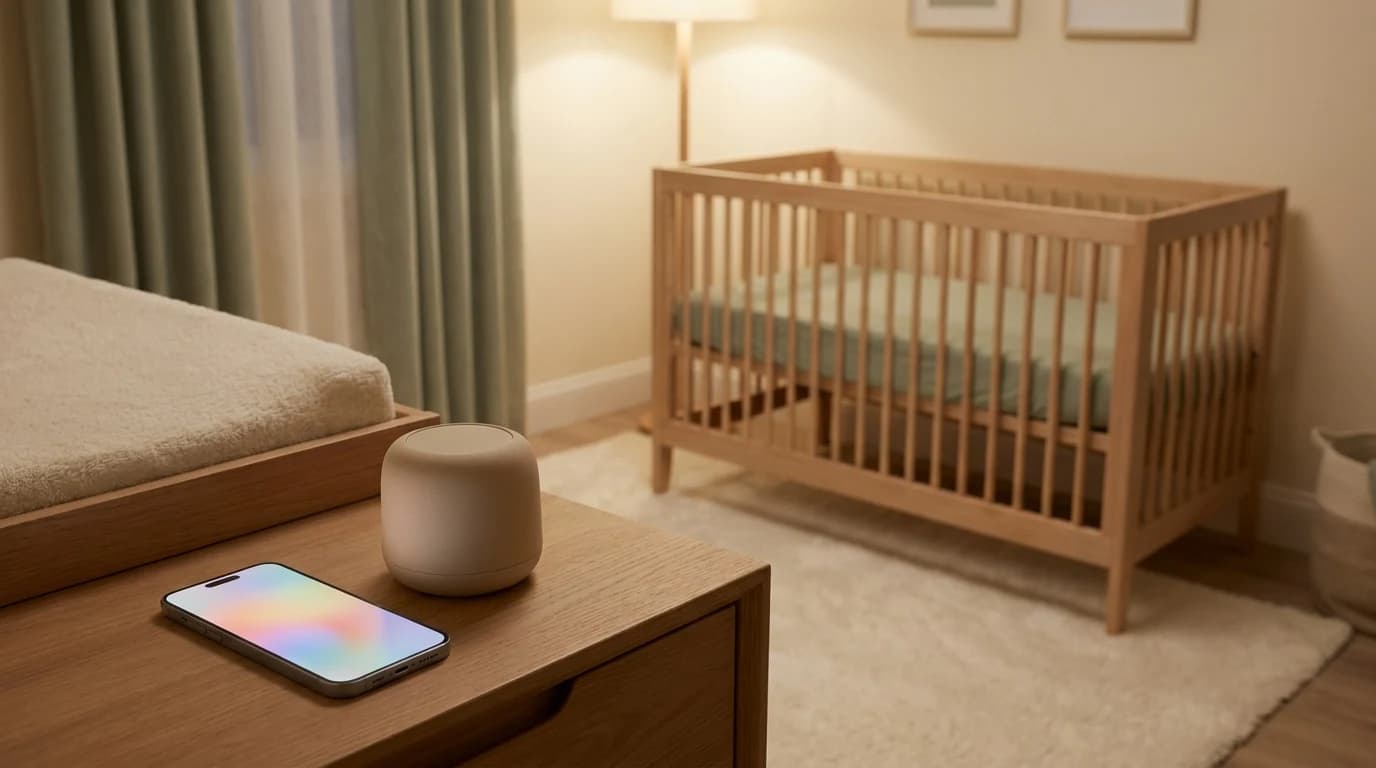
If you stay with an app, build the system as if it were dedicated hardware:
- Download the audio. Do not depend on a live stream, data connection, or a creator's playlist.
- Use one continuous track. Test the loop with headphones; a one-second gap can become the most noticeable sound in the room.
- Remove interruption rights. Use airplane mode when practical, with Wi-Fi off unless the app truly needs it. Audit alarms separately because Do Not Disturb rules vary.
- Lock the media volume. Mark the safe setting and check it after any adult uses the phone for something else.
- Keep the phone outside the crib zone. No phone, cable, power bank, or loose accessory belongs in the sleep space. Put it across the room on a stable surface.
- Keep a human-operable fallback. If the app crashes, the response should be “restart it,” not “the nap is ruined.”
An old phone with no active number can remove calls and the temptation to carry it away. But once you dedicate an entire phone to this job, you have recreated a sound machine with more software. That may still be free, which is a perfectly rational choice.
Safety does not care which device you chose
The 2014 Pediatrics study measured 14 infant sleep machines at maximum volume from 30, 100, and 200 centimeters. At 30 cm, every machine exceeded 50 A-weighted decibels; three exceeded 85 dB. Read the AAP-published study for the measured setup and limits. It tested dedicated machines, but the lesson applies to any speaker: maximum volume close to an infant's head is the avoidable risk.
The American Academy of Pediatrics' parent guidance says to place infant sleep machines as far from the baby's head as possible and use them only for a short time. See HealthyChildren.org's noise guidance. Our full white-noise safety guide turns the measurements into a placement ladder.
Whether the source is a phone or a dedicated box:
- Put it across the room, never in or attached to the crib.
- Start at the lowest useful volume.
- Do not aim the speaker at the baby's head.
- Recheck the setting after updates, travel, or another person uses the device.
What most comparisons get wrong
They treat the decision like a speaker purchase. Nursery white noise is closer to an alarm clock or night-light: the winning feature is predictable behavior. A phone sounds good enough. It also has a social life, a battery, an operating system, and an owner who leaves the room.
That is the falsifiable difference. If you can remove every phone failure in the table, the app is sufficient. If you cannot, the dedicated machine earns its cost without sounding one bit better.
The bottom line
Start with an offline app. It is the cheapest honest trial and the best travel option. If white noise becomes permanent nursery infrastructure, move the job to a dedicated machine so the phone can go back to being a phone.
Do not pay for dramatic “sleep technology” claims. Pay, if you pay at all, for continuous playback, a true low volume, simple controls, and a device that stays where you left it.
Can I use a free white noise app for my baby?
Yes, if it plays offline without ads or track-end gaps, the phone cannot be interrupted, and you place it far from the crib at low volume. Test the complete setup before relying on it overnight.
Will a phone call stop white noise playback?
It can, depending on the phone, app, audio route, and settings. Airplane mode removes the cellular call path, but alarms and app behavior still need testing. A dedicated sound machine has no call path at all.
Is a sound machine safer than a phone?
Not automatically. Either speaker can be too loud or too close. Distance and volume determine the exposure. The dedicated machine's advantage is reliability, not a blanket safety exemption.
Research Sources
Hilly Shore Inc.
Editorial teamIndependent product research team behind Cribworthy. Reviews are grounded in published AAP / CDC / NHTSA / CPSC pediatric guidance, JPMA / GREENGUARD GOLD / OEKO-TEX certification verification, and aggregated buyer sentiment.
124 products reviewed · 22 categories covered · cites AAP, CDC, NHTSA, CPSC, FDA, ACOG.
Safety claims are verified against published pediatric guidelines and CPSC databases. See our editorial standards.