Baby-Led Weaning First Foods: What to Serve at 6, 7, 8, and 9 Months
Quick Answer
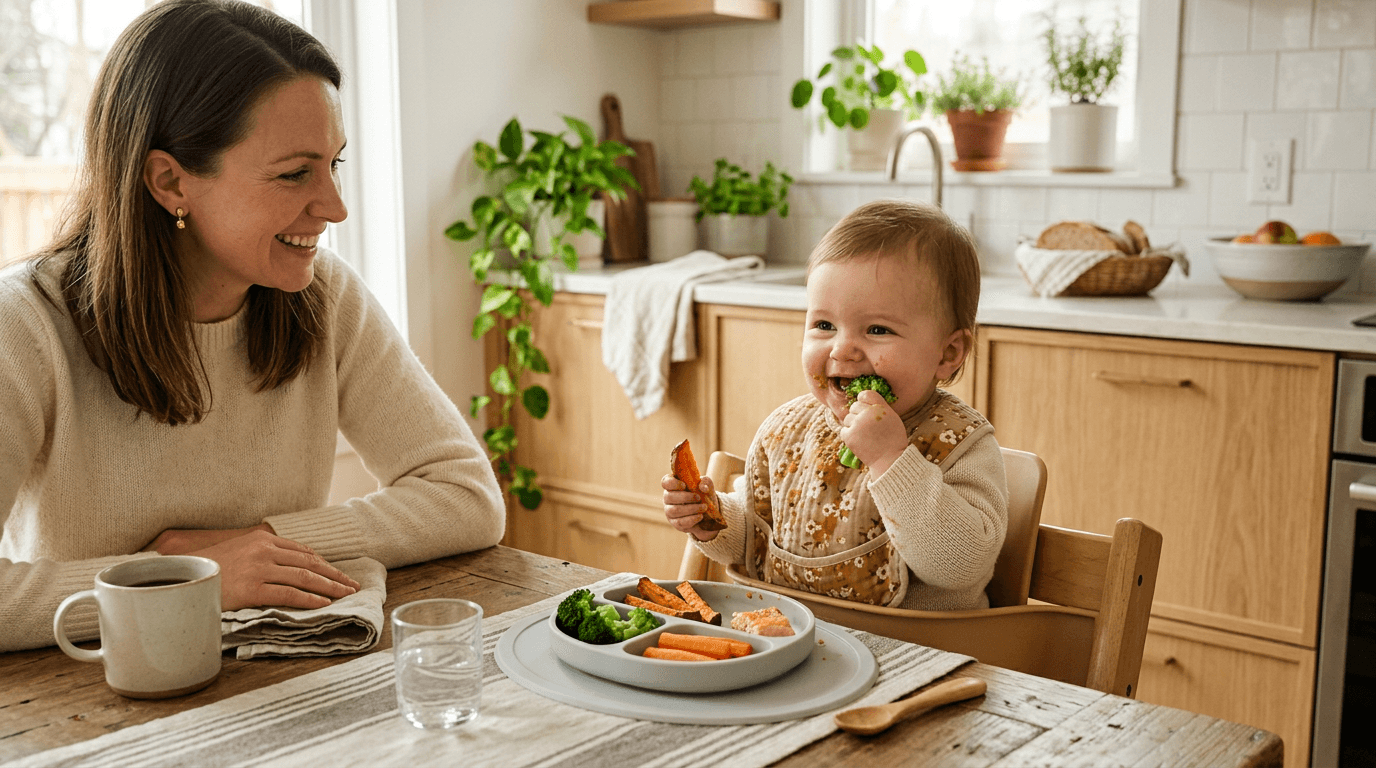
From six months, serve soft finger foods cut to a shape your baby can actually hold: spears roughly the length of an adult finger at first, then pea-sized pieces once the pincer grasp arrives around nine months. Start with avocado, roasted sweet potato, banana, and well-cooked broccoli florets. Round, hard, or sticky foods stay off the tray, and your baby must sit fully upright to eat.
Our Verdict
Begin with finger-length spears of something soft enough to squash between your thumb and forefinger, then widen the menu week by week instead of chasing variety on day one. Introduce iron-rich meat, beans, and lentils early rather than saving them for later. Keep whole grapes, whole nuts, popcorn, raw carrot, and hot dog coins off the menu entirely, and never let a baby eat while reclined or moving.
Key Takeaways
- ✓Baby-led weaning (BLW) is the practice of offering babies soft, appropriately sized solid foods from the start of solids introduction rather than progressing through pureed foods.
- ✓This is the thing that stops most parents from starting BLW. Gagging is normal and protective — it's the baby's mechanism for moving food away from the airway.
- ✓At 6 months, cut everything into stick shapes approximately the length and width of an adult finger. The baby cannot yet use a pincer grasp — they'll use a palmar grasp to hold the stick and gnaw the end.
- ✓When your child is walking and ready to help prepare food, a toddler tower brings them up to counter height; check the maker's minimum age (18 months to 2 years).
As an Amazon Associate I earn from qualifying purchases. Product prices and availability are subject to change.
Baby-Led Weaning First Foods: What to Serve at 6, 7, 8, and 9 Months
Baby-led weaning (BLW) is the practice of offering babies soft, appropriately sized solid foods from the start of solids introduction rather than progressing through pureed foods. The research supports it: babies who eat family foods from the beginning tend to develop broader food acceptance, better self-regulation of appetite, and more developed oral motor skills than puree-fed peers.
The biggest barrier for most parents is knowing what to actually serve — and how to cut it safely.
Is My Baby Ready?
Before starting solids at all, look for these readiness signs (usually around 6 months, occasionally earlier):
- Can sit up with minimal support (head steady)
- Has lost the tongue-thrust reflex (doesn't automatically push food out of mouth)
- Shows interest in food (watching others eat, reaching toward plates)
- Can bring objects to mouth reliably
The AAP now recommends exclusive breastfeeding until 6 months and introduction of solids (including common allergens) around that time.
The Gagging vs. Choking Distinction
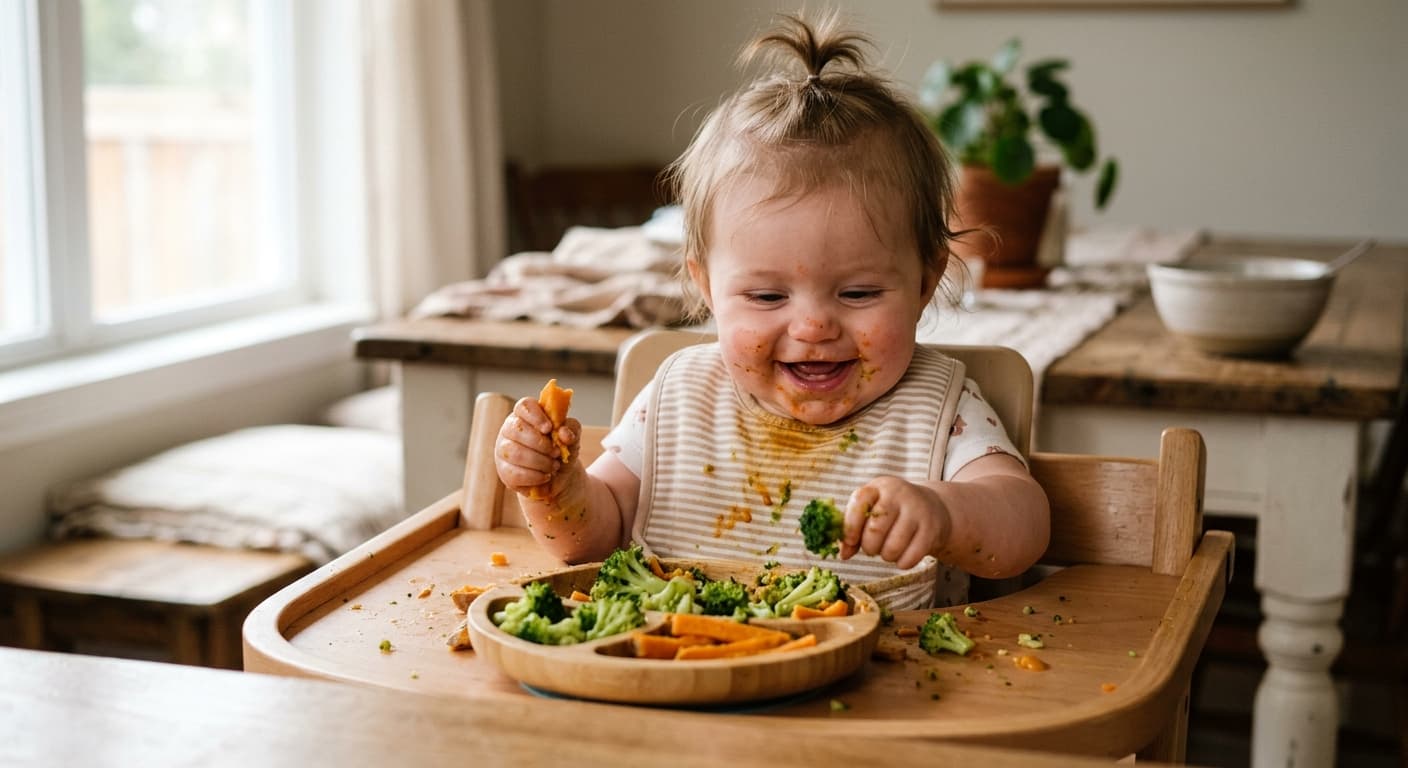
This is the thing that stops most parents from starting BLW. Gagging is normal and protective — it's the baby's mechanism for moving food away from the airway. It looks alarming, sounds alarming, and is completely normal for a baby learning to manage solids. It diminishes rapidly as they develop oral motor skills.
Choking is different — it's silent, the baby can't cough or cry, and the face turns blue or red. Choking requires immediate intervention (infant Heimlich).
Learn infant CPR and choking response before starting solids. It's the single most important preparation for any solids feeding method.
6 Months: First Foods
At 6 months, cut everything into stick shapes approximately the length and width of an adult finger. The baby cannot yet use a pincer grasp — they'll use a palmar grasp to hold the stick and gnaw the end. The stick shape means the grasped end can't enter the mouth and cause choking.
Best first foods at 6 months:
- Steamed broccoli florets (large enough to hold, soft enough to squish)
- Soft-cooked sweet potato sticks
- Ripe avocado spears (natural grip from the skin if left on)
- Banana spears (naturally soft, easy to manage)
- Steamed carrot sticks (cooked until easily squished between thumb and forefinger)
- Scrambled eggs (soft-cooked, excellent protein and common allergen to introduce early)
Priority: Introduce the top 8 allergens early. The LEAP study (2015) demonstrated that early introduction of common allergens (peanuts, eggs, tree nuts, dairy, wheat, soy, fish, shellfish) dramatically reduces allergy development. Offer each allergen individually, 3–5 days apart to monitor for reactions.
7 Months: Adding Variety and Texture
By 7 months, many babies are developing more confidence and starting to move food around their mouth more effectively. You can introduce:
- Soft-cooked pasta (penne or rigatoni — tubes are easy to grasp)
- Soft-cooked chicken or salmon (shredded into large strips)
- Soft toast fingers with thinly spread nut butter (thin spreading prevents a thick clump)
- Ripe melon strips
- Soft-cooked green beans
- Full-fat yogurt (offered on a preloaded spoon or swiped from a bowl)
8 Months: Introducing More Complex Textures
Babies at 8 months are developing a pincer grasp. Start introducing smaller pieces alongside stick-shaped foods:
- Small soft-cooked pasta shapes (orzo, small shells)
- Soft-cooked lentils
- Diced ripe fruit (very ripe pear, peach, banana in small dice)
- Shredded chicken or beef
- Soft cheese pieces
9 Months: Moving Toward Family Foods
By 9 months, most BLW babies are eating modified versions of family meals. The focus shifts to:
- Reducing the salt in family meals rather than making entirely separate baby food
- Offering a wide variety to prevent food selectivity
- Continuing allergen exposure through regular inclusion
Foods to still avoid until 12 months:
- Honey (risk of botulism)
- Cow's milk as a main drink (breast milk/formula until 12 months)
- High-mercury fish (shark, swordfish, king mackerel)
- Whole grapes, large chunks of raw apple (choking risk)
- Added salt and sugar
When your child is walking and ready to help prepare food, a toddler tower brings them up to counter height; check the maker's minimum age (18 months to 2 years).
For more on starting solids, see our how to start baby-led weaning guide and best baby food makers for parents who want to combine BLW with some purees.
🏆 Bottom Line: Start with large finger-sized sticks of soft foods at 6 months. Prioritize allergen introduction in the first few weeks. Progress to smaller pieces at 8–9 months as pincer grasp develops. The gagging is normal — learn the difference between gagging and choking before you begin.
Sources
- American Academy of Pediatrics (AAP) — Infant feeding guidelines 2024. healthychildren.org.
- Du Toit G et al. — "Randomized Trial of Peanut Consumption in Infants at Risk for Peanut Allergy (LEAP study)." New England Journal of Medicine, 2015.
- Rapley G, Murkett T — Baby-Led Weaning: Helping Your Baby to Love Good Food. The Experiment, 2010.
- Brown A — "No difference in self-reported frequency of choking between infants introduced to solid foods using a baby-led weaning or traditional spoon-feeding approach." Journal of Human Nutrition and Dietetics, 2018.
- CDC — Infant feeding and introduction of solid foods. cdc.gov.
Your next step
The gear that makes BLW easier.
Research Sources
Hilly Shore Inc.
Editorial teamIndependent product research team behind Cribworthy. Reviews are grounded in published AAP / CDC / NHTSA / CPSC pediatric guidance, JPMA / GREENGUARD GOLD / OEKO-TEX certification verification, and aggregated buyer sentiment.
122 products reviewed · 22 categories covered · cites AAP, CDC, NHTSA, CPSC, FDA, ACOG.
Safety claims are verified against published pediatric guidelines and CPSC databases. See our editorial standards.