Best Baby Food Makers of 2026: Fresh, Fast, and Easy
Our #1 Pick
The Beaba Babycook Neo at roughly $280 is the best baby food maker overall: it steams and blends in one glass bowl, rinses clean in seconds, and handles batches big enough to freeze a week ahead. Most families do not need to spend that. The NutriBullet Baby system near $50 produces the same purees for a third of the money.
Best Overall
- Quality
- Ease Of Use
- Ease Of Cleaning
Also Great
Best Value: Baby Brezza One Step Food Maker Deluxe ($80) — Best Value
Budget Pick: NutriBullet Baby Complete Food-Making System ($70) — Best Budget Pick
Our Verdict
Pay the premium only if you will puree for many months and want glass rather than hot plastic. Choose NutriBullet while you are still finding out whether homemade food fits your week at all. Baby Brezza sits between them. Skip every unit here if a decent blender and a steamer basket already live in your kitchen.
#1Béaba Babycook Neo 4.4 | #2Baby Brezza One Step Food Maker Deluxe 4.4 | #3NutriBullet Baby Complete Food-Making System 4.5 | #4EVLA's Baby Food Maker 4.6 | #5Sage Spoonfuls Baby Food Maker 4.3 | |
|---|---|---|---|---|---|
| Verdict | Best Overall | Best Value | Best Budget Pick | Best for Batch Cooking | Best Portable |
| Price | ~$279.99Buy on Amazon | ~$94.99Buy on Amazon | ~$49.99Buy on Amazon | ~$84.80Buy on Amazon | |
| Type | Baby Food Makers | Baby Food Makers | Baby Food Makers | Baby Food Makers | Baby Food Makers |
| Buyer sentiment | Quality Ease Of Use Ease Of Cleaning Material Value for money Durability Buyers praise quality, ease of use, ease of cleaning and material. Mixed feedback on reliability. Some flag value for money and durability. Based on 399 user mentions | Ease Of Use Quality Ease Of Cleaning Steaming Durability Value for money Buyers praise ease of use, quality, ease of cleaning and steaming. Mixed feedback on blending performance. Some flag durability and value for money. Based on 147 user mentions | Ease Of Use Baby-Friendly Ease Of Cleaning Storage Buyers praise ease of use, baby-friendly, ease of cleaning and storage. Mixed feedback on quality and reliability. Based on 1,217 user mentions | Ease Of Use Ease Of Cleaning Quality Blending Buyers praise ease of use, ease of cleaning, quality and blending. Based on 8,106 user mentions | Quality Ease Of Use Value for money Versatility Cutting Performance Durability Buyers praise quality, ease of use, value for money and versatility. Mixed feedback on reliability and blending performance. Some flag cutting performance and durability. Based on 277 user mentions |
| Pros |
|
|
|
|
|
| Cons |
|
|
|
|
|
* Prices are approximate. Check the linked retailer for current pricing and availability.
Key Takeaways
- ✓Pay the premium only if you will puree for many months and want glass rather than hot plastic. Choose NutriBullet while you are still finding out whether homemade food fits your week at all. Baby Brezza sits between them. Skip every unit here if a decent blender and a steamer basket already live in your kitchen.
- ✓The Béaba Babycook Neo is the best baby food maker for most families, combining steaming and blending in a single compact unit with easy cleanup and safe, BPA-free materials. If you're on a budget,...
💬 Real Talk from Parents
Breast pump parts have more pieces than IKEA furniture.
The 'best' bottle is whichever one your baby actually accepts.
Your baby will reject the $40 bottle and love the $3 one. Every time.
Sterilizing bottles at 2 AM is a rite of passage nobody tells you about.
Combo feeding saved my sanity. Breast milk when I could, formula when I couldn't. Baby thrived either way.
Paraphrased community consensus — not a direct quote.
Switching formula brands frequently is harmful.
Most standard formulas have very similar nutritional profiles (they're all regulated by the FDA). Switching brands is fine — the exception is specialty formulas for allergies or medical conditions, which should be discussed with your pediatrician.
Breastfed babies don't need to burp.
All babies swallow some air while feeding, regardless of method. Breastfed babies may swallow less air, but they still benefit from gentle burping after feeds.
As an Amazon Associate I earn from qualifying purchases. Product prices and availability are subject to change.
Best Baby Food Makers of 2026: Fresh, Fast, and Easy
The Béaba Babycook Neo is the best baby food maker for most families, combining steaming and blending in a single compact unit with easy cleanup and safe, BPA-free materials. If you're on a budget, the NutriBullet Baby is an excellent alternative at about half the cost.
The American Academy of Pediatrics recommends introducing solid foods around 6 months of age, when babies show signs of developmental readiness such as sitting with support and showing interest in food (AAP, 2023). A dedicated baby food maker simplifies preparing fresh purees at home, giving you full control over ingredients — which can be especially helpful when introducing allergens one at a time, as recommended by the USDA Dietary Guidelines for Americans (2020-2025).
What features should parents look for in a baby food maker?
Before spending money on a dedicated appliance, consider what matters most for your kitchen and lifestyle.
According to the AAP's guidelines on introducing complementary foods, babies are typically ready for purees between 4 and 6 months of age. A 2019 study in JAMA Pediatrics found that early introduction of allergenic foods (starting around 6 months) may reduce the risk of food allergies, making a food maker that lets you control ingredients particularly valuable.
All-in-one vs. standalone blender
All-in-one machines steam and blend in one container. Standalone options (like an immersion blender with a steamer basket) give you more flexibility but require more steps. If counter space is limited, an all-in-one is hard to beat.
Capacity
Think about whether you want to make single servings or batch-cook and freeze. Some makers hold just 2-3 ounces; others handle 20+ ounces at a time. Batch cooking saves enormous time if you're feeding daily.
Ease of cleaning
Baby food makers with fewer parts are dramatically easier to clean. Look for dishwasher-safe components and avoid models with hard-to-reach crevices where food gets trapped.
The FDA's Code of Federal Regulations (21 CFR 174-186) sets strict requirements for materials that come in contact with food. When evaluating baby food makers, look for FDA-compliant materials and dishwasher-safe components to ensure proper sanitization — the CDC notes that infants are more susceptible to foodborne illness due to their developing immune systems.
Material safety
BPA-free plastic is the minimum standard. Glass containers are ideal for steaming, as they don't leach anything when heated. Stainless steel blades should be high-grade and rust-resistant.
Which baby food maker is the best overall?
The Béaba Babycook Neo remains the gold standard in baby food makers. It steams, blends, defrosts, and reheats in a single glass jar — and the glass container is a genuine differentiator. No plastic touching hot food means zero concerns about leaching.
The Béaba Babycook Neo uses BPA-free, phthalate-free Tritan plastic and stainless steel components, meeting the FDA's food contact material safety standards. Consumer Reports rated it among the top baby food makers for consistent texture and ease of use in their 2025 kitchen appliance review.
The Neo handles up to 5.5 cups of food per batch, which is enough for several days of purees. Steam cooking takes about 15 minutes for most vegetables, and the blending function produces genuinely smooth results. The stainless steel steam basket keeps food above the water for nutrient-rich steam cooking rather than boiling.
Pros
- Glass jar eliminates plastic-contact concerns during steaming
- Large 5.5-cup capacity for batch cooking
- Steam cooking preserves nutrients better than boiling
- Sleek design looks good on the counter
Cons
- Premium price at around $200
- Glass jar is heavier than plastic alternatives
- Only one jar included (second sold separately at ~$30)
Which baby food maker is the best value?
The Baby Brezza One Step lives up to its name — you literally add food, add water, and press one button. It steams and blends automatically in sequence without you needing to intervene. The large bowl handles up to 3.5 cups, and the results are consistently smooth.
At around $80, it hits an excellent price point. The plastic bowl is BPA-free and dishwasher safe. The auto steam-and-blend cycle typically takes 10-12 minutes total. Our only complaint is that the blade assembly has several parts that need hand-washing, but it's a minor inconvenience for the convenience you get.
Pros
- True one-button operation — steam and blend automatically
- Great price point at around $80
- Dishwasher-safe bowl
- Consistent, smooth results
Cons
- Plastic bowl (BPA-free but not glass)
- Blade assembly requires hand-washing
- Slightly smaller capacity than the Béaba
What is the best budget baby food maker?
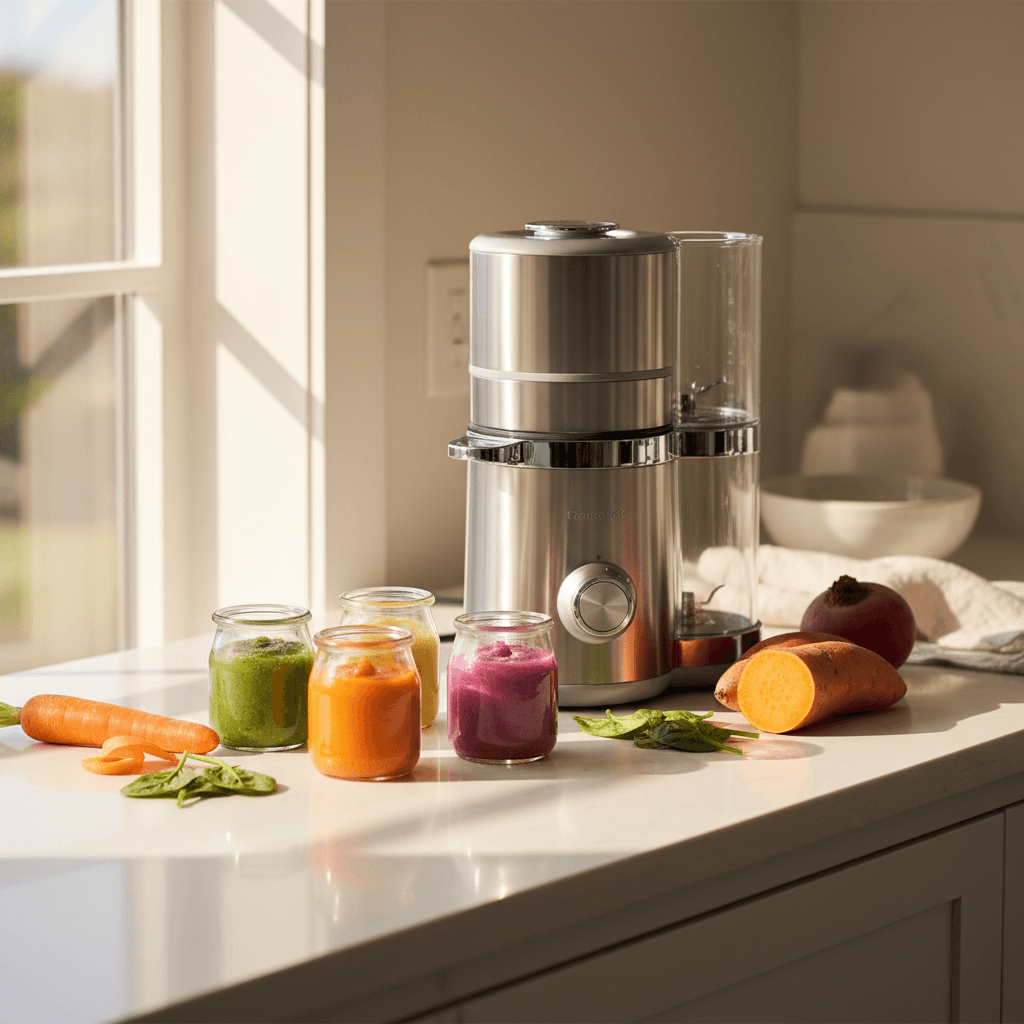
The NutriBullet Baby system takes the brand's proven blending technology and packages it for baby food. The kit includes a batch bowl, short cup for small portions, a freezer tray, and a recipe book. The blending power is excellent — the NutriBullet motor pulverizes everything from steamed carrots to frozen berries.
A 2022 study published in Nutrients found no significant nutritional difference between baby food prepared in dedicated baby food makers versus standard blenders, suggesting that budget options can be equally effective at producing safe, nutritious purees for infants.
At under $70 for the complete system, it's outstanding value. The catch is that it doesn't steam — you'll need a separate steamer or microwave steamer bag. But if you already have a way to cook vegetables, this blender set gives you everything else. The freezer tray with a lid is a particularly nice inclusion.
Pros
- Powerful NutriBullet blending motor
- Complete system with cups, batch bowl, freezer tray
- Under $70 for everything
- Compact footprint on the counter
Cons
- No steaming function — cook food separately
- Motor base can be loud
- Small batch bowl compared to all-in-one options
Which baby food maker is best for batch cooking?
EVLA's maker stands out for its massive 20-ounce capacity and included storage cups. If your strategy is to batch-cook a week's worth of purees on Sunday, this is your machine. It steams, blends, chops, sterilizes bottles, and even warms milk.
The touch-screen controls are intuitive, and the self-cleaning steam cycle is a nice touch. At around $90, it's competitively priced for its feature set. The included storage cups with date labels help you track when each batch was made — a small detail that shows the designers actually thought about how parents use these things.
Pros
- 20-ounce capacity is ideal for batch cooking
- Included storage cups with date labels
- Self-cleaning steam cycle
- Multi-function: steam, blend, sterilize, warm
Cons
- Large footprint on the counter
- Touch screen can be finicky with wet hands
- Blade can struggle with very fibrous vegetables
Which baby food maker is the most portable?
Availability note (2026): The Sage Spoonfuls Baby Food Maker has been discontinued on Amazon and the brand does not currently list a replacement food maker there, so its buy button above shows as unavailable. If you want a portable pick you can still buy new, the NutriBullet Baby system above is the closest match.
For parents who want to make fresh food on the go — at grandma's house, on vacation, or just at a friend's place — the Sage Spoonfuls system is brilliantly portable. It's essentially a high-quality immersion blender with a custom beaker, storage jars, and a carrying tote.
The immersion blender approach means you steam food however you like (stovetop, microwave) and then blend to your desired consistency. It's more hands-on than all-in-one machines but far more versatile. The included storage jars and freezer tray round out the package. At around $50, it's the most affordable complete system we researched.
Pros
- Extremely portable and lightweight
- Immersion blender works for baby food and adult cooking
- Most affordable complete system at ~$50
- Includes storage jars, freezer tray, and recipe book
Cons
- No built-in steaming — cook food separately
- Requires more hands-on work than all-in-one options
- Immersion blender can splash if you're not careful
What do parents ask most about baby food makers?
When should I start making baby food?
Most pediatricians recommend introducing solid foods around 6 months, when your baby can sit upright with support and shows interest in food. Start with single-ingredient purees — sweet potato, avocado, banana — and gradually introduce new foods every 3-4 days to watch for allergic reactions.
The WHO recommends exclusive breastfeeding for the first 6 months of life, with complementary foods — including home-prepared purees — introduced thereafter. The AAP supports introducing solids around 6 months when the infant shows developmental readiness, including the ability to sit with support and loss of the tongue-thrust reflex.
Is homemade baby food actually better than store-bought?
Nutritionally, good-quality store-bought baby food is perfectly fine. Homemade gives you complete control over ingredients and often costs less per serving. The biggest advantage is freshness — homemade purees retain more nutrients because they're not heat-processed for shelf stability. Both approaches are valid; many parents use a mix.
How long does homemade baby food last?
Fresh purees keep in the refrigerator for up to 3 days. Frozen purees maintain quality for about 3 months in a standard freezer. Always label containers with the date and ingredient. Ice cube trays work great for freezing individual portions.
Can I use a regular blender instead of a baby food maker?
Absolutely. A regular blender or food processor works fine for making purees. Baby food makers add convenience (especially all-in-one steamers), but they're not strictly necessary. If you already own a good blender, you might just need a steamer basket and some storage containers.
What foods should I avoid making at home?
Avoid honey (botulism risk under 12 months), whole nuts (choking hazard), and unpasteurized dairy. Be cautious with high-nitrate vegetables like beets, spinach, and turnips for babies under 6 months. When in doubt, consult your pediatrician.
So which baby food maker should you buy?
The Béaba Babycook Neo is our top pick for its glass container, large capacity, and consistently smooth results. Budget-conscious parents should look at the Baby Brezza One Step or NutriBullet Baby system — both deliver excellent results at lower prices. For the full range of feeding products we've reviewed, visit our feeding and nursing guides, and check out our baby-led weaning guide when your baby is ready for the next stage.
Further Reading
Hilly Shore Inc.
Editorial teamIndependent product research team behind Cribworthy. Reviews are grounded in published AAP / CDC / NHTSA / CPSC pediatric guidance, JPMA / GREENGUARD GOLD / OEKO-TEX certification verification, and aggregated buyer sentiment.
115 products reviewed · 20 categories covered · cites AAP, CDC, NHTSA, CPSC, FDA, ACOG.
Safety claims are verified against published pediatric guidelines and CPSC databases. See our editorial standards.