Best Baby Books for Newborns: Board Books, Sensory, and Classics
Our #1 Pick
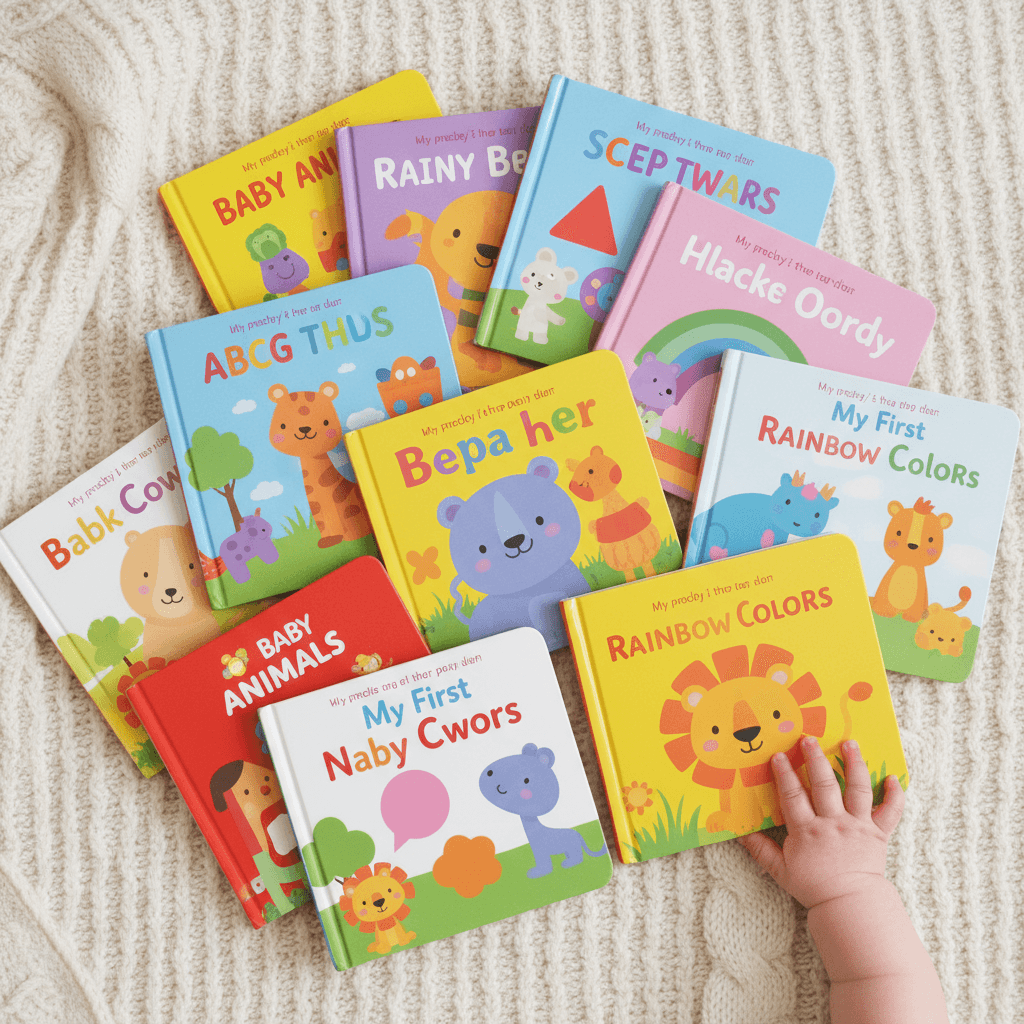
Start with Look Look! by Peter Linenthal, around $8, because high-contrast black-and-white pages are what newborn vision can actually resolve. Add the That's Not My touch-and-feel series at about three months, and make Goodnight Moon the bedtime ritual. Five board books in rotation do more for a baby than a shelf holding thirty.
Best High-Contrast Book
- Suitable For Newborns
- Content
- Image Quality
Also Great
Best Sensory Book: "That's Not My..." Series by Fiona Watt ($9) — Best Sensory Book
Best Classic Read-Aloud: "Goodnight Moon" by Margaret Wise Brown ($8) — Best Classic Read-Aloud
Our Verdict
Choose board over paper; anything tearable becomes a chewed page within a fortnight. Contrast matters in month one, texture from month three, rhythm from month six, and a naming title like First 100 Words around the first birthday. Keep them on a low shelf, since the ones a baby can grab get opened most.
#1"Look Look!" by Peter Linenthal 4.8 | #2That's Not My Puppy 4.8 | #3"Goodnight Moon" by Margaret Wise Brown 4.9 | #4"Dear Zoo" by Rod Campbell 4.8 | #5"First 100 Words" by Roger Priddy 4.8 | |
|---|---|---|---|---|---|
| Verdict | Best High-Contrast Book | Best Sensory Book | Best Classic Read-Aloud | Best Interactive Book | Best First Words Book |
| Price | ~$7.99Buy on Amazon | ~$7.76Buy on Amazon | ~$5.83Buy on Amazon | ~$4.09Buy on Amazon | |
| Type | Baby Books Newborns | Baby Books Newborns | Baby Books Newborns | Baby Books Newborns | Baby Books Newborns |
| Buyer sentiment | Suitable For Newborns Content Image Quality Engaging Buyers praise suitable for newborns, content, image quality and engaging. Based on 1,582 user mentions | Content Textures Entertaining Cute Buyers praise content, textures, entertaining and cute. Based on 143 user mentions | Content Classic Story Readability Buyers praise content, classic, story and readability. Based on 2,604 user mentions | Content Suitable For Toddlers Entertaining Flaps Buyers praise content, suitable for toddlers, entertaining and flaps. Based on 3,627 user mentions | Content Suitable For Babies Color Educational Buyers praise content, suitable for babies, color and educational. Mixed feedback on word selection. Based on 7,007 user mentions |
| Pros |
|
|
|
|
|
| Cons |
|
|
|
|
|
* Prices are approximate. Check the linked retailer for current pricing and availability.
Key Takeaways
- ✓Choose board over paper; anything tearable becomes a chewed page within a fortnight. Contrast matters in month one, texture from month three, rhythm from month six, and a naming title like First 100 Words around the first birthday. Keep them on a low shelf, since the ones a baby can grab get opened most.
- ✓The best book for newborns in the earliest weeks is "Look Look!" by Peter Linenthal, a high-contrast black-and-white board book designed for developing newborn vision. For sensory engagement starti...
- ✓"Look Look!" is the gold standard for newborn visual stimulation. Each page features bold black-and-white images — faces, shapes, patterns — designed specifically for the way newborn eyes process v...
- ✓The Usborne "That's Not My..." series is a phenomenon for good reason. Each page features a different texture — rough, bumpy, silky, fuzzy — and a simple repetitive sentence: "That's not my puppy, ...
- ✓Seventy-plus years after publication, "Goodnight Moon" remains the definitive bedtime book for babies. The slow, hypnotic rhythm of saying goodnight to everything in the great green room creates a ...
💬 Real Talk from Parents
Buy less than you think you need. Babies mostly need you.
Your most-used baby item will be something you almost didn't buy.
Your second kid will use half the gear and be twice as chill about it.
The baby gear you think you need and the gear you actually use are two very different lists.
Buy used when you can, new when safety matters. Car seats new, toys used. Books used, crib mattress new. That's the rule.
Paraphrased community consensus — not a direct quote.
You need everything on the registry checklist before baby arrives.
Most babies need surprisingly little: a safe sleep space, car seat, diapers, feeding supplies, and a few outfits. Everything else can be bought as needed after you learn your baby's preferences.
More expensive baby gear means better quality.
Many mid-range products match or outperform premium ones in safety tests and durability. Price often reflects brand name and aesthetics, not actual performance. Read reviews, not price tags.
As an Amazon Associate I earn from qualifying purchases. Product prices and availability are subject to change.
Best Baby Books for Newborns: Board Books, Sensory, and Classics
The best book for newborns in the earliest weeks is "Look Look!" by Peter Linenthal, a high-contrast black-and-white board book designed for developing newborn vision. For sensory engagement starting around 3-4 months, the "That's Not My..." series by Usborne is our top pick.
The American Academy of Pediatrics recommends reading aloud to babies from birth, citing a 2014 policy statement that early literacy exposure builds neural pathways essential for language development and strengthens the parent-child bond (Pediatrics, 2014). Research from the Reach Out and Read program shows that infants as young as 6 months who are read to daily demonstrate measurably larger vocabularies by age 2 compared to peers who are not read to regularly.
The five-book starter shelf
| Book | What it's for | Stage it lands | Price |
|---|---|---|---|
| "Look Look!" | High-contrast visual stimulation | Birth to ~3 months | Under $7 |
| "That's Not My..." | Texture and sensory play | From 3-4 months | Around $9 |
| "Goodnight Moon" | Bedtime read-aloud ritual | Any age | Around $8 |
| "Dear Zoo" | Cause and effect | From 5-6 months | Around $7 |
| "First 100 Words" | First words and pointing | 6 months to 2+ years | Around $6 |
What kind of books are best for newborn babies?
Not all baby books are created equal, and the right choice depends on your baby's age and developmental stage.
Contrast does more for a newborn than colour
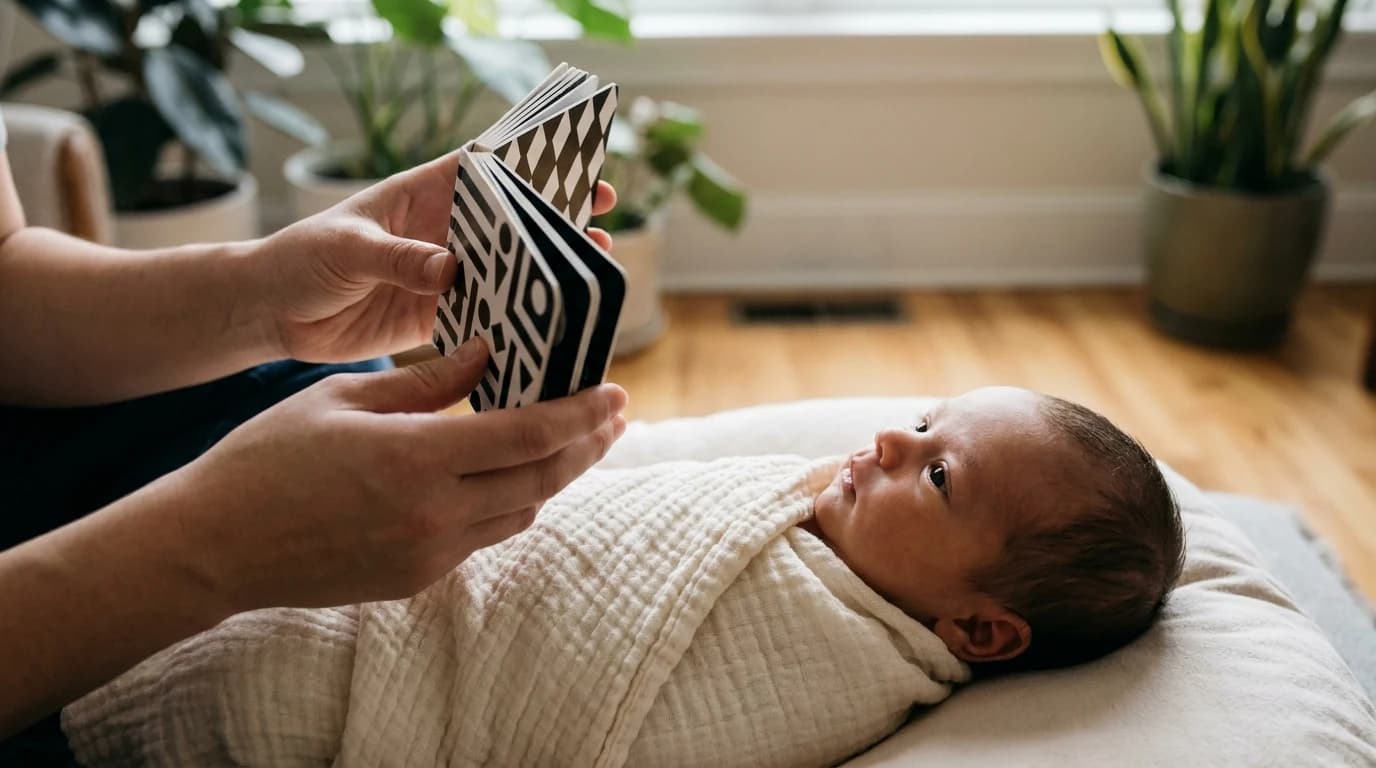
Newborns see best at 8-12 inches — roughly the distance from your arms to your face during feeding. Their vision is blurry, and they respond most strongly to high-contrast black-and-white patterns. Books with bold geometric shapes, simple faces, and strong contrast are genuinely stimulating for newborns, not just cute.
Research published in Developmental Science (2015) confirms that newborns show a strong visual preference for high-contrast, black-and-white patterns during the first 8 weeks of life. Their visual acuity at birth is approximately 20/400, meaning they can only focus clearly on objects 8-12 inches away — roughly the distance from a parent's arms to their face during feeding. High-contrast books are specifically designed to work within these visual limitations.
The one non-negotiable: board books only. Paper pages won't survive a baby. Thick, rounded-corner pages are chew-proof, tear-proof, and wipeable, and every book on this list for babies under 12 months is one.
Texture is the next skill to feed
Starting around 3-4 months, babies begin exploring textures. Touch-and-feel books with fur patches, crinkly pages, and raised elements turn reading into a multi-sensory experience that builds neural connections.
A 2019 study in Infant Behavior and Development found that multi-sensory book experiences — combining touch, sound, and visual elements — led to greater engagement and longer attention spans in infants aged 4-8 months compared to visual-only books. The researchers noted that tactile exploration during reading activates multiple brain regions simultaneously, supporting neural connectivity.
Rhythm and repetition are what the language is carried on
Babies learn language through repetition. Books with rhyming text, repeated phrases, and a musical cadence are easier for babies to latchISOFIXA standardized anchor system for installing car seats without the vehicle seatbelt. ISOFIX is the international name; in the US it's called LATCH (Lower Anchors and Tethers for Children). onto and eventually anticipate. This is why classics like "Goodnight Moon" have endured for generations.
According to research from the National Institute of Child Health and Human Development (NICHD), repetitive language patterns in read-aloud books help infants begin to identify phonemic boundaries — the building blocks of language comprehension — as early as 6 months of age. The AAP's Literacy Promotion guidelines recommend books with rhyme and repetition as especially effective for this developmental stage.
Best High-Contrast Book: "Look Look!" by Peter Linenthal
Buy on Amazon · $7.99 →"Look Look!" is the gold standard for newborn visual stimulation. Each page features bold black-and-white images — faces, shapes, patterns — designed specifically for the way newborn eyes process visual information. The images are simple enough for a brand-new baby but visually interesting enough that babies continue engaging with them through the first few months.
At under $7, it's an absolute essential for the newborn stage. Prop it up during tummy timetummy timeSupervised awake time on the stomach — builds neck, back, and arm strength and prevents flat-head syndrome. Aim for a few minutes several times a day from day one. or hold it during feeding — either way, you'll see your baby lock onto those high-contrast images with genuine focus.
Why we love it
- Designed specifically for newborn visual development
- Bold black-and-white patterns that grab attention
- Sturdy board book construction
- Small size perfect for diaper bag
Best Sensory Book: "That's Not My..." Series by Fiona Watt (Usborne)
The Usborne "That's Not My..." series is a phenomenon for good reason. Each page features a different texture — rough, bumpy, silky, fuzzy — and a simple repetitive sentence: "That's not my puppy, its ears are too fuzzy." The final page always ends with "That's MY puppy!" Your baby will eventually anticipate the ending and react with genuine excitement.
There are dozens of titles in the series (puppy, bunny, dinosaur, unicorn, and many more), making them perfect gifts and collection builders. At around $9 each, they're affordable enough to accumulate. The textures hold up well through repeated touching, chewing, and general baby destruction.
Why we love it
- Multiple textures per book for sensory exploration
- Repetitive text that babies learn to anticipate
- Durable construction that survives teething
- Dozens of titles to collect
Best Classic Read-Aloud: "Goodnight Moon" by Margaret Wise Brown
Buy on Amazon · $5.83 →Seventy-plus years after publication, "Goodnight Moon" remains the definitive bedtime book for babies. The slow, hypnotic rhythm of saying goodnight to everything in the great green room creates a calming ritual that signals sleep time. The illustrations shift from bright color to darkness as the room dims, visually reinforcing the bedtime wind-down.
The board book version is perfectly sized for small hands and bedside tables. Read this book every night and within weeks your baby will associate it with sleep — a powerful sleep cue that complements whatever bedtime routine you're building. At around $8, it's a book every family should own.
Why it endures
- Rhythmic, repetitive text that naturally calms
- Visual progression from light to dark mirrors bedtime
- Creates a powerful sleep association
- Generational favorite that grandparents will recognize
Best Interactive Book: "Dear Zoo" by Rod Campbell
Buy on Amazon · $5 →Lift-the-flap books introduce cause and effect — your baby learns that their action (lifting the flap) produces a result (revealing the animal). "Dear Zoo" is the best of the genre for babies. The story is simple: a child writes to the zoo asking for a pet, and each page reveals a different animal that isn't quite right. The elephant is too big, the giraffe is too tall, the lion is too fierce.
The flaps are sturdy enough to survive enthusiastic baby hands, though they'll eventually wear — that's fine. Babies from about 5-6 months start trying to lift the flaps, and by 9-10 months they're doing it independently. This is cause-and-effect learning disguised as fun. At around $7 for the board book, it's a must-have.
Why we love it
- Teaches cause and effect through flap interaction
- Simple, engaging story with animal reveals
- Encourages fine motor development
- Board book flaps are sturdier than paper versions
Best First Words Book: "First 100 Words" by Roger Priddy
Buy on Amazon · $4.09 →Once your baby hits about 6 months, photo-based word books become incredibly valuable. "First 100 Words" features bright, real-world photographs organized by category — food, animals, toys, clothes — with clear labels. Babies love looking at real photographs of objects they recognize, and you'll find yourself naturally narrating: "That's a banana! You eat bananas!"
This book becomes a workhorse from about 6 months through 2+ years. Babies start by looking, then pointing, then naming. It's one of the most re-read books in any family's collection. The padded cover and thick board pages make it nearly indestructible. At around $6, buy two — one for home and one for the diaper bag.
Why we love it
- Real photographs are more engaging than illustrations for word learning
- Organized by category for natural conversational flow
- Longevity from 6 months through toddlerhood
- Nearly indestructible padded board construction
How should I build a book collection for my newborn?
You don't need dozens of books right away. Five is a genuinely sufficient starting point.
Start with these five:
- One high-contrast book
- One touch-and-feel book
- One classic read-aloud
- Two board books you personally enjoy reading aloud
Why the last two matter as much as the first three:
- Your enjoyment is what keeps the habit going — a book you love reading gets read more often
- Reading aloud is a performance, and babies respond to your voice more than the page
- A book you resent will quietly migrate to the bottom of the basket
The Reach Out and Read national program, endorsed by the AAP, recommends that families start with a small, curated collection and read the same books repeatedly. Their longitudinal data across 6 million children shows that consistent daily reading — even with the same few books — is more impactful for language development than a large library read infrequently.
Rotate rather than accumulate
Babies benefit from repetition, so reading the same five books for a few weeks beats rushing through twenty. When your baby starts losing interest (usually after 2-3 weeks of heavy rotation), swap in a few new titles.
Books your baby can reach get read more
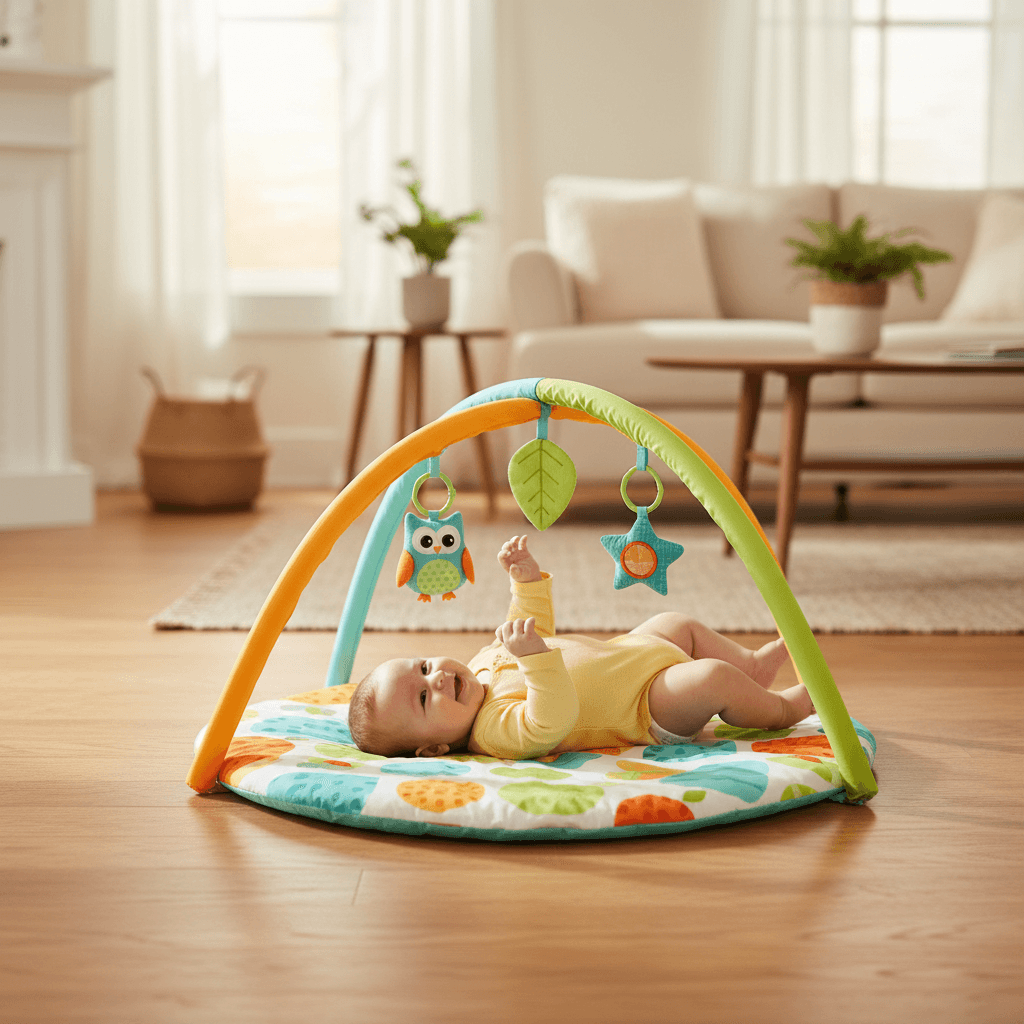
Keep a small basket of board books wherever your baby plays. Babies who can reach books independently develop stronger reading habits. A book basket next to their play gym works perfectly.
Worth knowing: bedtime is the obvious slot, but feeds, tummy time, and diaper changes are the ones that add up. The AAP recommends reading aloud to your baby from birth — there is no "too early."
Frequently Asked Questions
When should I start reading to my baby?
From birth. Newborns won't understand the words, but they respond to your voice, the cadence of language, and the closeness of being held during reading. Studies consistently show that babies read to from birth develop stronger language skills by age 2.
How long should reading sessions be for a newborn?
As long as your baby is engaged — which might be 30 seconds or 10 minutes. Short, frequent sessions are better than one long forced session, so follow your baby's cues.
They're telling you they're done when they:
- Turn away from the page
- Arch their back
- Start to fuss
Are cloth books or crinkle books worth buying?
Yes, especially from about 3-6 months when babies are grabbing and mouthing everything. Cloth books with crinkle pages provide sensory stimulation and are machine-washable. They're not replacements for board books (the visual content is less detailed), but they're excellent supplementary toys.
Do babies benefit from e-books or screen reading?
The AAP recommends avoiding screens for children under 18 months (video chat excepted). Physical books provide sensory experiences — texture, weight, page-turning — that screens cannot replicate. For newborns and infants, stick with physical books.
How many books does a newborn need?
Five to ten books is a perfect starting collection. Quality of reading time matters far more than quantity of books. You can always add more through gifts, libraries, and secondhand sources. Check out our newborn essentials checklist to see where books fit into the bigger picture.
Which baby books should you buy first?
"Look Look!" is the essential first book for newborns — its high-contrast images are genuinely stimulating from day one. The Usborne "That's Not My..." series adds sensory richness starting around 3 months. And "Goodnight Moon" remains the ultimate bedtime read-aloud for a reason. Start with these three and build from there.
Reading to your newborn is free, requires no special equipment, and is one of the highest-impact things you can do for their brain development. Pair storytime with a quality play mat for tummy time reading, and check our newborn essentials checklist for everything else you need in those early weeks.
Further Reading
Your next step
Bedtime stories down — here's how you watch the sleep that follows.
Hilly Shore Inc.
Editorial teamIndependent product research team behind Cribworthy. Reviews are grounded in published AAP / CDC / NHTSA / CPSC pediatric guidance, JPMA / GREENGUARD GOLD / OEKO-TEX certification verification, and aggregated buyer sentiment.
115 products reviewed · 20 categories covered · cites AAP, CDC, NHTSA, CPSC, FDA, ACOG.
Safety claims are verified against published pediatric guidelines and CPSC databases. See our editorial standards.