Best Play Mats & Activity Gyms 2026 (Tummy Time + Development)
Our #1 Pick
The Lovevery Play Gym, about $175, is the best activity gym: staged play zones, high-contrast cards for the newborn weeks, and an organic cotton mat that stays useful into toddlerhood. It is expensive for something used hardest between months one and six. The Fisher-Price Kick 'n Play Piano Gym near $48 covers most of the same ground.
Also Great
Best Value: Fisher-Price Deluxe Kick 'n Play Piano Gym ($45) — Best Value
Best Play Mat: Toki Mats ($129) — Best Play Mat
Our Verdict
The equipment matters less than the minutes spent on the floor. Supervised tummy time from day one is the actual advice, and any clean mat that gets a baby down there satisfies it. Pay for Lovevery if staged materials and resale value appeal; take Fisher-Price when the budget is real; choose wood if the living room doubles as the nursery.
#1Lovevery Play Gym 4.8 | #2Fisher-Price Deluxe Kick 'n Play Piano Gym 5 | #3Little Big Friends Wooden Baby Activity Gym 4 | #4Boppy Nursing Pillow 4.2 | #5Fisher-Price Baby Playmat Deluxe Kick & Play Piano Gym 4.8 | |
|---|---|---|---|---|---|
| Verdict | Best Overall | Best Value | The Little Big Friends Wooden Baby Activity Gym is a Montessori-style wooden play gym with hanging toys, a design-forward reputable replacement for the discontinued Lalo gym at ~$70. | Best for Tummy Time | The Fisher-Price Deluxe Kick & Play Piano Gym is a well-reviewed, big-brand activity gym with a removable kick-piano that grows from tummy time to sit-and-play, live around $59. |
| Price | ~$170Buy on Amazon | ~$59.39Buy on Amazon | ~$69.99Buy on Amazon | ~$50Buy on Amazon | ~$63.31Buy on Amazon |
| Type | Baby Gyms Play Mats | Baby Gyms Play Mats | — | Baby Gyms Play Mats | — |
| Brand | — | — | Little Big Friends | — | Fisher-Price |
| Buyer sentiment | Quality Educational Entertainment Appearance Buyers praise quality, educational, entertainment and appearance. Mixed feedback on value for money. Based on 1,636 user mentions | — | — | Support Quality Firmness Comfort Stability Buyers praise support and quality. Mixed feedback on breastfeeding. Some flag firmness and comfort. Based on 316 user mentions | — |
| Pros |
|
|
|
|
|
| Cons |
|
|
|
* Prices are approximate. Check the linked retailer for current pricing and availability.
Key Takeaways
- ✓The equipment matters less than the minutes spent on the floor. Supervised tummy time from day one is the actual advice, and any clean mat that gets a baby down there satisfies it. Pay for Lovevery if staged materials and resale value appeal; take Fisher-Price when the budget is real; choose wood if the living room doubles as the nursery.
- ✓*Looking for a play mat, activity gym, baby floor gym, or foam activity mat? This guide ranks all of them — and you can browse every play mat and activity gym we recommend.*
💬 Real Talk from Parents
The baby gear you think you need and the gear you actually use are two very different lists.
Buy less than you think you need. Babies mostly need you.
Every parent's 'essential' list is different because every baby is different.
Your most-used baby item will be something you almost didn't buy.
Buy used when you can, new when safety matters. Car seats new, toys used. Books used, crib mattress new. That's the rule.
Paraphrased community consensus — not a direct quote.
More expensive baby gear means better quality.
Many mid-range products match or outperform premium ones in safety tests and durability. Price often reflects brand name and aesthetics, not actual performance. Read reviews, not price tags.
You need everything on the registry checklist before baby arrives.
Most babies need surprisingly little: a safe sleep space, car seat, diapers, feeding supplies, and a few outfits. Everything else can be bought as needed after you learn your baby's preferences.
As an Amazon Associate I earn from qualifying purchases. Product prices and availability are subject to change.
Best Baby Gyms and Play Mats for Development and Tummy Time
Looking for a play mat, activity gym, baby floor gym, or foam activity mat? This guide ranks all of them — and you can browse every play mat and activity gym we recommend.
The Lovevery Play Gym is the best baby gym overall, with developmentally staged play zones, high-contrast cards, and an organic cotton mat that grows with your baby from newborn through toddlerhood. For a budget-friendly option, the Fisher-Price Deluxe Kick 'n Play Piano Gym offers excellent interactive features at a fraction of the cost.
The AAP emphasizes that supervised tummy timetummy timeSupervised awake time on the stomach — builds neck, back, and arm strength and prevents flat-head syndrome. Aim for a few minutes several times a day from day one. should begin from day one to promote motor development, strengthen neck and shoulder muscles, and prevent positional plagiocephaly (flat head syndrome). A 2020 study in Pediatrics found that infants who engaged in at least 30 minutes of daily tummy time by 2 months of age reached crawling milestones an average of 3 weeks earlier than those with less tummy time.
| Pick | Best for | Price |
|---|---|---|
| Lovevery Play Gym | Overall — staged developmental design | Around $140 |
| Fisher-Price Deluxe Kick 'n Play Piano Gym | Value and cause-and-effect play | Around $45 |
| Toki Mats | A mat that looks like furniture | $129-$189 |
| Infantino Prop-A-Pillar | Tummy time specifically | Around $25 |
| Tiny Love Sunny Day | Travel and storage | Around $50 |
Worth knowing before you spend: the gym's peak window is narrow. Babies under 6 weeks mostly just look, active batting starts around 2-3 months, and most babies outgrow the under-the-arch format at 5-7 months. Buy for that window, not for the first year.
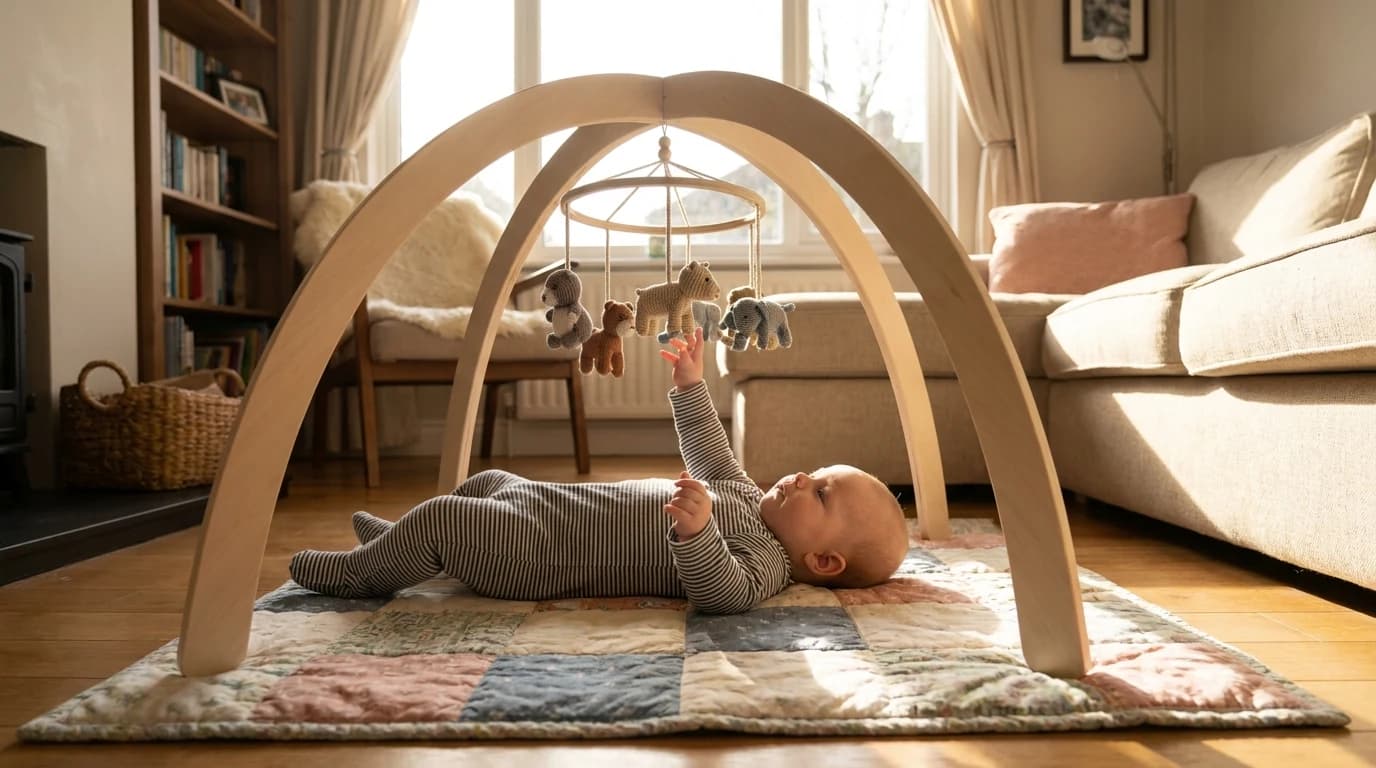
What features matter most in a baby gym or play mat?
Match the stimulation to the month, not the price
Newborns need high-contrast visuals and dangling toys within reaching distance. By 3-4 months, babies benefit from mirrors, crinkle textures, and toys they can bat and kick. Look for gyms that offer age-appropriate stimulation without overwhelming.
The AAP's Bright Futures guidelines recommend that tummy time begin in the first week of life, starting with 3-5 minute sessions and building to at least 30 minutes daily by 2 months. Research published in Early Human Development (2017) found that play gyms with high-contrast visual stimuli promoted earlier visual tracking milestones in infants compared to unstructured floor time.
Everything on this gym is going in a mouth
Babies will mouth every surface. Look for BPA-free, phthalate-free materials, and machine-washable fabric. Organic cotton and sustainably sourced wood are premium options worth considering.
The CPSCCPSCThe US federal agency that issues product recalls and enforces safety standards on cribs, strollers, car seats, and other juvenile products. requires that all infant play mats and gyms comply with ASTM F963 (Standard Consumer Safety Specification for Toy Safety), which limits lead, phthalates, and other hazardous substances.
Worth knowing: in 2023, the CPSC recalled several play mats for failing lead paint standards, making it important to choose products from reputable manufacturers with third-party testing certifications.
Adjustability and longevity
The best gyms adapt as your baby grows — converting from overhead play to tummy time support to a free play mat. A gym that lasts 6-12 months is better value than one your baby outgrows in 8 weeks.
Aesthetics
You'll look at this thing every day for months. Modern baby gyms have moved beyond garish primary colors, and several brands now offer genuinely beautiful designs that complement adult living spaces.
Which baby gym is the best overall?
The Lovevery Play Gym is the Wirecutter of baby gyms — meticulously designed, research-backed, and beautiful. Developed with child development experts, each element serves a specific developmental purpose. The Montessori-inspired design features organic cotton, sustainably sourced wood, and a muted color palette.
A 2019 study in Infant Behavior and Development found that play environments with age-appropriate, developmentally staged toys promoted longer periods of focused attention and more advanced exploratory behavior in infants aged 3-9 months compared to environments with non-staged toy access.
The gym comes with five learning zones (batting, reaching, focus, hiding, and tummy time), each targeting different skills. The activity cards explain what your baby is learning at each stage. The play mat detaches for use as a standalone mat, and the wooden frame is sturdy without being heavy.
At around $140, it's the most expensive gym we recommend, but its quality, developmental intentionality, and longevity justify the price for many families.
Pros
- Research-backed developmental design
- Organic cotton, sustainably sourced wood
- Five distinct learning zones
- Beautiful, minimalist aesthetic
- Converts from gym to standalone mat
- Developmental activity cards included
Cons
- Premium price at ~$140
- Muted colors may be less visually stimulating for very young newborns
- Wooden frame doesn't fold flat for storage
- Some hanging toys are harder to replace if lost
What is the best value baby gym?
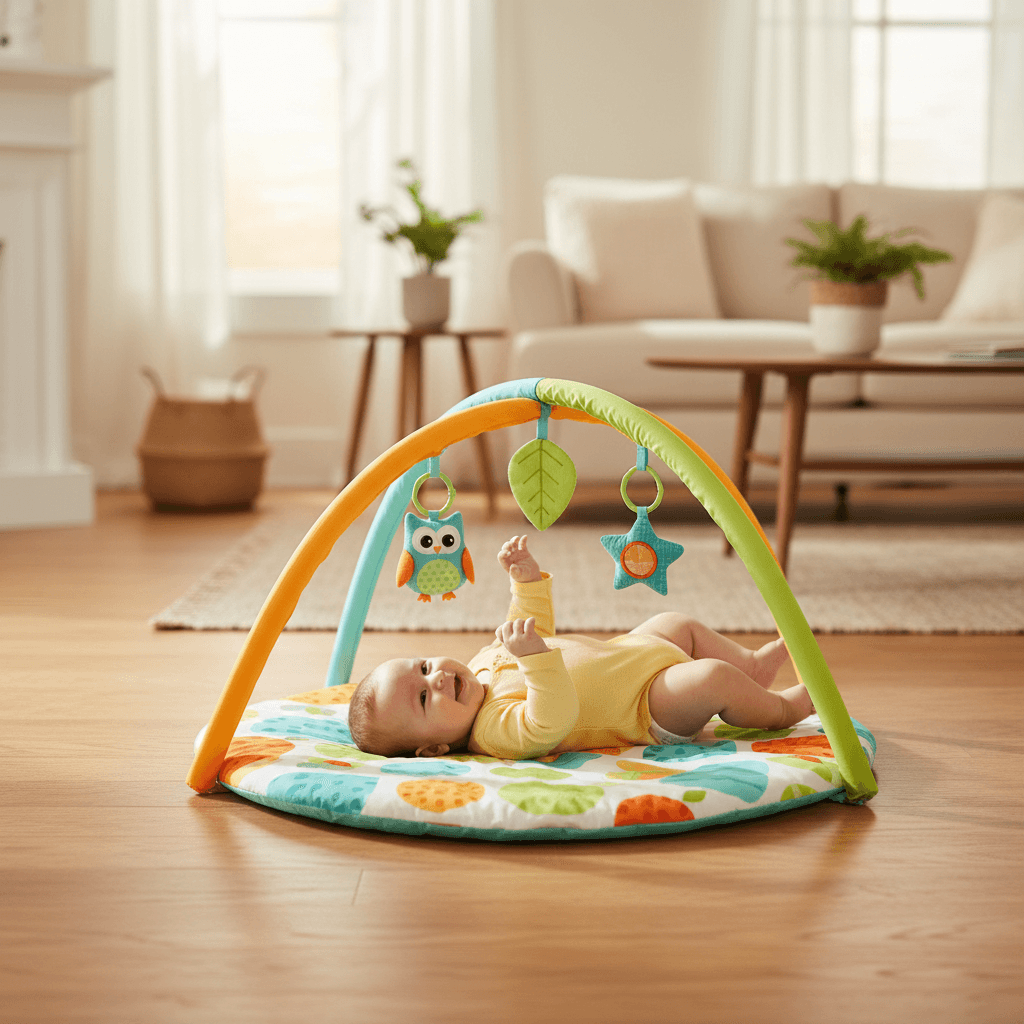
Fisher-Price's piano gym has been a bestseller for years, and the updated version remains excellent. The large piano keyboard at baby's feet responds to kicks with music, lights, and sounds. It converts from lying-down play to tummy time to sit-and-play piano as baby grows through three stages.
The five repositionable toys include a mirror, elephant teether, crinkle panda, lion rattle, and monkey cymbal clapper. It's colorful, stimulating, and genuinely engaging — most babies love the cause-and-effect feedback from the piano keys. At around $45, it's outstanding value.
Pros
- Piano keyboard encourages kicking and cause-and-effect learning
- Three growth stages from newborn to sitting
- Five included toys plus mirror
- Very affordable at ~$45
- Widely available
Cons
- Plastic construction (though BPA-free)
- Battery-operated piano requires regular changes
- Bright colors may not suit minimalist decor
- Mat pad is thin — add a blanket underneath
Which play mat is best for babies?
If you want a play mat that doubles as a beautiful piece of home decor, Toki Mats are stunning. Made from padded organic cotton, they come in gorgeous patterns — from botanical prints to geometric designs. The mat is thick enough (1 inch) for comfortable tummy time and padded enough for early rolling and crawling.
Toki Mats are handmade, GOTS-certified organic, and machine washable. They don't have arches or hanging toys — they're pure play mats, which some parents prefer for a clutter-free approach. At $129-$189, they're priced as home decor items, which is how they look.
Pros
- Gorgeous designs that complement home decor
- GOTS-certified organic cotton
- Thick, comfortable padding (1 inch)
- Machine washable
- Handmade quality
Cons
- No arch or hanging toys — mat only
- Premium pricing at $129-$189
- Can take weeks to ship (handmade)
- Large size may not fit small spaces
Which play mat is best for tummy time?
Tummy time is essential but many babies hate it — at least at first. The Infantino Prop-A-Pillar makes it more tolerable with a supportive bolster pillow that lifts baby's chest, letting them look around more easily. The detachable support pillow, BPA-free teether, crinkle toys, and large mirror encourage engagement during tummy time.
At around $25, it's an affordable add-on to any play gym or mat setup. The pillow prop makes a genuine difference for babies who protest tummy time — the slightly elevated position reduces frustration while still building core strength.
Pros
- Prop pillow makes tummy time more comfortable
- Mirror and toys encourage engagement
- Very affordable at ~$25
- BPA-free teether included
- Compact and portable
Cons
- Limited to tummy time use (not a full gym)
- Fabric quality is basic
- Pillow may be too high for very small newborns
- Not machine washable (spot clean only)
What is the best portable baby play mat?
For families who want a play gym that packs up easily for grandparents' houses, travel, or simply storing between uses, the Tiny Love Sunny Day folds into a compact bundle. The arches fold flat, and the mat folds in half with toys stored inside.
Despite its portability, it doesn't sacrifice features. The adjustable arches accommodate different developmental stages, and the included toys are thoughtfully designed with mirrors, rattles, and textured elements. At around $50, it hits a sweet spot of features, quality, and portability.
Pros
- Folds compactly for travel and storage
- Adjustable arches for different stages
- Good selection of included toys
- ~$50 is competitive pricing
- Easy to set up and take down
Cons
- Mat padding is thinner than premium options
- Folding mechanism can be stiff initially
- Less visually appealing than premium brands
- Some toys dangle too high for young newborns
Are baby gyms worth the money?
A gym earns its keep when:
- Your baby is in the 2-6 month range, where it gets daily use
- You want one surface that supports vision, reaching, kicking, and tummy time
- Budget is tight — even options around $30-50 provide months of daily engagement
It's a weaker buy when:
- Your baby is already mobile enough to crawl away from the arch
- You only need tummy time support, in which case a prop pillow alone does the job
- Floor space is limited and the mat you want doesn't fold
What do parents ask most about baby gyms and play mats?
When should I start using a baby gym?
You can start from birth, but babies under 6 weeks won't interact much — they'll primarily look at high-contrast elements. Active engagement typically begins around 2-3 months when baby starts batting at dangling toys. The gym becomes most valuable between 2-6 months.
How much tummy time does my baby need?
The AAP recommends starting tummy time from day one, beginning with short sessions (3-5 minutes) several times a day. Gradually work up to 15-20 minutes per session. By 4 months, aim for about 90 minutes of total tummy time per day spread across multiple sessions. Tummy time builds neck, shoulder, and core strength essential for later milestones.
The WHO's 2019 guidelines on physical activity for children under 5 recommend at least 30 minutes of tummy time spread throughout the day for infants who are not yet mobile. The guidelines note that tummy time is associated with improved motor development and reduced adiposity in early childhood.
When do babies outgrow play gyms?
Most babies outgrow the lying-under-the-arch format around 5-7 months when they become mobile enough to crawl away. The mat portion continues to be useful for floor play well into the toddler years. Gyms that convert to sitting play tables extend their useful life further.
So which baby gym or play mat should you buy?
The Lovevery Play Gym is our top recommendation for its exceptional developmental design and beautiful aesthetics. The Fisher-Price Piano Gym delivers excellent engagement at a fraction of the price. For tummy time specifically, add the Infantino Prop-A-Pillar to your setup. Browse more gear recommendations on our baby health page and check out our newborn essentials checklist.
Further Reading
Add it to a registry instead
If baby hasn’t arrived yet, this is a classic registry item — worth adding rather than buying outright. Starting an Amazon Baby Registry is free, and you only pay for whatever your shower didn’t cover.
- Free Welcome Box of samples (Prime members, ~$35 value)
- Up to 15% completion discount on what's left when baby arrives
- Add items from any store — and free returns through baby's first year
Your next step
Next stage after floor play: mealtime that lasts a decade.
Hilly Shore Inc.
Editorial teamIndependent product research team behind Cribworthy. Reviews are grounded in published AAP / CDC / NHTSA / CPSC pediatric guidance, JPMA / GREENGUARD GOLD / OEKO-TEX certification verification, and aggregated buyer sentiment.
115 products reviewed · 20 categories covered · cites AAP, CDC, NHTSA, CPSC, FDA, ACOG.
Safety claims are verified against published pediatric guidelines and CPSC databases. See our editorial standards.