Best Baby Learning Toys for 0-12 Months
Our #1 Pick
The Manhattan Toy Winkel, about $18, is the best first toy for a newborn, a graspable rattle and teether that suits the 0-3 month window better than anything electronic. From three months the Baby Einstein Take Along Tunes at roughly $7 covers auditory play, and the Lovevery Play Gym near $175 is the premium staged-development alternative.
Best for 0-3 months sensory development
- Rattle
- Suitable for babies
- Color
Also Great
Premium Pick: Lovevery Play Gym ($140) — Premium developmental play gym for early months
Classic musical toy for auditory development: Baby Einstein Take Along Tunes ($10) — Classic musical toy for auditory development
Our Verdict
Spend very little during year one. Research consistently favours simple, open-ended objects over battery-powered ones, which reduce the back-and-forth talk that actually grows language. Stacking cups, a knob puzzle and the Tobbles Neo carry a child from six months to twelve. The VTech walker earns its place once your child pulls upright.
#1Manhattan Toy Winkel Rattle and Teether 4.8 | #2Lovevery Play Gym 5 | #3Baby Einstein Take Along Tunes 4.8 | #4Fat Brain Toys Dimpl 4.9 | #5VTech Sit-to-Stand Learning Walker 4.8 | #6Melissa & Doug First Shapes Jumbo Knob Puzzle 4.7 | #7Fat Brain Toys Tobbles Neo 4.7 | |
|---|---|---|---|---|---|---|---|
| Verdict | Best for 0-3 months sensory development | Premium developmental play gym for early months | Classic musical toy for auditory development | Irresistible sensory toy for curious babies | Best walker toy for pulling up and cruising | Great first puzzle for shape recognition | Creative stacking toy that wobbles and balances |
| Price | ~$17.95Buy on Amazon | ~$174.99Buy on Amazon | ~$9.59Buy on Amazon | ~$17.30Buy on Amazon | ~$47.99Buy on Amazon | ~$9.99Buy on Amazon | ~$34.95Buy on Amazon |
| Age Range | 0-3 months | 0-12 months | 3-6 months | 3-12 months | 6-12 months | 9-18 months | 9-24 months |
| Type | Rattle/Teether | Play Gym | Musical Toy | Sensory Toy | Learning Walker | Wooden Puzzle | Stacking Toy |
| Buyer sentiment | Rattle Suitable for babies Color Chewability Buyers praise rattle, suitable for babies, color and chewability. Based on 3,862 user mentions | Quality Educational Entertainment Appearance Buyers praise quality, educational, entertainment and appearance. Mixed feedback on value for money. Based on 1,636 user mentions | Lighting Sound quality Portability Cuteness Buyers praise lighting, sound quality, portability and cuteness. Based on 3,196 user mentions | Engagement Quality Durability Portability Buyers praise engagement, quality, durability and portability. Based on 190 user mentions | Age-appropriate Assembly Noise Mobility Buyers praise age-appropriate, assembly, noise and mobility. Based on 3,402 user mentions | Quality Suitable for children Appearance Piece size Durability Buyers praise quality, suitable for children, appearance and piece size. Some flag durability. Based on 2,238 user mentions | Quality Playfulness Stackability Color Buyers praise quality, playfulness, stackability and color. Based on 801 user mentions |
| Pros |
|
|
|
|
|
|
|
| Cons |
|
|
|
|
|
|
|
* Prices are approximate. Check the linked retailer for current pricing and availability.
Key Takeaways
- ✓Spend very little during year one. Research consistently favours simple, open-ended objects over battery-powered ones, which reduce the back-and-forth talk that actually grows language. Stacking cups, a knob puzzle and the Tobbles Neo carry a child from six months to twelve. The VTech walker earns its place once your child pulls upright.
- ✓For newborns (0-3 months), the Manhattan Toy Winkel Rattle and Teether and the Lovevery Play Gym are our top picks. As babies grow, the Baby Einstein Take Along Tunes (3-6 months) and VTech Sit-to-...
💬 Real Talk from Parents
The baby gear you think you need and the gear you actually use are two very different lists.
Buy less than you think you need. Babies mostly need you.
Your second kid will use half the gear and be twice as chill about it.
Every parent's 'essential' list is different because every baby is different.
The best baby gear advice I got: ask parents of 2+ kids what they'd buy again. First-time parents buy everything. Second-timers know what actually matters.
Paraphrased community consensus — not a direct quote.
More expensive baby gear means better quality.
Many mid-range products match or outperform premium ones in safety tests and durability. Price often reflects brand name and aesthetics, not actual performance. Read reviews, not price tags.
You need everything on the registry checklist before baby arrives.
Most babies need surprisingly little: a safe sleep space, car seat, diapers, feeding supplies, and a few outfits. Everything else can be bought as needed after you learn your baby's preferences.
As an Amazon Associate I earn from qualifying purchases. Product prices and availability are subject to change.
Best Baby Learning Toys for 0-12 Months
For newborns (0-3 months), the Manhattan Toy Winkel Rattle and Teether and the Lovevery Play Gym are our top picks. As babies grow, the Baby Einstein Take Along Tunes (3-6 months) and VTech Sit-to-Stand Learning Walker (6-9 months) offer excellent developmental value at each stage.
The AAP emphasizes that the best learning experiences for babies under 12 months come from responsive human interaction, not electronic toys. A 2015 study in JAMA Pediatrics found that electronic toys were associated with decreased quantity and quality of parent-child language compared to traditional toys and books. Simple, open-ended toys that encourage exploration and caregiver interaction consistently outperform high-tech alternatives in developmental research.
How do babies learn and develop during their first year?
Before diving into specific products, it helps to understand what babies are developmentally ready for:
A 2015 study published in JAMA Pediatrics compared infant interactions with electronic toys, traditional toys, and books, finding that traditional toys elicited more conversational turns, more parent words, and more content-specific words than electronic toys. The AAP's policy on media and young children (2016) recommends avoiding digital media for children under 18 months (except video chatting) and prioritizing hands-on, open-ended play.
| Age | What they're doing | What works |
|---|---|---|
| 0-3 months | Developing vision, beginning to track objects | High-contrast visuals, gentle sounds, soft textures |
| 3-6 months | Grasping, mouthing, reaching, batting; beginning to understand cause and effect | Toys that respond to their actions |
| 6-9 months | Sitting, transferring objects between hands, banging things together, early problem-solving | Toys with multiple actions |
| 9-12 months | Crawling, pulling to stand, pointing, early stacking and sorting | Things they can manipulate |
Best for 0-3 Months
Manhattan Toy Winkel Rattle and Teether
Buy on Amazon · $17.95 →The Manhattan Toy Winkel → is deceptively simple — a maze of soft, BPA-free tubes surrounding a central rattle. The colorful loops are easy for tiny hands to grasp, the gentle rattle rewards movement, and the tubes feel soothing on gums. It's one of those toys that spans the entire first year because it serves different purposes at different stages.
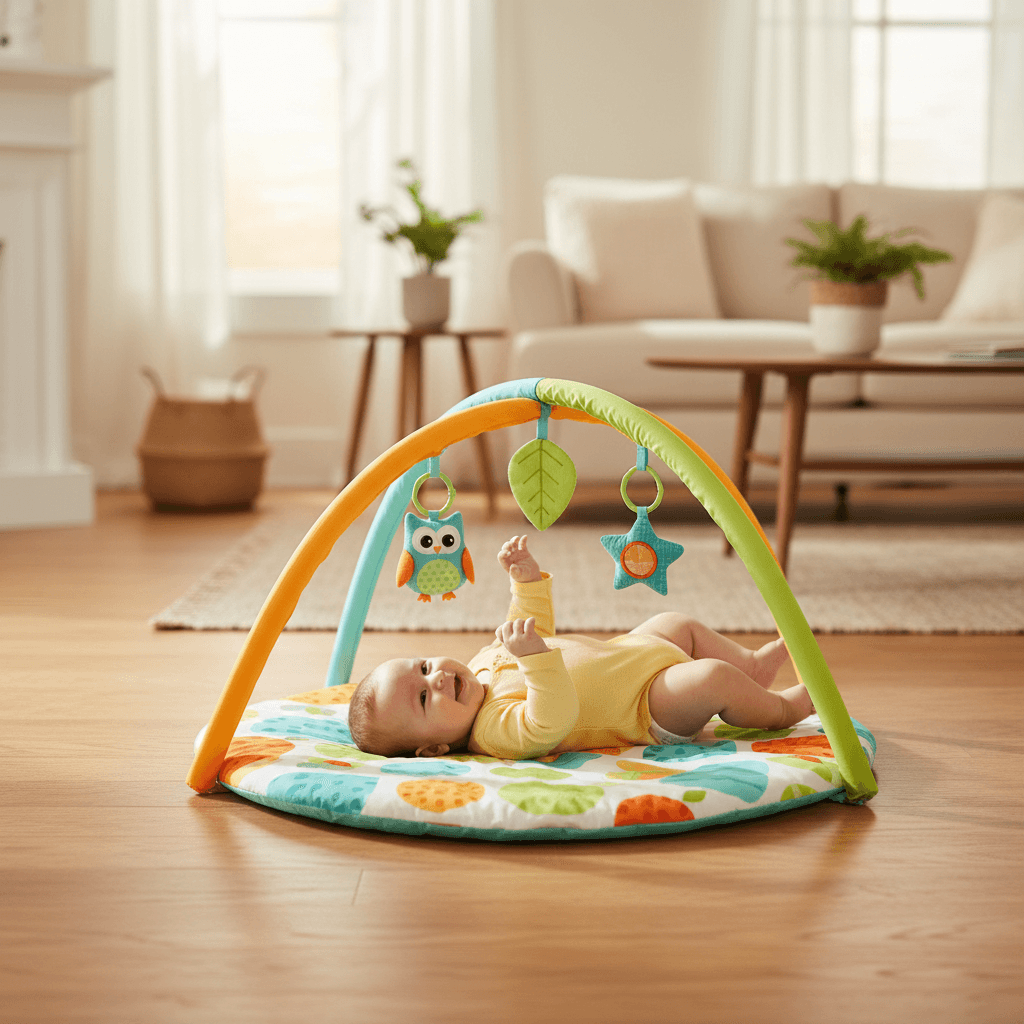
The AAP recommends supervised tummy timetummy timeSupervised awake time on the stomach — builds neck, back, and arm strength and prevents flat-head syndrome. Aim for a few minutes several times a day from day one. beginning in the first week of life to develop head control, neck strength, and upper body muscles. A 2020 study in Pediatrics found that infants who received at least 30 minutes of daily tummy time by 2 months of age reached crawling milestones an average of 3 weeks earlier. Play gyms and rattles that encourage reaching during tummy time serve double duty for motor and cognitive development.
At about $13, it's an incredible value, because it does a different job at each stage:
- Newborns stare at the contrasting colors
- Three-month-olds start grasping it
- Six-month-olds use it as a teether It's routinely recommended by pediatric occupational therapists.
Lovevery Play Gym
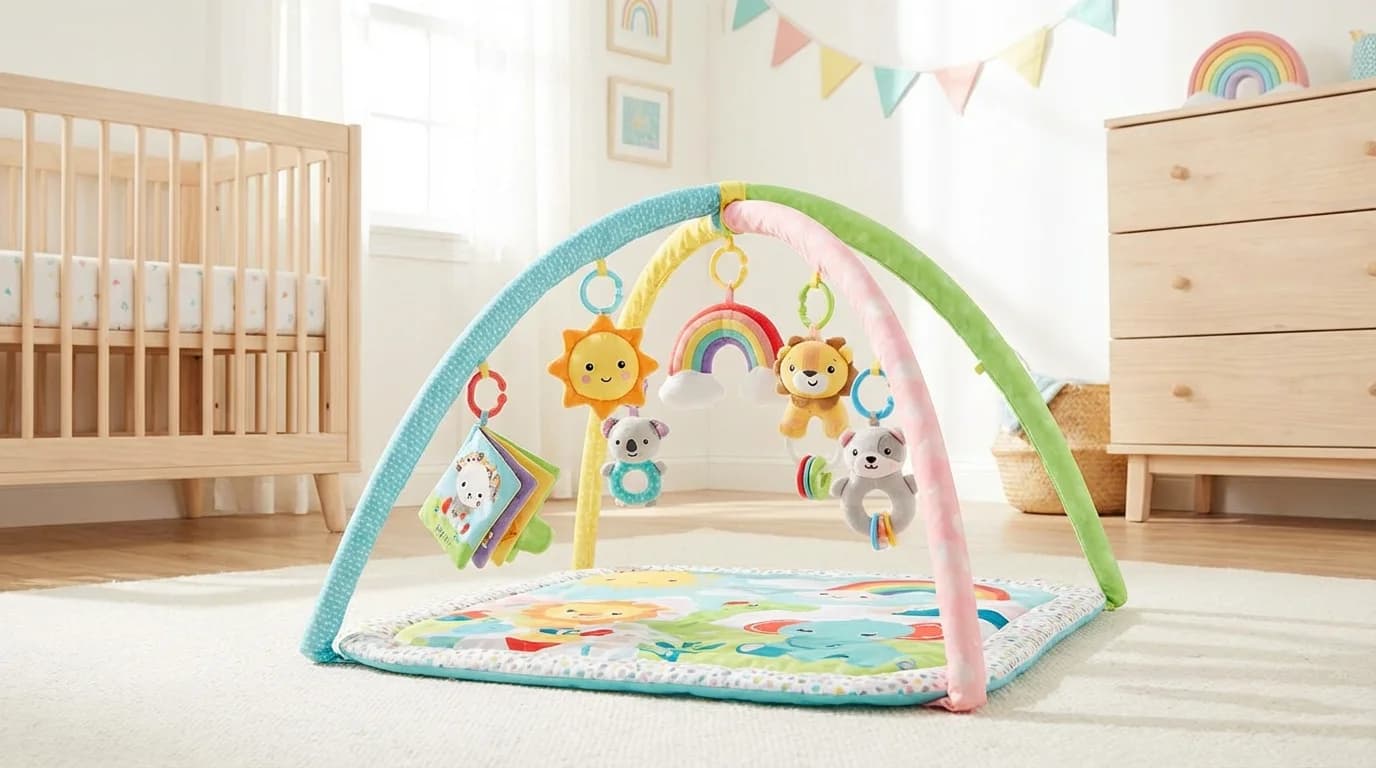
Buy on Amazon · $174.99 →The Lovevery Play Gym → is a premium play mat and gym system designed with developmental milestones in mind. The mat features:
- High-contrast zones for newborns
- Detachable toys for different stages
- A wooden batting bar
- Organic cotton teethers It comes with a detailed guide explaining how to use each element at each stage.
At about $140, it's significantly more expensive than basic play gyms, but the quality and intentional design are evident. The mat converts into a tent-like play space for older babies. If you want one play gym that genuinely grows with your baby from birth through the first year, this is it. For more options, see our best baby gyms and play mats guide.
Best for 3-6 Months
Baby Einstein Take Along Tunes
Buy on Amazon · $9.59 →The Baby Einstein Take Along Tunes → is one of the best-selling baby toys of all time, and for good reason. - The chunky caterpillar shape is easy to grasp
- The large button introduces cause-and-effect — push button, hear music
- The classical melodies are genuinely pleasant to listen to, a rarity in baby toys The light-up display adds visual stimulation.
At under $10, this is a no-brainer. Toss one in the diaper bag, keep one in the car seat, and have one at home. It runs on batteries that last surprisingly long. It's the toy that proves you don't need to spend a fortune to provide developmental stimulation.
Fat Brain Toys Dimpl
Buy on Amazon · $17.30 →The Fat Brain Toys Dimpl → features five colorful silicone bubbles set in a sturdy frame. Babies push the bubbles in and out, which develops fine motor skills and provides satisfying tactile feedback. The different-sized bubbles work different finger muscles. It's BPA-free, dishwasher safe, and virtually indestructible.
At about $13, the Dimpl is a fantastic sensory toy. Babies at this age are fascinated by cause and effect, and the popping sensation is endlessly engaging. It also serves as a great distraction during diaper changes. The simple design means nothing to break and no batteries needed.
Best for 6-9 Months
VTech Sit-to-Stand Learning Walker
Buy on Amazon · $47.99 →The VTech Sit-to-Stand Learning Walker → serves double duty as a sit-and-play activity panel and a push-along walker. The front panel features:
- Spinning gears
- Shape sorters
- Piano keys
- Light-up buttons
When baby is ready to cruise, the panel attaches to the walker base for mobile play.
According to the CDC developmental milestone guidelines (updated 2022), most babies begin pulling to stand between 8-10 months and take their first independent steps between 9-12 months. Push toys and activity walkers support this gross motor development, though the AAP cautions against traditional wheeled baby walkers (the sit-in type), which are associated with over 2,000 ER visits annually and have been banned in Canada since 2004.
At around $25, this is outstanding value for a toy that covers multiple developmental stages. The activity panel alone is engaging for sitting babies, and the walker supports early walking practice. The speed control on the wheels is a helpful feature for beginning walkers on hard floors.
Stacking Cups (any brand)
Simple stacking cups might be the single best learning toy you can buy. The First Years Stack Up Cups → are a classic at under $5. Babies at this age start understanding size relationships:
- Stacking
- Nesting
- Pouring
- Knocking down
These cups serve all those purposes, plus they work in the bath.
Child development researchers at the National Institutes of Health note that stacking, nesting, and sorting activities between 6-12 months help develop spatial awareness, cause-and-effect understanding, and early problem-solving skills. A 2018 study in Infant Behavior and Development found that infants who regularly engaged with shape-sorting and stacking toys showed advanced object permanence understanding by 10 months of age.
Don't underestimate simple toys. Babies learn spatial reasoning, size ordering and cause-and-effect from stacking cups just as effectively as from $50 electronic toys — sometimes more effectively, because there's no right or wrong way to play. Sometimes more effectively, because there's no right or wrong way to play.
Best for 9-12 Months
Melissa & Doug First Shapes Jumbo Knob Puzzle
Buy on Amazon · $9.99 →The Melissa & Doug First Shapes puzzle → introduces shape recognition with chunky, easy-to-grasp knobs. The wooden construction is durable and the bright colors are engaging. Babies at this age are beginning to understand that specific shapes fit specific holes, which is a foundational cognitive skill.
At about $10, wooden puzzles are among the best educational toys you can buy. The jumbo knobs are sized for small hands, and the satisfaction of fitting a piece correctly encourages repeated practice. Start with shapes, and by 18 months, your toddler will be ready for more complex puzzles.
Fat Brain Toys Tobbles Neo
Buy on Amazon · $34.95 →The Fat Brain Toys Tobbles Neo → is a weighted stacking toy where each colorful sphere balances on the one below it, creating a tilting, wobbling tower. Unlike traditional stacking rings, Tobbles teaches balance and spatial awareness because the pieces aren't fixed — they wobble and tilt, requiring careful placement.
At around $25, this is a beautifully designed toy that looks more like modern art than baby gear. The smooth surfaces and gentle curves are satisfying to handle, and the stacking challenge grows with your child. It's engaging from about nine months through age three.
How should I choose learning toys for my baby?
- Follow the child, not the label — age ranges on packaging are guidelines, not rules
- Less is more — rotate three to four toys at a time rather than putting everything out at once
- Books count as toys — reading from birth builds language skills, bonding and attention span
- Open-ended beats electronic — toys usable in multiple ways generally provide more developmental value
- Safety first — check small parts, battery compartment security, and material certifications
Follow the child, not the label: Age ranges on packaging are guidelines, not rules. Your baby might be ready for a 6-month toy at 4 months, or might not be interested until 8 months. Watch what engages them.
Less is more: Rotate three to four toys at a time rather than overwhelming baby with everything at once. Fewer options lead to deeper engagement and more learning.
Books count as toys: Reading to babies from birth builds language skills, bonding, and attention span. Check our best baby books list for age-appropriate picks.
Open-ended beats electronic: Toys that can be used in multiple ways (blocks, cups, balls) generally provide more developmental value than single-purpose electronic toys. Both have a place, but lean toward open-ended when possible.
Safety first: Check for small parts, battery compartment security, and material certifications. Anything that goes in baby's mouth should be BPA-free and non-toxic. For teething-specific options, see our teethers and teething remedies guide.
Which learning toys are best for babies?
You don't need to spend a fortune on learning toys. Our top recommendations across the first year:
- Manhattan Toy Winkel — birth onward
- Fat Brain Toys Dimpl — 3 months onward
- Stacking cups — 6 months onward
- Lovevery Play Gym — if you want one premium investment covering the entire first year
The most important ingredient isn't the toy — it's you. Narrate what you're doing, respond to their exploration, follow their curiosity. The toy is just a tool; your engagement is what transforms play into learning.
Further Reading
Hilly Shore Inc.
Editorial teamIndependent product research team behind Cribworthy. Reviews are grounded in published AAP / CDC / NHTSA / CPSC pediatric guidance, JPMA / GREENGUARD GOLD / OEKO-TEX certification verification, and aggregated buyer sentiment.
115 products reviewed · 20 categories covered · cites AAP, CDC, NHTSA, CPSC, FDA, ACOG.
Safety claims are verified against published pediatric guidelines and CPSC databases. See our editorial standards.