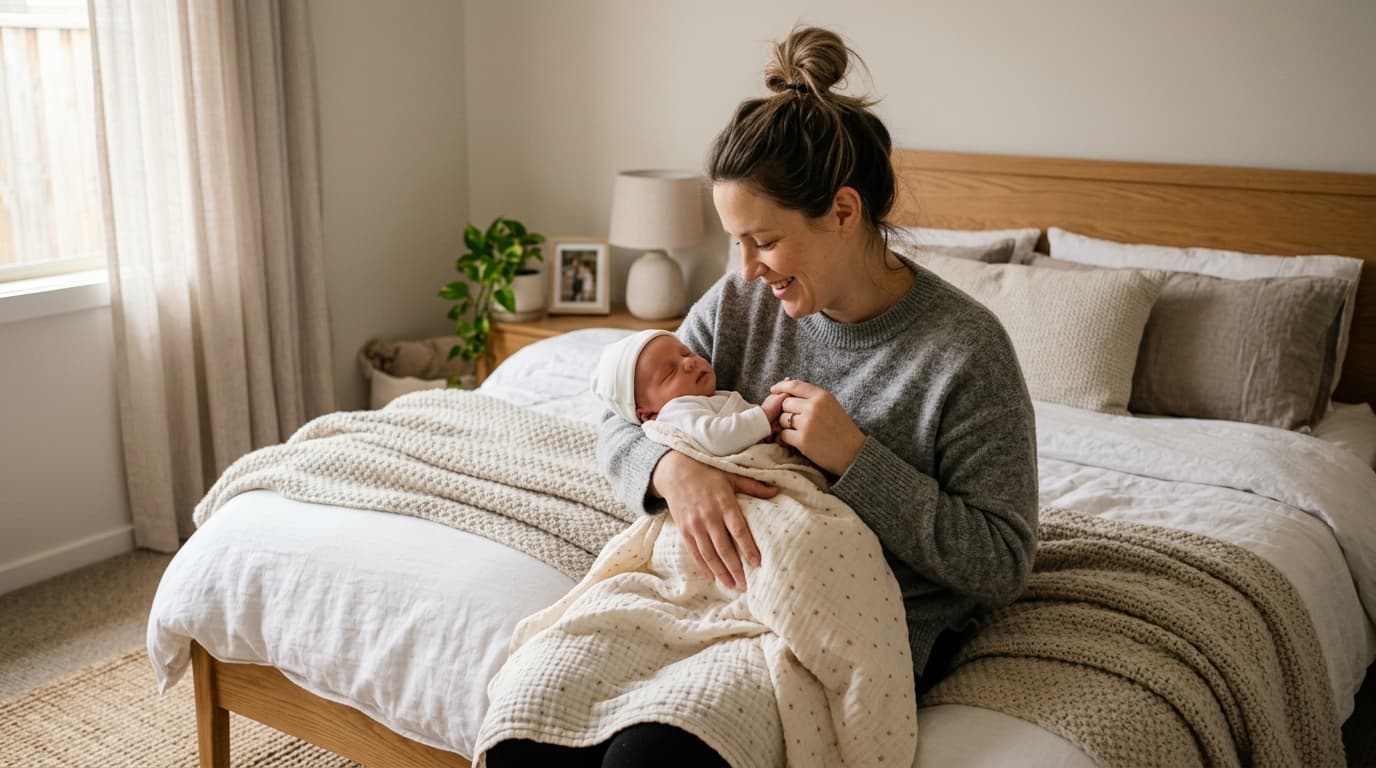
Newborn Sleep Schedule: What to Expect in the First 3 Months
Quick Answer
For the first three months, expect fourteen to seventeen hours of sleep spread across unpredictable two-to-four-hour stretches, day and night alike. There is no schedule to find and nothing to train, because circadian rhythm does not begin developing until six to eight weeks. What you can do is bright days, dark nights, full daytime feeds, and a short repeatable wind-down from about six weeks.
Our Verdict
Work with wake windows rather than a clock during these months, aiming for roughly forty-five to ninety minutes awake before the next rest. Introduce a brief evening sequence around six to eight weeks so it is already habit when longer stretches appear. Do not buy sleep-training materials for a newborn, and do not read a six-hour night at eight weeks as a pattern you can rely on.
Key Takeaways
- ✓Work with wake windows rather than a clock during these months, aiming for roughly forty-five to ninety minutes awake before the next rest. Introduce a brief evening sequence around six to eight weeks so it is already habit when longer stretches appear. Do not buy sleep-training materials for a newborn, and do not read a six-hour night at eight weeks as a pattern you can rely on.
- ✓In the first 3 months, newborns sleep 14-17 hours per day in short 2-4 hour bursts with no consistent schedule — and that is completely normal. You cannot "train" a newborn to sleep through the night.
- ✓Surviving the First Two Weeks with a Newborn
💬 Real Talk from Parents
Sleep training is 50% technique and 50% parental willpower.
Every baby sleep book contradicts the last one you read. That's normal.
The bassinet-to-crib transition feels scarier for you than for the baby.
The swaddle is magic until the day it isn't, and that day comes without warning.
We tried every sleep method. What actually worked? Blackout curtains, white noise, and a consistent bedtime routine. The boring stuff.
Paraphrased community consensus — not a direct quote.
Babies should sleep in complete silence.
The womb is roughly 80-90 decibels — about as loud as a vacuum cleaner. White noise at 60-65 dB actually helps babies sleep by mimicking the familiar uterine environment.
Sleep training damages your baby's attachment.
Multiple peer-reviewed studies (including a 2012 Pediatrics study following children for 5 years) found zero difference in emotional health, behavior, or parent-child attachment between sleep-trained and non-sleep-trained children.
As an Amazon Associate I earn from qualifying purchases. Product prices and availability are subject to change.
Newborn Sleep Schedule: What to Expect in the First 3 Months
In the first 3 months, newborns sleep 14-17 hours per day in short 2-4 hour bursts with no consistent schedule — and that is completely normal. You cannot "train" a newborn to sleep through the night.
The biology: Their bodies require frequent feeding, and their circadian rhythm does not begin developing until 6-8 weeks. Nothing you do speeds that up.
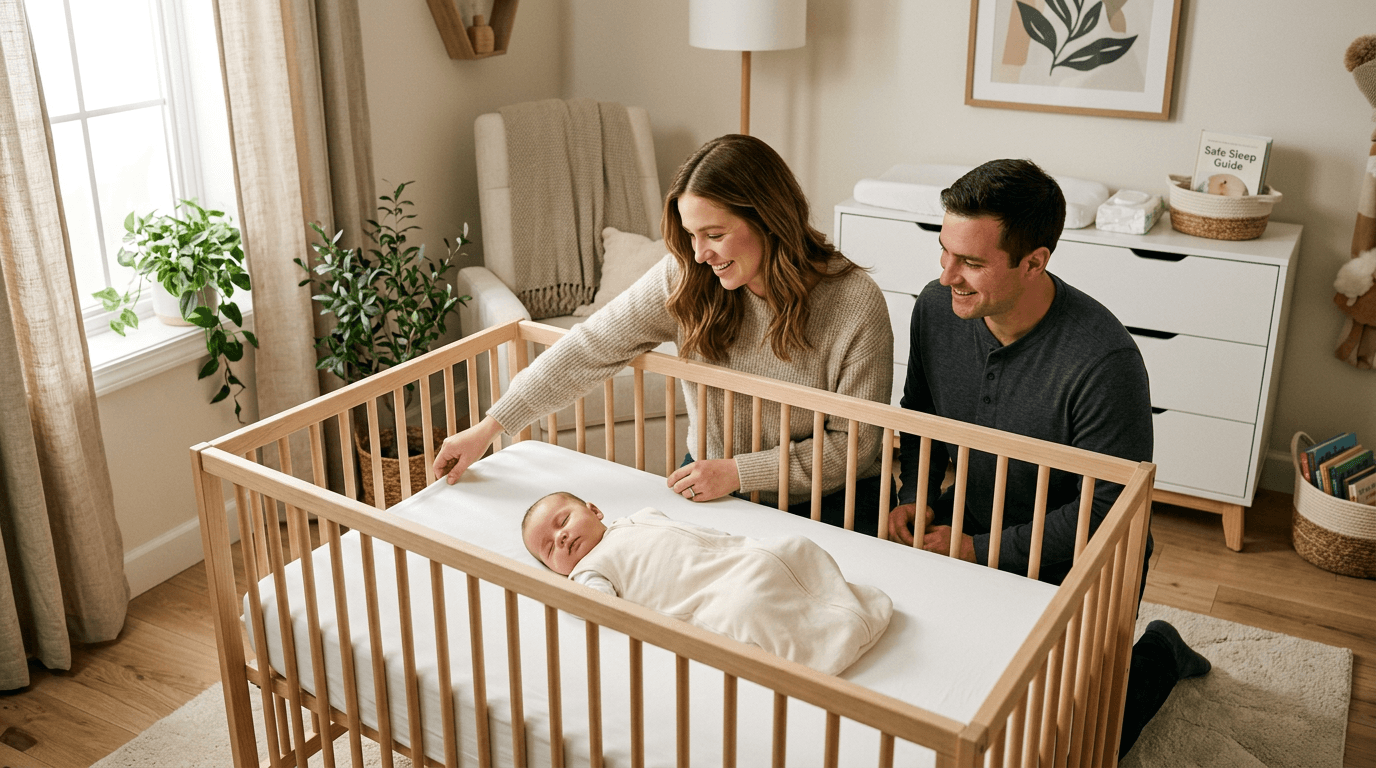
The AAP's safe sleepsafe sleepAAP guideline: baby sleeps Alone (no blankets, pillows, bumpers, or toys), on their Back, in a Crib or bassinet with a firm flat mattress. Room-sharing without bed-sharing is recommended for the first 6-12 months. guidelines (updated 2022) recommend that newborns sleep on their back on a firm, flat surface for every sleep, with no blankets, pillows, or soft objects in the sleep area. A 2016 study published in Pediatrics found that consistent bedtime routines introduced as early as 6-8 weeks were associated with improved sleep consolidation by 12 weeks, even though true "sleeping through the night" (defined as a 6+ hour stretch) typically does not occur until 3-4 months for most infants.
How many hours a day do newborns sleep?
Newborns sleep a lot — typically 14 to 17 hours per day. But that sleep comes in short bursts of 2-4 hours, scattered across day and night with little regard for your preferred schedule. This is completely normal and driven by two factors:
The National Sleep Foundation's 2015 consensus guidelines, published in Sleep Health, recommend 14-17 hours of total sleep per 24-hour period for newborns (0-3 months). The AAP notes that individual variation is wide — some healthy newborns sleep as little as 11 hours, while others sleep up to 19 hours. Wake periods of 45-90 minutes between sleep bouts are typical in the first 6 weeks.
- Small stomachs — newborns need to eat every 2-3 hours, and their tiny stomachs can't hold enough to sustain longer stretches
- Immature circadian rhythm — babies aren't born knowing day from night. The internal clock doesn't begin to develop until about 6-8 weeks and doesn't fully mature until 3-4 months
This means the first several weeks will feel relentless.
Read this twice: You're not doing anything wrong. Your baby's sleep architecture is functioning exactly as designed.
Week-by-Week Sleep Guide
| Weeks | Total sleep | Longest stretch | Wake windows |
|---|---|---|---|
| 1-2 Survival mode | 16-18 hours | 2-3 hours | 45-60 minutes |
| 3-4 Emerging patterns | 15-17 hours | 2-4 hours | 45-75 minutes |
| 5-6 The fussy peak | 15-16 hours | 3-4 hours | 60-90 minutes |
| 7-8 Light at the end | 14-16 hours | 4-5 hours | 60-90 minutes |
| 9-10 Building consistency | 14-15 hours | 5-6 hours | 75-105 minutes |
| 11-12 Almost there | 14-15 hours | 5-8 hours | 75-120 minutes |
Weeks 1-2: Survival Mode
Total sleep: 16-18 hours in 24 hours Longest stretch: 2-3 hours Wake windows: 45-60 minutes (including feeding time)
Your newborn will sleep most of the time, waking primarily to feed. Day and night will blend together. This is the phase where you sleep when baby sleeps (we know that advice is annoying, but it's genuinely the best strategy). For practical tips on getting through this intense period, read our guide on surviving the first two weeks with a newborn.
Focus on safe sleep from day one. Every sleep should happen on a firm, flat surface. Set up your sleep space using our safe sleep space guide before baby arrives.
Weeks 3-4: Emerging Patterns
Total sleep: 15-17 hours Longest stretch: 2-4 hours Wake windows: 45-75 minutes
You might start noticing your baby has a slightly longer stretch at one point in the 24-hour cycle. It might not be at night yet — that's normal. Some babies begin to be slightly more alert during wake windows, looking around and making eye contact.
Weeks 5-6: The Fussy Peak
Total sleep: 15-16 hours Longest stretch: 3-4 hours Wake windows: 60-90 minutes
Research on infant crying patterns, including the landmark study by Barr et al. published in Pediatrics (2000), shows that fussiness peaks at approximately 6 weeks of age (the so-called "Period of PURPLE Crying"). The National Center on Shaken Baby Syndrome developed the PURPLE Crying program based on this research, noting that this peak is a normal neurodevelopmental phase and not a sign of parental failure or illness.
Around six weeks, many babies hit peak fussiness. Evening crying jags are common and don't necessarily indicate a problem. This is also when you might see the beginning of day-night differentiation. Help this process along by exposing baby to natural light during the day and keeping nighttime feeds dim and boring.
Weeks 7-8: Light at the End of the Tunnel
Total sleep: 14-16 hours Longest stretch: 4-5 hours Wake windows: 60-90 minutes
The circadian rhythm is beginning to develop. You may get one longer stretch at night (the legendary 4-5 hour block that feels like heaven after weeks of 2-hour fragments). Daytime naps are still irregular, usually three to five naps of varying length.
Weeks 9-10: Building Consistency
Total sleep: 14-15 hours Longest stretch: 5-6 hours Wake windows: 75-105 minutes
Sleep is consolidating. Many babies start offering a more predictable longer stretch in the early part of the night. Daytime naps may start to loosely organize into three to four naps. This is a good time to begin a gentle bedtime routine if you haven't already.
Weeks 11-12: Almost There
Total sleep: 14-15 hours Longest stretch: 5-8 hours (some babies, not all) Wake windows: 75-120 minutes
By 12 weeks, some babies sleep a 6-8 hour stretch at night. Many don't. Both are normal. Daytime naps are becoming more predictable, typically three to four naps totaling 4-5 hours. The worst of the sleepless nights is usually behind you, though regressions can temporarily undo progress.
What are wake windows and why do they matter?
A wake window is the time between when your baby wakes up and when they're ready to sleep again. Keeping baby up too long leads to overtiredness, which paradoxically makes it harder for them to fall asleep. Too-short wake windows mean they're not tired enough to sleep well.
For newborns, wake windows include everything — feeding, diaper changes, play, and the wind-down before the next nap. It's a tight timeline.
Signs baby is tired within the wake window:
- Yawning
- Looking away
- Rubbing eyes
- Fussiness
- Jerky movements Learning to read your baby's sleep cues is one of the most valuable skills you can develop as a new parent.
How can I help my newborn sleep better?
Differentiate day and night
During the day:
- Keep curtains open
- Maintain normal household noise levels
- Interact and play during wake windows
At night:
- Dim the lights
- Minimize stimulation
- Keep feeds quiet and businesslike
A 2017 study in Sleep Medicine Reviews found that exposure to natural daylight during daytime wake periods helped newborns develop their circadian rhythm up to 2 weeks earlier than infants kept in consistently dim environments. The AAP recommends keeping rooms bright during daytime feeds and dark and quiet during nighttime feeds to support this natural process.
Start a simple bedtime routine early
Even at 4-6 weeks, a brief routine signals to baby that nighttime is coming. It doesn't need to be elaborate:
- A warm bath
- Fresh pajamas
- A feeding
- A song or book
Consistency matters more than content.
Optimize the sleep environment
- A dark room — blackout curtains are a game-changer
- White noise at about 60-65 decibels
- A room temperature of 68-72 degrees Fahrenheit
- A bare sleep surface — no pillows, blankets, bumpers or toys
Swaddling
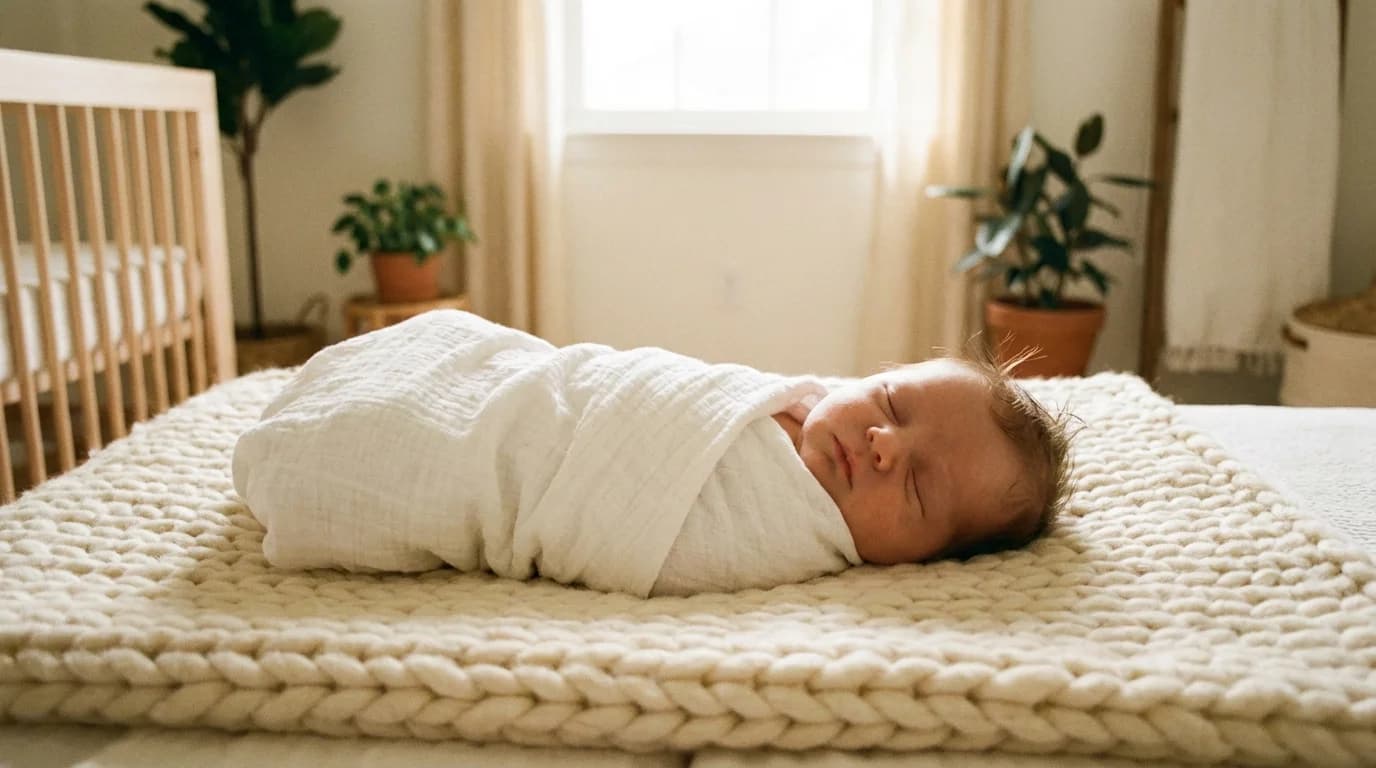
Most newborns sleep better swaddled. The snug wrapping prevents the startle reflex from waking them. Use a purpose-made swaddle like the Halo SleepSack Swaddle → or Love to Dream Swaddle UP → for safe, easy swaddling.
Stop line: Stop swaddling once baby shows signs of rolling, typically around 8-12 weeks.
The AAP endorses swaddling as a soothing technique for newborns but with specific safety guidelines: the swaddle must allow hip flexion and movement, should not cover the face, and must be discontinued as soon as the baby shows any signs of rolling (typically around 2-4 months). A 2016 meta-analysis in Pediatrics found that swaddled infants placed on their backs demonstrated longer sleep durations and less startling, but also noted increased SIDSSIDSSudden Infant Death Syndrome: unexplained death of an otherwise healthy infant under 1, usually during sleep. The AAP's ABCs of safe sleep (Alone, on Back, in a Crib) cut the risk by more than half. risk if swaddled infants rolled to the prone position.
White noise
A Hatch Rest or Yogasleep Dohm → provides consistent background sound that masks household noise and soothes baby. Place it across the room, not right next to the crib, at a volume no louder than a shower.
Feed well during the day
Ensuring your baby gets adequate calories during daytime hours helps them naturally stretch nighttime sleep. Full, efficient feeds during the day often correlate with longer overnight stretches.
What newborn sleep behaviors are normal and not a concern?
- Short naps — naps under 45 minutes are completely normal. Newborn sleep cycles are shorter than adults'
- Irregular patterns — day-to-day variation is expected. One great night doesn't mean all nights will be great, and one terrible night doesn't mean regression
- Comparing to other babies — that friend whose baby "slept through the night at six weeks" is either very lucky or has a different definition of it
- Not being able to put baby down drowsy but awake — this skill develops over time. It's okay to rock, feed or hold your newborn to sleep
Not a bad habit: You're not creating bad habits in the first three months.
What should I expect from my newborn's sleep?
The first three months of newborn sleep are genuinely hard, but they're also temporary. Understanding the biological reality — that newborns are supposed to wake frequently and that schedules emerge gradually — can relieve a lot of unnecessary anxiety.
Four things to focus on:
- Safe sleep practices
- Helping your baby learn day from night
- A simple bedtime routine by 6-8 weeks
- Giving yourself grace By 12 weeks, most families are seeing meaningful improvement. And if sleep feels unmanageable, talk to your pediatrician — they've heard it all and can offer personalized guidance.
You're doing better than you think. The sleepless nights won't last forever, even when it feels like they will.
Further Reading
Your next step
Set up for better newborn sleep.
Research Sources
- Newborn Sleep Patterns
- Newborn Sleep Patterns — Stanford Medicine Children's Health
- Stages of Newborn Sleep
- Development of Circadian Sleep-Wake Rhythms in Preterm and Full-Term Infants
- Mother-Infant Circadian Rhythm: Development of Individual Patterns and Dyadic Synchrony
- States of Consciousness in Newborns
Hilly Shore Inc.
Editorial teamIndependent product research team behind Cribworthy. Reviews are grounded in published AAP / CDC / NHTSA / CPSC pediatric guidance, JPMA / GREENGUARD GOLD / OEKO-TEX certification verification, and aggregated buyer sentiment.
115 products reviewed · 20 categories covered · cites AAP, CDC, NHTSA, CPSC, FDA, ACOG.
Safety claims are verified against published pediatric guidelines and CPSC databases. See our editorial standards.