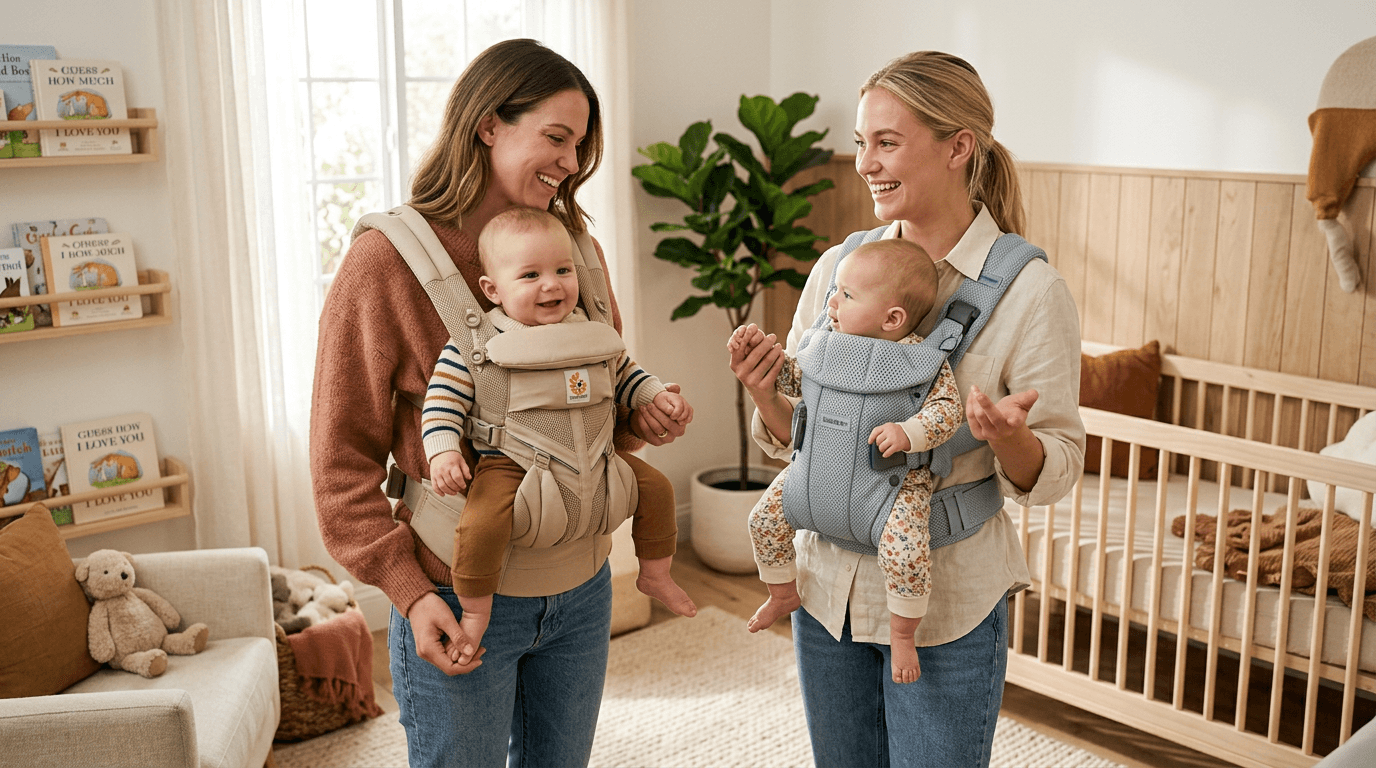
Best Baby Carriers for Newborns 2026: Safe from Day One
Our #1 Pick
Our top recommendation
- Comfort
- Ease Of Use
- Quality
Our Verdict
The Ergobaby Embrace is our top pick (~$99) — the best newborn carrier for babywearing from day one.
#1Ergobaby Embrace 4.6 | #2  KeaBabies All-in-1 Baby Wrap Carrier KeaBabies All-in-1 Baby Wrap Carrier4.6 | #3  Momcozy Easy-On 2-Piece Wrap Carrier Momcozy Easy-On 2-Piece Wrap Carrier4.5 | #4  GROWNSY Ergonomic Newborn Carrier GROWNSY Ergonomic Newborn Carrier4.5 | |
|---|---|---|---|---|
| Verdict | Best Baby Carriers for Newborns 2026 | The cheapest way to try babywearing, and a stretchy wrap is the format most newborns settle in fastest — no buckles, just fabric that holds the baby against your chest. | The wrap for people defeated by wrapping. Momcozy split it into two pieces you put on like a shirt, which removes the tying step that makes most parents give up on a stretchy wrap. | The structured option at wrap money. A buckle carrier takes seconds to put on and transfers weight to the hips, which is what starts to matter once the baby is heavier than a wrap is comfortable for. |
| Price | ~$91.99Buy on Amazon | ~$25.47Buy on Amazon | ~$32.99Buy on Amazon | ~$42.72Buy on Amazon |
| Type | — | Stretchy wrap | 2-piece wrap | Structured buckle carrier |
| Stage | — | Newborn | — | Newborn with insert |
| Position | — | Budget | — | — |
| Range | — | — | Newborn to 33 lb (manufacturer) | — |
| Feature | — | — | No tying | — |
| Support | — | — | — | Hip belt |
| Buyer sentiment | Comfort Ease Of Use Quality Softness Buyers praise comfort, ease of use, quality and softness. Mixed feedback on support and safety. Based on 1,283 user mentions | — | — | — |
| Pros |
|
|
|
|
| Cons |
|
|
|
|
* Prices are approximate. Check the linked retailer for current pricing and availability.
Key Takeaways
- ✓The Ergobaby Embrace is our top pick (~$99) — the best newborn carrier for babywearing from day one.
- ✓Babywearing is one of the most practical things you can do in the early months. A newborn in a carrier is comforted, stimulated, and hands-free — which makes eating, doing laundry, and functioning ...
- ✓Before any product recommendation, internalize this safety framework from the UK Sling Consortium:
- ✓For healthy hip development, newborns should be carried in the M-position (also called the "frog" or "jockey" position): knees higher than bottom, thighs supported from knee to bottom, hips gently ...
- ✓For our broader carrier recommendations including options for toddlers, see our Ergobaby vs BabyBjörn comparison and how to babywear safely guide.
💬 Real Talk from Parents
The baby gear you think you need and the gear you actually use are two very different lists.
Your most-used baby item will be something you almost didn't buy.
Buy less than you think you need. Babies mostly need you.
Every parent's 'essential' list is different because every baby is different.
The best baby gear advice I got: ask parents of 2+ kids what they'd buy again. First-time parents buy everything. Second-timers know what actually matters.
Paraphrased community consensus — not a direct quote.
As an Amazon Associate I earn from qualifying purchases. Product prices and availability are subject to change.
Best Baby Carriers for Newborns 2026: Safe from Day One
Babywearing is one of the most practical things you can do in the early months. A newborn in a carrier is comforted, stimulated, and hands-free — which makes eating, doing laundry, and functioning as a human being possible. But newborns require specific carrying positions for safety, and not all carriers are appropriate from birth.
Here's what to know and which carriers we recommend for the newborn stage.
The T.I.C.K.S. Rule for Safe Babywearing
Before any product recommendation, internalize this safety framework from the UK Sling Consortium:
- T — Tight: The carrier should be tight enough that the baby can't slump or shift
- I — In view at all times: You should be able to see your baby's face at all times without moving fabric
- C — Close enough to kiss: Baby's head should be close enough that you can lean down and kiss the top of it
- K — Keep chin off chest: Never allow the baby's chin to rest on their chest — this can restrict the airway. You should be able to fit two fingers between their chin and chest at all times
- S — Supported back: The baby's back should be supported in a natural curved position
The M-Position for Hip Health
For healthy hip development, newborns should be carried in the M-position (also called the "frog" or "jockey" position): knees higher than bottom, thighs supported from knee to bottom, hips gently abducted. This is the same position recommended by the International Hip Dysplasia Institute.
Avoid carriers that allow the baby's legs to dangle with thighs unsupported — this creates hip stress in an already vulnerable developmental window.
Our Top Picks
Best Structured Carrier for Newborns: Ergobaby Embrace ($80–$95)
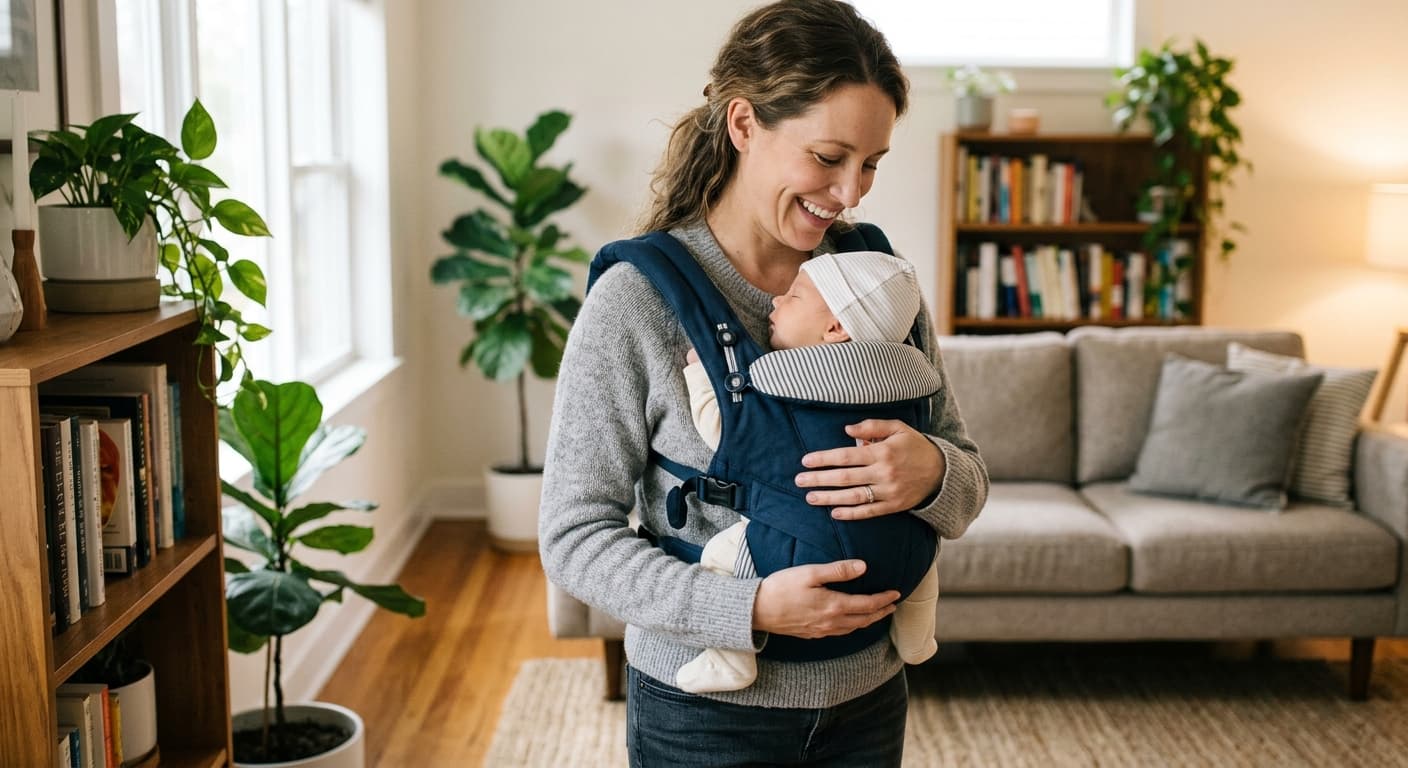
Buy on Amazon · $91.99 →The Ergobaby Embrace → is the easiest structured carrier for newborn use — no insert required from birth (7 lbs), no complicated fit adjustments. The ponte knit fabric is soft and stretchy enough to accommodate newborn proportions while maintaining the M-position, and the waistbelt provides meaningful weight distribution for the carrying parent.
Unlike most structured carriers that require a newborn insert (a separate padded piece) for the first few months, the Embrace is ready to use from day one. It transitions to 25 lbs, covering roughly the first year of carrying.
Best for: New parents who want an easy-to-use structured option, partners who want to share carrying
Pros: No insert needed, easy on/off, M-position from birth, good weight distribution
Cons: Doesn't grow as long as convertible carriers; for toddler carrying you'll want to upgrade
Best Wrap for Newborns: Solly Baby Wrap ($75–$85)
Stretchy wraps are beloved for newborns because the fabric molds perfectly to tiny proportions, providing a womb-like closeness that babies respond to. The Solly Baby Wrap → uses TENCEL Modal fabric — breathable, incredibly soft, and cooler than the common jersey wraps (important for keeping a sweaty newborn comfortable).
The trade-off with any stretchy wrap is the learning curve. Plan 10–15 practice sessions before you're confident with the tie, and watch video tutorials specific to the Solly Baby wrap (the technique varies from woven wraps).
Best for: Parents who want maximum closeness and have time to learn the wrap technique
Pros: Exceptional newborn closeness, breathable fabric, gentle M-position
Cons: Learning curve for tying, not as quick as structured carriers
Best Ring Sling: Sakura Bloom Single Layer Ring Sling ($90–$130)
Ring slings are the fastest option for short carries and nursing. The Sakura Bloom ring sling offers a single layer of woven cotton that threads through aluminium rings — once you learn the adjustment (15–20 minutes of practice), it goes on in under 30 seconds. The linen fabric is breathable and comfortable for the carrying parent's shoulder.
Ring slings are not ideal for extended carries (over an hour) as the weight is distributed on one shoulder, but for quick trips — grocery runs, kitchen chores, fussy baby moments — they're unmatched for convenience.
Best for: Short carries, nursing support, parents comfortable with a learning curve
Pros: Fastest on/off of any carrier type, good for nursing, compact to carry
Cons: One-shoulder design limits to shorter carries, learning curve
Carrier Comparison
| Carrier | Type | From Birth | Learning Curve | Price |
|---|---|---|---|---|
| Ergobaby Embrace | Structured | Birth (7 lbs) | Low | $80–$95 |
| Solly Baby Wrap | Stretchy wrap | Birth | Medium | $75–$85 |
| Sakura Bloom Ring Sling | Ring sling | Birth | Low-Medium | $90–$130 |
For our broader carrier recommendations including options for toddlers, see our Ergobaby vs BabyBjörn comparison and how to babywear safely guide.
🏆 Bottom Line: Ergobaby Embrace is the easiest structured newborn carrier — no insert, ready from birth, minimal learning curve. Solly Baby Wrap gives unmatched closeness if you invest in learning the technique. Ring slings are the fastest option for short around-the-house carries.
Sources
- International Hip Dysplasia Institute — Babywearing and hip positioning guidelines. hipdysplasia.org.
- UK Sling Consortium — T.I.C.K.S. safety rule for babywearing. ukslingsafety.com.
- American Academy of Pediatrics (AAP) — Infant carrier safety. healthychildren.org.
- Ergobaby — Embrace carrier safety and positioning documentation. ergobaby.com.
- Consumer Product Safety Commission (CPSC) — Soft infant carrier safety standard. cpscCPSCThe US federal agency that issues product recalls and enforces safety standards on cribs, strollers, car seats, and other juvenile products..gov.
Hilly Shore Inc.
Editorial teamIndependent product research team behind Cribworthy. Reviews are grounded in published AAP / CDC / NHTSA / CPSC pediatric guidance, JPMA / GREENGUARD GOLD / OEKO-TEX certification verification, and aggregated buyer sentiment.
115 products reviewed · 20 categories covered · cites AAP, CDC, NHTSA, CPSC, FDA, ACOG.
Safety claims are verified against published pediatric guidelines and CPSC databases. See our editorial standards.