Best Baby Food Pouches 2026 (Stage-by-Stage Picks)
Our #1 Pick
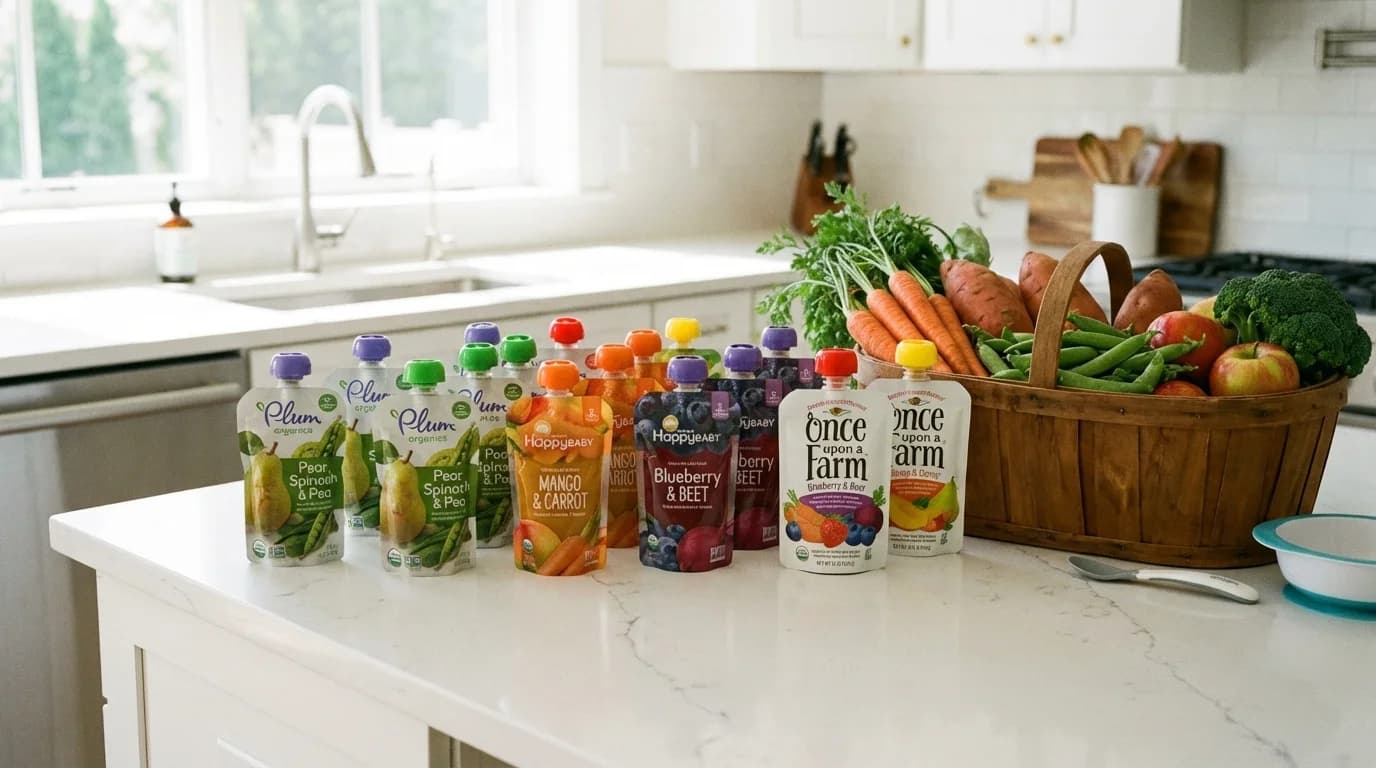
Serenity Kids is the best baby food pouch brand of 2026 because it leads with vegetables, meat and fat instead of the fruit puree that quietly sweetens most competitors. Once Upon a Farm is the organic cold-pressed alternative, and Happy Baby Organics is the value option. Squeeze the contents onto a spoon rather than letting a baby suck them.
Also Great
Best Organic: Once Upon a Farm ($25) — Best Organic
Best Value: Happy Baby Organics ($18) — Best Value
Our Verdict
Treat these as a convenience, never a feeding method. Sucking from a spout skips the chewing and tongue movement a child needs before table food, so keep textures advancing by eight or nine months. Read ingredient order: apple or pear listed first means you bought fruit. Reusable pouches only pay off with home-made batches.
#1Serenity Kids 4.9 | #2Once Upon a Farm 4.7 | #3Happy Baby Organics 4.4 | #4Plum Organics Just Veggies 4.8 | #5Happy Baby Organics Stage 2 Baby Food Pouches 4.7 | |
|---|---|---|---|---|---|
| Verdict | Best Overall | Best Organic | Best Value | Best for Stage 1 | Happy Baby Organics Stage 2 pouches are USDA-organic, gluten-free purees from a trusted brand, a solid in-stock replacement for Cerebelly for texture-progression feeding at ~$23/variety pack. |
| Price | ~$99.60Buy on Amazon | ~$18.83Buy on Amazon | ~$32.64Buy on Amazon | ~$16.14Buy on Amazon | ~$24.31Buy on Amazon |
| Type | Baby Food Pouches | Baby Food Pouches | Baby Food Pouches | Baby Food Pouches | — |
| Brand | — | — | — | — | Happy Baby |
| Buyer sentiment | — | Snack Quality Taste Ingredients Healthiness Buyers praise snack quality, taste, ingredients and healthiness. Based on 96 user mentions | Formula Effectiveness Digestive Benefits Ingredients Buyers praise formula, effectiveness, digestive benefits and ingredients. Mixed feedback on stomach issues and comfort. Based on 95 user mentions | Taste Digestive Effects Effectiveness Quality Buyers praise taste, digestive effects, effectiveness and quality. Based on 628 user mentions | — |
| Pros |
|
|
|
|
|
| Cons |
|
|
|
|
* Prices are approximate. Check the linked retailer for current pricing and availability.
Key Takeaways
- ✓Treat these as a convenience, never a feeding method. Sucking from a spout skips the chewing and tongue movement a child needs before table food, so keep textures advancing by eight or nine months. Read ingredient order: apple or pear listed first means you bought fruit. Reusable pouches only pay off with home-made batches.
- ✓Serenity Kids is our top pick for baby food pouches in 2026, thanks to its unique savory formulations that prioritize vegetables and healthy fats over fruit sugars. For organic options, Once Upon a...
- ✓Serenity Kids takes a fundamentally different approach to baby food. Their pouches are savory-first, featuring ethically sourced meats (grass-fed beef, pasture-raised chicken, wild-caught salmon) c...
- ✓Once Upon a Farm uses cold-pressed (HPP) processing instead of heat pasteurization, which preserves more nutrients, enzymes, and fresh flavor. The ingredient lists are refreshingly short — typicall...
- ✓Happy Baby Organics offers USDA Organic pouches across all stages at a price point that makes daily use feasible. Their Clearly Crafted line is particularly good, featuring visible ingredients and ...
💬 Real Talk from Parents
You'll develop strong opinions about bottle nipple flow rates, and that's okay.
The 'best' bottle is whichever one your baby actually accepts.
Your baby will reject the $40 bottle and love the $3 one. Every time.
Formula is not a failure. Fed is genuinely best.
The Dr. Brown's bottles are annoying to clean but genuinely reduce gas. Worth the extra parts for a gassy baby.
Paraphrased community consensus — not a direct quote.
Switching formula brands frequently is harmful.
Most standard formulas have very similar nutritional profiles (they're all regulated by the FDA). Switching brands is fine — the exception is specialty formulas for allergies or medical conditions, which should be discussed with your pediatrician.
Breastfed babies don't need to burp.
All babies swallow some air while feeding, regardless of method. Breastfed babies may swallow less air, but they still benefit from gentle burping after feeds.
As an Amazon Associate I earn from qualifying purchases. Product prices and availability are subject to change.
Best Baby Food Pouches: Convenient, Healthy, and Stage-by-Stage
Serenity Kids is our top pick for baby food pouches in 2026, thanks to its unique savory formulations that prioritize vegetables and healthy fats over fruit sugars. For organic options, Once Upon a Farm offers cold-pressed pouches with clean, simple ingredient lists.
The AAP recommends introducing complementary foods around 6 months of age and emphasizes variety in flavors and textures to support healthy eating habits. A 2021 study in Pediatrics raised concerns that over-reliance on squeezable pouches may delay oral motor development, as sucking from a spout does not engage the same chewing and tongue-lateralization skills needed for advancing to table foods. The WHO advises that complementary foods should include a mix of textures by 8-9 months to support proper jaw and speech development.
| Pick | Roughly per pouch | Why you'd choose it |
|---|---|---|
| Serenity Kids | $3-4 | Meat and vegetables first, no fruit filler |
| Once Upon a Farm | $18.83 | Cold-pressed, shortest ingredient lists |
| Happy Baby Organics | $1.20-1.50 | Everyday value, sold nearly everywhere |
| Plum Organics Just Veggies | $16.14 | Single-vegetable starts for Stage 1 |
| Cerebelly | $2.50 | Texture progression and targeted nutrients |
Are baby food pouches healthy for my baby?
Pouches are a tool, not the entire toolbox. They're fantastic for travel, busy days, and introducing new flavors — but they shouldn't completely replace spoon feeding and self-feeding with whole foods.
Babies need practice with textures, chewing, and using utensils to develop oral motor skills. Think of pouches as a convenient supplement to a varied diet that includes mashed foods, soft solids, and eventually finger foods. For more on the whole-foods approach, read our guide on how to start baby led weaning.
A 2021 study published in Pediatrics found that children who consumed food primarily from squeezable pouches at 9-12 months showed delayed advancement to textured foods compared to peers who practiced spoon-feeding and self-feeding. The AAP's Committee on Nutrition recommends that pouches be used as a supplement to — not a replacement for — varied textures including mashed, soft solid, and finger foods starting around 8 months.
Where pouches genuinely earn their place
- Travel days, appointments, and anywhere a bowl isn't practical
- Introducing an unfamiliar flavor before you cook it yourself
- Getting a fussy eater through a stretch without a fight
Where they quietly cost you something
- Sucking from a spout skips the chewing and tongue movement spoon-feeding builds
- A fruit-forward pouch trains a preference for sweet before vegetables get a chance
- The convenience is habit-forming for parents, not just babies
What are the different baby food pouch stages?
Most baby food pouches follow a staging system:
| Stage | Typical age | Texture | What's in it |
|---|---|---|---|
| Stage 1 | 4-6 months | Thin, very smooth puree | Single ingredient — one fruit or one vegetable |
| Stage 2 | 6-8 months | Slightly thicker | Two or more ingredients; flavor pairings begin |
| Stage 3 | 8-12 months | Chunkier | Complex combinations, may include grains, proteins, spices |
| Toddler | 12+ months | Thick blends | Often yogurt, grains, or protein; designed as snacks |
The trap: stage numbers are marketing, not regulation. The FDA regulates baby food under the Federal Food, Drug, and Cosmetic Act but does not mandate specific stage labeling — stages are industry-created categories. The AAP recommends introducing single-ingredient foods first and waiting 3-5 days between new foods to monitor for allergic reactions, regardless of the stage number on the packaging.
Best Overall: Serenity Kids
Buy on Amazon · $99.60 →Serenity Kids → takes a fundamentally different approach to baby food. Their pouches are savory-first, featuring ethically sourced meats (grass-fed beef, pasture-raised chicken, wild-caught salmon) combined with organic vegetables. There are no fruit fillers, no added sugars, and no grains.
This matters because most baby food pouches — even organic ones — use fruit as the primary ingredient, which trains babies to prefer sweet flavors. Serenity Kids intentionally breaks that pattern by making vegetables and proteins the stars. The result is a pouch that's genuinely nutritious rather than a fruit smoothie in disguise.
At about $3-4 per pouch, they're the premium option. But the nutritional profile is unmatched: high in healthy fats and protein, low in sugar, and packed with nutrient-dense vegetables. A variety pack is the best way to start.
Why it's our top pick
- Meat-and-vegetable-based (no fruit fillers)
- No added sugars, grains, or seed oils
- Ethically sourced meats and organic vegetables
- Savory flavors that build a diverse palate
Best Organic: Once Upon a Farm
Buy on Amazon · $18.83 →Once Upon a Farm → uses cold-pressed (HPP) processing instead of heat pasteurization, which preserves more nutrients, enzymes, and fresh flavor. The ingredient lists are refreshingly short — typically three to five real foods you can pronounce. They're organic, non-GMO, and include no added sugars or concentrates.
The cold-pressed approach means these pouches are refrigerated rather than shelf-stable, which limits portability slightly. But the taste difference is noticeable — they actually taste like the foods on the label. At about $2.50 per pouch, they're mid-range in price. Available at most grocery stores in the refrigerated section.
Best Value: Happy Baby Organics
Buy on Amazon · $32.64 →Happy Baby Organics → offers USDA Organic pouches across all stages at a price point that makes daily use feasible. Their Clearly Crafted line is particularly good, featuring visible ingredients and interesting combinations like bananas, raspberries, and oats.
At about $1.20-1.50 per pouch (often less in multi-packs), Happy Baby is the best value among organic options. The Stage 1 single-ingredient pouches are an excellent starting point, and the brand's wide availability means you can find them almost anywhere. The pouches include vitamin C added and are non-GMO verified.
Why it's our budget pick
- USDA Organic and Non-GMO Project Verified
- Available at nearly every grocery and retail store
- Wide range of flavors across all stages
- Multi-packs bring per-pouch cost under $1.25
- Consistent quality and taste
Best for Stage 1: Plum Organics Just Veggies
Buy on Amazon · $16.14 →Plum Organics Just Veggies → single-vegetable pouches are the ideal starting point for introducing solids. Single-ingredient options like peas, sweet potato, and butternut squash let you identify any sensitivities and build flavor acceptance one vegetable at a time.
Starting with vegetables before fruits is a strategy many pediatric nutritionists recommend, as it helps establish acceptance of less-sweet flavors. At about $1.50 per pouch, these are affordable enough for daily use during those early weeks of solids introduction.
Best Texture Progression: Cerebelly
Cerebelly Organic Baby Food Pouches → was developed by a neurosurgeon mom and formulated specifically to support brain development at each stage. Each pouch includes targeted nutrients — like choline, DHA, and iron — that are critical for neurological development during the first years of life.
What sets Cerebelly apart is the thoughtful texture progression. Their Stage 1 pouches are silky smooth, Stage 2 introduces more complex blends, and later stages incorporate texture that encourages oral motor development. At about $3.60 per pouch in the 8-pack variety box, the science-backed approach justifies the price for parents who want more than generic purees.
Are reusable baby food pouches worth it?
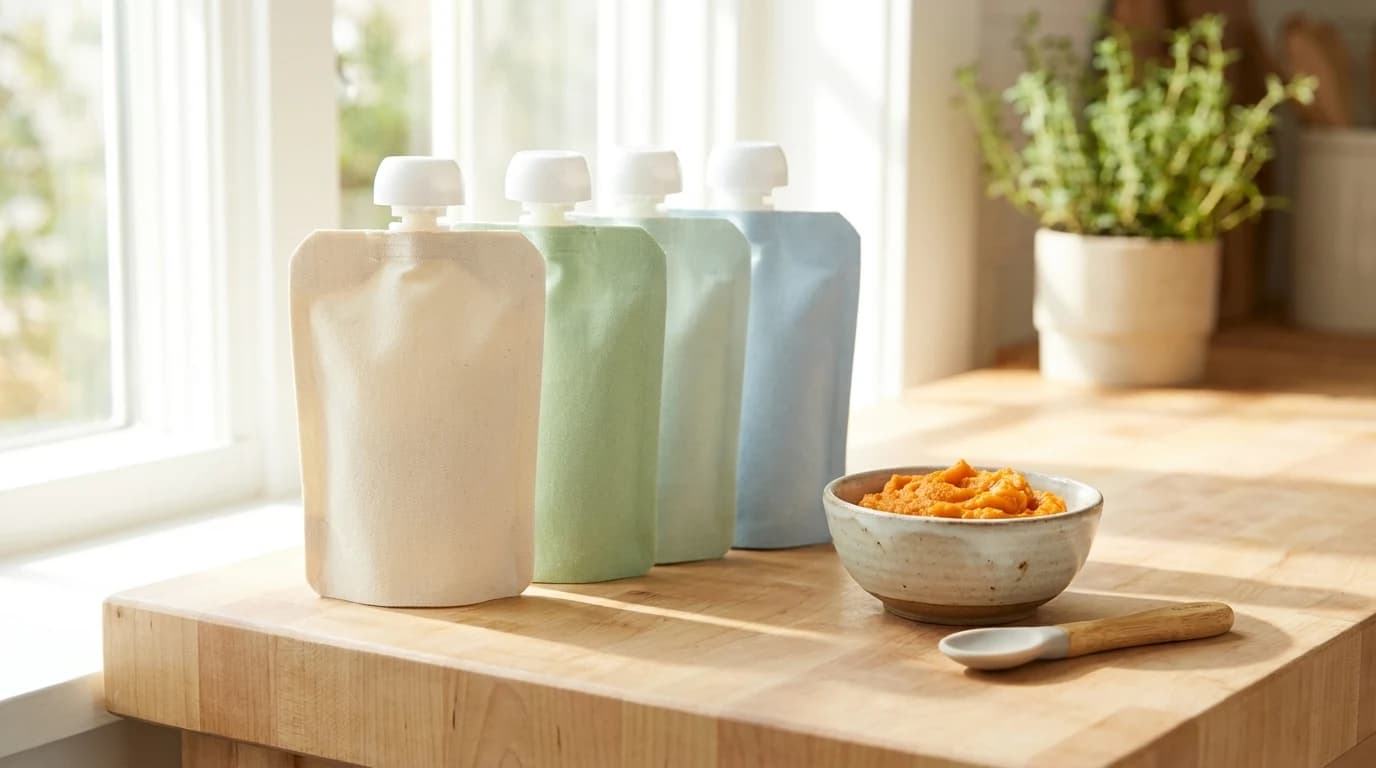
If you make your own baby food (or want to reduce packaging waste), reusable pouches are an excellent investment. The WeeSprout Reusable Pouches hold 5 ounces each, are dishwasher safe, and feature a double-zip closure that prevents leaks. A pack of twelve costs about $16.
Fill them with homemade purees using a baby food maker, freeze them, and grab one as needed. You control exactly what goes in, and you'll save significant money over time. Just make sure to clean them thoroughly between uses — the double-zip design makes drying the interior easier than some competitors.
How do I read baby food pouch labels?
Ingredient order tells you what you're actually buying
Ingredients are listed by weight. If apple or pear is the first ingredient in a "vegetable" pouch, that pouch is primarily fruit. Look for vegetables or proteins listed first.
A 2022 analysis published in Nutrients evaluated 236 commercially available baby food pouches and found that 53% listed fruit as the first ingredient even when vegetables were featured on the packaging. The researchers noted that apple and pear purees are commonly used as fillers because their sweetness masks vegetable flavors. The WHO advises that early exposure to a variety of vegetable-first flavors is important for establishing long-term healthy eating preferences.
Added sugar hides under several names
Organic cane sugar, fruit juice concentrate, and puree concentrates are all forms of added sugar. The best pouches contain only whole foods without concentrates or sweeteners.
The AAP's 2023 policy statement on sugar and children recommends avoiding all added sugars for children under 2 years of age. A USDA analysis of commercial baby foods found that some pouches marketed as vegetable blends contained up to 12 grams of sugar per serving — equivalent to 3 teaspoons — primarily from fruit concentrate fillers.
Two more label checks worth thirty seconds:
- Note the total sugar content. Even without added sugars, fruit-heavy pouches can contain 10-15 grams of sugar per serving. Compare between brands — lower is generally better, especially for daily-use pouches.
- Look for protein and fat. Babies need fat and protein for brain development and growth. Pouches that include meats, yogurt, nut butters, or coconut oil provide more complete nutrition than fruit-only blends.
How should I use baby food pouches without overdoing it?
Habits that keep pouches in their lane:
- Vary the delivery method. Squeeze pouches onto a spoon rather than always letting baby suck directly from the pouch. This promotes better oral motor development and helps baby learn to eat from a spoon.
- Offer whole-food versions too. If your baby loves the sweet potato pouch, also offer mashed or roasted sweet potato at meals. Pouches introduce the flavor; whole foods teach the texture.
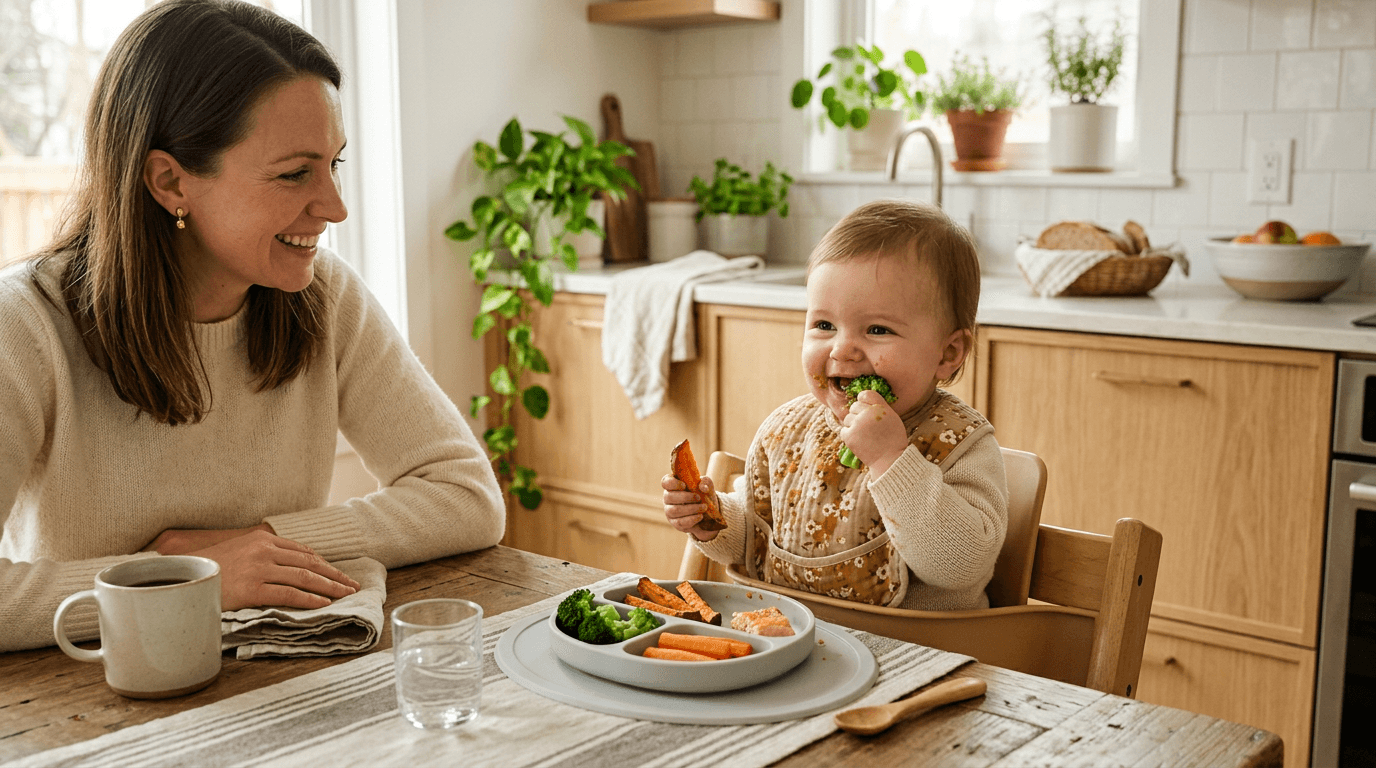
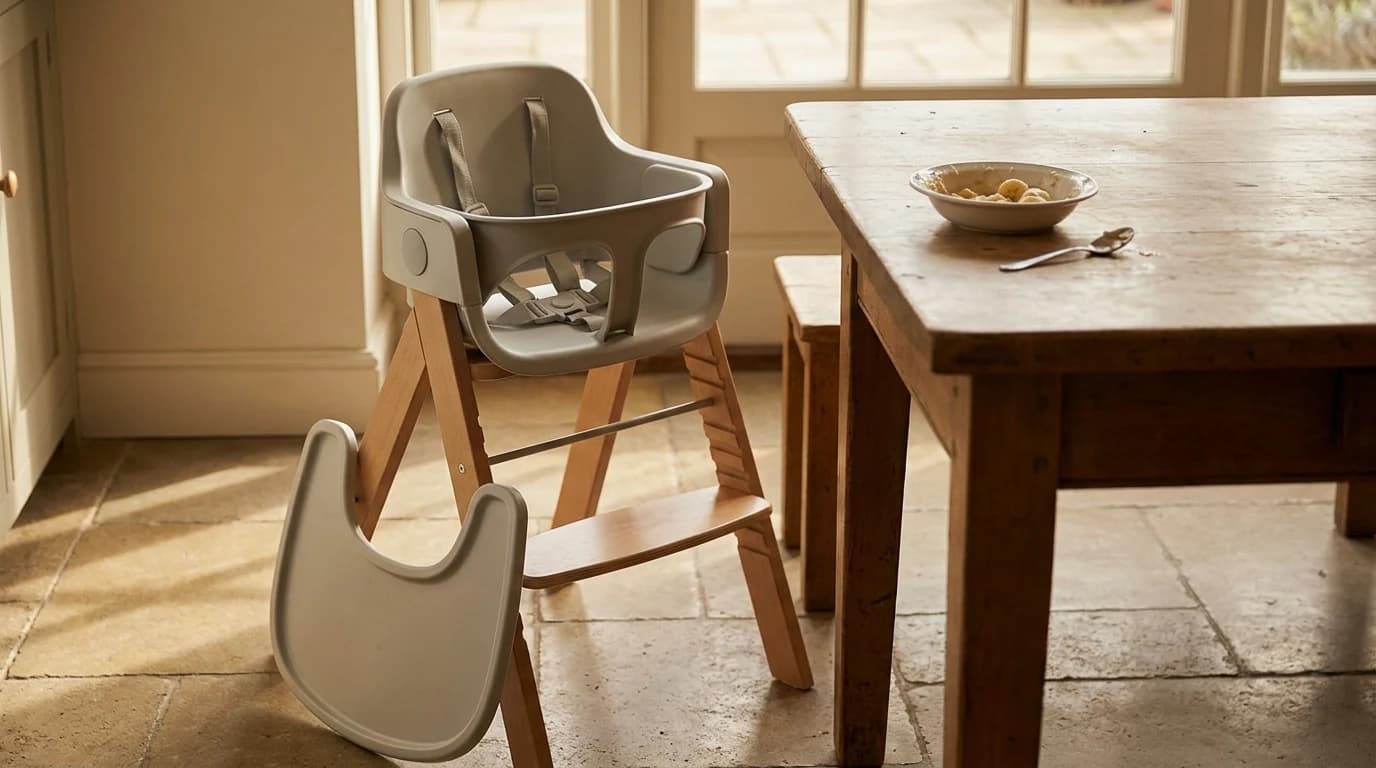
- Set up properly for meals. A good high chair with a footrest and proper positioning makes mealtimes more comfortable and productive. Pouch feeding is messier than you'd think when babies grab the pouch themselves.
- Refrigerate after opening. An opened pouch should be refrigerated and used within 24 hours. Write the date on opened pouches with a marker to track freshness.
Rule of thumb: don't stress about quantity. In the early months of solids (6-8 months), breast milk or formula remains the primary nutrition source. Solids, including pouches, are about exploration and learning, and quantities increase naturally over time.
Which baby food pouch brand is best?
For everyday use, Happy Baby Organics offers the best combination of quality, variety, and affordability. For parents who want the most nutritious option regardless of price, Serenity Kids is unmatched with its meat-and-vegetable-first approach. And for the freshest taste and nutrient preservation, Once Upon a Farm cold-pressed pouches are worth the refrigerator space.
The healthiest approach combines pouches with homemade foods and whole-food finger foods. Use pouches strategically — for travel, busy days, and flavor exploration — while building a diverse whole-foods diet at home. Your baby's palate is being shaped right now, and variety is the most valuable ingredient you can offer.
Further Reading
Your next step
Set up for starting solids.
Hilly Shore Inc.
Editorial teamIndependent product research team behind Cribworthy. Reviews are grounded in published AAP / CDC / NHTSA / CPSC pediatric guidance, JPMA / GREENGUARD GOLD / OEKO-TEX certification verification, and aggregated buyer sentiment.
115 products reviewed · 20 categories covered · cites AAP, CDC, NHTSA, CPSC, FDA, ACOG.
Safety claims are verified against published pediatric guidelines and CPSC databases. See our editorial standards.