Best Baby Walkers and Activity Centers of 2026: Safe Options Compared
Our #1 Pick
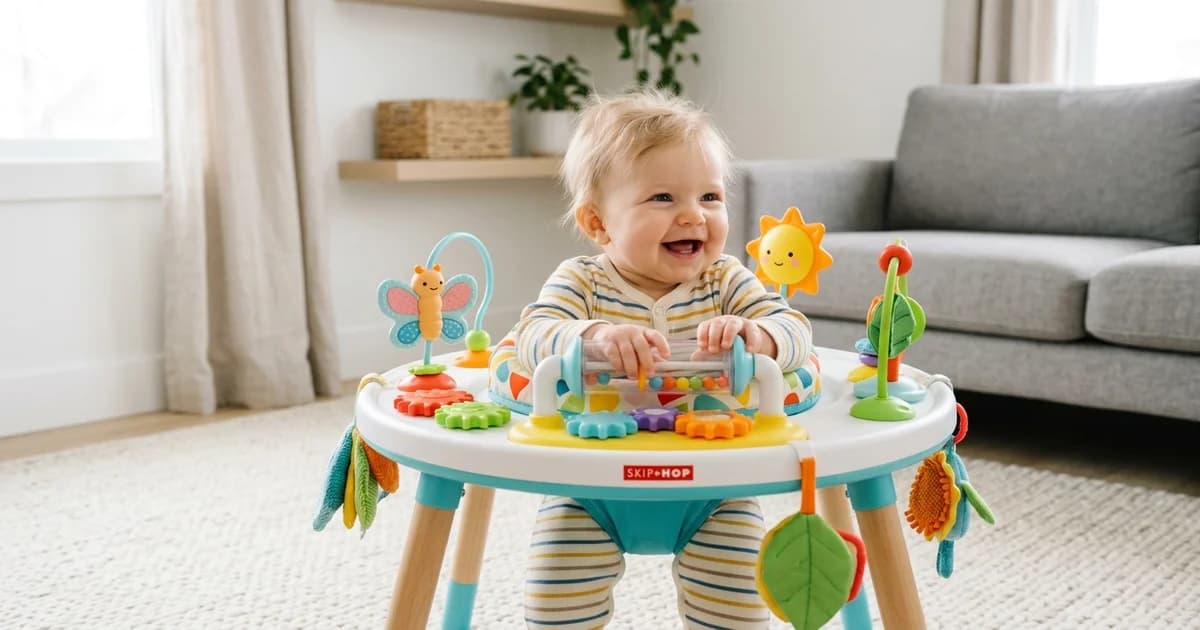
Buy a stationary activity center or a push walker, not a wheeled sit-in walker. The Skip Hop Explore & More is the best stationary pick because it converts into a play table and then a toddler table, and the VTech Sit-to-Stand is the push walker to get once your baby pulls up around nine to twelve months. Cap any container at fifteen or twenty minutes.
Also Great
Budget Pick: Baby Einstein Around We Grow 4-in-1 ($80) — Best Budget Activity Center
Premium Pick: Lovevery The Play Gym to Activity Center ($175) — Best Premium Activity Center
Our Verdict
Get the Skip Hop Explore & More if you want one purchase that lasts into toddlerhood, the Baby Einstein Around We Grow when the budget is tight, or the Oribel PortaPlay in a small apartment. Add the VTech push walker separately once your child is pulling to stand. Do not buy a wheeled sit-in walker at any price, and do not let any of them replace floor time.
#1Skip Hop Explore & More Activity Center 4.7 | #2Baby Einstein Around We Grow 4-in-1 4.6 | #3Lovevery The Play Gym to Activity Center 4.8 | #4VTech Sit-to-Stand Learning Walker 4.6 | #5Oribel PortaPlay 4.7 | |
|---|---|---|---|---|---|
| Verdict | Best Stationary Activity Center | Best Budget Activity Center | Best Premium Activity Center | Best Push Walker | Best for Small Spaces |
| Price | ~$194.98Buy on Amazon | ~$89.99Buy on Amazon | ~$145Buy on Amazon | ~$47.99Buy on Amazon | ~$139Buy on Amazon |
| Type | Baby Walkers Activity Centers | Baby Walkers Activity Centers | Baby Walkers Activity Centers | Baby Walkers Activity Centers | Baby Walkers Activity Centers |
| Buyer sentiment | — | Quality Entertainment Educational Versatility Stability Buyers praise quality, entertainment, educational and versatility. Mixed feedback on mobility and assembly. Some flag stability. Based on 759 user mentions | Quality Educational Entertainment Appearance Buyers praise quality, educational, entertainment and appearance. Mixed feedback on value for money. Based on 1,636 user mentions | Quality Entertainment Educational Pushability Buyers praise quality, entertainment, educational and pushability. Mixed feedback on noise. Based on 10,527 user mentions | Quality Engagement Foldability Appearance Buyers praise quality, engagement, foldability and appearance. Based on 426 user mentions |
| Pros |
|
|
|
|
|
| Cons |
|
|
|
|
|
* Prices are approximate. Check the linked retailer for current pricing and availability.
Key Takeaways
- ✓Get the Skip Hop Explore & More if you want one purchase that lasts into toddlerhood, the Baby Einstein Around We Grow when the budget is tight, or the Oribel PortaPlay in a small apartment. Add the VTech push walker separately once your child is pulling to stand. Do not buy a wheeled sit-in walker at any price, and do not let any of them replace floor time.
- ✓The best activity center for most families is the Skip Hop Explore & More, which converts from a seated activity center to a play table and then a toddler table, providing years of use from a singl...
- ✓The Skip Hop Explore & More is our top pick because it converts through three stages: activity center for sitters, a play table for standers, and a toddler table with chairs. That gives you years o...
- ✓The Baby Einstein Around We Grow offers four modes: activity center, push walker, play table, and individual floor toys. The removable toys are genuinely engaging — light-up piano, spinning gears, ...
- ✓Lovevery's approach is Montessori-inspired, focusing on developmentally appropriate activities rather than flashy lights and sounds. The wooden activity table looks like a piece of furniture rather...
💬 Real Talk from Parents
Your second kid will use half the gear and be twice as chill about it.
Buy less than you think you need. Babies mostly need you.
The baby gear you think you need and the gear you actually use are two very different lists.
Your most-used baby item will be something you almost didn't buy.
Buy used when you can, new when safety matters. Car seats new, toys used. Books used, crib mattress new. That's the rule.
Paraphrased community consensus — not a direct quote.
More expensive baby gear means better quality.
Many mid-range products match or outperform premium ones in safety tests and durability. Price often reflects brand name and aesthetics, not actual performance. Read reviews, not price tags.
You need everything on the registry checklist before baby arrives.
Most babies need surprisingly little: a safe sleep space, car seat, diapers, feeding supplies, and a few outfits. Everything else can be bought as needed after you learn your baby's preferences.
As an Amazon Associate I earn from qualifying purchases. Product prices and availability are subject to change.
Best Baby Walkers and Activity Centers of 2026: Safe Options Compared
The best activity center for most families is the Skip Hop Explore & More, which converts from a seated activity center to a play table and then a toddler table, providing years of use from a single product. We strongly recommend stationary activity centers over traditional wheeled walkers — the AAP advises against sit-in wheeled walkers, which contribute to over 2,000 emergency room visits per year according to CPSCCPSCThe US federal agency that issues product recalls and enforces safety standards on cribs, strollers, car seats, and other juvenile products. data, and they are outright banned in Canada. For babies pulling to stand around 9 to 12 months, the VTech Sit-to-Stand push walker is our top pick for encouraging safe, independent walking practice.
Are baby walkers safe, or should you use an activity center instead?
Let's address this upfront: the AAP recommends against traditional wheeled baby walkers. Data shows they contribute to thousands of injuries annually, primarily from falls down stairs and tipping. Canada has outright banned the sale of wheeled baby walkers.
The number that settles it: the CPSC reports an estimated 9,400 emergency department visits associated with infant walkers in the United States between 2018 and 2023, primarily from stairway falls.
The AAP has called for a federal ban on the manufacture and sale of mobile infant walkers since 2001, citing persistent injury data despite voluntary safety standards.
That said, many modern "walkers" are actually push walkers (baby walks behind them holding a handle) or stationary activity centers that let babies bounce and play without moving across the floor. These are significantly safer options.
Three very different products share one word
What we recommend, and when:
- Stationary activity centers, for babies who can support their head and trunk (~4-6 months)
- Push walkers, for babies who are already pulling to stand (~9-12 months)
What we don't recommend at any age:
- Traditional sit-in wheeled walkers — the category the AAP has wanted federally banned since 2001
- Any wheeled device used where stairs are reachable, which is where the injury data concentrates
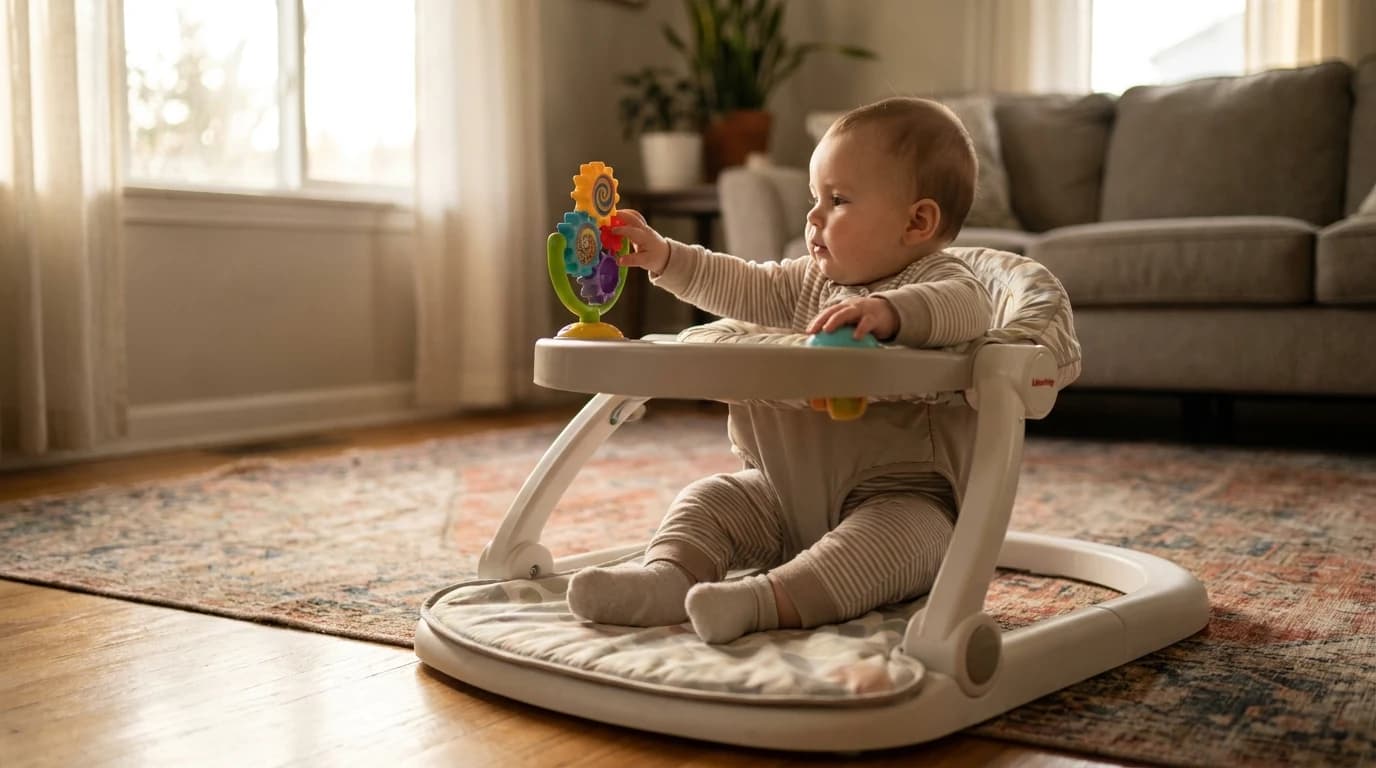
Best Stationary Activity Center: Skip Hop Explore & More Activity Center
Buy on Amazon · $194.98 →The Skip Hop Explore & More → is our top pick because it converts through three stages: activity center for sitters, a play table for standers, and a toddler table with chairs. That gives you years of use from a single product.
The AAP's Committee on Injury, Violence and Poison Prevention recommends that if parents choose to use activity centers, they select stationary models with wide, stable bases and no wheels.
The setup step people skip: pediatric orthopedists advise adjusting seat height so the baby's feet rest flat on the floor, supporting healthy hip and leg development.
The 360-degree rotating seat lets baby access different activity stations — a piano, spinning gears, a ball drop, and more. The seat height adjusts to three positions as baby grows. At around $90, the long-term versatility makes it excellent value.
Why we love it
- Three-stage design grows with your child from 4 months to 3+ years
- 360-degree rotating seat with locking positions
- Activities encourage fine motor skills without being overstimulating
- Folds relatively compact for storage
Best Budget Activity Center: Baby Einstein Around We Grow 4-in-1
Buy on Amazon · $89.99 →The Baby Einstein Around We Grow → offers four modes: activity center, push walker, play table, and individual floor toys. The removable toys are genuinely engaging — light-up piano, spinning gears, and crinkle book — and they detach for independent play.
At around $80, it's slightly less than the Skip Hop with arguably more versatility. The push walker mode is a bonus that other activity centers don't offer. The seat pad is machine washable, which earns bonus points from every parent who's dealt with a diaper blowout in an activity center.
Best Premium Activity Center: Lovevery The Play Gym to Activity Center
Buy on Amazon · $145 →Lovevery's approach is Montessori-inspired, focusing on developmentally appropriate activities rather than flashy lights and sounds. The wooden activity table looks like a piece of furniture rather than a plastic play station, and each station is designed by child development experts to encourage specific skills.
At around $175, it's a premium price, but the build quality is exceptional (solid wood frame) and the aesthetic is genuinely nursery-worthy. If you prefer toys that look good and follow a developmental philosophy, Lovevery delivers. Read more about developmental play in our baby gyms and play mats guide.
Best Push Walker: VTech Sit-to-Stand Learning Walker
Buy on Amazon · $47.99 →The VTech Sit-to-Stand → is a classic for good reason. The front panel detaches for sit-down play, and when baby is ready to stand, it reattaches to a sturdy push handle. The wheels have adjustable speed control — start slow for new walkers, speed up as confidence builds.
The interactive panel has buttons, spinning rollers, shape sorters, and music that keep babies engaged for surprisingly long stretches. At around $25, it's one of the best values in baby gear, period.
Why it's our top push walker
- Detachable activity panel works from sitting age (~6 months)
- Speed-adjustable wheels prevent runaways
- Incredibly sturdy — doesn't tip easily
- Under $30 is almost unbelievable value
Best for Small Spaces: Oribel PortaPlay
Buy on Amazon · $139 →The Oribel PortaPlay → folds flat when not in use — a godsend for apartment-dwelling families. It unfolds into a full activity center with a bouncing seat and interactive toy stations. Later, it converts to a play table by adding the included stools.
At around $120, the PortaPlay offers the fold-and-store convenience that larger activity centers can't match. It's also our top pick for grandparents' houses — set it up when the grandkids visit, fold it away when they leave.
What are the safety guidelines for baby activity centers and walkers?
The ASTM International standard F2012-18 governs safety requirements for stationary activity centers, including stability testing, small parts requirements, and entrapment hazard assessments.
For stationary activity centers
- Check height settings: Baby's feet should touch the floor flat, not on tiptoes. Dangling strains developing joints.
- Limit time: The CPSC recommends limiting sessions to 15-20 minutes at a time. Extended time in activity centers can delay crawling motivation.
- Supervise always: Even stationary centers can tip if a determined baby rocks hard enough.
- Check weight limits: Most activity centers max out at 25-30 lbs. Don't exceed the limit.
For push walkers
- Use on flat surfaces only: Push walkers + slopes or stairs = disaster. Baby-proof stairs before introducing a push walker.
- Non-slip surfaces: Hardwood floors can cause the walker (and baby) to slide. Use on carpet or rugs.
- Always supervise: Push walkers can move fast once baby gains confidence.
- Wait for readiness: Baby should be pulling to stand independently before using a push walker.
Do activity centers or walkers delay a baby's ability to walk?
This is a common concern, and the answer is nuanced. Short, supervised sessions (15-20 minutes) are fine and don't appear to delay walking. Spending hours daily in an activity center, though, can reduce the floor time babies need to develop crawling, balance, and independent standing skills.
A 2022 study published in the Journal of Developmental & Behavioral Pediatrics found no significant difference in the age of independent walking between infants who used stationary activity centers and those who did not. The study did find that excessive time in any containment device (more than 30 minutes per session) was associated with minor delays in crawling onset.
The key is balance: activity centers are great for supervised play while you cook dinner or take a breather, not as all-day containment devices. Plenty of floor time on a play mat should complement activity center sessions.
So which baby walker or activity center should you buy?
| Pick | What it is | Around | Best for |
|---|---|---|---|
| Skip Hop Explore & More | Stationary activity center | $177.1 | Three-stage use, 4 months to 3+ years |
| Baby Einstein Around We Grow | 4-in-1 activity center | $80 | Most modes for the money |
| Lovevery activity table | Wooden activity table | $175 | Montessori-style play, nursery-worthy |
| VTech Sit-to-Stand | Push walker | $25 | Babies already pulling to stand |
| Oribel PortaPlay | Folding activity center | $120 | Apartments and grandparents' houses |
The Skip Hop Explore & More is our top overall pick for its three-stage design and excellent activity options. For push walkers, the VTech Sit-to-Stand is unbeatable at under $30. Skip traditional wheeled sit-in walkers entirely — stationary activity centers and push walkers offer the same entertainment and development benefits without the safety risks.
Related Reading
Your next step
Big-kid energy? The next long-haul purchase is the chair.
Research Sources
Hilly Shore Inc.
Editorial teamIndependent product research team behind Cribworthy. Reviews are grounded in published AAP / CDC / NHTSA / CPSC pediatric guidance, JPMA / GREENGUARD GOLD / OEKO-TEX certification verification, and aggregated buyer sentiment.
115 products reviewed · 20 categories covered · cites AAP, CDC, NHTSA, CPSC, FDA, ACOG.
Safety claims are verified against published pediatric guidelines and CPSC databases. See our editorial standards.