Baby Proofing Checklist: Start at 4 Months (Room by Room)
Quick Answer
Begin at four to five months, before your baby is mobile, and work in priority order rather than room order: anchor furniture and televisions, hardware-mount gates at the top and bottom of stairs, fit self-closing outlet covers, and lock away cleaners and medicine. Then crawl the house at your baby's eye level — you will find hazards that standing adults never notice.
Our Verdict
Four purchases carry most of the risk reduction: anti-tip straps, two hardware-mounted gates, sliding outlet plates, and cabinet locks. Buy those before the corner bumpers and the magnetic drawer kit. Pressure-mounted gates belong in doorways and never at the head of a staircase, and plug-in caps become a choking hazard the moment a toddler works one free.
Key Takeaways
- ✓Four purchases carry most of the risk reduction: anti-tip straps, two hardware-mounted gates, sliding outlet plates, and cabinet locks. Buy those before the corner bumpers and the magnetic drawer kit. Pressure-mounted gates belong in doorways and never at the head of a staircase, and plug-in caps become a choking hazard the moment a toddler works one free.
- ✓Start baby-proofing your home at 4-5 months of age, before your baby becomes mobile. The most critical priorities are these four.
- ✓The living room is where families spend the most time, which means it's where most infant injuries occur.
💬 Real Talk from Parents
Corner bumpers look ridiculous but head bonks on coffee tables are real.
Baby-proofing is an ongoing project, not a one-time event.
You'll crawl around your house on hands and knees seeing hazards everywhere.
Outlet covers are cheap but cabinet locks will test your patience daily.
The outlet covers that you have to plug into the outlet are the worst. Get the ones that replace the entire faceplate. So much easier.
Paraphrased community consensus — not a direct quote.
Baby walkers help babies learn to walk faster.
The AAP has called for a ban on baby walkers. They actually delay walking by discouraging natural muscle development, and cause over 9,000 ER visits per year from falls.
If baby-proofing products have a safety certification, they're completely safe.
No baby-proofing product replaces supervision. Products can fail, and determined toddlers can defeat most safety devices. Think of them as a delay tactic, not a guarantee.
As an Amazon Associate I earn from qualifying purchases. Product prices and availability are subject to change.
Complete Baby Proofing Checklist: Room by Room
Start baby-proofing your home at 4-5 months of age, before your baby becomes mobile. The most critical priorities are these four.
| Priority | What to do | Why it comes first |
|---|---|---|
| Anchor furniture | Anti-tip straps on bookshelves, dressers and TV stands | Tip-over injuries are among the most serious household accidents for young children |
| Hardware-mounted gates | At the top and bottom of stairs | Pressure-mounted gates can be pushed out by a determined toddler |
| Cover electrical outlets | Sliding plate covers that close automatically | Standard plug-in covers can be a choking hazard if a toddler pulls one out |
| Lock cabinets | Anything containing cleaning products or medications | Child-resistant caps slow toddlers down but don't stop them |
According to the CDC, unintentional injuries are the leading cause of death in children ages 1-4, with the home being the most common setting. The CPSCCPSCThe US federal agency that issues product recalls and enforces safety standards on cribs, strollers, car seats, and other juvenile products. estimates that 4.5 million children under 5 are treated in emergency departments annually for home-related injuries. A 2019 study in Academic Pediatrics found that households implementing systematic baby-proofing measures had a 61% lower rate of childhood injury compared to un-proofed homes.
When should I start baby-proofing my home?
The ideal time to baby proof is before your baby is mobile — around four to five months of age. Once they're mobile, things happen fast:
- Rolling can start as early as three months
- Crawling typically begins between six and ten months
- Pulling to stand follows quickly If you wait until your baby is already crawling, you'll be playing catch-up in a house full of hazards.
The AAP recommends that parents begin baby-proofing before their child becomes mobile, ideally at 4-5 months of age. According to CDC data, the peak age for unintentional home injuries in young children is 12-24 months, when toddlers are mobile but lack hazard awareness. Starting early ensures that the most dangerous hazards are addressed before they become accessible.
Living Room
The living room is where families spend the most time, which means it's where most infant injuries occur.
Furniture anchoring
Bookshelves, dressers, TV stands, and any freestanding furniture should be anchored to the wall with anti-tip straps. The Furniture Straps by Skyla Homes are easy to install and work on most furniture types. Tip-over injuries are among the most serious household accidents for young children.
If you do one thing: Anchor the furniture. This is the single most important baby proofing step.
The CPSC reports that a child is injured by a falling piece of furniture or television every 17 minutes in the United States, and a child dies from a tip-over incident approximately every two weeks. The CPSC's Anchor It! campaign urges parents to secure all furniture over 30 inches tall to the wall using anti-tip straps or L-brackets. ASTM F2057-23 sets voluntary stability standards for clothing storage units, but the CPSC notes that compliance is not yet mandatory for all furniture types.
Corner and edge protectors
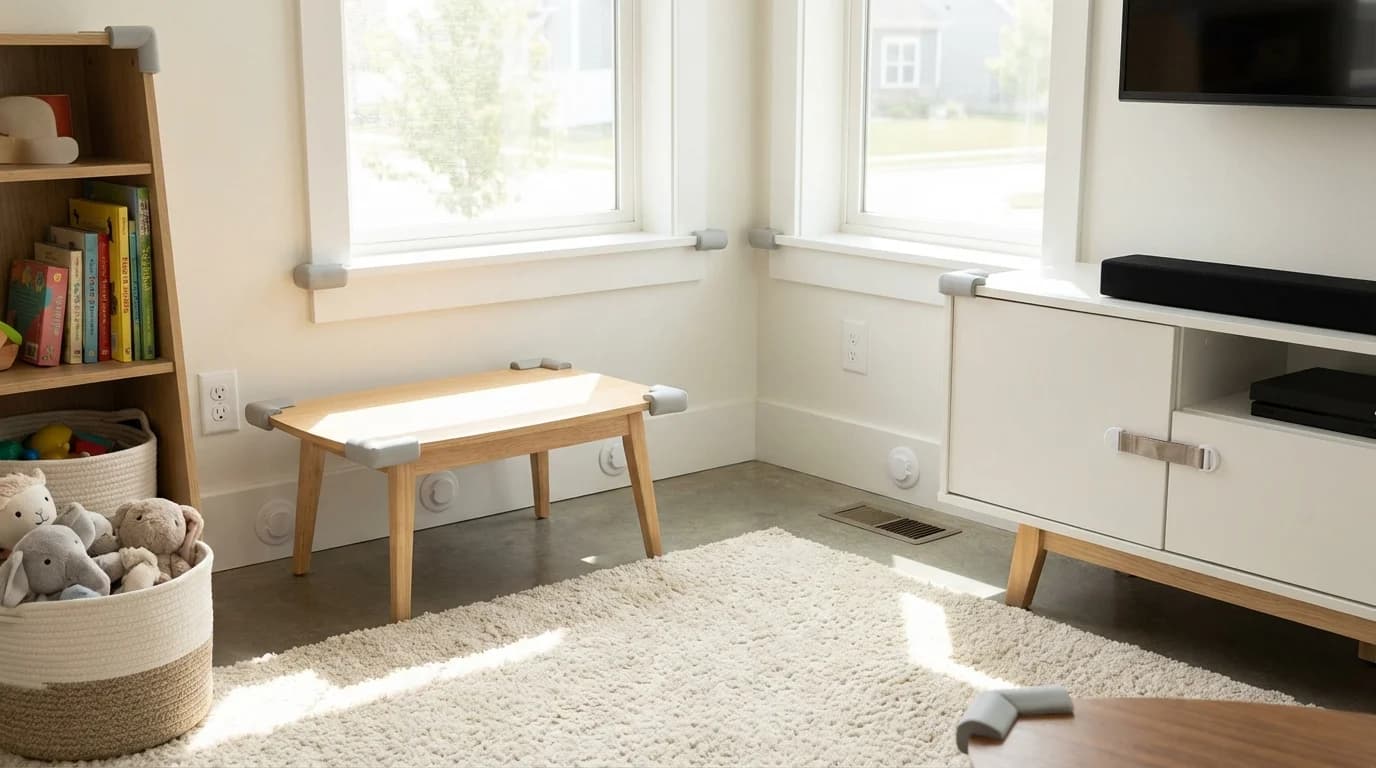
Coffee tables and fireplace hearths are notorious head-bump zones. Safety 1st Foam Corner Protectors → and edge bumpers cushion hard surfaces. They're inexpensive and can be removed without damage when no longer needed.
Electrical outlets
Cover all accessible outlets with outlet covers or, better yet, install sliding plate covers that automatically close when not in use. Standard plug-in covers can be a choking hazard if a toddler manages to pull one out.
The CPSC estimates that approximately 2,400 children under age 10 are treated in emergency rooms annually for injuries related to electrical outlets, with the majority involving children inserting metal objects into unprotected outlets. The National Electrical Code (NEC) requires tamper-resistant receptacles in all new residential construction, but homes built before 2008 typically lack this feature. The CPSC recommends outlet covers or plates as an interim safety measure.
Cords and cables
- Bundle and secure TV cords, lamp cords and charging cables out of reach
- Use cord covers that attach to the wall or baseboard
- Replace corded blinds with cordless versions — window blind cords are a strangulation hazard
Small objects
Get on the floor at baby's level and scan for anything smaller than a toilet paper tube:
- Coins
- Batteries
- Pen caps
- Small toys from older siblings
- Pet kibble
Worst case: Button batteries are especially dangerous and can cause serious internal injuries if swallowed.
Kitchen
Cabinet and drawer locks
The kitchen is full of dangers: sharp knives, heavy pots, cleaning chemicals. Install Safety 1st Secure-to-Explore Adhesive Cabinet Locks → on every low cabinet and drawer. Magnetic locks are another excellent option — they're invisible from outside and more difficult for clever toddlers to defeat.
According to the American Association of Poison Control Centers, over 44,000 children under age 6 were exposed to potentially harmful household chemicals in 2022. The most common products involved were cleaning substances, personal care products, and medications. The AAP and Poison Control both recommend cabinet locks on all storage areas containing chemicals, medications, and small objects accessible to children.
Stove safety
- A stove knob cover set prevents your toddler from turning on burners
- A stove guard blocks access to hot pots and pans on the stovetop
- Cook on back burners when possible and turn pot handles inward
Dishwasher
Keep the dishwasher locked when not actively loading or unloading. The inside contains sharp utensils, detergent residue, and small parts. A simple dishwasher lock or the built-in child lock feature (check your model) handles this.
Trash and recycling
Use a trash can with a locking lid or keep it behind a locked cabinet door. Babies are inexplicably drawn to garbage, which can contain sharp edges, choking hazards, and spoiled food.
Refrigerator
A fridge lock prevents toddlers from opening the refrigerator and accessing glass containers, choking-size foods, or making a spectacular mess. This becomes more important once your child can walk and reach handles.
Bathroom
Toilet lock
Toddlers are fascinated by toilets, and a curious leaning-in can result in a drowning risk. A toilet lock keeps the lid securely closed. Install one on every toilet in the house, not just the one nearest the nursery.
Medicine and cleaning supplies
Move all medications, vitamins, cleaning products, and personal care items to high cabinets or locked storage. Child-resistant caps slow toddlers down but don't stop them. True out-of-reach storage is the only reliable protection.
Bath safety
- A faucet cover protects baby's head from the hard spout
- A non-slip bath mat prevents slipping
- Set your hot water heater to 120 degrees Fahrenheit maximum to prevent scalding
No exceptions: Never leave a baby or toddler unattended in the bath, even for a moment — not to grab a towel, not to answer the phone, not for any reason.
Door lock
A bathroom door lever lock or high-mounted hook-and-eye latchISOFIXA standardized anchor system for installing car seats without the vehicle seatbelt. ISOFIX is the international name; in the US it's called LATCH (Lower Anchors and Tethers for Children). keeps toddlers out when unsupervised. The bathroom contains too many hazards to rely on supervision alone.
Nursery
Crib safety
The crib should contain only a firm mattress with a fitted sheet.
- No pillows, blankets, bumpers or stuffed animals until at least 12 months, and many experts recommend longer
- Crib slats no more than 2-3/8 inches apart
Furniture anchoring
Dressers and changing tables must be anchored to the wall. Even if they seem heavy enough not to tip, a climbing toddler can create enough leverage to bring them down.
Window safety
Install window guards or stops that prevent windows from opening more than four inches. Move the crib away from windows to prevent climbing access to window coverings and falls.
Monitor placement
Keep baby monitor cords at least three feet from the crib. Cord strangulation is a real risk. Wall-mounted monitors like the Nanit eliminate this hazard entirely.
Stairs and Hallways
Baby gates
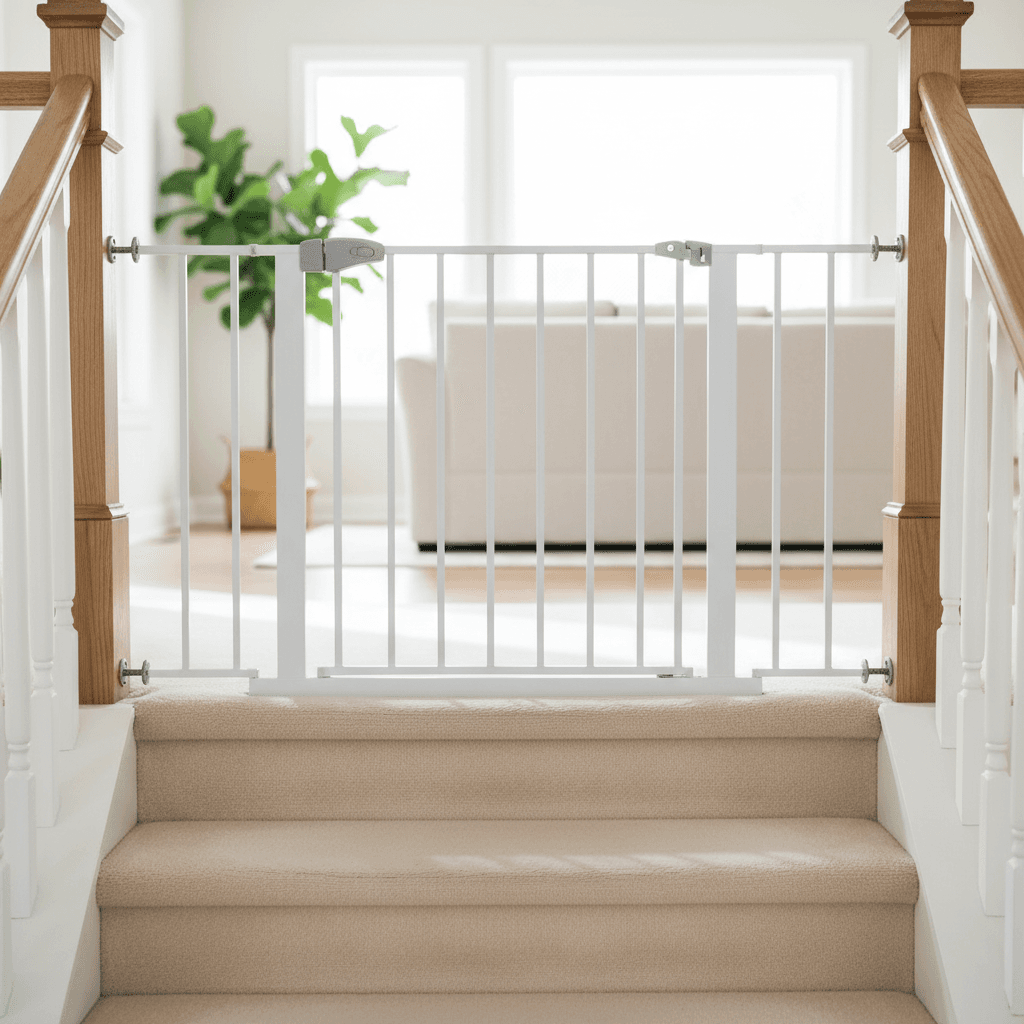
Gates at the top and bottom of stairs are essential once baby is mobile. Our best baby gates for stairs guide covers hardware-mounted vs. pressure-mounted options in detail. The critical rule: only hardware-mounted gates at the top of stairs. Pressure-mounted gates can be pushed out by a determined toddler.
ASTM F1004-22 is the safety standard for expansion gates and expandable enclosures. The CPSC strongly recommends hardware-mounted gates at the top of stairs and notes that pressure-mounted gates should only be used in low-risk locations such as doorways between rooms. All gates should bear the JPMA certification seal indicating compliance with ASTM F1004.
Hallway hazards
- Secure loose rugs with non-slip pads
- Remove hallway furniture that could tip
- Add a night light — it helps you navigate during nighttime trips and prevents tripping while carrying baby
Garage and Outdoor Areas
Garage
- Keep the garage door to the house locked
- Store chemicals, tools, paints and automotive supplies in locked cabinets or high shelves
- Test auto-reverse sensors on garage doors monthly
Outdoor spaces
- Check fencing for gaps and lock gates
- Store gardening chemicals and tools out of reach
- Cover or fence pools and hot tubs — drowning is the leading cause of injury death for children ages 1-4
- If you have a pool, install a four-sided fence with a self-closing, self-latching gate
What is the crawl test for baby proofing?
After baby proofing each room, get on your hands and knees and crawl through it. You'll immediately spot hazards you missed from standing height:
- A loose outlet cover behind the couch
- A button battery under the bookshelf
- A cord dangling from a side table Do this test in every room, and repeat it every few months as your baby's reach and mobility increase.
What are the most important baby-proofing steps?
Baby proofing doesn't need to happen all at once, but the most critical steps — furniture anchoring, outlet covers, cabinet locks, and stair gates — should be completed before your baby is mobile. Start with the rooms where you spend the most time and work outward.
The total cost for comprehensive baby proofing is typically $100-200 for a standard home, which is a modest investment for significant peace of mind. You'll spend more replacing the things your toddler manages to reach than you will on the safety devices that prevent it.
Remember that baby proofing reduces risk but doesn't eliminate it. Active supervision remains your most important safety tool. Baby proofing buys you reaction time — those extra seconds between your toddler reaching for something and you getting there to redirect them. Add these items to your newborn essentials checklist so you're ready before mobility begins.
Further Reading
Hilly Shore Inc.
Editorial teamIndependent product research team behind Cribworthy. Reviews are grounded in published AAP / CDC / NHTSA / CPSC pediatric guidance, JPMA / GREENGUARD GOLD / OEKO-TEX certification verification, and aggregated buyer sentiment.
115 products reviewed · 20 categories covered · cites AAP, CDC, NHTSA, CPSC, FDA, ACOG.
Safety claims are verified against published pediatric guidelines and CPSC databases. See our editorial standards.