Tummy Time Tips for Newborns: How to Make It Fun and Effective
Quick Answer
Start the first day home and build gradually: a few minutes several times daily at first, 15 to 30 minutes of total daily time by seven weeks, and about an hour a day by three months. Chest-to-chest on a reclined adult counts, and it is the position most newborns accept. Always awake, always supervised, and never on a soft or angled surface.
Our Verdict
Frequency beats duration — six sixty-second sessions after diaper changes get you further than one long stretch ending in screaming. If your baby hates the floor, use your chest, your lap, or a forearm carry before buying any prop. Persistent head-turning to one side, or a flattening spot developing, is a pediatrician conversation rather than a gear problem.
Key Takeaways
- ✓Frequency beats duration — six sixty-second sessions after diaper changes get you further than one long stretch ending in screaming. If your baby hates the floor, use your chest, your lap, or a forearm carry before buying any prop. Persistent head-turning to one side, or a flattening spot developing, is a pediatrician conversation rather than a gear problem.
- ✓You can start tummy time on the very first day home from the hospital, and the AAP recommends that you do.
- ✓*Note: As an Amazon affiliate, we may earn from qualifying purchases. All recommendations are based on independent research and real parent feedback.*

As an Amazon Associate I earn from qualifying purchases. Product prices and availability are subject to change.
Tummy Time Tips for Newborns: How to Make It Fun and Effective
You can start tummy time on the very first day home from the hospital, and the AAP recommends that you do. Tummy time is one of the most important activities for your newborn's physical development — it builds the neck, shoulder, and core strength your baby needs for every major motor milestone from rolling to crawling to walking. The catch is that most newborns hate it at first, which is why knowing the right techniques and positions makes all the difference.
According to the AAP, supervised tummy time should begin in the newborn period and increase to at least 15-30 minutes of total daily tummy time by 7 weeks of age, building to at least 60 minutes by 3 months. The National Institutes of Health's "Back to Sleep, Tummy to Play" campaign emphasizes that while babies should always sleep on their backs, they need plenty of supervised prone time while awake to develop properly.
Why does tummy time matter so much?
Tummy time is not just exercise — it is the foundation for your baby's entire motor development trajectory. Here is what it builds:
- Neck and shoulder strength — the muscles that let them hold their head steady, roll over and sit up
- Core stability — the same trunk muscles needed for sitting, crawling and walking
- Prevention of positional plagiocephaly — relieves pressure on the back of the skull so it can develop a more rounded shape
- Visual and sensory development — a new perspective, horizontal tracking, and vestibular engagement
Neck and shoulder strength. When your baby lifts their head during tummy time, they are strengthening the muscles that will eventually let them hold their head steady, roll over, and sit up. These muscles develop sequentially, and tummy time is the trigger.
Core stability. The trunk muscles your baby engages while on their tummy are the same muscles needed for sitting, crawling, and eventually walking. Babies who get consistent tummy time tend to hit these milestones within typical timeframes.
Prevention of positional plagiocephaly (flat head syndrome). Since babies sleep on their backs (as they should for safety), they spend a lot of time with pressure on the back of their skull. Tummy time relieves that pressure and allows the skull to develop a more rounded shape. The AAP notes that the incidence of flat head syndrome increased after the "Back to Sleep" campaign launched in 1994, making supervised tummy time even more important.
Visual and sensory development. Being in a different position gives your baby a new perspective on the world, literally. They see things from a different angle, learn to track objects horizontally, and engage their vestibular system (balance and spatial awareness) in ways that lying on their back does not.
How much tummy time does your baby need by age?
| Age | Daily target | What to expect |
|---|---|---|
| Newborn to 2 weeks | 2-3 minutes, 2-3 times per day | Little head lifting — just being on their tummy is beneficial |
| 2 to 4 weeks | 3-5 minutes, 3-4 times per day | Brief head lifts, turning to one side |
| 1 to 2 months | 10-15 total minutes per day | Head lifting to a 45-degree angle |
| 2 to 3 months | 20-30 total minutes daily | Head to 90 degrees, pushing up on forearms |
| 3 to 4 months | 40-60 total minutes daily | Reaching for toys, pushing up on extended arms, pivoting or rolling |
| 4 to 6 months | 60+ minutes daily | Many are rolling, which means they are choosing tummy time on their own |
Three things that help along the way:
- In the newborn weeks, place them on your chest while you recline — it counts as tummy time and adds the comfort of skin-to-skin contact
- Around 1 to 2 months, a small rolled towel under the chest gives the support that makes head-lifting easier
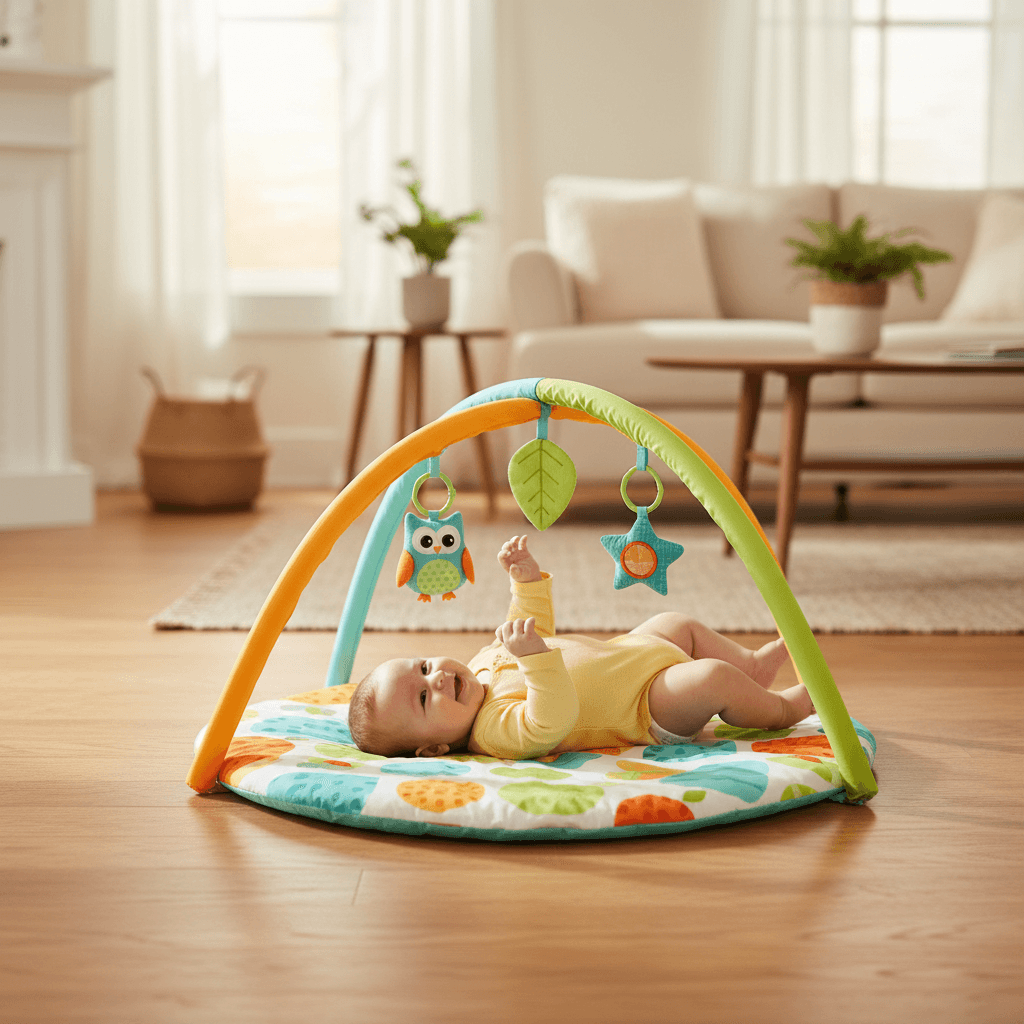
- From 3 to 4 months, a good play mat makes long sessions more engaging
Celebrate the tiny victories — they are building critical strength.
What positions work for babies who hate tummy time?
If your baby screams the moment you put them on the floor, you are not alone. Five positions build the same muscles with less protest:
- Chest-to-chest — the gentlest introduction, and the best starting position for newborns
- The football hold — face-down along your forearm, soothing for many fussy babies
- Lap tummy time — a slight incline that feels less overwhelming than the flat floor
- Rolled towel support — elevates the upper body so lifting the head is easier
- Exercise ball — the motion is soothing and the incline changes keep it engaging
Chest-to-chest (tummy to tummy). Recline on the couch or bed and place your baby face-down on your chest. This is the gentlest introduction to tummy time because your baby gets your warmth, heartbeat, and face as motivation to lift their head. This is the best starting position for newborns who are not yet ready for floor time.
The football hold. Carry your baby face-down along your forearm, with their head near your elbow and their legs straddling your hand. This position strengthens the same muscles as floor tummy time while keeping your baby in motion and close to you. Many fussy babies find this soothing.
Lap tummy time. Lay your baby across your lap on their tummy while you sit. You can gently rub their back and talk to them while they practice lifting their head. This gives them a slight incline, which can feel less overwhelming than the flat floor.
Rolled towel support. Place a small rolled towel or receiving blanket under your baby's chest during floor tummy time, tucked under their armpits. This elevates their upper body slightly, making it easier to lift their head and reducing the feeling of being face-planted into the mat.
Exercise ball. Lay your baby tummy-down on a partially deflated exercise ball and gently roll it forward and back. The motion is soothing, and the slight incline changes make it more engaging. Always keep both hands on your baby.
What should you watch for during tummy time?
Completely normal, especially in the early weeks:
- Fussing and grunting
- Turning the head to one side
- Brief head lifts followed by face-planting
- Arms flailing
Talk to your pediatrician if your baby:
- Consistently turns their head to only one side, which could indicate torticollis
- Shows no improvement in head lifting after several weeks of regular practice
- Seems to have unusual muscle tone — extremely floppy or extremely stiff
- Is not tolerating any tummy time position by 2 months
Worth raising early: Early identification of issues like torticollis means early intervention, which is very effective.
Do not hesitate to bring up concerns — your pediatrician would rather address a non-issue than miss something that benefits from early treatment.
For more activities and gear that support your newborn's development in those early weeks, see our newborn essentials checklist and our guide to surviving the first two weeks with a newborn.
Further Reading
Note: As an Amazon affiliate, we may earn from qualifying purchases. All recommendations are based on independent research and real parent feedback.
The best baby gear advice I got: ask parents of 2+ kids what they'd buy again. First-time parents buy everything. Second-timers know what actually matters.
Paraphrased community consensus — not a direct quote.
Hilly Shore Inc.
Editorial teamIndependent product research team behind Cribworthy. Reviews are grounded in published AAP / CDC / NHTSA / CPSC pediatric guidance, JPMA / GREENGUARD GOLD / OEKO-TEX certification verification, and aggregated buyer sentiment.
115 products reviewed · 20 categories covered · cites AAP, CDC, NHTSA, CPSC, FDA, ACOG.
Safety claims are verified against published pediatric guidelines and CPSC databases. See our editorial standards.