When Do Babies Start Crawling? The Range, Style by Style
Quick Answer
Most babies crawl on hands and knees between 7 and 10 months, the window the AAP gives. The WHO's healthy range is wider, about 5 to 13.5 months, and roughly 4% of healthy babies in its study never crawled on hands and knees. Belly crawling and bottom scooting count. What matters is moving both sides of the body evenly and sitting alone by 9 months.
Swipe to compare every product.
| Comparison field | #1  Cardinal Gates Stairway Special SS30 Owner rating | #2  Regalo Easy Step Walk-Thru Gate Owner rating |
|---|---|---|
| Verdict | Best for Angled Openings and Banisters | Best Budget Gate for Doorways and the Bottom of the Stairs |
| Price | ~$99.95Buy on Amazon | ~$44.99Buy on Amazon |
| Mount type | Hardware-mounted | Pressure-mounted (wall-mount hardware included) |
| Width range | 27 to 42.5 inches | 29 to 32 inches; 35.5 to 38.5 with extension |
| Height | 29.5 inches | 30 inches |
| Top of stairs | Yes (with one-way stop bracket) | No (Regalo warning) |
| Material | Aluminum | — |
| Buyer sentiment | — | Installation Quality Functionality Value for money Buyers praise installation, quality, functionality and value for money. Mixed feedback on sturdiness and ease of use. Based on 48,484 user mentions |
| Pros |
|
|
| Cons |
|
|
* Prices are approximate. Check the linked retailer for current pricing and availability.

As an Amazon Associate I earn from qualifying purchases. Product prices and availability are subject to change.
Most babies crawl on hands and knees somewhere between 7 and 10 months, the window the AAP gives for crawling. The full healthy range is much wider. The WHO Motor Development Study followed 816 children in five countries and put hands-and-knees crawling anywhere from 5.2 to 13.5 months, and 4.3% of those healthy children never crawled on hands and knees at all.
So "late" starts later than most parents fear. The more useful question is not when your baby crawls, but how they move.
Crawling comes in more than one shape
The AAP describes several ways babies get across the floor. Any of them can be the first, and some babies use two or three before settling on one.
| Style | What it looks like | What the AAP says about it |
|---|---|---|
| Rocking in place | Up on hands and knees, rocking back and forth, going nowhere | A common step before moving forward |
| Backward first | Pushes off and slides backward, often frustrated | Arms are stronger than legs early on, so reverse comes first for some |
| Belly (commando) crawl | Belly on the floor, pulling with the arms and pushing with the legs | On its list of typical 8 to 12 month movement skills |
| Hands-and-knees crawl | Trunk lifted, arms and legs alternating | Usually mastered between 7 and 10 months |
| Bottom scoot | Sits upright and shuffles forward on the bottom | A normal alternative for babies who never crawl |
The test that covers every style: the AAP says there is no cause for concern as long as your baby coordinates each side of the body and uses each arm and leg equally. Style matters far less than symmetry.
Where crawling sits among the big motor milestones
The WHO study measured six milestones and reported each as a window from the 1st to the 99th percentile, meaning 98% of healthy children fell inside it. Its authors describe these as normal variation, not targets.
| Milestone | Earliest (1st percentile) | Latest (99th percentile) |
|---|---|---|
| Sitting without support | 3.8 months | 9.2 months |
| Standing with assistance | 4.8 months | 11.4 months |
| Hands-and-knees crawling | 5.2 months | 13.5 months |
| Walking with assistance | 5.9 months | 13.7 months |
| Standing alone | 6.9 months | 16.9 months |
| Walking alone | 8.2 months | 17.6 months |
Two things stand out. The windows overlap heavily: about 90% of children reached five of the milestones in a common sequence, so the order is a tendency, not a rule. And sitting has the narrowest window of the six, and it is the 9-month skill both the CDC checklist and the AAP name.
Why crawling vanished from the CDC checklist
In 2022 the CDC and AAP rewrote the CDC milestone checklists. The published revision kept only milestones that at least 75% of children reach by each checkup age. Its motor list in the first year reads:
- 6 months: rolls from tummy to back, pushes up on straight arms, leans on hands while sitting
- 9 months: gets to a sitting position alone, sits without support
- 12 months: pulls up to stand
Crawling does not appear at any age. The paper doesn't single crawling out, but the WHO data fits: a skill some healthy babies skip can't work as a pass-or-fail line. The CDC 9-month page still suggests placing toys a little out of reach to encourage your baby to crawl, scoot or roll.
Is my baby late? When to call the pediatrician
The AAP's 8 to 12 month list of possible delay signs includes not crawling. Read that alongside its note that a few healthy children never crawl: the pediatrician's job is to tell the two apart. Raise it if you see any of these:
- Drags one side of the body while crawling for more than a month
- Not sitting without support by 9 months
- Cannot stand when supported, toward the end of the first year
- Not crawling, scooting or otherwise getting around by the first birthday
- Moves in a way that simply looks off to you; the AAP asks parents to raise that feeling too
Born early? Use corrected age for the first 2 years, the AAP says. A baby born at 32 weeks is 8 weeks early, so at 10 months old they are working on the skills of an 8-month-old.
Helping it along, without a walker
Crawling can't be taught, but floor time builds the strength for it.
- Start with tummy time. The AAP recommends daily awake tummy time with an adult watching, for motor development. Our tummy time guide covers making it bearable.
- Put a favorite toy just out of reach. Both the AAP and CDC suggest it.
- Build a cushion obstacle course once your baby is mobile, and stay right there. The AAP warns that a baby who falls between pillows may not get out.
- Skip the wheeled walker. The AAP says walkers don't teach walking and cause tip-overs and stair falls. A stationary activity center with no wheels is the alternative it names.
Get the floor ready before the first scoot
The AAP's safety list for newly mobile babies is short and specific:
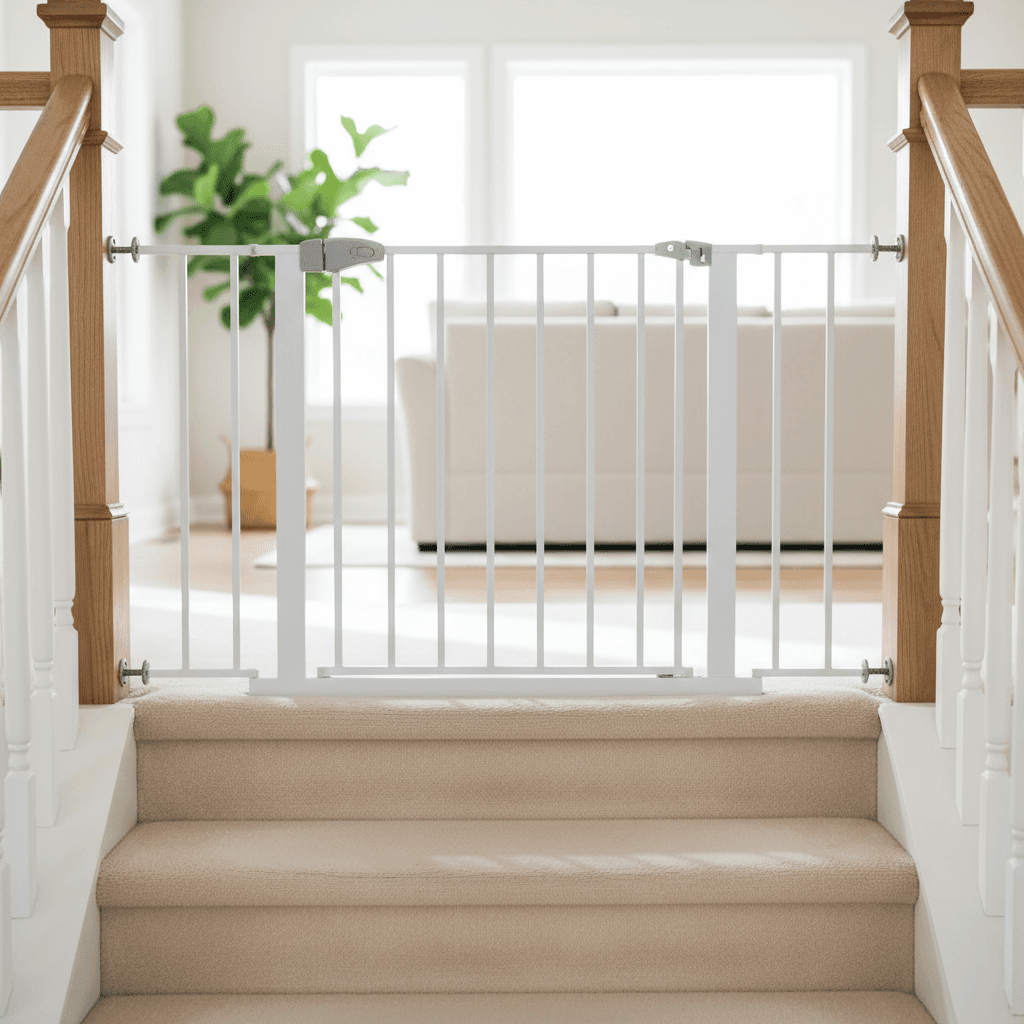
- Gates at the top and bottom of every staircase, kept closed even after your baby learns to come down backward
- Coins, balloon pieces and button batteries off the floor and out from under the couch
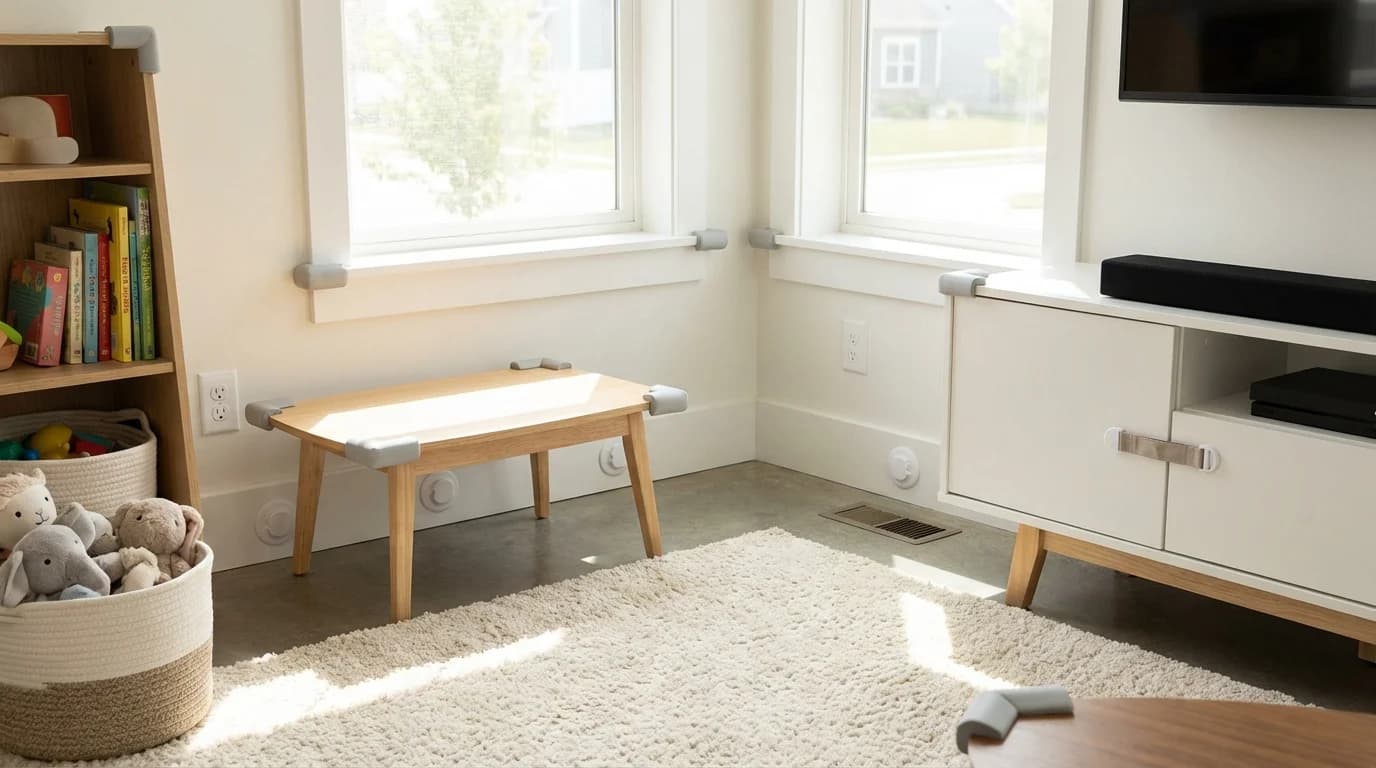
- Furniture your baby will cruise along weighted or attached, with no sharp edges
- Diaper changes moved off the changing table if your baby flips mid-change
Top and bottom need different gates: Nationwide Children's Hospital says to use only hardware-mounted gates at the top of stairs, because even a baby who cannot walk may push a pressure gate down. One option is the Cardinal Gates Stairway Special SS30 → with its one-way stop bracket. A pressure gate like the Regalo Easy Step Walk-Thru Gate is for doorways and the bottom step only; Regalo warns against using it at the top.
For the full stair breakdown see our baby gate guide, and for every room, the baby proofing checklist. For anchoring dressers, the Quakehold Furniture Strap Kit screws into a stud.
Quick answers
Can a baby skip crawling entirely?
Yes. In the WHO study 4.3% of healthy children never crawled on hands and knees, and the AAP says some babies scoot or slither instead and go on to walk normally.
Why does my baby crawl backward?
Early on the arms are stronger than the legs, so pushing off sends a baby backward. The AAP says forward movement usually follows with practice.
How long after crawling do babies walk?
There is no fixed gap. The WHO window for walking alone runs from 8.2 to 17.6 months, and many babies keep crawling for speed even after they walk.
Our Verdict
Treat 7 to 10 months as the usual window, not a deadline. A baby who belly crawls, scoots or skips crawling but uses both sides evenly and sits alone by 9 months is on track. Lopsided movement, no sitting by 9 months, or not getting around by the first birthday is a reason to call the pediatrician, and gates go up before the first scoot.
What you are seeing at home
| If your situation is… | Pick | Why |
|---|---|---|
| 8 months, sits well, rocks on hands and knees without going anywhere | Keep up floor time | The AAP describes rocking on hands and knees as a normal step before crawling forward. |
| 10 months and only belly crawling | Normal style, no action needed | The AAP lists crawling forward on the belly among typical 8 to 12 month movement skills. |
| Bottom scooting instead of crawling | Fine if both sides work evenly | The AAP says a few children never crawl and scoot or slither instead, which is no cause for concern when each arm and leg is used equally. |
| Drags one side of the body for more than a month | Call your pediatrician | The AAP lists this among signs of possible developmental delay at 8 to 12 months. |
| Not sitting alone by 9 months | Tell your pediatrician | Sitting without support is on the CDC 9-month checklist, and the AAP asks parents to flag it. |
| Born before 37 weeks | Use corrected age | The AAP advises judging milestones by corrected age for the first 2 years. |
Each pick is one of the products ranked below — this row is for shortcutting based on your situation, not a separate recommendation.
Key Takeaways
- ✓The AAP describes several ways babies get across the floor. Any of them can be the first, and some babies use two or three before settling on one.
- ✓The WHO study measured six milestones and reported each as a window from the 1st to the 99th percentile, meaning 98% of healthy children fell inside it. Its authors describe these as normal variation, not targets.
- ✓Crawling does not appear at any age. The paper doesn't single crawling out, but the WHO data fits: a skill some healthy babies skip can't work as a pass-or-fail line.
- ✓Crawling can't be taught, but floor time builds the strength for it.
- ✓Top and bottom need different gates: Nationwide Children's Hospital says to use only hardware-mounted gates at the top of stairs, because even a baby who cannot walk may push a pressure gate down.
Every baby has to crawl before walking.
In the WHO Motor Development Study, 4.3% of healthy children never crawled on hands and knees, and the AAP notes some babies scoot on their bottoms or slither on their stomachs instead.
The CDC checklist says a baby should crawl by 9 months.
The 2022 CDC and AAP revision lists sitting without support and getting to sitting alone at 9 months, and pulling up to stand at 12 months. Crawling is not on the motor list at any age.
Research Sources
- HealthyChildren.org (AAP) - Movement Milestones in Babies 8 to 12 Months Old
- HealthyChildren.org (AAP) - Developmental Milestones: 12 Months (includes signs of possible delay at 8 to 12 months)
- WHO Multicentre Growth Reference Study Group - WHO Motor Development Study: windows of achievement for six gross motor development milestones (Acta Paediatrica, 2006)
- Zubler et al. - Evidence-Informed Milestones for Developmental Surveillance Tools (Pediatrics, 2022; the CDC and AAP checklist revision)
- CDC Learn the Signs. Act Early. - Important Milestones: Your Baby By Nine Months
- HealthyChildren.org (AAP) - Corrected Age For Preemies
- HealthyChildren.org (AAP) - A Parent's Guide to Safe Sleep (awake, supervised tummy time)
- Nationwide Children's Hospital Center for Injury Research and Policy - Baby Gates (hardware-mounted gates at the top of stairs)
Hilly Shore Inc.
Editorial teamIndependent product research team behind Cribworthy. Reviews are grounded in published AAP / CDC / NHTSA / CPSC pediatric guidance, JPMA / GREENGUARD GOLD / OEKO-TEX certification verification, and aggregated buyer sentiment.
128 products reviewed · 22 categories covered · cites AAP, CDC, NHTSA, CPSC, FDA, ACOG.
Safety claims are verified against published pediatric guidelines and CPSC databases. See our editorial standards.