When to Start Solid Foods: Signs of Readiness and How to Begin
Quick Answer
Around six months, and readiness beats the calendar: steady head control, sitting with support, real interest in your food, and no tongue-thrust reflex pushing the spoon back out. Lead with iron — fortified cereal, pureed meat, lentils — since fetal iron stores run down near six months. Introduce peanut and egg early; delaying them raises allergy risk rather than lowering it.
Our Verdict
Do not read night waking, fist chewing, or a growth spurt as hunger for solids — those are exactly the cues that push families to begin at four months, and starting before the swallow is ready buys nothing. Milk remains the main nutrition source through twelve months; solids are practice. Honey is the one absolute no before the first birthday.
Key Takeaways
- ✓Do not read night waking, fist chewing, or a growth spurt as hunger for solids — those are exactly the cues that push families to begin at four months, and starting before the swallow is ready buys nothing. Milk remains the main nutrition source through twelve months; solids are practice. Honey is the one absolute no before the first birthday.
- ✓Most babies are ready to start solid foods around 6 months of age, when they can sit with support, have good head control, show interest in food, and have lost the tongue-thrust reflex. Start with ...
- ✓Your baby's first experience with solid food will likely be anticlimactic and messy.
- ✓Day 1-2: One to two teaspoons of iron-fortified rice cereal mixed with breast milk or formula, once a day.
💬 Real Talk from Parents
Sterilizing bottles at 2 AM is a rite of passage nobody tells you about.
Your baby will reject the $40 bottle and love the $3 one. Every time.
You'll develop strong opinions about bottle nipple flow rates, and that's okay.
The 'best' bottle is whichever one your baby actually accepts.
Try at least 3 different bottles before deciding your baby 'won't take a bottle.' Each one has a different flow and shape. Babies are picky.
Paraphrased community consensus — not a direct quote.
Breastfed babies don't need to burp.
All babies swallow some air while feeding, regardless of method. Breastfed babies may swallow less air, but they still benefit from gentle burping after feeds.
You should sterilize bottles before every single use.
The CDC recommends sterilizing bottles once when new, then again only if your baby is premature, under 2 months, or immunocompromised. For healthy babies over 3 months, hot soapy water or a dishwasher is sufficient.
As an Amazon Associate I earn from qualifying purchases. Product prices and availability are subject to change.
When to Start Solid Foods: Signs of Readiness and How to Begin
Most babies are ready to start solid foods around 6 months of age, when they can sit with support, have good head control, show interest in food, and have lost the tongue-thrust reflex. Start with iron-rich foods like fortified infant cereal or pureed meats, and introduce common allergens early.
The AAP and WHO both recommend exclusive breastfeeding or formula feeding for approximately the first 6 months of life, with introduction of complementary foods around 6 months. A landmark 2015 study (the LEAP trial) published in the New England Journal of Medicine demonstrated that early introduction of peanut protein between 4-11 months reduced the risk of peanut allergy by 81% in high-risk infants, fundamentally changing AAP guidance on allergen introduction.
At what age should babies start eating solid foods?
The American Academy of Pediatrics and the World Health Organization recommend introducing solid foods around six months of age. Some pediatricians may suggest starting as early as four months for certain babies, but the consensus is that most babies benefit from exclusive breastfeeding or formula feeding until about six months.
The AAP's 2021 clinical report on complementary feeding states that most infants are developmentally ready for solid foods between 4-6 months, with the WHO recommending closer to 6 months for exclusively breastfed infants. A 2019 systematic review in JAMA Pediatrics found no benefit to introducing solids before 4 months and noted increased risk of obesity and allergic disease with very early introduction.
The key word is "about." Readiness is determined by developmental signs, not a specific birthday.
What are the signs my baby is ready for solids?
All four of these signs should be present before you start solids:
- Good head and neck control — able to hold their head up steadily and sit with minimal support
- Loss of the tongue-thrust reflex — usually around four to six months
- Interest in food — watching you eat, reaching for your food, opening their mouth when food approaches
- Able to sit in a high chair — upright, with good posture
1. Good head and neck control
Your baby should be able to hold their head up steadily and sit with minimal support. Eating requires coordinated head and trunk control to swallow safely.
2. Loss of the tongue-thrust reflex
Babies are born with a reflex that pushes food out of their mouth. When this reflex diminishes (usually around four to six months), they can accept food from a spoon without immediately pushing it back out.
3. Interest in food
Watching you eat with fascination, reaching for your food, opening their mouth when food approaches — these are signals that your baby is developmentally curious about eating.
4. Able to sit in a high chair
Your baby should be able to sit upright in a high chair with good posture. A proper high chair with a footrest supports safe positioning.
What signs are commonly mistaken for solid food readiness?
- Waking more at night: Often attributed to hunger, but nighttime waking is more commonly caused by sleep regressionsleep regressionA stretch of worse sleep tied to a developmental leap — common at 4, 8-10, 12, and 18 months. Not a sign you did something wrong. Usually passes in 2-6 weeks. or developmental leaps. More food rarely fixes a sleep problem.
- Being a certain age: Four months old doesn't automatically mean ready. Follow the developmental signs, not the calendar.
- Being big for their age: Size doesn't correlate with digestive or developmental readiness.
What foods should I feed my baby first?
Iron-rich foods
Iron stores from birth begin to deplete around six months. Good first options:
- Iron-fortified infant cereal mixed with breast milk or formula
- Pureed meats — chicken, turkey, beef
- Pureed lentils or beans
- Mashed tofu
The AAP recommends iron-rich foods as among the first complementary foods because infant iron stores from birth begin to deplete around 4-6 months. A 2019 study in The Journal of Pediatrics found that 12% of U.S. infants had iron deficiency by 12 months, with those who started iron-rich foods after 8 months at significantly higher risk. The CDC recommends 11 mg of iron daily for infants 7-12 months.
Single-ingredient vegetables and fruits
Introduce one new food at a time, waiting two to three days before adding another. This makes it easier to identify any reactions.
Great starter vegetables: sweet potato, butternut squash, peas, green beans, avocado.
Great starter fruits: banana, pear, cooked apple, peaches.
Early allergen introduction
Current guidelines recommend introducing common allergens — peanuts, eggs, dairy, wheat, soy, tree nuts, fish, and shellfish — early and regularly, starting around six months. Early introduction actually reduces allergy risk. For peanuts, thin smooth peanut butter with breast milk or formula and offer a small amount.
Never: Whole peanuts or chunky peanut butter to a baby.
The landmark LEAP trial (Learning Early About Peanut Allergy), published in the New England Journal of Medicine in 2015, found that introducing peanut protein between 4-11 months of age reduced the incidence of peanut allergy by 81% among high-risk infants. This finding led the AAP and NIAID to update their guidelines in 2017, now recommending that peanut-containing foods be introduced as early as 4-6 months for high-risk infants, after evaluation by a pediatrician.
Should I do purees or baby-led weaning?
A 2021 randomized controlled trial published in JAMA Pediatrics (the BLISS study follow-up) found no significant difference in choking risk between baby-led weaningBLWBaby-led weaning: skipping purees and offering finger-sized pieces of soft food from ~6 months so baby self-feeds. Reduces picky eating risk; does not increase choking when done right. and traditional spoon-feeding when parents were given appropriate safety guidance. The AAP does not endorse one approach over the other but emphasizes that regardless of method, foods should be age-appropriate in texture and size to reduce choking risk.
Traditional purees
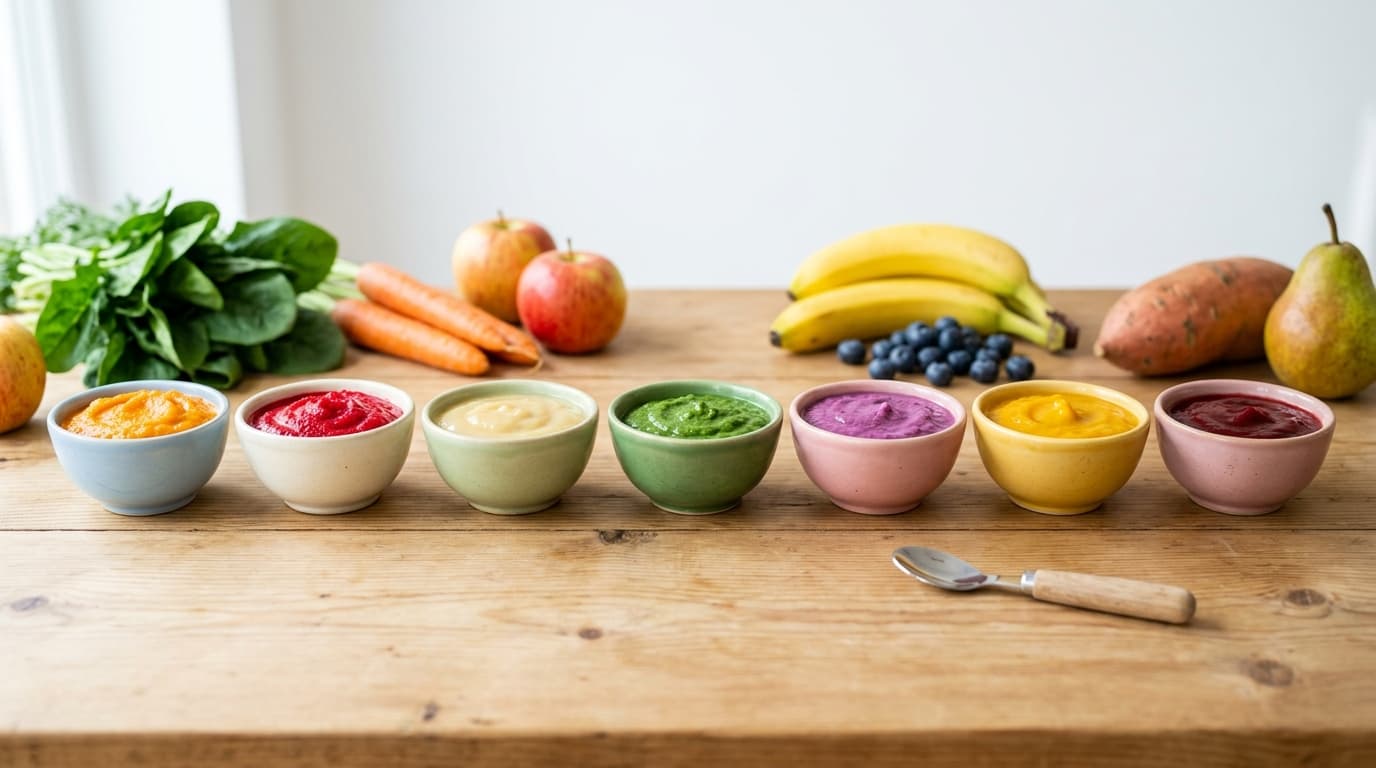
Start with thin, smooth purees and gradually increase thickness and texture. Use a baby food maker to prepare fresh purees at home, or choose high-quality commercial options.
Baby-led weaning (BLW)
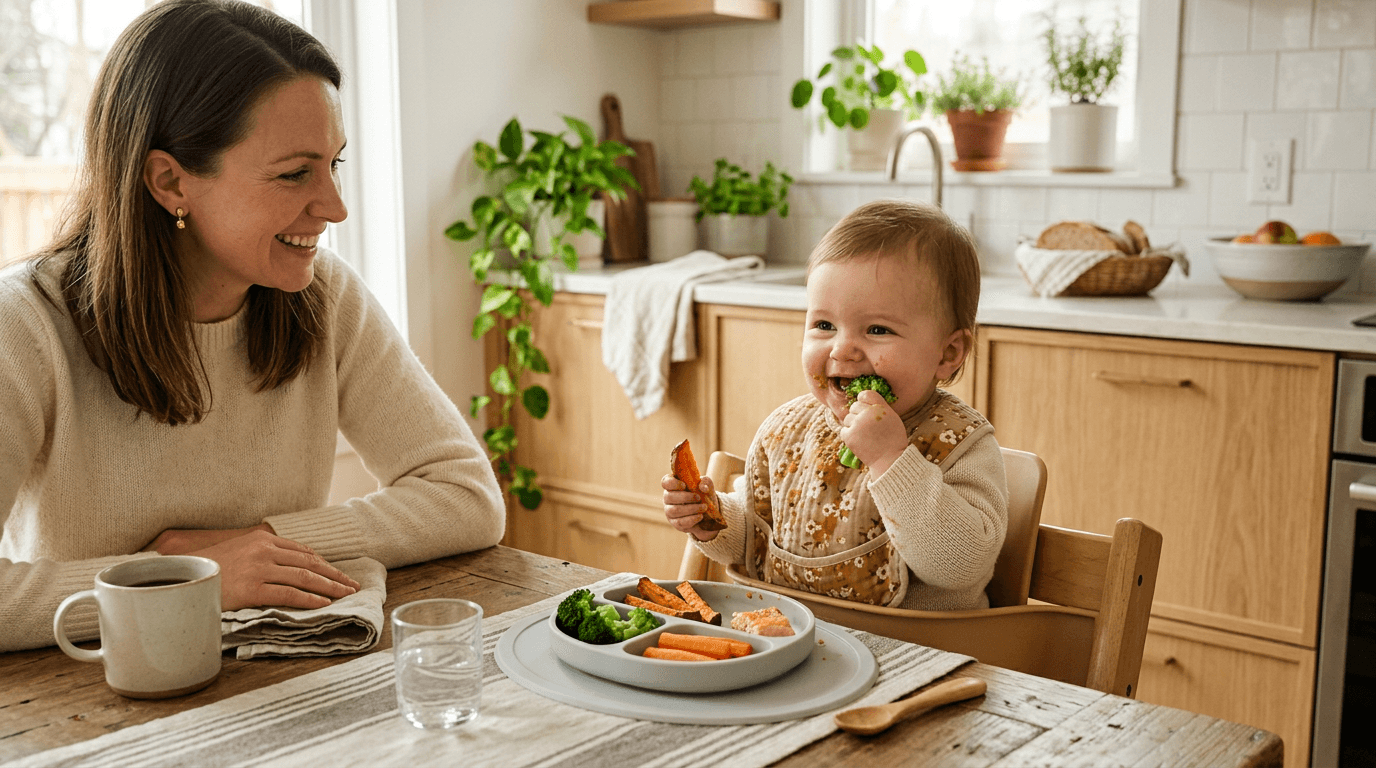
Baby-led weaning skips purees entirely, offering soft, appropriately-sized finger foods from the start. Baby feeds themselves, developing fine motor skills and self-regulation. For a detailed guide, read our baby-led weaning guide.
The combination approach
Many families use both methods — offering purees at some meals and soft finger foods at others. There's no rule that says you have to choose one approach exclusively.
First Feeding: What to Expect
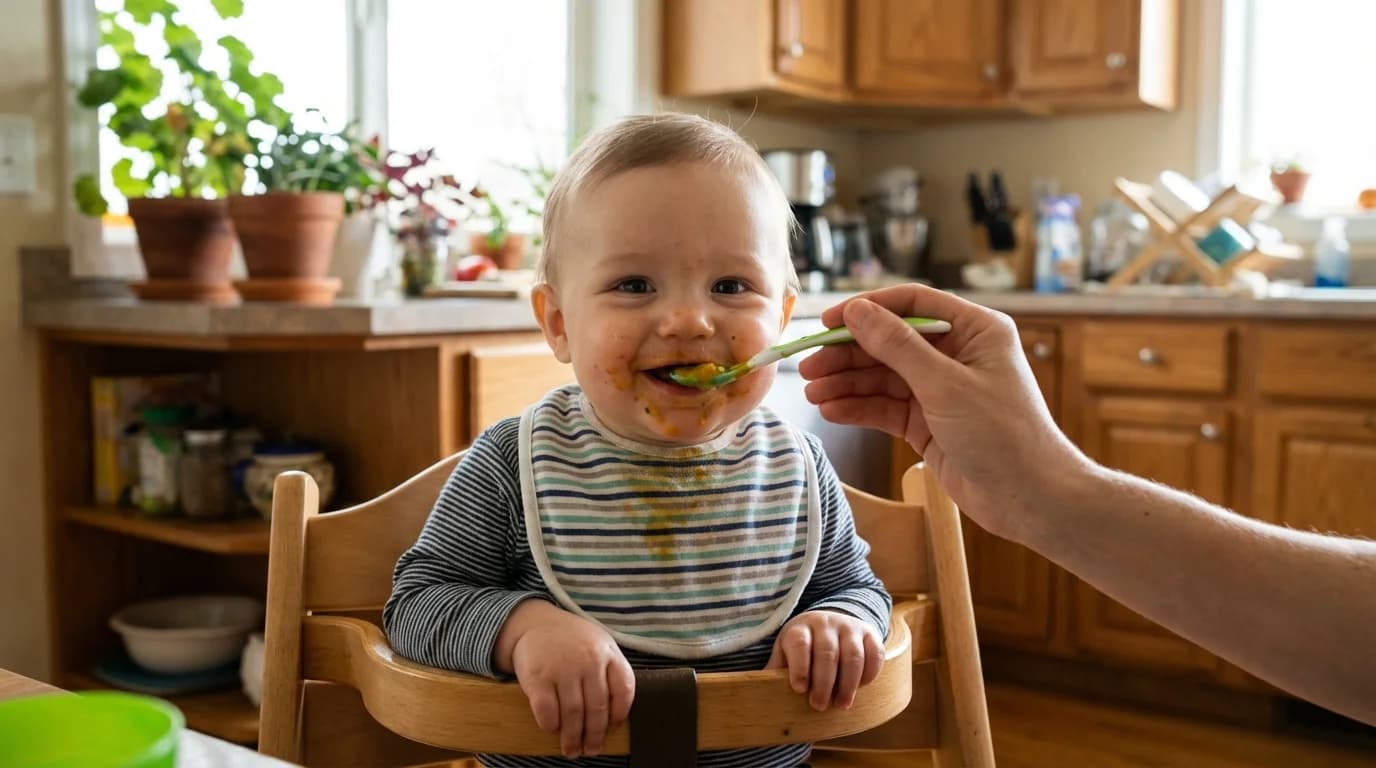
Your baby's first experience with solid food will likely be anticlimactic and messy.
- Setup: Place baby in their high chair when they're alert and not too hungry. Mid-morning, about an hour after a milk feed, works well.
- Amount: Start with one to two teaspoons. This is about exploration, not nutrition.
- Reaction: Baby might lean forward eagerly, turn away, make faces, gag (a normal protective reflex different from choking), push food out, or seem uninterested. All normal.
- Frequency: Start with one meal a day and gradually increase to two and then three meals over the next two to three months.
What are common mistakes when starting baby on solids?
- Starting too early — before all four readiness signs are present
- Forcing it — pressuring a baby to eat creates negative food associations that can persist
- Not offering variety — it can take 10-15 exposures before a baby accepts a new food
- Confusing gagging with choking — learn the difference before you start
- Offering honey before 12 months — botulism spores an immature digestive system cannot handle
- Delaying allergens — this does not reduce allergy risk and may increase it
Starting too early
Introducing solids before baby shows all four readiness signs can increase the risk of choking and digestive issues.
Forcing it
If baby turns away or cries, stop. Pressuring a baby to eat creates negative food associations that can persist.
Not offering variety
Continue introducing new flavors, textures, and food groups. It can take 10-15 exposures to a new food before a baby accepts it.
Confusing gagging with choking
Know the difference: Gagging is a normal safety reflex — baby's face may redden and they may cough or retch. Choking is silent: baby cannot cough, cry, or breathe.
Take an infant CPR class before starting solids.
The AAP distinguishes between gagging — a normal protective reflex that pushes food forward in the mouth — and choking, which is a silent blockage of the airway. A 2018 study in Pediatrics found that gagging occurred in 35% of all early feeding sessions regardless of method (purees or BLW) and decreased significantly by 8 months as babies learned to manage food textures. The AAP recommends that all parents of infants starting solids complete an infant CPR course.
Offering honey before 12 months
No honey in any form until at least one year old. Honey can contain botulism spores that a baby's immature digestive system cannot handle.
Delaying allergens
Current research strongly supports early introduction around six months. Delaying allergens does not reduce allergy risk and may actually increase it.
What gear do I need for starting solid foods?
- High chair with footrest: Proper positioning supports safe swallowing. See our high chair guide.
- Soft-tipped spoons: The NumNum Pre-Spoon GOOtensils → are designed for self-feeding from the start.
- Suction bowls: The ezpz Tiny Bowl sticks to the high chair tray, reducing spills.
- Bibs with pockets: The BabyBjörn Soft Bib catches food that misses the mouth.
- Open cup: Introduce a small open cup with sips of water at mealtimes to build cup-drinking skills early.
A Sample First Week
- Day 1-2: One to two teaspoons of iron-fortified rice cereal mixed with breast milk or formula, once a day.
- Day 3-4: Two to three teaspoons of sweet potato puree, once a day.
- Day 5-6: Two to three teaspoons of mashed avocado, once a day. Watch for any reactions from previously introduced foods.
- Day 7: Offer a food baby has already tried. Repeat exposure builds familiarity.
Continue this pattern — one new food every two to three days, gradually increasing amounts based on baby's interest.
How should I start my baby on solid foods?
Starting solid foods should be exciting, not stressful. Four things:
- Wait for all four readiness signs
- Start with iron-rich foods
- Introduce allergens early
- Follow your baby's cues Whether you choose purees, baby-led weaning, or a combination, the goal is the same: building a positive, exploratory relationship with food.
The most important thing is to make mealtimes pleasant. Sit with your baby, eat together when possible, offer variety, and don't stress about quantities. In these early months, breast milk or formula still provides the majority of nutrition. Solid food is about learning, exploring, and developing skills that will serve your child for a lifetime.
Further Reading
Research Sources
Hilly Shore Inc.
Editorial teamIndependent product research team behind Cribworthy. Reviews are grounded in published AAP / CDC / NHTSA / CPSC pediatric guidance, JPMA / GREENGUARD GOLD / OEKO-TEX certification verification, and aggregated buyer sentiment.
115 products reviewed · 20 categories covered · cites AAP, CDC, NHTSA, CPSC, FDA, ACOG.
Safety claims are verified against published pediatric guidelines and CPSC databases. See our editorial standards.