Baby Teething Chart: Which Tooth Comes When, and What Helps
Quick Answer
Baby teeth usually arrive in this order: central incisors (lower 6-10 months, upper 8-12), lateral incisors (9-16 months), first molars (13-19), canines (16-23) and second molars (23-33). Most children have all 20 by age 3. Rub sore gums with a clean finger or offer a firm, never-frozen teether. Skip benzocaine or lidocaine gels, homeopathic tablets and amber necklaces, and call your pediatrician for a fever over 100.4°F.
Our Verdict
Treat the ADA chart as a map of where soreness is likely, not a deadline. Match the teether shape to the teeth in progress, stick to the short list of comfort measures the FDA and AAP endorse, and call the pediatrician about a fever or diarrhea instead of blaming a tooth.
Match the comfort to the stage
| If your situation is… | Pick | Why |
|---|---|---|
| Lower front teeth on the way (about 6-10 months) | Brush-head or flat textured teether | The ADA chart puts the lower central incisors first, and front-mounted texture sits right where they erupt. |
| Molars coming in (13-19 months, then 23-33 months) | A teether with slim, finger-length arms | First and second molars sit at the back of the mouth, where flat discs and chunky rings don't reach. |
| Sore gums plus a fever over 100.4°F | Call your pediatrician | The AAP says a true fever is not associated with teething and signals illness or infection. |
| Diarrhea or a rash beyond drool irritation | Call your pediatrician | The ADA lists diarrhea and rash as not normal teething symptoms. |
| Clearly uncomfortable on a rough night | Ask your pediatrician about acetaminophen and the dose | The AAP suggests this for an occasional rough night, dosed by weight, with ibuprofen only after 6 months. |
| Tempted by a numbing gel | Skip it | The FDA says benzocaine and lidocaine teething products offer little to no benefit and carry serious risks. |
Each pick is one of the products ranked below — this row is for shortcutting based on your situation, not a separate recommendation.
#1Comotomo Silicone Baby Teether 4.8 | #2Baby Banana Infant Training Toothbrush 4.8 | #3Itzy Ritzy Silicone Teether 4.8 | |
|---|---|---|---|
| Verdict | Best for molars: finger-length arms built to reach back gums | Best for front teeth: a brush head aimed at the incisors | Flat, open teether for the front eight |
| Price | ~$6.99Buy on Amazon | ~$7.61Buy on Amazon | ~$8.99Buy on Amazon |
| Type | Teethers Teething Remedies | Teethers Teething Remedies | — |
| Buyer sentiment | Quality Grip Chewability Teething suitability Buyers praise quality, grip, chewability and teething suitability. Based on 3,240 user mentions | Grip Teething suitability Teething Chewing Buyers praise grip, teething suitability, teething and chewing. Based on 5,092 user mentions | Appearance Teething performance Grip Durability Buyers praise appearance, teething performance, grip and durability. Based on 150 user mentions |
| Pros |
|
|
|
| Cons |
|
|
|
* Prices are approximate. Check the linked retailer for current pricing and availability.
Key Takeaways
- ✓Treat the ADA chart as a map of where soreness is likely, not a deadline. Match the teether shape to the teeth in progress, stick to the short list of comfort measures the FDA and AAP endorse, and call the pediatrician about a fever or diarrhea instead of blaming a tooth.
- ✓Ranges are in months after birth, from the ADA's primary tooth development chart. Rows run in the usual order of arrival.
- ✓These are reference ranges, not due dates. The AAP says most babies get teeth between 6 and 12 months, and some have none by their first birthday. Its teething guidance adds that timing may run in ...
- ✓A baby working on the front eight can mouth almost anything. Molars are a different job: the sore spot sits deep beside the cheek, where a flat disc or chunky ring can't get.
- ✓The left column comes from the ADA's list of normal teething symptoms and the AAP's teething guidance, which notes drool can irritate the skin around the mouth. On the right, the ADA names fever, d...
A fever means a tooth is coming.
The AAP says a true fever, over 100.4°F (38°C), is not associated with teething and is a sign of an illness or infection that may need treatment.
Amber teething necklaces are a gentle, natural option.
The FDA has received reports of death and serious injuries to infants and children, including strangulation and choking, from teething jewelry such as amber necklaces. The AAP notes no research supports their effectiveness.
The colder the teether, the better, so freeze it.
The FDA says a teething ring should not be frozen, because an object that is too hard can hurt a child's gums.

As an Amazon Associate I earn from qualifying purchases. Product prices and availability are subject to change.
Twenty baby teeth arrive over roughly two and a half years, and they don't come in front to back. The first molars usually beat the canines, so a toddler can have a gap beside the front teeth and a sore back gum at the same time. It is also why a teether that worked at 9 months can stop helping at 15.
Below is the American Dental Association's eruption chart, rebuilt tooth by tooth, with the teether shape that can physically reach each part of the mouth.
The baby teeth chart, tooth by tooth
Ranges are in months after birth, from the ADA's primary tooth development chart. Rows run in the usual order of arrival.
| Teeth | Upper jaw | Lower jaw | Where they sit | Teether shape that reaches them |
|---|---|---|---|---|
| Central incisors | 8-12 mos | 6-10 mos | The front middle pair | Brush-head or flat teether |
| Lateral incisors | 9-13 mos | 10-16 mos | Beside the front pair | Flat teether with a textured face |
| First molars | 13-19 mos | 14-18 mos | Back of the mouth | Slim, finger-length arms |
| Canines | 16-22 mos | 17-23 mos | Between the incisors and first molars | Finger-length arms, or a clean finger along the side |
| Second molars | 25-33 mos | 23-31 mos | Furthest back | Finger-length arms, or a clean finger |
How to read the last column: the month ranges are the ADA's. The shape column is practical guidance about what physically reaches each area, not a medical recommendation. No health authority ranks teether shapes by tooth.
Reading the chart without turning it into a countdown
These are reference ranges, not due dates. The AAP says most babies get teeth between 6 and 12 months, and some have none by their first birthday. Its teething guidance adds that timing may run in families, and a late first tooth doesn't mean anything is wrong.
Two patterns worth knowing:
- Lower central incisors usually lead. The AAP calls them almost always the first teeth in.
- The windows overlap. Upper laterals, lower laterals and upper first molars can all be in range in the same month, so a fussy week rarely maps to one tooth.
Most children have all 20 baby teeth by about age 3, according to both the AAP and ADA.
Front teeth vs. molars: one teether rarely reaches both
A baby working on the front eight can mouth almost anything. Molars are a different job: the sore spot sits deep beside the cheek, where a flat disc or chunky ring can't get.
6-16 months: the front eight
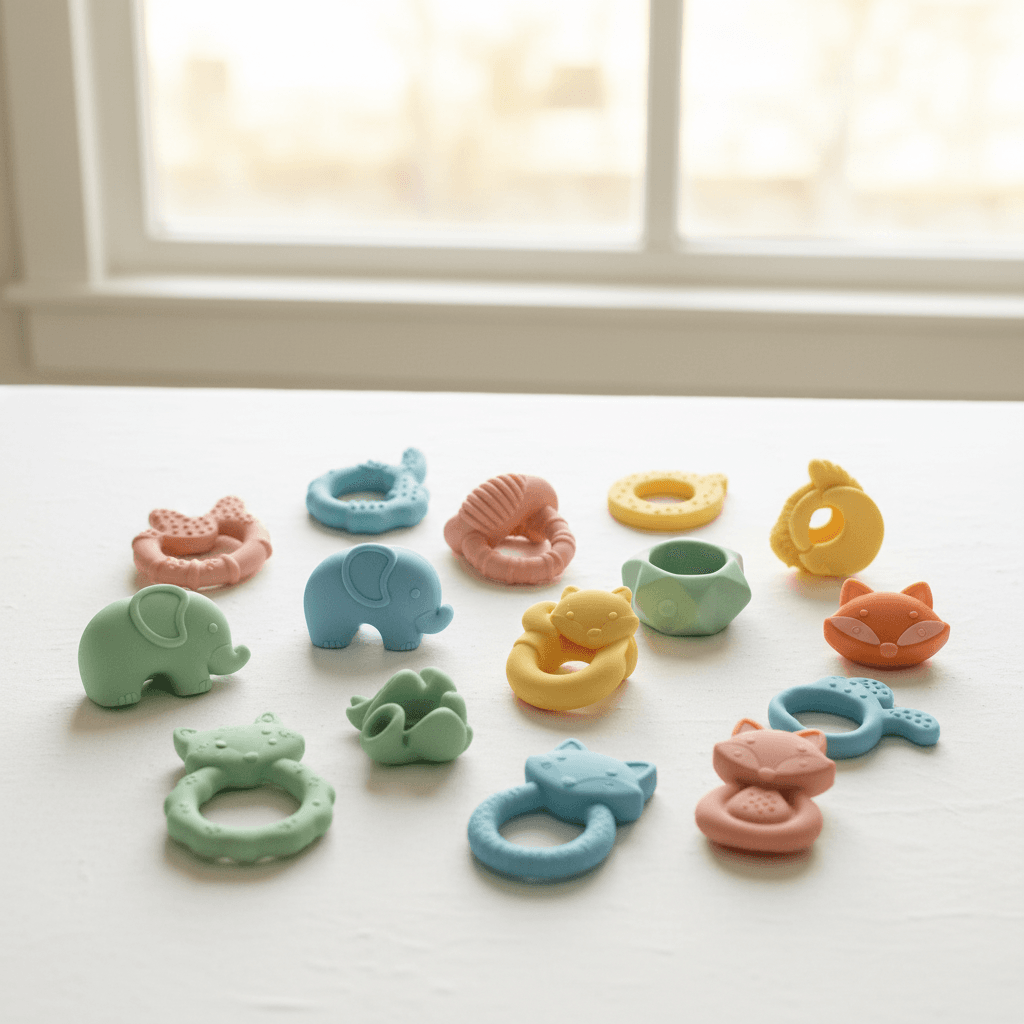
Brush-head and flat shapes put texture right where the incisors erupt. The Baby Banana Infant Training Toothbrush → has soft silicone bristles and banana-peel handles a baby can grasp. The Itzy Ritzy Silicone Teether → is a flat, open silicone shape with texture on one side for sore gums.
13-33 months: first molars, canines, second molars
This is when length matters. The Comotomo Silicone Baby Teether → has finger-shaped arms that Comotomo says are long enough to reach the back molars but sized to prevent choking. A clean finger reaches the back gum too, and gum rubbing is the first comfort measure the FDA lists.
Whatever the shape: the FDA's standard is a firm teether, not liquid-filled, never frozen, and always supervised. The ADA adds a warning against plastic objects that could break. All three picks above are solid silicone.
What teething does and doesn't cause
| Usually teething | Not teething: call your pediatrician |
|---|---|
| Drooling more than usual | A fever over 100.4°F (38°C) |
| Chewing on hands and toys | Diarrhea |
| Fussiness and trouble sleeping | Diaper rash or a rash elsewhere |
| Swollen, tender gums near the tooth | Crying much more than usual |
| A dip in appetite | A baby who seems particularly miserable |
The left column comes from the ADA's list of normal teething symptoms and the AAP's teething guidance, which notes drool can irritate the skin around the mouth. On the right, the ADA names fever, diarrhea and rash as reasons to call. The AAP says teething doesn't change how a baby's gut works, and that extra crying may mean illness.
The line that matters: the AAP says a true fever, over 100.4°F, is not associated with teething and is a sign of illness or infection. A swollen gum never explains a fever away.
What the FDA, AAP and ADA say to skip
- Benzocaine gels and creams. The FDA says they offer little to no benefit and can cause methemoglobinemia, a serious, sometimes fatal drop in the blood's ability to carry oxygen. The ADA says benzocaine or lidocaine numbing gels should not be used in children under 3.
- Lidocaine solutions. Prescription viscous lidocaine can cause seizures, heart problems, severe brain injury and death in young children, per the FDA.
- Homeopathic teething tablets. The FDA warns against them. The ADA notes lab tests found inconsistent amounts of belladonna, a toxic substance, sometimes far above the label.
- Amber necklaces and other teething jewelry. The FDA has reports of deaths and serious injuries, including strangulation and choking. The AAP adds that no research supports them.
- Frozen-solid teethers. A surface that is too hard can hurt gums, per the FDA.
- Unsupervised teething biscuits. The AAP warns chunks break off easily and can cause choking.
Comfort that is on the approved list
- Rub the gum. Wash your hands, then gently massage the sore spot with a clean finger.
- Offer a firm teether that reaches the teeth in progress, using the chart above.
- Go cold, not frozen. The AAP suggests a clean wet or frozen washcloth to chew; the FDA says the teething ring itself should not be frozen.
- Ask before medicine. If your baby is clearly uncomfortable, the AAP says to ask your pediatrician about acetaminophen, or ibuprofen after 6 months, and the right dose for your child's weight.
The first tooth starts two other clocks
Brushing. From the first tooth, brush twice a day with a soft child's toothbrush and a smear of fluoride toothpaste the size of a grain of rice, per the AAP and ADA. Move to a pea-sized amount at age 3. Once two teeth touch, the ADA says to start cleaning between them daily.
The dentist. The ADA recommends a first visit within six months of the first tooth and no later than the first birthday. The dentist checks growth and development and can discuss teething and pacifier habits.
For product-by-product picks, see our best teethers and teething remedies and best pacifiers and teethers. If new teeth are arriving alongside first foods, here is when to start solids.
When do babies start teething?
The AAP puts the start of teething at about 4 to 7 months, with discomfort possible weeks or months before a tooth shows. On the ADA chart, the first teeth, the lower central incisors, arrive at 6-10 months. No tooth by the first birthday can still be normal; mention it at the next checkup.
How long does teething last?
On the ADA chart, it runs from the lower central incisors at 6-10 months to the upper second molars at 25-33 months. Most children have all 20 baby teeth by about age 3.
Is Orajel safe for teething?
The FDA names Orajel among benzocaine products that should not be used for teething pain in children, because benzocaine can cause methemoglobinemia. Rub the gums or offer a firm teether instead, and ask your pediatrician if your baby seems very uncomfortable.
Research Sources
- American Dental Association - Primary Tooth Development (eruption chart, PDF)
- ADA MouthHealthy - Teething
- ADA MouthHealthy - Healthy Habits: Babies and Kids
- FDA - Safely Soothing Teething Pain in Infants and Children
- HealthyChildren.org (AAP) - Baby's First Tooth: 7 Facts Parents Should Know
- HealthyChildren.org (AAP) - When Does Teething Start?
- HealthyChildren.org (AAP) - Teething Pain Relief: How to Soothe Your Baby's Discomfort
Hilly Shore Inc.
Editorial teamIndependent product research team behind Cribworthy. Reviews are grounded in published AAP / CDC / NHTSA / CPSC pediatric guidance, JPMA / GREENGUARD GOLD / OEKO-TEX certification verification, and aggregated buyer sentiment.
115 products reviewed · 20 categories covered · cites AAP, CDC, NHTSA, CPSC, FDA, ACOG.
Safety claims are verified against published pediatric guidelines and CPSC databases. See our editorial standards.