Brown Noise for Sleep: What Exhausted Parents Should Know
Quick Answer
Brown noise is a sound with more energy concentrated in the low frequencies than white or pink noise — a deeper rumble rather than a hiss. It may be a comfortable personal preference, but the evidence does not establish that it reliably improves adult sleep or beats other sounds. Try it as a small, reversible experiment, at a low volume, and keep it separate from any decision about your baby's room.
Our Verdict
Brown noise is an acoustic description, not a treatment. The research on continuous noise as a sleep aid is mixed, and most of the recent sleep studies tested pink noise rather than brown, so nothing here establishes that it beats another sound or reliably improves adult sleep. Treat it as a preference worth one small, reversible trial at a low volume — and keep it entirely separate from any decision about your baby's room.
#1LectroFan Classic 4.6 | #2Yogasleep Dohm Classic 4.6 | |
|---|---|---|
| Verdict | The only pick here whose manufacturer lists brown noise among the sounds it makes. | A real fan in a housing. No files, no app, nothing to browse or update. |
| Price | ~$54.95Buy on Amazon | ~$49Buy on Amazon |
| Power | USB or AC adapter | 120V AC, 7 ft cord |
| Sound Library | 20 non-looping variations | — |
| Sleep Timer | 1, 2, 3, 4, 5, 6, 7 hours or continuous | — |
| Volume Range | Wide, with fine control | — |
| Dimensions | 4.4 x 4.4 x 2.2 inches | — |
| Sound Type | — | Mechanical fan |
| Speed Settings | — | 2 (high and low) |
| Tone Adjust | — | Yes, rotating cap |
| Made In | — | USA |
| Buyer sentiment | Noise Level Sound Quality Noise Cancellation Sleep Quality Buyers praise noise level, sound quality, noise cancellation and sleep quality. Mixed feedback on noise. Based on 14,947 user mentions | Sound Quality Sleep Quality Noise Cancellation Effectiveness Noise Level Durability Buyers praise sound quality, sleep quality, noise cancellation and effectiveness. Some flag noise level and durability. Based on 26,246 user mentions |
| Pros |
|
|
| Cons |
|
|
* Prices are approximate. Check the linked retailer for current pricing and availability.
Key Takeaways
- ✓Brown noise is an acoustic description, not a treatment. The research on continuous noise as a sleep aid is mixed, and most of the recent sleep studies tested pink noise rather than brown, so nothing here establishes that it beats another sound or reliably improves adult sleep. Treat it as a preference worth one small, reversible trial at a low volume — and keep it entirely separate from any decision about your baby's room.
- ✓The baby finally settles, the house gets quieter, and your mind starts replaying tomorrow. A low, steady sound is an appealing answer — and the trouble starts when it is sold as a proven treatment....
- ✓White, pink and brown describe how sound energy is distributed across frequencies: white has equal power per unit of frequency, pink emphasizes the lower ones, brown more strongly still. Brown ther...
- ✓A steady layer reduces the contrast between a quiet bedroom and intermittent sounds elsewhere. In an already quiet room, it can become the disturbance itself.
- ✓A systematic review by Samantha Riedy and colleagues found no consistent case for routine use of continuous noise as a sleep aid.
As an Amazon Associate I earn from qualifying purchases. Product prices and availability are subject to change.
Brown noise, and what it can honestly do
The baby finally settles, the house gets quieter, and your mind starts replaying tomorrow. A low, steady sound is an appealing answer — and the trouble starts when it is sold as a proven treatment. This is a guide to that gap, and to a reversible choice for your own bedroom — not your baby's.
What brown noise actually is
White, pink and brown describe how sound energy is distributed across frequencies: white has equal power per unit of frequency, pink emphasizes the lower ones, brown more strongly still. Brown therefore reads as a rumble, not a hiss — an acoustic pattern, not a medical effect.
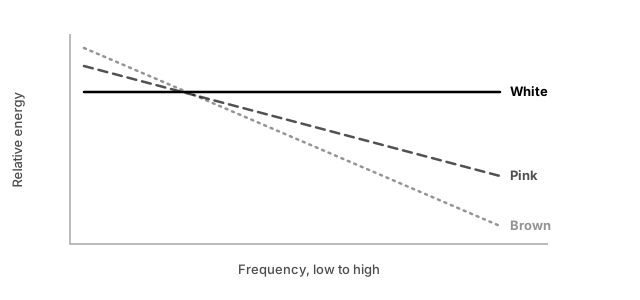
A schematic of the definitions only. The axes carry no values, and the picture says nothing about how any of these sounds affects sleep.
A recording labelled "brown noise" may also contain rain, wind or water. The label is a description to investigate, not proof of a spectrum.
Masking a disturbance is not better sleep
A steady layer reduces the contrast between a quiet bedroom and intermittent sounds elsewhere. In an already quiet room, it can become the disturbance itself.
Name the problem before you shop for a sound
- Write the difficulty in one sentence, specific enough to act on.
- Decide which kind it is. "The hallway door slams" is acoustic; "I am planning tomorrow in bed" is not.
- If it is acoustic, name the source. If not, no noise colour addresses it.
The evidence is less settled than the marketing
A systematic review by Samantha Riedy and colleagues found no consistent case for routine use of continuous noise as a sleep aid.
- 25 Healthy adults in the 2026 Penn Medicine overnight laboratory study. A small sample, and the sound tested was pink noise, not brown.
- 2021 Year of the Riedy systematic review, which found that methods and findings across studies of continuous noise varied substantially.
- Pilot The design of the 2026 Vincens crossover study reporting benefits from pink noise against traffic noise. A pilot is a starting point, not a verdict.
In the Penn Medicine study, continuous pink noise at the tested level was associated with less REM sleep, while earplugs better protected sleep against aircraft noise — the opposite direction to the Vincens pilot. Neither is about brown noise.
Start with the room, not the soundtrack
Find out what the room does at the hour you try to sleep.
Audit the room before you add anything to it
- Walk the bedroom at your usual bedtime and note where intermittent sounds come from.
- Close the loudest door more gently, or fix what makes it slam.
- Move one noisy evening task out of the hour before bed; silence nonessential alerts.
- Ask honestly whether the room is already quiet enough.
- Confirm alarms, monitor and requests for help stay audible overnight.
Try it as a small experiment, not a commitment
Choose a quiet, consistent recording without sudden transitions or advertisements, start it low, and try it during a brief wind-down before committing to all-night playback. If static-like sounds are not for you, an alternative is a wind-down with slow, low-tempo instrumental music, then quiet. Compare several ordinary evenings with sound against several without: a preference test, not proof.
LectroFan Classic
Buy on Amazon · $54.95 →If you want to try brown noise specifically rather than "whatever a streaming search returns," this is the one device in our sound-machine lineup whose manufacturer lists brown noise at all. Adaptive Sound Technologies describes the ten non-fan sounds as white, pink and brown noise variants, and describes all of them as digitally synthesized and truly non-looping — so there is no recorded file cycling round, and no seam to start listening for. The listing specifies precision volume settings for fine-tuning the sound, which is what makes starting low practical. The feature list is otherwise bare: no app, clock or light appears on it, and the manufacturer's own comparison chart marks Bluetooth as not included. That is the point — there is very little here to turn into another bedtime task.
Worth knowing: Owning a device that can produce brown noise is not evidence that brown noise will help you sleep. Nothing in the research above supports that. Treat it as a way to run the small experiment described here with a consistent sound, and be equally willing to conclude you do not like it.
Low volume matters, but there is no magic number
The National Institute on Deafness and Other Communication Disorders explains that hearing risk depends on sound intensity and exposure duration. A low-frequency sound is not exempt: a bass-heavy recording is not harmless because it feels less sharp than a hiss. No established level guarantees better sleep, and a phone-volume percentage is not a standard — "30 percent" means something different on every device. Set it by what you hear in your own room, and keep the source away from your head. Persistent ringing or sound sensitivity deserves professional advice.
Agree on the sound when you share a bedroom
Try it together while both adults are awake, and agree that either can stop it without having to justify it.
Yogasleep Dohm Classic
Buy on Amazon · $49 →The argument for this one in a shared bedroom is entirely about friction. Yogasleep sells it as soothing natural sounds from a real fan, so there is no file and no app — its own comparison chart lists this model as twist-to-adjust where a stablemate offers app control — which means there is nothing for either partner to browse, update or negotiate at midnight. The instructions are to flip the switch to high or low, then rotate the cap and collar to adjust tone and volume. When the deal is that either person can turn it off without justifying themselves, a device you can stop in the dark without waking up properly is worth more than a feature list.
Worth knowing: The listing specifies one fan-based white noise with adjustable tone, and no brown noise option appears on it anywhere. So if the low rumble specifically is what you want to test, this is not the device for that test.
This is adult advice, not nursery guidance
A parent and an infant are not interchangeable research populations. An adult's preference establishes nothing about volume, distance or duration in a baby's room.
When adults and babies share a room, an adult's audio choice changes the baby's environment too.
Protect the chance to sleep first
A recording cannot create sleep opportunity when your schedule leaves too little time in bed. NHLBI's guidance emphasizes adequate opportunity, consistent habits and an appropriate environment; audio is an optional detail inside that. The more useful conversation is usually coverage: who handles the next waking, and whether either adult gets a stretch off duty.
Infant Optics DXR-8 Pro
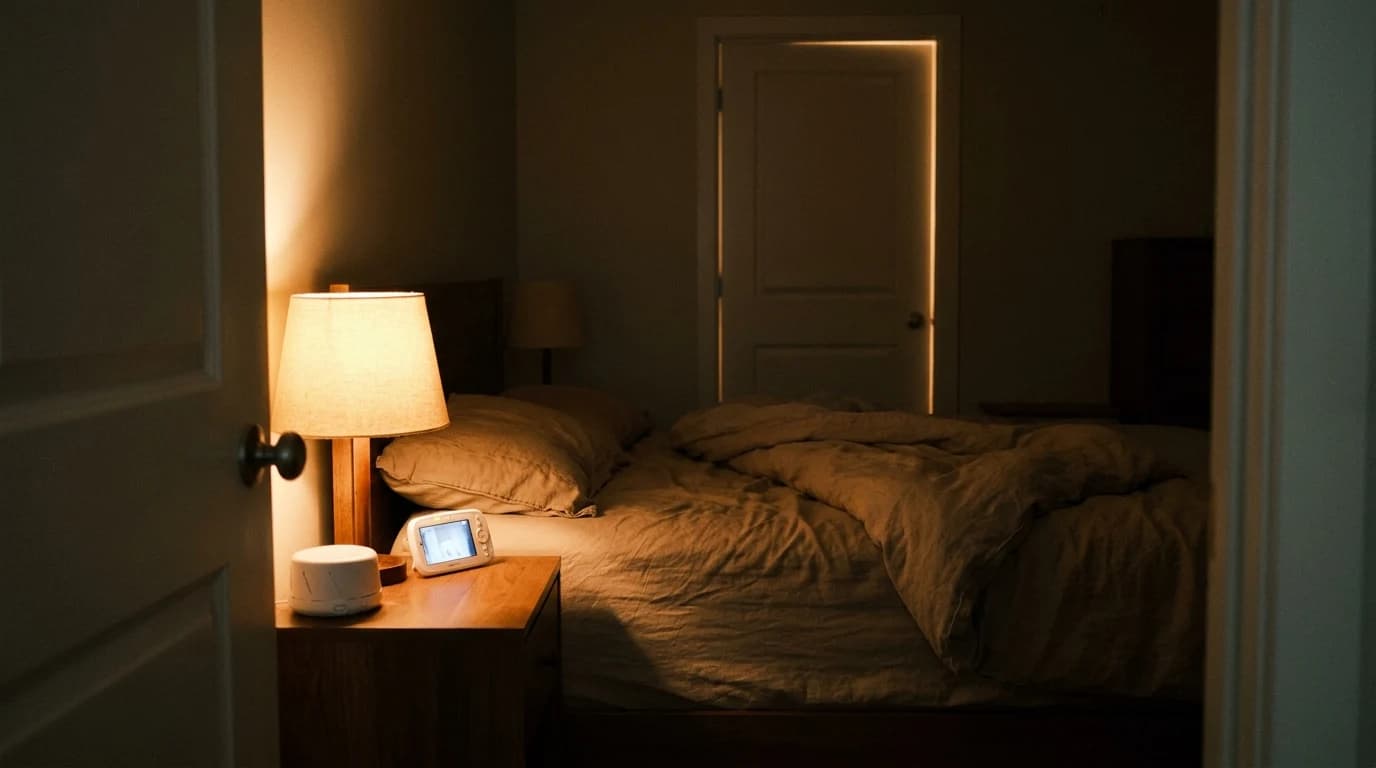
This is not a sleep aid, and it is here for one narrow reason: the moment you put a steady sound in your bedroom, the thing that has to stay audible over it is the monitor. Infant Optics describes a dedicated parent unit receiving a private, direct signal from the camera, with no WiFi, no app and no cloud — rather than an alert routed through a silenced phone — which is what makes an off-duty stretch something you can actually agree to. The listing specifies a 5-inch display and interchangeable lenses; the reason to mention it in an article about background noise is that the handoff plan only works if the signal still gets through.
Worth knowing: Infant Optics also states that its Active Noise Reduction filters out fans, air purifiers, heaters and air conditioners so that what you hear is your baby — but note which room that applies to. It describes the sound in the nursery, and says nothing about a sound you add in your own bedroom, which is the direction that matters here. Confirm the alert is clearly audible over whatever sound you add, at your chosen level, before you rely on it for a night.
Judge the result without chasing perfection
A sound can settle you one evening and irritate the next without ever improving your sleep. Stop when it becomes another thing to manage. Ongoing difficulty sleeping, daytime sleepiness or distress that interferes with daily life is a reason to seek professional support — a noise-colour experiment cannot identify the cause.
Common questions
Is brown noise better than white noise for sleep?
There is no good evidence that it is. The colours describe how energy is spread across frequencies, not how well a sound works, and the studies cited here tested pink noise rather than brown. Preference is a reasonable basis for choosing; proof of superiority is not available.
Is it safe to run brown noise all night?
Hearing risk depends on how intense a sound is and how long you are exposed to it, and a low-frequency sound is not exempt. Keep the source away from your head, start at the lowest comfortable level, and do not raise it to overpower household noise.
Can I use the same sound machine for me and for the baby?
Treat these as two separate decisions. An adult's comfortable level says nothing about the volume, distance or duration appropriate for an infant. Infant sound use is a question for your child's health professional.
Research Sources
- Noise as a Sleep Aid: A Systematic Review — Sleep Medicine Reviews (2021)
- Pink Noise Reduces REM Sleep and May Harm Sleep Quality — Penn Medicine (2026)
- Noise-Induced Hearing Loss — NIDCD
- Pink Noise Reduces Impact of Traffic Noise on Sleep and the Blood Metabolome: a Cross-Over Pilot Study — Communications Medicine (2026)
- Healthy Sleep Habits — NHLBI
- Colored Noise Processes (dsp.ColoredNoise) — MathWorks Documentation
Hilly Shore Inc.
Editorial teamIndependent product research team behind Cribworthy. Reviews are grounded in published AAP / CDC / NHTSA / CPSC pediatric guidance, JPMA / GREENGUARD GOLD / OEKO-TEX certification verification, and aggregated buyer sentiment.
115 products reviewed · 20 categories covered · cites AAP, CDC, NHTSA, CPSC, FDA, ACOG.
Safety claims are verified against published pediatric guidelines and CPSC databases. See our editorial standards.