Do You Actually Need a Baby Wipe Warmer? An Honest Assessment
Quick Answer
No, for most families you do not need a wipe warmer, and you do not need a wipe dispenser either. The AAP notes that most babies get used to cool wipes from the start, and a warm washcloth does the same job for nothing. A warmer earns its price only if cold wipes clearly wake your baby at night changes; weigh that against dried-out wipes, another cord and one more thing to clean.
Our Verdict
Leave it off the registry and buy later, only if cold wipes are demonstrably rousing your baby — something you can establish in week two rather than predict during pregnancy. If you do get one, refill in small batches so the stack does not dry out, and empty it weekly. Skip a separate wipe dispenser too: the pack's own lid keeps wipes moist. A warm damp washcloth solves the cold-wipe problem for nothing.
As an Amazon Associate I earn from qualifying purchases. Product prices and availability are subject to change.
Do You Actually Need a Baby Wipe Warmer? An Honest Assessment
Short answer: no — most families do not need a baby wipe warmer, and you do not need a wipe dispenser either. A warmer is a convenience item that earns its place only if cold wipes are genuinely waking your baby at night.
The AAP's own take, on HealthyChildren.org, is that room-temperature wipes sit around 60°F against a baby's 98.6°F skin, warmers hold wipes at about 104°F — and that, realistically, most babies never get warm wipes and get used to cool ones from the start. If cold wipes consistently wake your baby during night changes, a warmer can help; if not, skip it. If you do buy one, the hiccapop Wipe Warmer is our pick.
The quick verdict:
- Wipe warmer: skip it at registry time. Buy one later only if cold wipes are clearly rousing your baby at night.
- Wipe dispenser: skip it. The resealable lid on a wipes pack already keeps them moist; a refillable container only pays off if you buy wipes in bulk refill packs.
- Free alternative to both: a washcloth and warm water, which the AAP lists as a fine substitute for wipes.
Do you really need a baby wipe warmer?
Most families don't need one, but some genuinely benefit from it. It's a convenience item, not an essential. If your baby doesn't react to room-temperature wipes, skip it and save the money. If cold wipes consistently wake your baby during nighttime changes or cause dramatic crying, a warmer might be worth every penny.
When is a wipe warmer actually worth it?
Four situations where a warmer earns its spot:
- Nighttime diaper changes
- Sensitive skin
- Winter babies
- Colicky or high-needs babies
Nighttime diaper changes
This is the strongest argument. When you've spent 20 minutes getting a fussy newborn back to sleep and they need a diaper change, the last thing you want is a cold wipe shocking them fully awake.
The payoff: warm wipes keep nighttime changes calmer and quieter, which means baby (and you) get back to sleep faster.
Sensitive skin
Some parents of newborns and babies with eczema find a cold wipe causes more fuss at changes. There is no evidence that warm wipes prevent diaper rash; for irritated skin, the AAP's advice is frequent diaper changes, and switching wipe brands if a baby may be reacting to fragrances or dyes.
Winter babies
If your nursery runs cool (which is good for sleep — see our safe sleep space guide), wipes can feel genuinely cold. A warmer takes the edge off.
Colicky or high-needs babies
If your baby is already sensitive to stimulation, removing one more source of discomfort — even a minor one — can make the difference between a manageable diaper change and a screaming fit.
What are the downsides of baby wipe warmers?
A warmer is a plug-in heating appliance that sits next to a damp stack of wipes, which is where most of its downsides come from.
Creates dependency
This is the most common concern from pediatricians and experienced parents. A baby who only accepts warm wipes at home won't have that luxury at daycare, grandma's house, restaurants, or the car. You may be creating a problem you'll need to solve later.
Bacteria risk
A warm, damp box is the kind of place mold and bacteria like, so wipes should not sit in a warmer for long.
Don't skip the maintenance: use the top wipes regularly and refill with fresh wipes every few days. This step is important and often overlooked.
Dries out wipes
Many warmers dehydrate wipes, especially the ones on top. The wipe you grab is sometimes crispy and unusable. Higher-quality warmers have better moisture retention, but it's an ongoing issue with the category.
It's another thing on the changing table
Nursery real estate is limited. A wipe warmer takes up space, needs a power outlet, and adds one more cord to manage.
It is an electrical appliance
Warmers have been recalled before: in 2000, 152,000 Prince Lionheart-distributed wipe warmers were recalled because cracks in the inner tub could let water reach the electrical parts, after four reports of shocks. Register any warmer you buy so you hear about recalls, and stop using one with a cracked tub.
Cost adds up
The warmer itself is a modest purchase, but replacing wipes that dry out and using the warmer's electricity (minor) incrementally increases your diaper-changing costs.
What do pediatricians think about wipe warmers?
Pediatricians generally treat wipe warmers as optional. Room-temperature wipes are perfectly safe and appropriate for all babies. That said, pediatricians also acknowledge that anything that makes nighttime diaper changes smoother for exhausted parents has value. It's not medically necessary, but it's not harmful either (as long as you maintain it properly).
The AAP's HealthyChildren.org piece on wipes, written by two pediatricians, goes further than most: not every diaper change needs a wipe at all, because pee is rarely irritating and modern disposables keep most of it off the skin — save wipes for poop. A moist tissue, a wet washcloth or a quick rinse in the tub works in place of a wipe when it is convenient. For diaper rash, the AAP's advice centers on changing diapers every three to four hours, or whenever soiled, and switching brands if a baby may be reacting to fragrances or dyes in wipes.
What is the best baby wipe warmer if you decide to buy one?
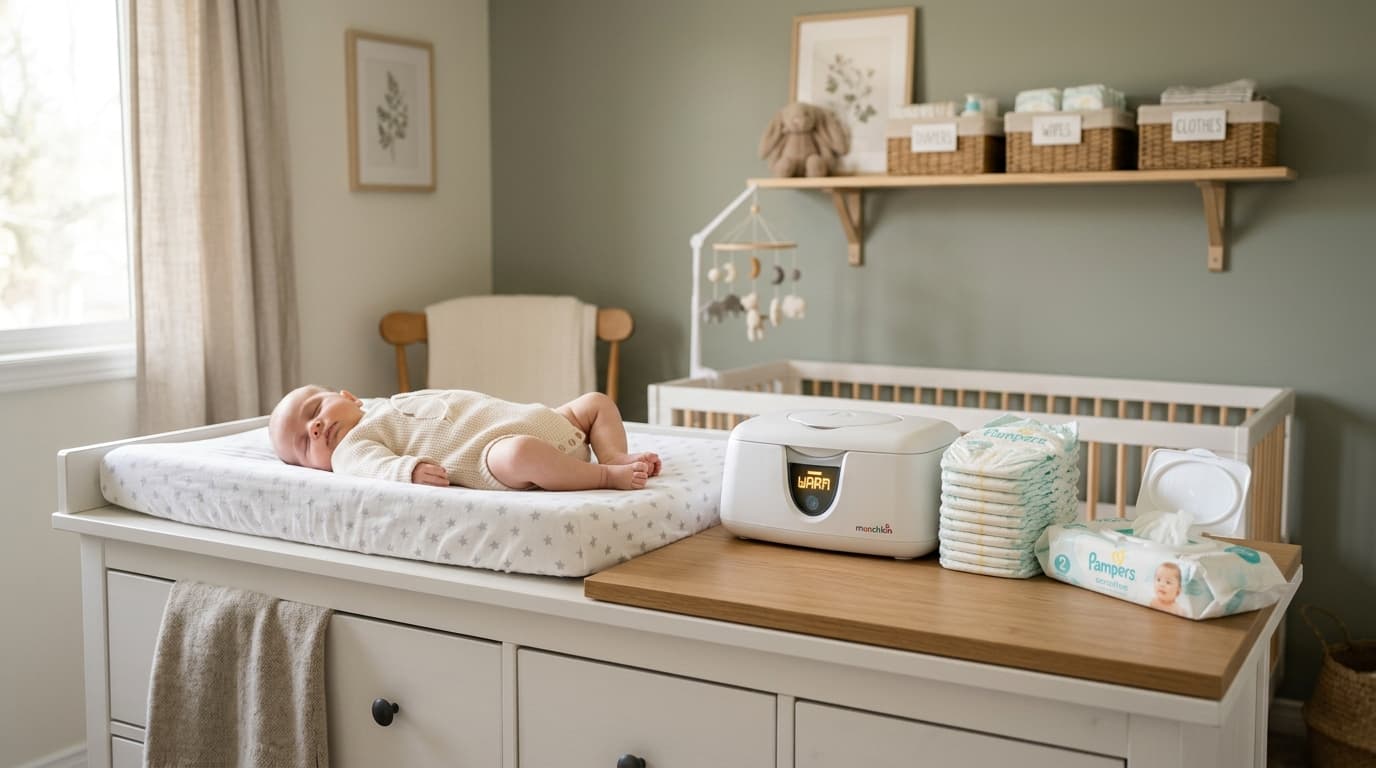
The hiccapop Wipe Warmer is the best option we've found. It heats from the top, uses a silicone seal and a flip-top lid to keep the stack moist, holds up to a week's worth of wipes, and has a changing light that switches itself off after 10 minutes — genuinely useful for dark-room diaper changes. Those are hiccapop's own specs.
If you buy one: hiccapop vs Munchkin
| Warmer | How it warms | Light | What else the maker states |
|---|---|---|---|
| hiccapop Wipe Warmer and Dispenser → | Heats from the top, so the lower wipes are not dried out | Changing light that switches off after 10 minutes | Silicone moisture seal; holds 100 wipes, including continuous-feed packs |
| Munchkin Warm Glow Wipe Warmer → | Low-voltage warmer | Soft night light with a 10-minute auto shut-off | Flip-top lid; holds up to 100 standard wipes |
Whichever you choose, the maintenance advice above applies: use the top wipes regularly, refill with a fresh stack every few days, and register the warmer so you hear about recalls.
Free alternative: instead of a wipe warmer, some parents simply hold a wipe in their closed hand for 10-15 seconds before using it. Your body heat takes the chill off, costs nothing, and works everywhere.
It's not as warm as a warmer, but it's a meaningful improvement over a straight-from-the-package cold wipe.
Do you need a wipe dispenser?
No. Wipes packs come with a resealable lid that keeps them moist, and a separate dispenser is one more thing to refill and wash. The AAP's advice on wipes is about cost rather than containers: you pay for packaging, so if you want a dispenser at all, keep one refillable container and restock it from large refill packs. Many warmers double as a dispenser, which is the one case where the two purchases collapse into one.
What should you buy instead of a wipe warmer?
If you're on the fence, here are nursery items that deliver more value than a wipe warmer:
- A good white noise machine — helps with every sleep, every night. See our white noise machine picks.
- Extra crib sheets — because 3 AM blowouts happen and you don't want to do laundry at 3 AM.
- Quality diaper cream — prevents problems rather than treating them. Our diaper cream guide has picks at every price.
- A dim nightlight — lets you change diapers without fully waking yourself or baby.
For our complete list of nursery essentials ranked by actual usefulness, check our guide on what you actually need vs. what you don't.
So should you buy a baby wipe warmer or skip it?
Buy one if:
- Nighttime changes are consistently terrible and cold wipes seem to be a factor.
- Your baby has sensitive skin, eczema, or is colicky and high-needs.
- Your nursery runs cool and wipes feel genuinely cold.
Skip it if:
- Your baby doesn't react to room-temperature wipes.
- You want one less thing on the changing table to power and maintain.
A wipe warmer is a "nice to have" for nighttime changes, especially for winter babies and sensitive-skinned newborns. It's not on our essentials list, and most families do just fine without one. If you're building a registry, put it in the "if someone wants to buy it" category rather than the must-have section.
Try room-temperature wipes first. If nighttime changes are consistently terrible and cold wipes seem to be a factor, a warmer is a small price for smoother nights. But don't buy one preemptively — you might be solving a problem that doesn't exist for your baby.
Related Reading
- What You Actually Need vs. What You Don't
- Newborn Essentials Checklist
- Best Diaper Creams of 2026
- How to Build Your Baby Registry
As an Amazon affiliate, Cribworthy may earn from qualifying purchases. Our recommendations are based on independent research and real parent feedback. Prices and availability are subject to change.
You need everything on the registry checklist before baby arrives.
Most babies need surprisingly little: a safe sleep space, car seat, diapers, feeding supplies, and a few outfits. Everything else can be bought as needed after you learn your baby's preferences.
Research Sources
Hilly Shore Inc.
Editorial teamIndependent product research team behind Cribworthy. Reviews are grounded in published AAP / CDC / NHTSA / CPSC pediatric guidance, JPMA / GREENGUARD GOLD / OEKO-TEX certification verification, and aggregated buyer sentiment.
124 products reviewed · 22 categories covered · cites AAP, CDC, NHTSA, CPSC, FDA, ACOG.
Safety claims are verified against published pediatric guidelines and CPSC databases. See our editorial standards.