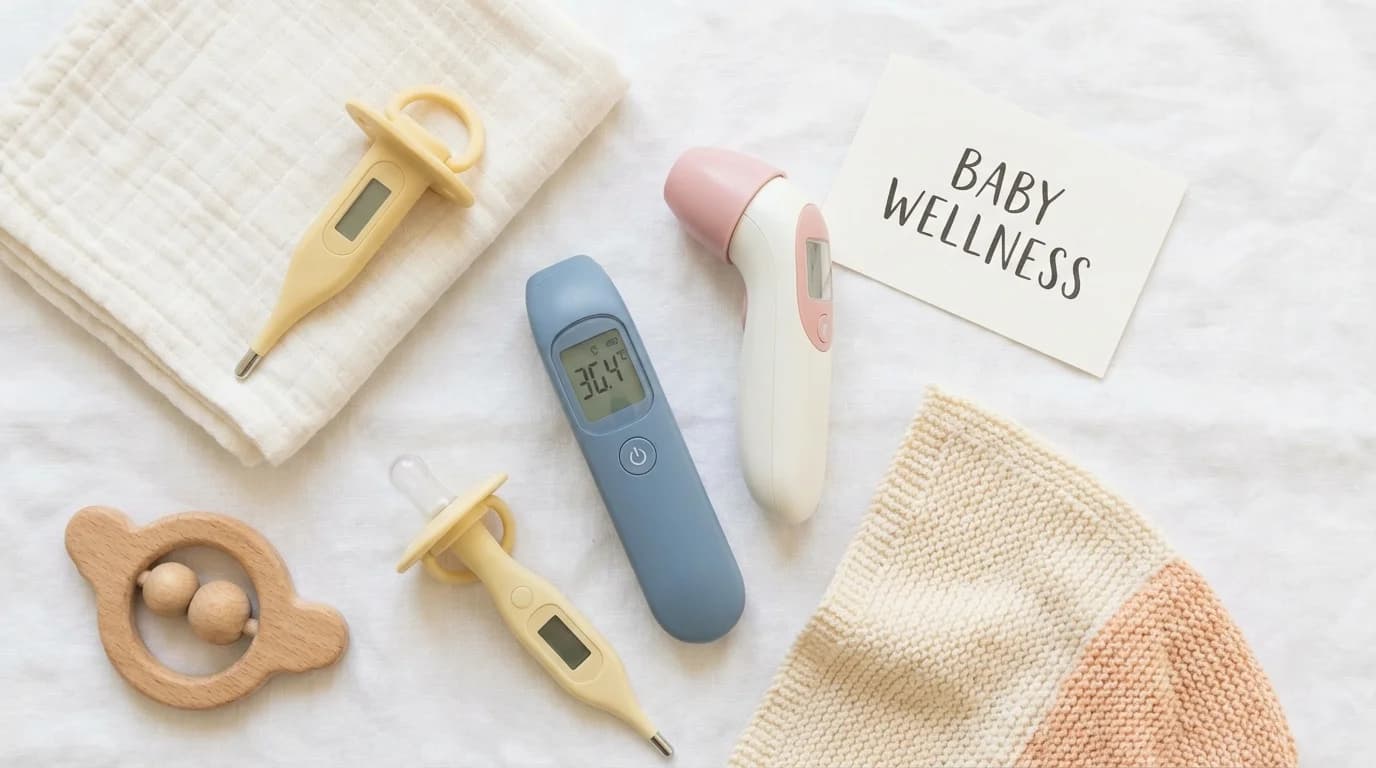
How to Take a Baby's Temperature (and When a Fever Is Urgent)
Quick Answer
A fever is a temperature of 100.4 degrees Fahrenheit (38 degrees Celsius) or higher, measured rectally, orally, by ear, or on the forehead. The single most important rule: if your baby is 3 months old or younger and has a rectal temperature of 100.4 or higher, call your pediatrician immediately, even if nothing else seems wrong. For young infants a rectal reading is the most accurate. Forehead (temporal artery) thermometers are the next most accurate and work at any age, ear thermometers are reliable only from 6 months, and underarm readings are the least accurate, useful only for a rough screen.
Our Verdict
Match the thermometer to your baby's age and read it correctly: rectal or forehead at any age, ear only from 6 months, oral only from age 4. Hold one rule above all, under 3 months a rectal 100.4 or higher is an immediate call to the pediatrician. After that, watch the whole baby, not just the number, and trust the urgent-signs list over the digits on the screen.
Key Takeaways
- ✓Match the thermometer to your baby's age and read it correctly: rectal or forehead at any age, ear only from 6 months, oral only from age 4. Hold one rule above all, under 3 months a rectal 100.4 or higher is an immediate call to the pediatrician. After that, watch the whole baby, not just the number, and trust the urgent-signs list over the digits on the screen.
- ✓A fever is a temperature of 100.4 degrees Fahrenheit (38 degrees Celsius) or higher, measured rectally, orally, by ear, or on the forehead. The single most important rule: if your baby is 3 months ...
- ✓100.4 F (38 C) is the fever line for rectal, oral, ear, and forehead readings. Armpit readings run lower, so about 99 F (37.2 C) under the arm can already mean a fever.
- ✓The "best" thermometer is the most accurate one your child's age allows. Here is the order pediatric guidance actually ranks them in.
- ✓You do not need a fancy device. A basic digital thermometer used correctly beats an expensive one used wrong.
As an Amazon Associate I earn from qualifying purchases. Product prices and availability are subject to change.
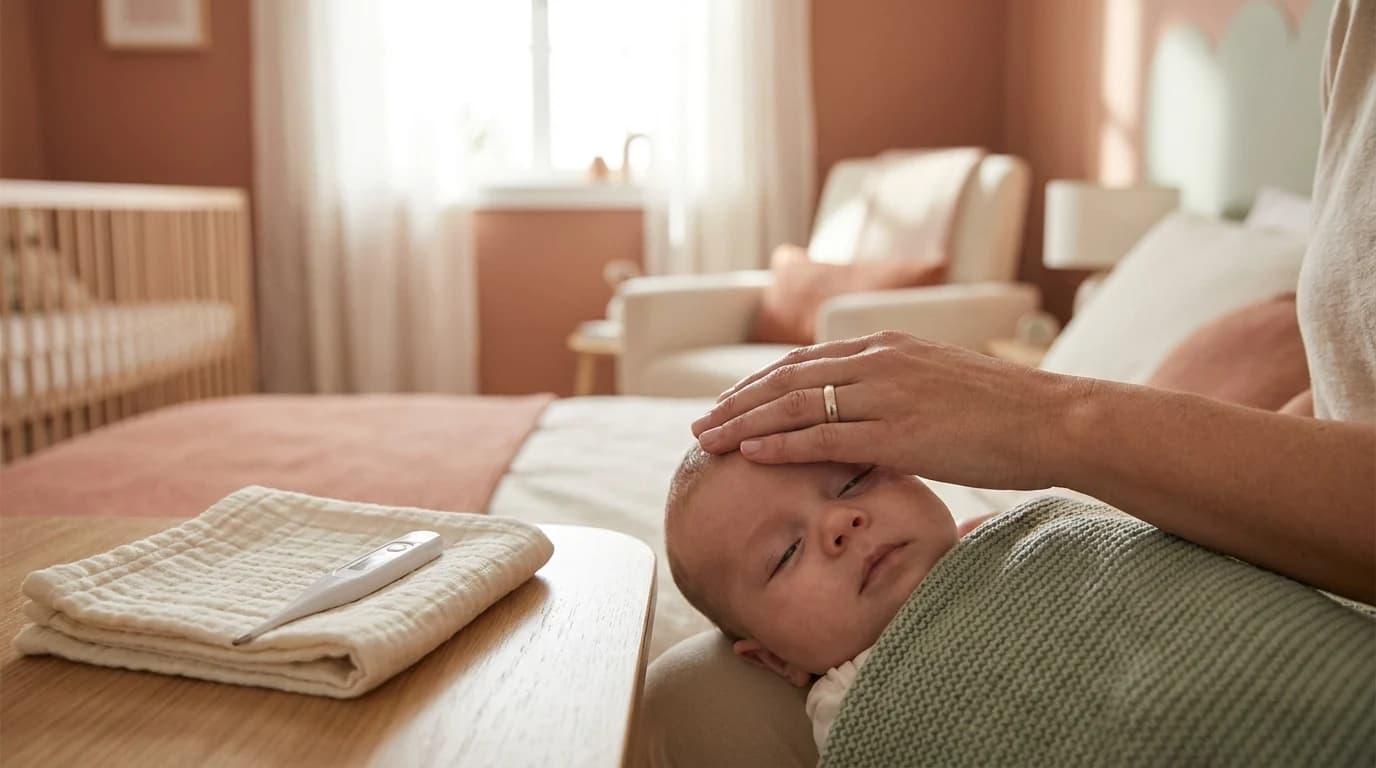
A forehead that feels hot at 2 a.m. is one of the scariest moments of new parenthood. But a hand on the head only tells you "warm" or "not warm," not whether you have a real fever or a true emergency. The number you get depends almost entirely on where and how you take it, and for one age group, the right method is non-negotiable. Here is what actually matters.
Quick answer
A fever is a temperature of 100.4 degrees Fahrenheit (38 degrees Celsius) or higher, measured rectally, orally, by ear, or on the forehead. The single most important rule: if your baby is 3 months old or younger and has a rectal temperature of 100.4 or higher, call your pediatrician immediately, even if nothing else seems wrong. For young infants, a rectal reading is the most accurate and the one your doctor will trust. Forehead (temporal artery) thermometers are the next most accurate and work at any age. Ear thermometers are only reliable from 6 months on, and underarm readings are the least accurate, useful only for a rough screen.
Key takeaways
- 100.4 F (38 C) is the fever line for rectal, oral, ear, and forehead readings. Armpit readings run lower, so about 99 F (37.2 C) under the arm can already mean a fever.
- Under 3 months changes everything. A rectal 100.4 in a baby this young is an automatic call to the doctor, day or night, no other symptoms required.
- The method has an age. Rectal and forehead work at any age; ear only from 6 months; oral only from age 4. Using the wrong tool gives the wrong number.
- Accuracy beats convenience. Pacifier thermometers and stick-on fever strips are screening toys, not measurements. Confirm anything they suggest with a digital thermometer.
Pick the method by your baby's age
The "best" thermometer is the most accurate one your child's age allows. Here is the order pediatric guidance actually ranks them in.
| Method | Best for ages | Accuracy | Notes |
|---|---|---|---|
| Rectal | Birth and up (essential under 3 mo) | Most accurate | The gold standard for young infants; what your doctor relies on |
| Forehead (temporal artery) | Any age | Next most accurate | Fast, no-fuss; follow the device's exact sweep or aim instructions |
| Ear (tympanic) | 6 months and older | Accurate if placed right | Skip under 6 mo; ear canals are too narrow to read reliably |
| Oral (mouth) | 4 years and older | Accurate if done right | Too young to hold it under the tongue before that |
| Armpit (axillary) | Any age | Least accurate | Screening only; confirm a positive with another method |
One practical rule that gets ignored: never use the same digital thermometer for rectal and oral readings. Buy two and label them, or keep one strictly for rectal use.
How to take a reliable reading
You do not need a fancy device. A basic digital thermometer used correctly beats an expensive one used wrong.
- Rectal: Lay your baby on their back or tummy, put a dab of petroleum jelly on the tip, gently insert about half an inch to one inch, hold still until it beeps, then read.
- Forehead: Make sure the forehead is dry and uncovered (sweat or hair lowers the reading). Slide or aim the sensor exactly as the instructions specify, since each model targets the temporal artery a little differently.
- Ear (6 months and up): Pull the ear gently back and up for a child over 1 year, aim the probe toward the opposite eye, and seat it snugly. A loose fit reads low.
- Armpit: Place the tip directly against bare skin, not over a sleeve, and hold the arm down until it beeps.
Whatever you use, tell your pediatrician which method and what number. "101 on the forehead" and "101 under the arm" are not the same finding.
When a fever is actually urgent
Most fevers are the immune system doing its job against an ordinary virus, and a high number alone is not a measure of how sick a child is. How your baby looks and acts matters more than the digits, with one hard exception for the youngest babies.
| Age | When to call right away |
|---|---|
| 3 months or younger | Any rectal temperature of 100.4 F (38 C) or higher, even with no other symptoms |
| 3 to 24 months | Fever that lasts beyond 24 to 48 hours, or a baby who looks very ill, very drowsy, or very fussy |
| Any age | Fever above 104 F (40 C) that keeps returning, a stiff neck, trouble breathing, an unexplained rash, repeated vomiting, or no wet diapers |
Call 911 or go to the emergency department for a fever paired with a seizure, blue lips, severe trouble breathing, or a baby who is limp or will not wake.
A word on febrile seizures, because they terrify parents: in children between 6 months and 5 years, fever can trigger a brief seizure. These almost always last under a minute and, while frightening, are typically harmless and cause no lasting damage. Still, a first seizure, or one lasting more than five minutes, means call 911.
What most parents get wrong
The instinct is to treat the number. The research does not support that. A fever is a symptom, not the illness, and "bringing the number down" with medicine is about comfort, not safety. A child with 103 who is playing and drinking is often less concerning than a listless baby at 100.6. The exceptions are real and worth memorizing: the under-3-months rule, and the comfort-medicine caution that ibuprofen is not for babies 6 months or younger, and for any baby 3 months or younger you should check with the doctor before giving any fever medicine at all.
The other common mistake is trusting a screening tool as a measurement. A pacifier thermometer or a forehead strip can be a useful nudge to grab the real thermometer, but they do not work as well as a proper digital reading and should never be the basis for an emergency-room decision either way.
The bottom line
Match the thermometer to your baby's age, read it correctly, and report the method along with the number. Hold one rule above all: under 3 months, a rectal 100.4 or higher is a phone call, not a wait-and-see. After that, watch the whole baby, not just the digits, and trust the urgent-signs list over the number on the screen.
What is the most accurate way to take a baby's temperature?
A rectal reading with a digital thermometer is the most accurate, especially for infants under 3 months. A forehead (temporal artery) thermometer is the next best and works at any age.
At what temperature should I worry about my baby's fever?
A fever is 100.4 F (38 C) or higher. For a baby 3 months or younger, any rectal reading at that level means call the pediatrician immediately. For older babies, focus on how sick the child looks and on fever that persists beyond a day or two.
Can I use an ear thermometer on a newborn?
No. Ear (tympanic) thermometers are reliable only from about 6 months of age, because a young infant's ear canal is too narrow for an accurate reading. Use a rectal or forehead thermometer instead.
Are forehead-strip and pacifier thermometers accurate?
They are screening tools, not measurements. They do not work as well as a digital rectal, forehead, ear, or oral reading, so confirm anything they suggest with a proper thermometer before acting on it.
Sources
Research Sources
Hilly Shore Inc.
Editorial teamIndependent product research team behind Cribworthy. Reviews are grounded in published AAP / CDC / NHTSA / CPSC pediatric guidance, JPMA / GREENGUARD GOLD / OEKO-TEX certification verification, and aggregated buyer sentiment.
115 products reviewed · 20 categories covered · cites AAP, CDC, NHTSA, CPSC, FDA, ACOG.
Safety claims are verified against published pediatric guidelines and CPSC databases. See our editorial standards.