What Temperature Should a Baby's Room Be for Sleep?
Quick Answer
There is no universal safe nursery temperature or AAP thermostat ceiling. The UK Lullaby Trust suggests 16–20°C (61–68°F), while AAP advice focuses on avoiding overheating and excess clothing. Keep the room comfortable, follow the sleepwear maker’s guidance, and check for sweating or a hot chest. A reading of 72°F alone does not mean the room is unsafe.
Our Verdict
Use room temperature as one cue, alongside clothing and signs of overheating. The Lullaby Trust’s 16–20°C range is UK guidance, not an AAP cutoff. Follow your sleepwear maker’s temperature chart, skip indoor hats and loose bedding, and reduce layers if your baby is sweating or has a hot chest.
Key Takeaways
- ✓The UK Lullaby Trust recommends 16–20°C (61–68°F) as a room-temperature guide. It is not an AAP thermostat limit or proof that a slightly warmer room is unsafe. But the temperature dial is only half the job.
- ✓If your home naturally sits a degree or two outside that window, do not panic. The range is a comfort target, not a safety cliff.
- ✓This is the part almost no listicle says out loud. People assume the American Academy of Pediatrics publishes an exact safe room temperature, and they hunt for it. It does not.
- ✓Forget converting your nursery into a lab. Match the layers to the temperature and let one simple rule do the work.
- ✓Your hands are a poor thermometer here, because a baby's hands and feet are usually cooler than their core even when they are perfectly warm. Check the right spots instead.
As an Amazon Associate I earn from qualifying purchases. Product prices and availability are subject to change.
You set up the crib, you mastered the swaddle, and then a relative asked, "Is the room too warm for the baby?" Now you are standing in the nursery with a thermometer app, hunting for the one official number that makes it safe. Here is the uncomfortable truth that quietly drives a lot of new-parent anxiety: there is no single magic temperature, and the leading pediatric authority deliberately refuses to give you one. What actually matters is much simpler to get right.
Quick answer
The UK Lullaby Trust recommends 16–20°C (61–68°F) as a room-temperature guide. It is not an AAP thermostat limit or proof that a slightly warmer room is unsafe. But the temperature dial is only half the job. The American Academy of Pediatrics intentionally does not publish a target room number, and recommends checking for overheating and avoiding overbundling. The reliable rule is to dress your baby in one layer more than you are comfortable wearing in the same room, skip loose blankets entirely, and check the back of the neck or chest to confirm they are warm but not hot. Overheating raises the risk of sudden infant death syndrome (SIDS). Adjust clothing if your baby is sweating or has a hot chest, and follow the sleepwear instructions.
Key takeaways
- The 16-20 C / 61-68 F range is a guide, not a hard line. It comes from infant-safety bodies as a comfortable target; comfort and clothing matter more than hitting an exact degree.
- The AAP does not give a thermostat number on purpose. Studies link overheating to higher SIDS risk, but they define "overheating" inconsistently, so the AAP focuses on dressing rather than degrees.
- Clothing and room conditions work together. The AAP’s extra-layer advice is a general guide, not a reason to ignore sweating or a hot chest.
- Feel the chest or back of the neck, not the hands and feet. Babies' hands and feet run cool normally; sweating, flushed skin, or a hot chest mean it is time to remove a layer.
The number parents actually want
| Setting | Target | Notes |
|---|---|---|
| Comfortable nursery range | 16-20 C (61-68 F) | UK Lullaby Trust room-temperature guide, not an AAP safety threshold |
| AAP thermostat ceiling | No universal number specified | Consider clothing and signs of overheating |
| What to use | A simple room thermometer | A wall or nightstand thermometer beats guessing by hand |
If your home naturally sits a degree or two outside that window, do not panic. The range is a comfort target, not a safety cliff. A thermostat reading alone cannot tell you whether your baby is overheated; clothing, bedding and your baby’s condition matter too.
What most people get wrong: the AAP gives no magic number
This is the part almost no listicle says out loud. People assume the American Academy of Pediatrics publishes an exact safe room temperature, and they hunt for it. It does not. In its safe-sleep guidance the AAP explicitly notes that while studies show overheating raises SIDS risk, those studies define overheating differently, so a precise room-temperature rule cannot be given. Instead the AAP anchors everything to clothing: dress your baby in no more than one layer more than an adult would wear to be comfortable in that room.
So the honest answer to "what temperature should the room be" is: comfortable for a lightly dressed adult, with the baby in one extra layer. The 16-20 C range you see quoted is a useful proxy for "comfortable," popularized by infant-safety organizations, not a hard threshold the AAP enforces. Chasing a single perfect degree is the wrong project. Getting the layers right is the real one.
How to dress your baby for the room
Forget converting your nursery into a lab. Match the layers to the temperature and let one simple rule do the work.
| Room feels | What you would wear | Dress baby in |
|---|---|---|
| Room warmer than usual | Lighter adult clothing | Check the sack maker’s chart; reduce insulation if baby is sweaty or hot |
| Room comfortable | Your usual comfortable layers | Avoid overbundling and check the chest |
| Room cooler than usual | Warmer adult clothing | Adjust clothing using the maker’s chart; do not add loose blankets |
A few non-negotiables that sit underneath all of this:
- No loose blankets, quilts, or comforters in the crib for babies under one. Use a wearable blanket or sleep sack instead, which gives warmth without anything that can cover the face.
- No hats indoors for sleep. Babies release heat through their heads; a hat in a normal room is a fast route to overheating.
- Do not over-dress an unwell baby. When a baby has a cold or fever they may already run warm, so resist the urge to add layers.
How to tell if your baby is too hot or too cold
Your hands are a poor thermometer here, because a baby's hands and feet are usually cooler than their core even when they are perfectly warm. Check the right spots instead.
- Feel the chest or the back of the neck. Warm and dry is the goal.
- Signs of overheating: sweating, damp hair, flushed or red skin, or a chest that feels hot to the touch. Remove a layer.
- Signs of being cold: a genuinely cool chest or back of the neck. Add a layer or a slightly warmer sleep sack (our sleep sack TOG guide explains the ratings), not a blanket.
- Ignore cool hands and feet. On their own they are normal and not a reason to bundle up.
If you find your baby sweaty in the night, strip a layer rather than reaching to crank the thermostat down; you can adjust clothing promptly while also checking room conditions.
A 60-second nursery setup
- Put a room thermometer where you will actually see it, on the nightstand or wall near the crib.
- Keep the room comfortable. The Lullaby Trust’s 16–20°C range is one guide, rather than a universal overnight heating ceiling.
- Dress the baby in one layer more than you are comfortable wearing, finished with a well-fitting sleep sack.
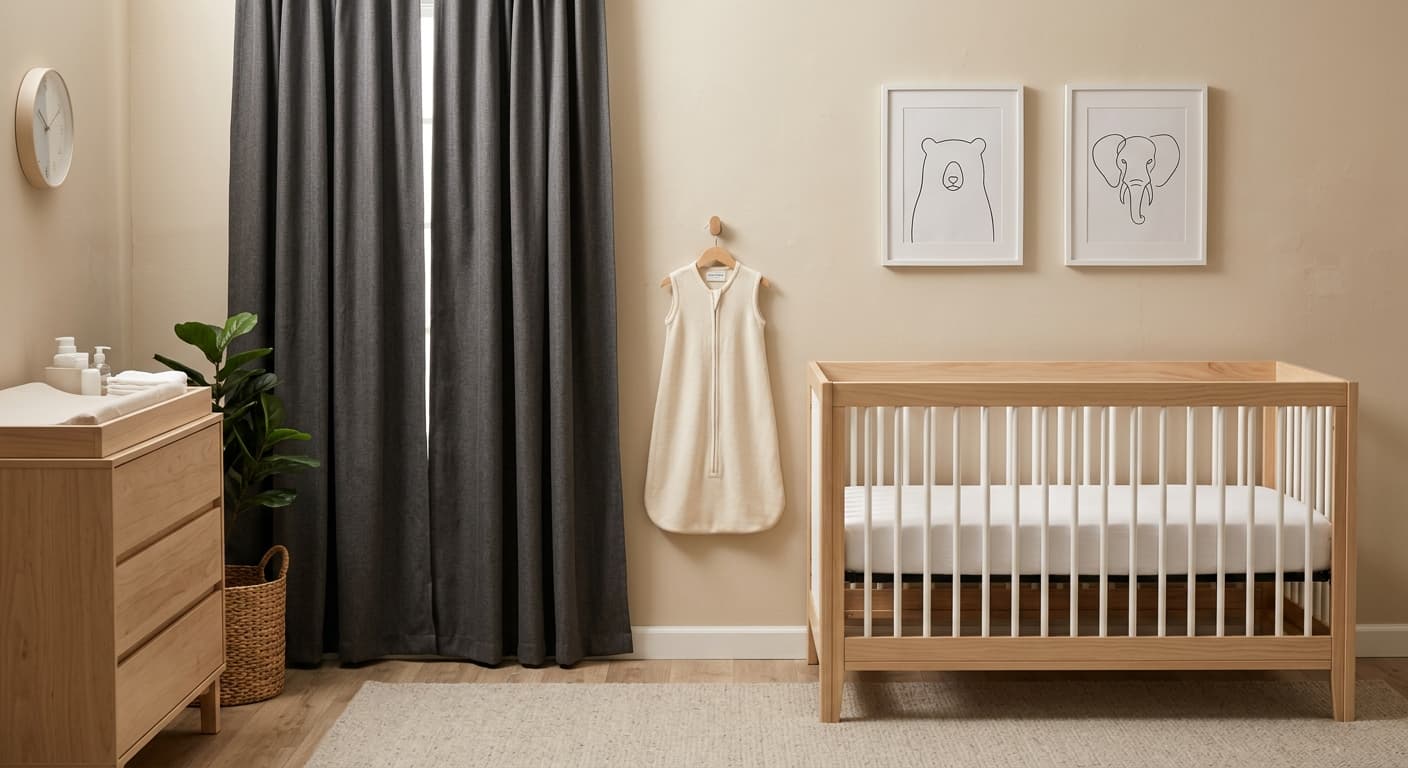
- Strip the crib to a fitted sheet on a firm mattress. No blankets, bumpers, or loose items. Our safe sleep checklist covers the rest of the crib setup.
- Do a chest-or-neck check whenever you pass by, and adjust a layer up or down as needed.
Bottom line
Stop hunting for the one perfect degree. Keep the room comfortable, lean toward 16-20 C (61-68 F), and put your energy into layers instead of the thermostat: one more than you would wear, no loose bedding, no indoor hat. Then trust a quick touch to the chest or the back of the neck over any number on a screen.
Frequently asked questions
Is 72 F too warm for a baby's room?
A room at 72°F (about 22°C) is not automatically unsafe. The AAP does not define a single safe thermostat setting. Match clothing to conditions and the sleepwear instructions, avoid indoor hats and loose bedding, and check for sweating or a hot chest rather than cooling the room solely to reach 68°F.
Do I really need a room thermometer?
It is genuinely helpful and inexpensive. Rooms feel warmer or cooler than they are, and a thermometer takes the guessing out of it. But it is a guide, not a verdict; the chest-or-neck check on your baby is what confirms they are actually comfortable.
Should the baby wear a hat to sleep?
No, not for routine indoor sleep. Babies lose heat through their heads, so an indoor hat is a common cause of overheating. Hats are for going outside in the cold, not for the crib.
Sources
Research Sources
Hilly Shore Inc.
Editorial teamIndependent product research team behind Cribworthy. Reviews are grounded in published AAP / CDC / NHTSA / CPSC pediatric guidance, JPMA / GREENGUARD GOLD / OEKO-TEX certification verification, and aggregated buyer sentiment.
130 products reviewed · 22 categories covered · cites AAP, CDC, NHTSA, CPSC, FDA, ACOG.
Safety claims are verified against published pediatric guidelines and CPSC databases. See our editorial standards.