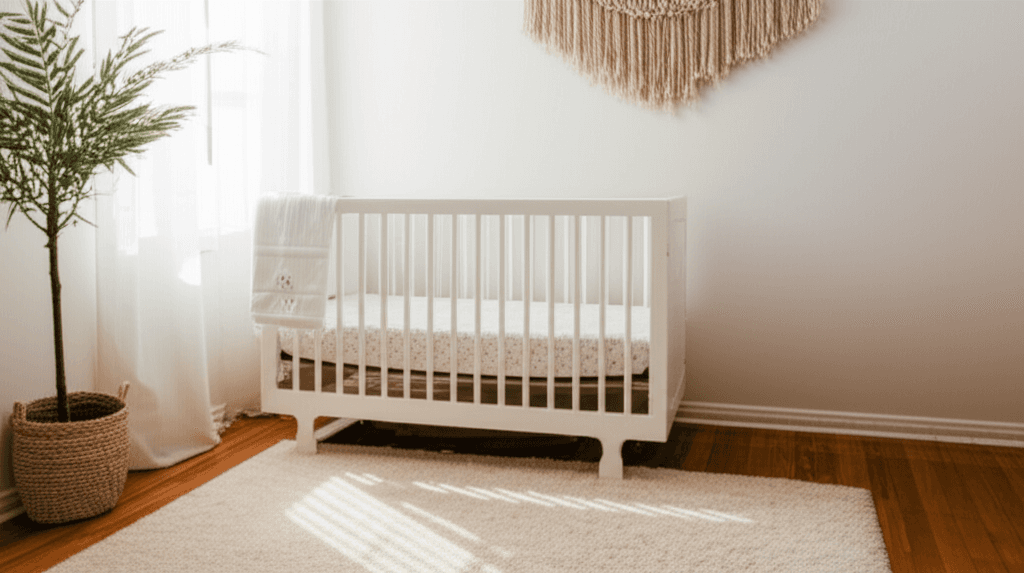
When to Move Baby From Bassinet to Crib: Age, Weight & Signs
Quick Answer
Move your baby into the crib as soon as any one of four things appears: rolling, pushing up onto hands and knees, nearing the stated weight ceiling of roughly 15 to 20 pounds, or simply looking boxed in. That usually lands between three and six months, and age is the weakest of those four signals. Room-sharing refers to the room, so the crib can stay beside your bed.
Our Verdict
Act on whichever milestone shows up first instead of waiting for a birthday, and begin with daytime naps so the new surface feels familiar before dark. Carry the same wind-down, the same sound, and the same sleepwear across with you. Refuse inserts, wedges, and nests marketed to make a crib feel cozier, because a bare mattress under a fitted sheet is the entire correct setup.
Key Takeaways
- ✓Act on whichever milestone shows up first instead of waiting for a birthday, and begin with daytime naps so the new surface feels familiar before dark. Carry the same wind-down, the same sound, and the same sleepwear across with you. Refuse inserts, wedges, and nests marketed to make a crib feel cozier, because a bare mattress under a fitted sheet is the entire correct setup.
- ✓Most babies are ready to transition from bassinet to crib between 3 and 6 months of age, but the most important trigger is developmental milestones, not age alone. You should move your baby to a cr...
- ✓*As an Amazon affiliate, Cribworthy may earn from qualifying purchases. Our recommendations are based on independent research and real parent feedback. Prices and availability are subject to change.*
💬 Real Talk from Parents
White noise machines are not for the baby. They're for your sanity.
Every baby sleep book contradicts the last one you read. That's normal.
The swaddle is magic until the day it isn't, and that day comes without warning.
You'll google 'baby sleep regression' at least once a month for the first year.
We tried every sleep method. What actually worked? Blackout curtains, white noise, and a consistent bedtime routine. The boring stuff.
Paraphrased community consensus — not a direct quote.
Adding cereal to a bottle helps babies sleep longer.
The AAP advises against adding cereal to bottles. It doesn't improve sleep, increases choking risk, and can lead to overfeeding. Solid readiness signs usually appear around 6 months.
Sleep training damages your baby's attachment.
Multiple peer-reviewed studies (including a 2012 Pediatrics study following children for 5 years) found zero difference in emotional health, behavior, or parent-child attachment between sleep-trained and non-sleep-trained children.

As an Amazon Associate I earn from qualifying purchases. Product prices and availability are subject to change.
When to Switch From Bassinet to Crib: Signs, Timing, and How to Transition
Most babies are ready to transition from bassinet to crib between 3 and 6 months of age, but the most important trigger is developmental milestones, not age alone. You should move your baby to a crib immediately if they are rolling over, approaching the bassinet's weight limit (typically 15 to 20 pounds), or appear cramped. The AAP recommends room-sharing for at least the first 6 months, but this means the crib can be in your bedroom — it does not require the baby to remain in a bassinet. Starting with naps in the crib and maintaining consistent sleep cues are the most effective strategies for a smooth transition.
At what age should you move baby from bassinet to crib?
Most babies transition from bassinet to crib between 3 and 6 months old. But age alone isn't the deciding factor — your baby's size, development, and the bassinet's specifications all play a role.
The AAP's 2022 safe sleepsafe sleepAAP guideline: baby sleeps Alone (no blankets, pillows, bumpers, or toys), on their Back, in a Crib or bassinet with a firm flat mattress. Room-sharing without bed-sharing is recommended for the first 6-12 months. guidelines recommend room-sharing (but not bed-sharing) for at least the first 6 months. Importantly, the AAP clarifies that a full-size crib placed in the parents' room satisfies this recommendation — there is no requirement to use a bassinet for any specific duration.
The American Academy of Pediatrics (AAP) recommends room-sharing (not bed-sharing) for at least the first 6 months, ideally 12. This doesn't mean baby has to stay in the bassinet that long — it means their crib can be in your room. A full-size crib in the parents' bedroom is perfectly aligned with AAP guidelines.
What are the signs your baby has outgrown the bassinet?
Watch for these indicators rather than relying purely on age:
The CPSCCPSCThe US federal agency that issues product recalls and enforces safety standards on cribs, strollers, car seats, and other juvenile products. requires all bassinets sold in the United States to comply with ASTM F2194, which mandates a maximum weight limit clearly stated in the product manual. Exceeding the manufacturer's weight limit compromises the structural integrity of the bassinet and has been cited in multiple CPSC incident reports involving bassinet collapse or tipping.
1. Baby is approaching the weight limit
Every bassinet has a maximum weight rating, typically between 15 and 20 pounds. Check your specific model's manual — exceeding this limit is a genuine safety risk, as the bassinet's structure isn't designed for heavier babies. Most babies hit 15 lbs between 3 and 5 months.
2. Baby is rolling over
This is the most urgent sign. Once your baby can roll from back to front (or shows strong attempts), they need a crib's flat, firm, spacious sleep surface. Bassinets have shallow sides that a rolling baby could potentially flip over. If your baby is rolling, transition immediately regardless of weight.
3. Baby seems cramped
If your baby's head or feet regularly touch the bassinet walls, they're outgrowing the space. Cramped babies sleep worse and may wake themselves up by bumping into sides.
4. Baby is pushing up on hands and knees
Pre-crawling movements in a bassinet are a safety concern. The rocking or movement features on some bassinets can become dangerous when baby can shift their own weight.
5. Sleep is deteriorating
Sometimes a baby who was sleeping well in the bassinet starts waking more frequently — not from a sleep regressionsleep regressionA stretch of worse sleep tied to a developmental leap — common at 4, 8-10, 12, and 18 months. Not a sign you did something wrong. Usually passes in 2-6 weeks., but because they've simply outgrown the space and need more room to move and settle.
How do you transition baby from bassinet to crib smoothly?
A 2023 study published in Infant Behavior and Development found that gradual environmental transitions (starting with daytime naps in a new sleep space before nighttime sleep) reduced infant stress cortisol levels by 40% compared to abrupt transitions. Maintaining consistent pre-sleep routines was the strongest predictor of successful sleep location changes.
Start with naps
Begin by putting baby down for daytime naps in the crib. This lets them get familiar with the new space during lower-stakes sleep periods. Once they're napping well in the crib (give it 3-5 days), move nighttime sleep there too.
Keep the environment consistent
If you used white noise and a dark room with the bassinet, replicate that exactly at the crib. Same sound machine, same darkness level, same pre-sleep routine. Consistency signals to your baby that it's still sleep time, even though the location changed. Our white noise machine guide can help if you need a recommendation.
Use familiar scents
Sleep with your baby's crib sheet for a night before making the switch. Your familiar scent on the sheet can ease the transition. Some parents also place a worn (not loose) shirt under the fitted sheet for the same effect.
Maintain your bedtime routine
Whatever routine you've established — bath, feeding, book, swaddle or sleep sack, sound machine — keep it identical. The routine is your baby's cue that sleep is coming. Don't change the routine and the sleep location simultaneously. For tips on building a solid routine, read our bedtime routine guide.
Consider a transitional step
If the crib is in a separate room and baby has been right beside your bed, try moving the crib into your room first. Once baby is sleeping well in the crib (even in your room), then move the crib to the nursery. Two smaller changes are often easier than one big one.
How should you set up the crib for safe sleep?
Safe crib setup is non-negotiable. Follow these AAP guidelines:
According to the AAP's 2022 updated policy statement on safe sleep, the crib should contain only a firm, flat mattress with a fitted sheet — no bumpers, blankets, pillows, or stuffed animals. CPSC has reports of 113 fatalities associated with crib bumpers occurring between January 1, 1990 and March 31, 2019, though CPSC classified 30 of those as incidental to the death. Congress responded with the federal Safe Sleep for Babies Act of 2021, approved May 16, 2022, which banned padded bumpers, vinyl bumper guards and vertical slat covers.
- Firm, flat mattress that fits snugly in the crib frame (no gaps wider than two fingers between mattress and crib)
- Fitted sheet only — no blankets, pillows, bumpers, stuffed animals, or positioners
- Nothing in the crib except baby and the fitted sheet
- Room temperature of 68–72°F
- Baby on their back for every sleep
If your baby has started rolling, you don't need to flip them back once they roll on their own — but always place them on their back initially. For a complete safe sleep setup, see our safe sleep space guide.
For crib recommendations at every price point, visit our best cribs and bassinets guide.
What should you do if your baby won't sleep in the crib?
Some resistance is normal. Give it at least a week of consistent effort before deciding it's not working. A few strategies:
- Stay nearby. Sit beside the crib until baby falls asleep, gradually moving your chair toward the door over several nights.
- Gradual retreat. Comfort with your voice and brief touches, but try not to pick baby up every time they fuss.
- Check your timing. Make sure baby is actually tired (not overtired or undertired) when you put them down. Our guide on reading baby sleep cues can help.
- Be patient with night wake-ups. It's normal for night waking to temporarily increase during the transition. It usually settles within a week.
When is the right time to switch from bassinet to crib?
Most babies are ready to move from bassinet to crib between 3 and 6 months, but rolling, weight limits, and apparent discomfort in the bassinet are more important signals than age alone. Start with naps, keep the environment consistent, and give your baby (and yourself) time to adjust. This transition feels big, but within a week or two, the crib will feel just as natural as the bassinet did.
Related Reading
- How to Set Up a Safe Sleep Space
- Best Cribs and Bassinets of 2026
- Sleep Regression Survival Guide
- Best White Noise Machines for Babies
As an Amazon affiliate, Cribworthy may earn from qualifying purchases. Our recommendations are based on independent research and real parent feedback. Prices and availability are subject to change.
Your next step
Making the move to a crib? Start here.
Research Sources
Hilly Shore Inc.
Editorial teamIndependent product research team behind Cribworthy. Reviews are grounded in published AAP / CDC / NHTSA / CPSC pediatric guidance, JPMA / GREENGUARD GOLD / OEKO-TEX certification verification, and aggregated buyer sentiment.
115 products reviewed · 20 categories covered · cites AAP, CDC, NHTSA, CPSC, FDA, ACOG.
Safety claims are verified against published pediatric guidelines and CPSC databases. See our editorial standards.