WiFi vs Non-WiFi Baby Monitor: Which Is Right for You?
Quick Answer
A non-WiFi (closed-circuit) monitor connects the camera straight to a handheld parent unit over an encrypted radio signal, with no app, no account, and no remote-viewing risk. A WiFi monitor streams over your home network to a phone, adding remote access and features like sleep tracking but also a documented hacking risk if it isn't secured. The Federal Trade Commission penalized a camera maker after roughly 700 home and baby-monitor feeds were posted online. Neither type is a medical device, and the American Academy of Pediatrics says no monitor reduces SIDS risk, so don't let either give you a false sense of security. For most families who just want to hear and see the baby in the next room, a non-WiFi monitor is the simpler, lower-risk default. Choose WiFi only if you genuinely need remote viewing and will lock it down with a strong password, two-factor authentication, and current firmware.
Our Verdict
Match the monitor to how you'll actually use it. Non-WiFi is the simpler, lower-risk default for in-home viewing with no app, account, or subscription. Choose WiFi only if you truly need to check in remotely, and then secure it: WPA2/WPA3 router, a strong unique password, two-factor authentication, and current firmware. Either way, no monitor reduces SIDS risk, so it never replaces safe sleep, and keep the camera cord at least 3 feet from the crib.
Key Takeaways
- ✓A non-WiFi (closed-circuit) monitor connects the camera directly to a handheld parent unit over an encrypted radio signal, so there is no internet account, no app, and no remote-viewing risk.
- ✓The core distinction is the signal path, and everything else follows from it.
- ✓This is half true, and the half that is wrong matters.
- ✓If that list feels like more than you want to manage, that is itself a reason to choose non-WiFi.
- ✓A monitor is for your peace of mind, not your baby's vital signs.
As an Amazon Associate I earn from qualifying purchases. Product prices and availability are subject to change.
You're standing in the nursery aisle (or scrolling at 2 a.m.) facing two very different boxes. One streams crisp video straight to your phone from anywhere. The other beams to a dedicated handheld screen and never touches the internet. The marketing makes the WiFi model sound smarter and the non-WiFi one sound safer. Reality is more nuanced, and the right pick depends on three things almost no listing tells you about.
Here is the honest breakdown, grounded in federal consumer-protection guidance and pediatric safe-sleep recommendations.
The short answer
A non-WiFi (closed-circuit) monitor connects the camera directly to a handheld parent unit over an encrypted radio signal, so there is no internet account, no app, and no remote-viewing risk. A WiFi monitor streams over your home network to a phone app, which adds remote access and features like sleep analytics but also adds a genuine, documented hacking risk if it is not secured. The Federal Trade Commission has actually penalized a camera maker after roughly 700 home and baby-monitor feeds were posted online. Neither type is a medical device, and the American Academy of Pediatrics says no monitor reduces SIDS risk, so do not let either give you a false sense of security. For most families who just want to hear and see the baby in the next room, a non-WiFi monitor is the simpler, lower-risk default; choose WiFi only if you genuinely need remote viewing and will lock it down.
Key takeaways
- Non-WiFi means closed-circuit, not internet-free magic. The camera talks only to its own parent unit over encrypted radio — no app, no account, no remote stranger.
- WiFi monitors can be hacked, and it has happened at scale. The FTC's first-ever "Internet of Things" enforcement action followed about 700 camera feeds (showing sleeping babies) being posted publicly online.
- No baby monitor is a safety device. The AAP says there is no evidence any monitor lowers SIDS risk, and they are not held to medical-device standards.
- The biggest physical risk is the cord, not the connection. Keep any camera and its power cord at least 3 feet from the crib to prevent strangulation.
How the two actually differ
The core distinction is the signal path, and everything else follows from it.
| Non-WiFi (closed-circuit) | WiFi / smart | |
|---|---|---|
| How it connects | Camera → dedicated parent unit over encrypted radio (FHSS/DECT) | Camera → home router → phone app over the internet |
| View from work/travel | No | Yes |
| Remote-hack exposure | Effectively none | Real if not secured |
| Subscriptions | Almost never | Sometimes (cloud video, analytics) |
| Works if internet is down | Yes | Often no, or app-only loses |
| Extra features | Basic video/audio, temp, talk-back | Sleep tracking, breathing/HR add-ons, recordings |
| Who it suits | Want simple, private, in-home only | Want remote access and data |
A closed-circuit monitor is essentially a private walkie-talkie with a screen. A WiFi monitor is a small internet-connected camera in your child's room — which is exactly why it needs the same care you would give any smart camera.
What most people get wrong: "WiFi monitors get hacked, non-WiFi ones can't"
This is half true, and the half that is wrong matters.
The hacking risk is real. The FTC's complaint against camera maker TRENDnet found that lax security left its cameras "open to online viewing, and in some instances listening, by anyone with the cameras' Internet address," and that hackers eventually "posted links to the live feeds of nearly 700 of the cameras," showing "babies asleep in their cribs." That is not a hypothetical — it is a documented federal case.
But "WiFi = unsafe" is too simple. The same FTC consumer guidance lays out concrete steps that close most of that gap. And "non-WiFi = totally private" overstates it too: closed-circuit signals are encrypted on modern units, but the real point is that there is simply no internet attack surface, not that radio is unbreakable. So the accurate framing is: a WiFi monitor is as safe as you make it; a non-WiFi monitor removes the remote-viewing risk by removing the feature.
If you choose WiFi, secure it like this
The FTC's advice for internet-connected cameras is specific and worth following before the camera ever points at the crib:
- Start with the router. Change the default admin username, password, and network name, and confirm your WiFi is encrypted with WPA2 or WPA3.
- Use a strong, unique password on the camera account — never one reused from another login, since attackers test breached passwords elsewhere.
- Turn on two-factor authentication if the app offers it.
- Keep firmware and the phone app updated to patch security bugs.
- Consider a separate (guest) network for the camera so a breach elsewhere on your network does not reach it.
- Check the camera's access logs periodically for unfamiliar IP addresses or odd login times.
If that list feels like more than you want to manage, that is itself a reason to choose non-WiFi.
Whichever you choose: the rules that actually protect the baby
A monitor is for your peace of mind, not your baby's vital signs. The AAP is blunt about consumer monitors: "there is no evidence that these devices, which don't have to meet the same requirements as medical devices, decrease SIDS risk. Don't let them give you a false sense of security."
So the monitor never replaces safe sleep. Per AAP guidance, that means baby on their back, on a firm flat surface, alone in the crib with nothing but a fitted sheet — no pillows, bumpers, or loose blankets, which raise the risk of entrapment, suffocation, or strangulation.
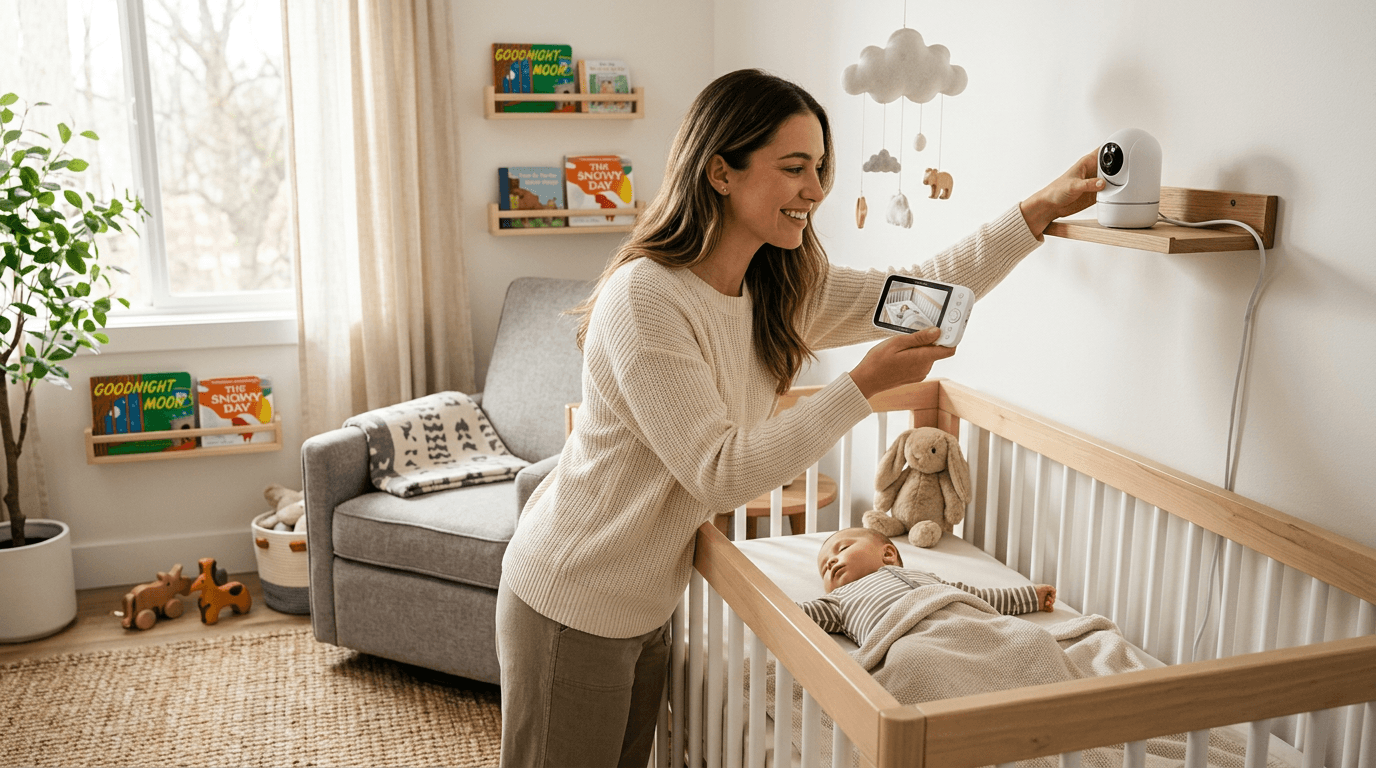
And mind the cord. Any camera, WiFi or not, has a power cord, and cords are a strangulation hazard. Mount the camera and run the cable so the cord stays at least 3 feet from the crib and well out of a standing baby's reach.
So which should you buy?
Match the monitor to your actual life, not the spec sheet:
- Pick non-WiFi if you mostly want to watch and listen from the next room, you would rather not run a smart camera in your child's room, you hate subscriptions, or your internet is flaky. It is the lower-maintenance, lower-risk default for most families.
- Pick WiFi if you truly need to check in from work or travel, you want sleep-tracking features and accept they are wellness data not medical readings, and you are willing to do the router-and-password homework above.
There is no single "best" answer — there is the one that fits how you will actually use it. Want help narrowing models? Start with our guide to choosing a baby monitor, or if you have already decided to skip the internet entirely, see our researched non-WiFi monitor picks.
Sources
We agonized over the smart monitor with the breathing tracker and almost skipped a simple video unit. In the end the dedicated parent-unit monitor was the one we actually used every night because it just turned on and worked, no app loading, no WiFi dropping. Save the worry for safe sleep, not the gadget.
Paraphrased community consensus — not a direct quote.
WiFi baby monitors get hacked, but non-WiFi ones can't.
The hacking risk is real and documented: the FTC's first Internet-of-Things enforcement action followed about 700 camera feeds, including sleeping babies, being posted online. But a WiFi monitor is as safe as you make it (strong password, WPA2/WPA3, 2FA, updates). And non-WiFi isn't 'unhackable magic' — it simply removes the remote attack surface by removing remote viewing. Accurate framing: WiFi adds a feature and a risk; non-WiFi skips both.
A good monitor will keep my baby safe while they sleep.
The AAP says consumer monitors are not medical devices and there's no evidence any of them lower SIDS risk. They're for your peace of mind, not your baby's vital signs. The monitor never replaces safe sleep: back sleeping, firm flat surface, bare crib with only a fitted sheet, and the camera cord kept at least 3 feet from the crib.
Research Sources
Hilly Shore Inc.
Editorial teamIndependent product research team behind Cribworthy. Reviews are grounded in published AAP / CDC / NHTSA / CPSC pediatric guidance, JPMA / GREENGUARD GOLD / OEKO-TEX certification verification, and aggregated buyer sentiment.
124 products reviewed · 22 categories covered · cites AAP, CDC, NHTSA, CPSC, FDA, ACOG.
Safety claims are verified against published pediatric guidelines and CPSC databases. See our editorial standards.