Will a Car Seat Fit My Car? 3-Across and Small Cars
Quick Answer
A car seat fits your car only if both manuals permit that seating position and you can meet the seat’s recline, clearance, support, and installation rules. Measure first, then try the actual seat; less than one inch of movement at the belt path is one check, not a complete fit test. Three-across also requires each seat to remain independently secure and each buckle accessible.
Our Verdict
Measure first, then verify the actual installation against both manuals. Belt-path movement of less than one inch matters alongside recline, support, clearance, child fit, and an approved seating position. For three-across, check each seat independently. Use NHTSA’s inspection-station finder to arrange a certified technician’s check.
Swipe to compare every product.
| Comparison field | #1Graco SlimFit3 LX 3-in-1 Car Seat | #2Clek Fllo Convertible Car Seat | #3Clek Foonf Convertible Car Seat |
|---|---|---|---|
| Verdict | Narrowest of the three: 16.7 in wide, per Graco | Clek's seat-belt-install model, 16.9 in wide | Clek's Rigid LATCH model, 16.9 in wide |
| Price | ~$299.99Buy on Amazon | ~$429.99Buy on Amazon | ~$559.99Buy on Amazon |
| Width (maker) | 16.7 in | 16.9 in | 16.9 in |
| Type | All-in-one (3-in-1) | Convertible | Convertible |
| Pros |
|
|
|
| Cons |
|
|
|
* Prices are approximate. Check the linked retailer for current pricing and availability.
Key Takeaways
- ✓Car seat fit depends on the specific seat, vehicle, seating position, and child; measurements alone cannot confirm a safe installation.
- ✓Before you fall in love with a seat, write down four numbers from your car.
- ✓Parents in a compact brace for the back seat to be too small. It rarely is. The conflict appears in front of it.
- ✓Crash research points to the rear center as the most protected spot, because it sits farthest from any side impact — the preferred single-seat location when you can use it.
- ✓Pickups and two-door cars protect children no less; they create two headaches.
As an Amazon Associate I earn from qualifying purchases. Product prices and availability are subject to change.
Most parents ask "which car seat is safest?" The better question is "will it actually fit my car, in the spot I need it, without forcing the driver to hug the steering wheel?" A seat with top crash ratings is worthless if it cannot be installed tightly in your specific vehicle. Fit is not a footnote to safety. It is the safety.
This guide will not rank seats. It helps you predict, before you spend the money, whether the seat you want will fit the car you have.
Quick answer
Car seat fit depends on the specific seat, vehicle, seating position, and child; measurements alone cannot confirm a safe installation. The real problems are specific: a tall rear-facing seat that shoves the front passenger forward, a center seat with no lower anchors, a narrow back row that cannot hold three across, and a truck or coupe with a shallow, upright cushion. Measurements narrow your options, but only an actual installation check against both manuals can confirm fit. Verify recline, support, clearance, child fit and belt-path movement, not movement alone.
Key takeaways
- The classic "small car" complaint is really a front-seat conflict. A correctly reclined rear-facing seat eats legroom from the passenger in front, not the back row.
- The center position is statistically safer but hardest to install. Many vehicles have no center lower anchors, so you install there with the seat belt, not LATCH.
- Three-across is a width problem, not a brand problem. Most full-size seats are 17 to 19 inches wide and three rarely clear a standard bench.
- Trucks and coupes fail on access and angle, not crash protection. Shallow, upright benches are a recline and belt-path issue, not a reason to avoid the vehicle.
Start with a tape measure, not a wish list
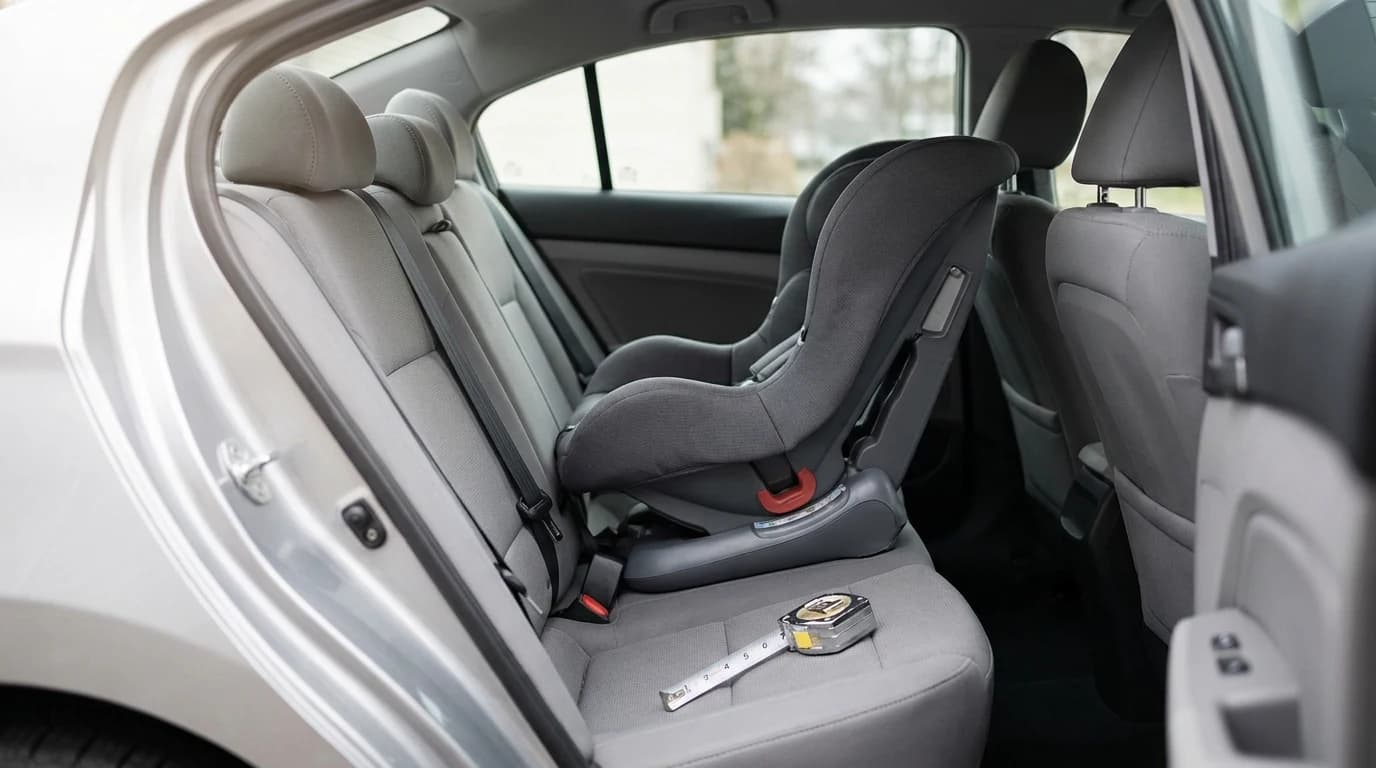
Before you fall in love with a seat, write down four numbers from your car.
| Measure this | Why it decides fit |
|---|---|
| Back-seat width at hip level | Whether two or three seats fit side by side |
| Depth of the rear cushion | Shallow cushions (trucks, coupes) fight a stable base |
| Rear cushion to front seatback | The legroom a rear-facing seat will consume |
| The seat's footprint and recline | Tall, deeply reclined seats need the most front clearance |
The best free fit tool you own is your vehicle owner's manual. It tells you which positions have lower anchors and top tethers, whether the center belt locks for an install, and any weight limits. NHTSA is blunt: read both the car seat instructions and the vehicle manual before installing.
The "small car" myth: it is usually a front-seat fight
Parents in a compact brace for the back seat to be too small. It rarely is. The conflict appears in front of it.
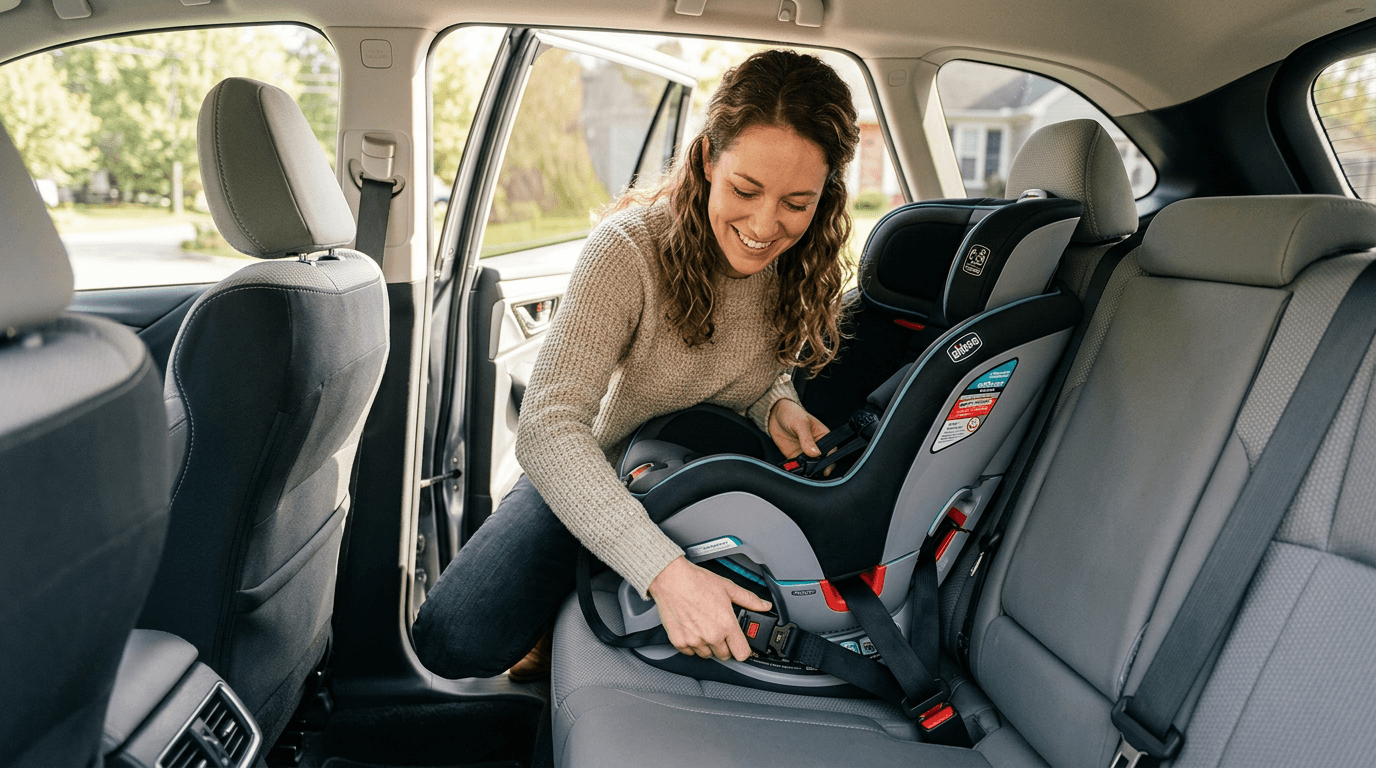
A rear-facing seat must sit at a specific recline so a newborn's head does not slump. That recline pushes the shell toward the front seats, the front passenger slides forward to make room, and ends up cramped. The fixes are clean:
Fix the front-seat fight, not the back seat. Put the rear-facing seat behind the shorter front occupant, pick a more compact rear-facing footprint, or move it to the center, where the recline often gives everyone the most room.
A small car can work with a suitable seat, but fit is not guaranteed. Check both manuals, required recline, front-seat clearance and permitted base overhang, then try the installation before buying if possible.
Center seat: safer, but check your anchors
Crash research points to the rear center as the most protected spot, because it sits farthest from any side impact — the preferred single-seat location when you can use it.
The catch most parents find only after buying: many vehicles have no lower anchors (LATCH) in the center. You cannot borrow one anchor from each side to fake a center LATCH install unless both the vehicle and car seat manufacturers allow that anchor spacing. So a center install is usually a seat-belt install — safe and approved, just a different technique: lock the belt per your manual, route it through the correct belt path, and pull out the slack. And a booster needs a lap-and-shoulder belt; if the center has a lap-only belt, a booster does not belong there.
Three-across: do the width math first
Seat width is only the first filter for three-across. Shell shapes, belt and buckle positions, permitted contact, and each seat’s independent installation also decide fit. Most full-size seats are 17 to 19 inches wide. A sedan bench is often around 50 inches across, so three 18-inch seats need 54 inches and will not fit, while three slim 16- to 17-inch seats might. The playbook:
- Measure your back row at the widest point the seats touch, and use slim seats marketed for three-across.
- Consider seat-belt installation where both manuals allow it; belt position may provide more flexibility than fixed lower anchors. Do not slide a seat outside its permitted seating position to make room.
- Install each seat independently and confirm none moves more than an inch. Touching is fine as long as each is independently tight.
Narrowest seats for 3-across (maker-stated widths)
These are the seats marketed for three-across whose makers publish a seat width on their own product pages. Widths are the manufacturers' figures, not our measurements.
| Seat | Width (maker) | What the maker says about 3-across | Source |
|---|---|---|---|
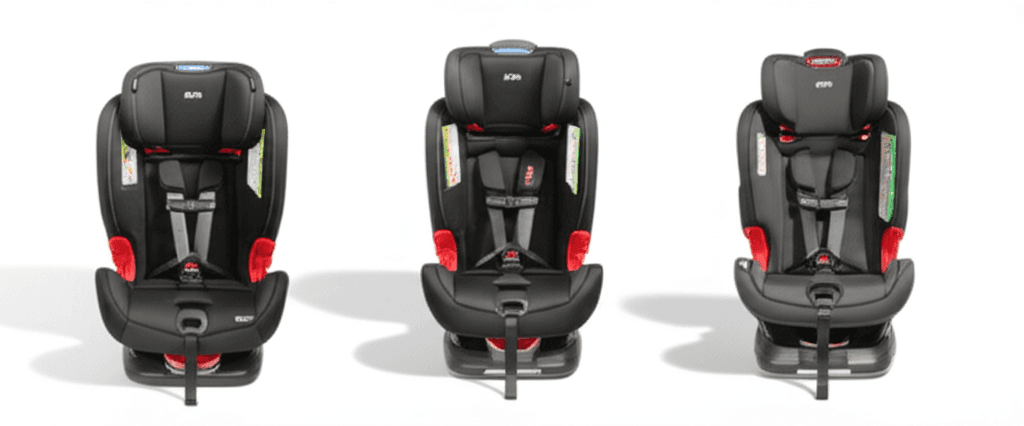
| Graco SlimFit3 LX 3-in-1 | 16.7 in | Fits three across "with select other Graco car seats" | Graco SlimFit3 LX product page |
| Clek Fllo | 16.9 in | Built for 3-across; Clek suggests it for seat-belt installs, "common for 3-across or center seat installs" | Clek Fllo product page |
| Clek Foonf | 16.9 in | "Saves space and makes 3-across seating possible"; Clek's pick if you plan to use Rigid LATCH | Clek Foonf product page |
Three seats at 16.7 to 16.9 inches add up to roughly 50 to 51 inches before any gaps, so measure your bench before you buy, and plan on the seat-belt install above: it lets each seat slide to the edge of its spot. The Diono Radian 3QXT and Cosco Scenera NEXT also come up for three-across, but neither maker states a seat width on its own site, so they are not in the table. The prices and buy links for the three seats above are in the comparison table at the top of this page.
If three never clears the math, a vehicle with third-row seating turns three-across into two-plus-one.
Trucks and coupes: access and angle, not crash worthiness
Pickups and two-door cars protect children no less; they create two headaches. Access: extended-cab and coupe rear seats are tight, and front seats slide forward to reach them, so a bulky rear-facing seat can crowd a tall driver — fix it like the small car (shorter front occupant, or center). Angle: many truck benches are shallow and upright, so use the seat's recline adjusters and level indicator to hit the required angle, and check both manuals, since some seats are approved for these positions and some are not.
One absolute rule for any vehicle with a front passenger airbag: never install a rear-facing seat in front of an active airbag. An inflating airbag strikes the back of the shell hard enough to injure a child. If a truck's only spot is the front, the airbag must be off, confirmed in the manual.
The test that overrides every spec sheet
Once the seat is in, the marketing stops mattering. Grab it at the belt path — where the belt or anchors pass through — and pull firmly side to side and front to back. It must not move more than one inch in any direction. More than an inch means the install is not tight enough, no matter the lab score.
Two more rules from NHTSA: use the installation method permitted by both manuals; do not combine lower anchors and the seat belt unless the car seat manufacturer explicitly permits it; and for forward-facing seats, always use the top tether when the seat and vehicle allow, because it sharply limits how far a child's head pitches forward in a crash. Lower anchors also have a combined weight ceiling — follow the lower-anchor limit on the seat label and in the vehicle manual; switch to a permitted seat-belt install when that limit is reached. NHTSA’s 65-pound combined-weight calculation is a fallback when the seat has no label, not permission to exceed a lower stated limit.
What most people get wrong
The popular belief is that the safest seat is the highest-rated one, and that a small car limits your options. Both are misleading. A top-rated seat installed loosely, in front of an active airbag, or with a lap-only belt under a booster is less safe than a modestly rated seat installed correctly. A compact car may limit rear-facing clearance or approved installation options, so fit must be checked rather than assumed.
The verdict you can act on: measure your back row and front clearance, decide belt-versus-anchor before you buy, and check the one-inch test alongside recline, support, clearance, child fit and both manuals’ restrictions. For a free check, NHTSA runs inspection stations where a certified technician confirms your install.
Once you know your seat will fit, choosing gets easier. Our how to choose the right car seat guide walks the type-and-stage decisions, the best convertible car seats covers the grow-with-you seats, and the car seats category lists what we recommend.
Sources
Research Sources
- Car Seats: Information for Families — HealthyChildren.org (AAP)
- Car Seat Recommendations for Children by Age and Size (PDF) — NHTSA
- Where Should I Install My Car Seat in My Vehicle? — Chicco
- Child Safety Research — Insurance Institute for Highway Safety (IIHS)
- SlimFit3 LX 3-in-1 Car Seat specifications — Graco
- Fllo convertible car seat specifications — Clek
- Foonf convertible car seat specifications — Clek
- NHTSA: Vehicle and Car Seat Parts Explained
- Clek: Foonf dual installation exception
Hilly Shore Inc.
Editorial teamIndependent product research team behind Cribworthy. Reviews are grounded in published AAP / CDC / NHTSA / CPSC pediatric guidance, JPMA / GREENGUARD GOLD / OEKO-TEX certification verification, and aggregated buyer sentiment.
130 products reviewed · 22 categories covered · cites AAP, CDC, NHTSA, CPSC, FDA, ACOG.
Safety claims are verified against published pediatric guidelines and CPSC databases. See our editorial standards.