Baby Ball Pits: The 1.75-Inch Ball Rule and What to Check
Quick Answer
Wait until your baby sits steadily without help, keep the fill shallow and stay within arm's reach. Check the ball diameter: federal rules ban balls under 1.75 inches across for children under 3, a stricter line than the 1.25-inch small-parts test. Skip any set graded 3+ with a small-ball choking warning, and pull cracked balls as you find them.
Our Verdict
A home ball pit is a reasonable sitting-stage toy when the balls are at least 1.75 inches across, the set is graded for babies, the fill is shallow and an adult is close. The famous germ study looked at shared clinic pits, so it is a better reason to be choosy about public pits than to avoid one at home.
Key Takeaways
- ✓Most parents know the small-parts test: anything that fits in a 1.25-inch-wide cylinder is a choking hazard. Balls get a stricter test.
- ✓The 1.75-inch ban covers balls intended for children under 3.
- ✓The study every ball pit article cites is real. Researchers at the University of North Georgia sampled therapeutic ball pits in physical therapy clinics.
- ✓Regulators do not only test toys new. Pieces that break off during use-and-abuse testing count as small parts. A ball that splits at home can leave edges and fragments that the original ball never had.
As an Amazon Associate I earn from qualifying purchases. Product prices and availability are subject to change.
Most ball pit advice argues about germs. The rule that matters more for a baby is a number in federal regulation: 1.75 inches. We researched the CPSC regulations, the CDC milestone list and the one peer-reviewed ball pit study. We have not tested any pit or ball set; read your product's age grading first.
The 1.75-inch line, and why the usual choke test misses it
Most parents know the small-parts test: anything that fits in a 1.25-inch-wide cylinder is a choking hazard. Balls get a stricter test. Under 16 CFR 1500.18(a)(17), a ball intended for children under 3 is banned if it can pass, in any orientation, through a 1.75-inch hole under its own weight.
| Object | Federal test | Banned for under-3s if it... |
|---|---|---|
| Any small toy part | Small-parts cylinder, 1.25 in wide by 2.25 in long | fits entirely inside the cylinder |
| A ball | 1.75 in hole in a rigid template | passes entirely through the hole |
| A piece broken off in abuse testing | The same cylinder, after use-and-abuse tests | fits inside the cylinder |
That gap is the point. A 1.5-inch ball does not fit the small-parts cylinder, so it "passes" the test most parents know. It still fails the ball rule. The CPSC's summary describes the cylinder as approximating the fully expanded throat of a child under three; for balls, the regulation simply draws the line wider.
The practical check: find the ball diameter on the listing or the bag. Anything under 1.75 inches is not a baby product, whatever the photo shows.
The age label decides which rule applies
The 1.75-inch ban covers balls intended for children under 3. A smaller ball can be sold legally if it is graded for ages 3 and up, and 16 CFR 1500.19 then requires a choking-hazard cautionary statement for that small ball.
Reading a ball set's packaging
Fine for a baby's pit
- Graded for babies or toddlers, or for ages 0 and up
- Diameter listed at 1.75 inches or more
Keep it away from under-3s
- Graded 3+ only
- A choking-hazard warning about a small ball
- No diameter listed and no age grading at all
An unlabeled bulk bag is not proof of a hazard; it just gives you nothing to check, so measure one ball.
What age can a baby use a ball pit?
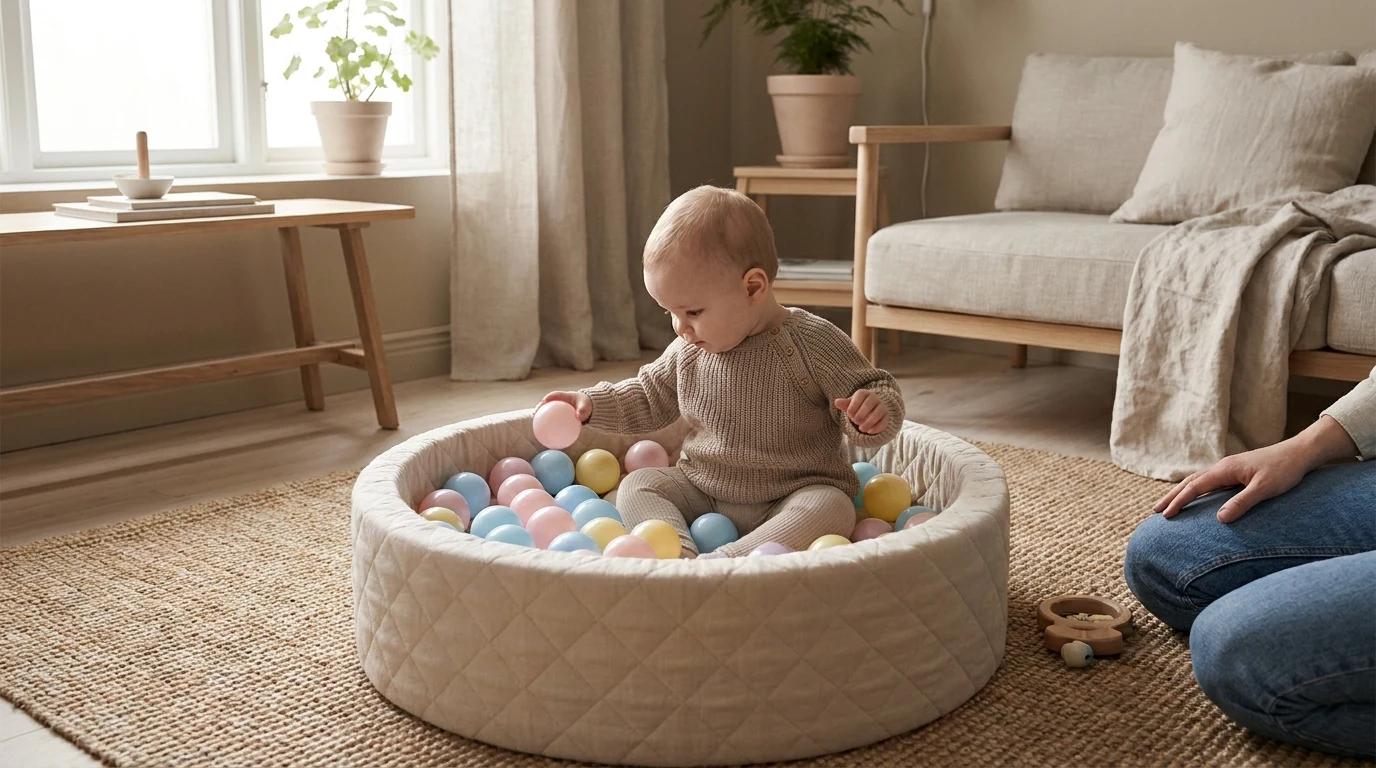
No federal rule sets a minimum age for the pit itself. The rules above govern the balls. Our editorial line is a skill, not a birthday: steady sitting without help. The CDC's 9-month milestone list includes "Sits without support" and getting into a sitting position alone. Many babies get there earlier; the milestone shows when most have.
A baby who cannot sit or roll freely has no way to push up out of a pile of balls. We found no published incident data on babies in home ball pits either way, so this is a supervision rule, not a statistic: an adult within arm's reach, and a fill shallow enough to keep a sitting baby's chest clear.
How many balls do you need?
Box counts mean little alone, because ball volume rises with the cube of the diameter. A 2.75-inch ball takes up about 1.8 times the space of a 2.25-inch ball, so "200 balls" fills very different depths depending on size.
We calculated counts for round pits, assuming poured spheres fill about 60% of the space. That is the figure for randomly poured spheres (roughly 0.59 to 0.63). Soft walls and dented balls move real counts by roughly 10% either way.
| Pit inside diameter | Fill depth | 2.25 in balls | 2.75 in balls |
|---|---|---|---|
| 30 in | 6 in | about 430 | about 230 |
| 30 in | 10 in | about 710 | about 390 |
| 36 in | 6 in | about 610 | about 340 |
| 36 in | 10 in | about 1,020 | about 560 |
| 48 in | 6 in | about 1,090 | about 600 |
| 48 in | 10 in | about 1,820 | about 1,000 |
- 1.75 in the federal minimum for a ball meant for under-3s
- 1.8x space a 2.75 in ball takes vs a 2.25 in ball
- 6 in a shallow fill we would start a new sitter with
Source: Cribworthy calculation: pit volume x 0.6 packing / one ball's volume.
For a sitting baby, the 6-inch rows are the ones to buy for. Check a set's stated count and diameter against the pit you own before ordering extra bags.
The germ question: what the one study actually tested
The study every ball pit article cites is real. Researchers at the University of North Georgia sampled therapeutic ball pits in physical therapy clinics. Their 2019 paper in the American Journal of Infection Control reported "considerable microbial colonization," including 8 opportunistic pathogenic bacteria and 1 opportunistic pathogenic yeast.
The evidence limit: those were shared clinic pits used by many children. The paper did not study a home pit used by one family, and its abstract describes sampling, not a test of any cleaning method. Anyone quoting it as proof that your living-room pit is dangerous is stretching it.
What follows from it is modest and practical:
- Shared pits (play cafés, therapy clinics, soft-play centers) are where the study's finding applies.
- A home pit mostly carries your own household's germs, like any floor toy.
- Wash and dry fully. Balls that stay wet inside a bag are the obvious thing to avoid. Our guide to baby-safe cleaning products covers what to look for on a label.
The check that matters after month one: broken balls
Regulators do not only test toys new. Pieces that break off during use-and-abuse testing count as small parts. A ball that splits at home can leave edges and fragments that the original ball never had.
Monthly ball pit check
- Squeeze a handful at a time and pull any ball that is cracked, split or crushed flat
- Count against the size table: a pit that looks emptier may mean balls are going missing
- Check any new ball added from another set, which may be a different, smaller size
- Look under the sofa: escaped balls are the ones a baby finds unsupervised
Where a ball pit fits in a baby's play space
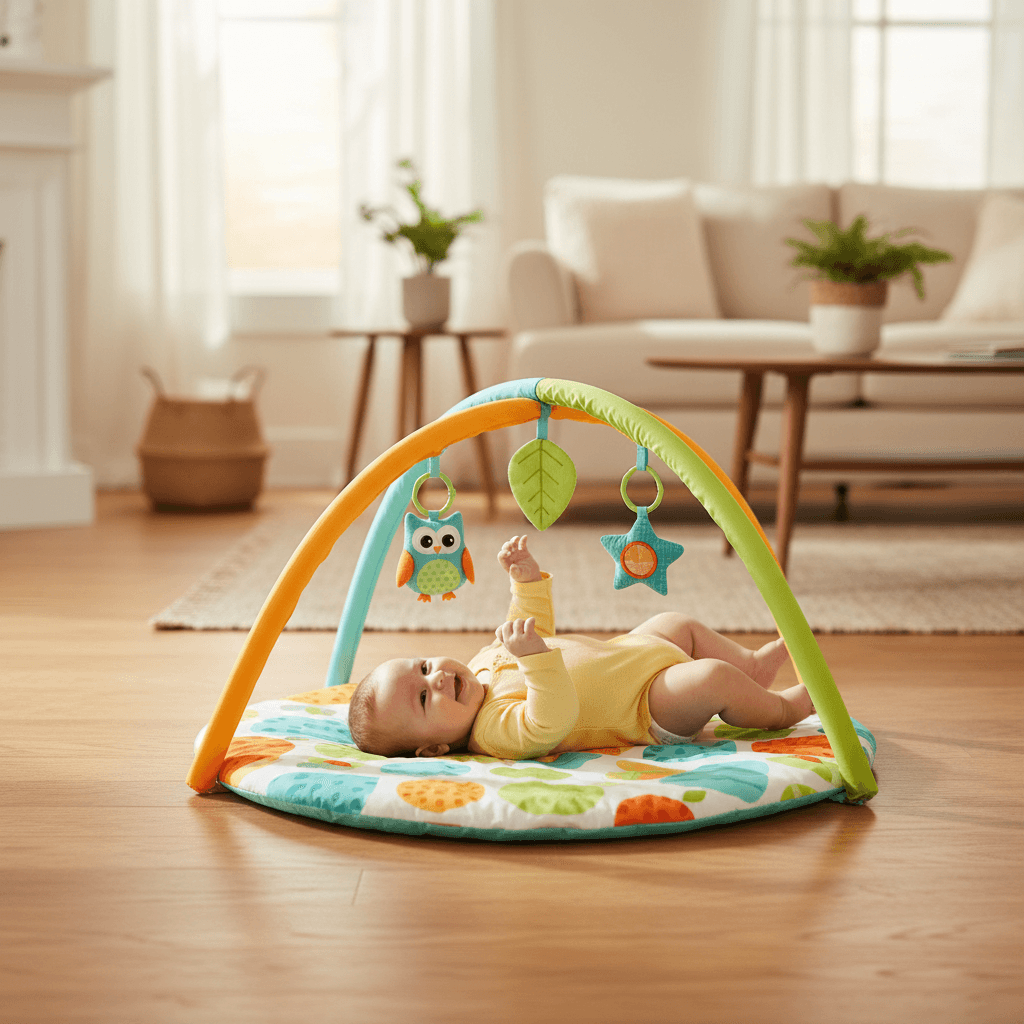
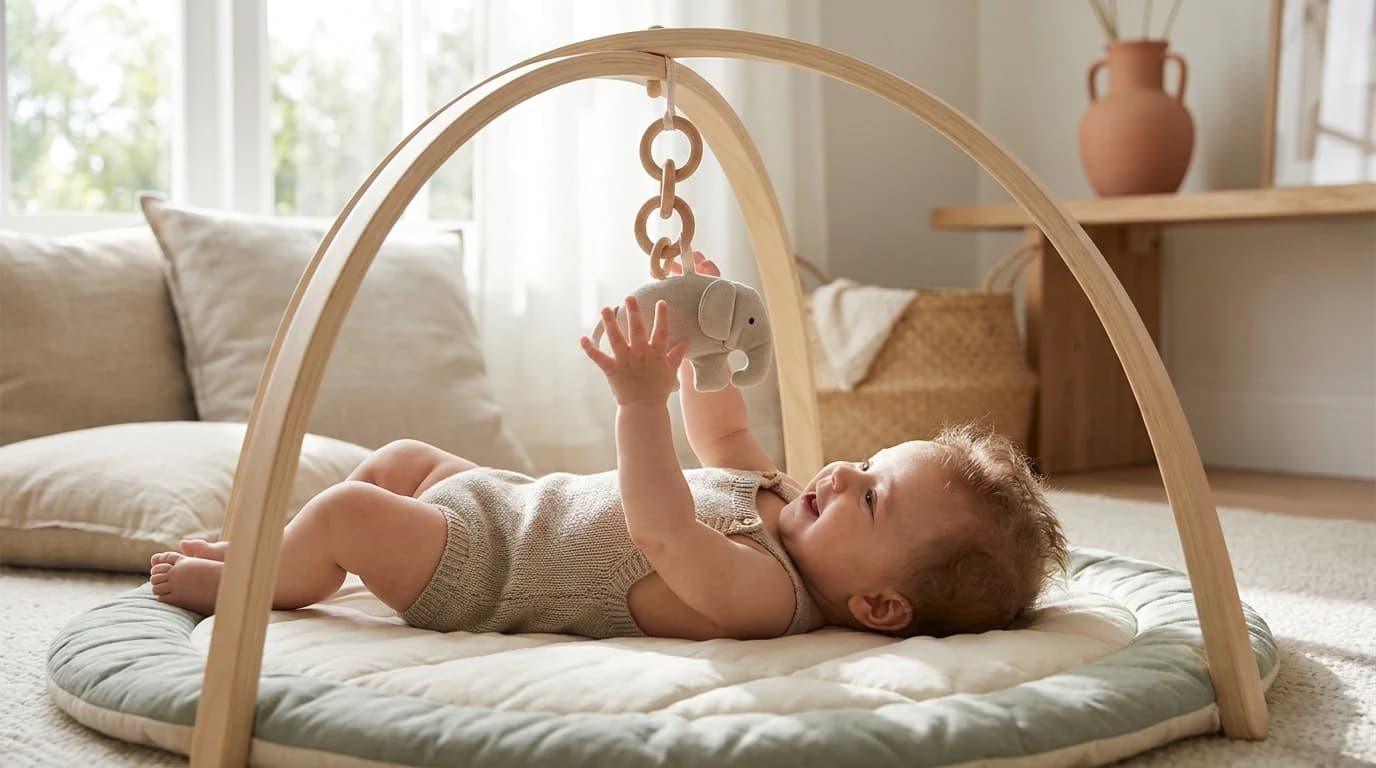
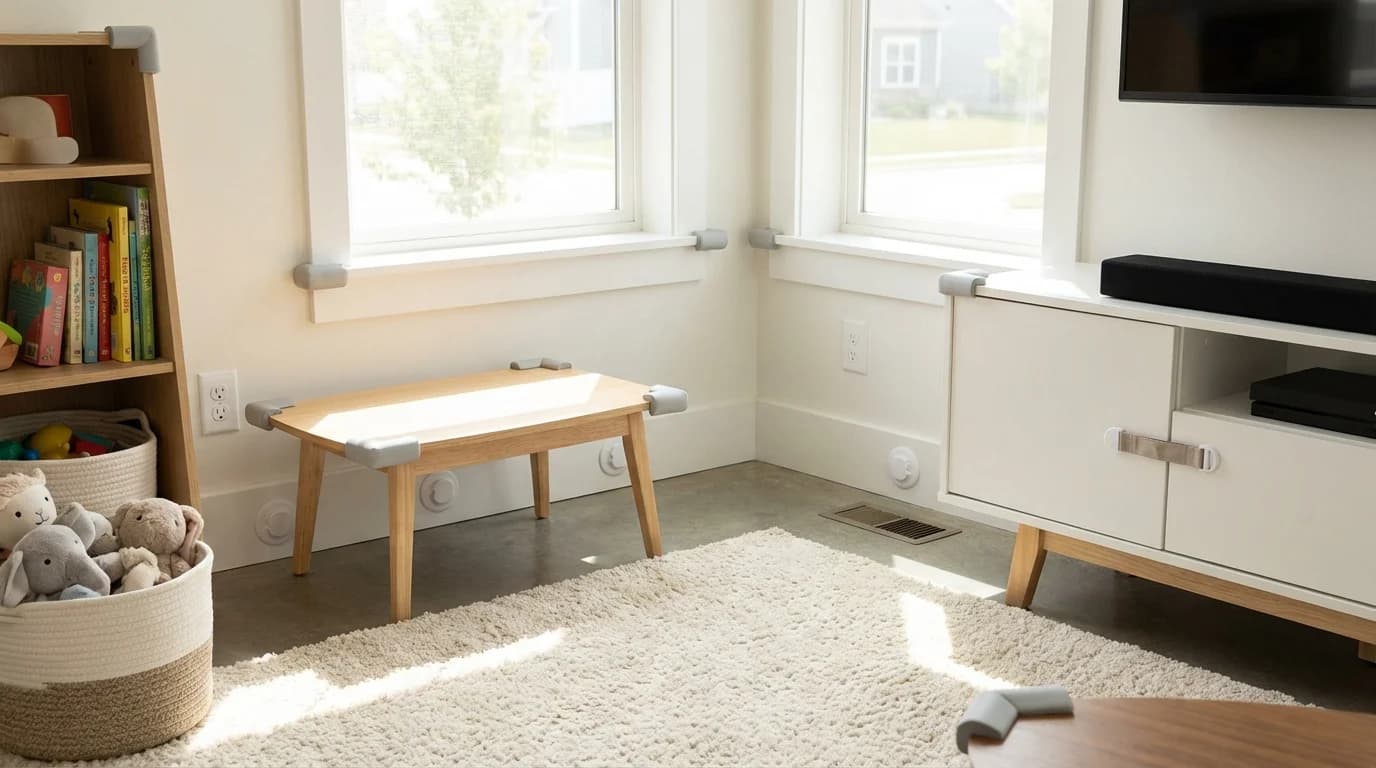
A ball pit is a sitting-stage toy, not a first toy. Before steady sitting, a play gym or play mat does more; our activity gym vs activity center comparison maps each stage, and our play-mat and activity-gym picks cover the gear. Work through the baby-proofing checklist first, because loose balls end up everywhere.
Research Sources
- eCFR — 16 CFR 1500.18(a)(17): balls intended for children under 3 (1.75-inch test)
- eCFR — 16 CFR 1500.19: small ball cautionary labeling
- CPSC — Summary Information for Small Parts, 16 CFR Part 1501 (PDF)
- CPSC — Small Parts for Toys and Children's Products (business guidance)
- CDC — Important Milestones: Your Baby By Nine Months
- Oesterle et al., American Journal of Infection Control (2019) — Are ball pits located in physical therapy clinical settings a source of pathogenic microorganisms?
Hilly Shore Inc.
Editorial teamIndependent product research team behind Cribworthy. Reviews are grounded in published AAP / CDC / NHTSA / CPSC pediatric guidance, JPMA / GREENGUARD GOLD / OEKO-TEX certification verification, and aggregated buyer sentiment.
128 products reviewed · 22 categories covered · cites AAP, CDC, NHTSA, CPSC, FDA, ACOG.
Safety claims are verified against published pediatric guidelines and CPSC databases. See our editorial standards.