Activity Gym vs. Activity Center vs. Walker: What Baby Needs
Quick Answer
These are four separate products. A play gym (activity mat) is a padded mat with an overhead toy arch for a baby who cannot yet sit, and it is the one most babies from newborn to pre-sitting actually need. A stationary activity center is a wheels-free seat ringed with toys, useful in short stretches once a baby has head and trunk control, around 4 to 6 months. A mobile baby walker has wheels, and the American Academy of Pediatrics has called for a ban on it because it causes serious injuries and offers no developmental benefit. There is no safe "activity center walker" with wheels; if it rolls, skip it.
Our Verdict
Buy a play gym for the first six months as a tummy-time anchor, add a wheels-free stationary activity center later only for short hands-free stretches, and skip the mobile baby walker entirely no matter what the listing calls it. None of these beats the real driver of development: supervised time on the floor.
Key Takeaways
- ✓Buy a play gym for the first six months as a tummy-time anchor, add a wheels-free stationary activity center later only for short hands-free stretches, and skip the mobile baby walker entirely no matter what the listing calls it. None of these beats the real driver of development: supervised time on the floor.
- ✓These are four separate products. A play gym (activity mat) is a padded mat with an overhead arch of dangling toys for a baby who cannot yet sit, and it is the one most babies from newborn to pre-s...
- ✓Match the product to the milestone, not the marketing. A play gym is for a baby on their back or belly; an activity center is for a baby with head and trunk control; a walker is for no one.
- ✓For the first half-year, the play gym matches what your baby is working on. On their back, your baby tracks and bats at the hanging toys, building vision and reaching. Flipped to their belly for tu...
- ✓A stationary activity center is the seat-ringed-with-toys product your baby stands or bounces in, and the word that matters is stationary: it stays put. These are fine to introduce once your baby h...
As an Amazon Associate I earn from qualifying purchases. Product prices and availability are subject to change.
"Activity gym," "activity mat," "activity center walker," "activity gym for babies": the baby-gear aisle uses four similar names for four very different products. One builds the muscles your baby needs to crawl. One pediatricians want banned. Here is how to tell them apart and which your baby actually needs at each age.
Quick answer
These are four separate products. A play gym (activity mat) is a padded mat with an overhead arch of dangling toys for a baby who cannot yet sit, and it is the one most babies from newborn to pre-sitting genuinely need. A stationary activity center is a wheels-free seat ringed with toys, useful in short stretches once your baby has head and trunk control, around 4 to 6 months. A mobile baby walker has wheels, and the American Academy of Pediatrics has called for a ban on its manufacture and sale because it causes serious injuries and offers no developmental benefit. There is no safe "activity center walker" with wheels; if it rolls, skip it.
Key takeaways
- Match the product to the milestone, not the marketing. A play gym is for a baby on their back or belly; an activity center is for a baby with head and trunk control; a walker is for no one.
- Only the wheels are dangerous. A wheels-free stationary activity center is a reasonable short-use product. A mobile walker (wheels) is the one the AAP wants pulled from shelves.
- Floor time beats every container. Babies build what they need from supervised time on a mat, not from sitting upright in a frame.
- "Activity center walker" is a confusing label, not a safe hybrid. If it has wheels, it is a walker, whatever the box calls it.
The four products, side by side
| Product | What it is | Best age | What it builds | Safety verdict |
|---|---|---|---|---|
| Play gym / activity mat | Padded floor mat with an overhead toy arch | Newborn to sitting (~0-6 mo) | Tummy-time strength, reaching, vision, neck and shoulder control | Safe and recommended, supervised and awake |
| Stationary activity center | Seat ringed with toys; baby bounces or pivots in place, no wheels | ~4-6 mo, once head and trunk control is solid | Light standing practice, hand play; minimal real development | OK in short stretches; not a developmental tool |
| Mobile baby walker | Wheeled frame a baby scoots across the floor | None | Nothing; can delay walking | Skip entirely; AAP calls for a ban |
| Floor (no product) | A blanket on a safe floor | Any age | Everything a gym does, free | The gold standard |
Start here: the play gym (activity mat)
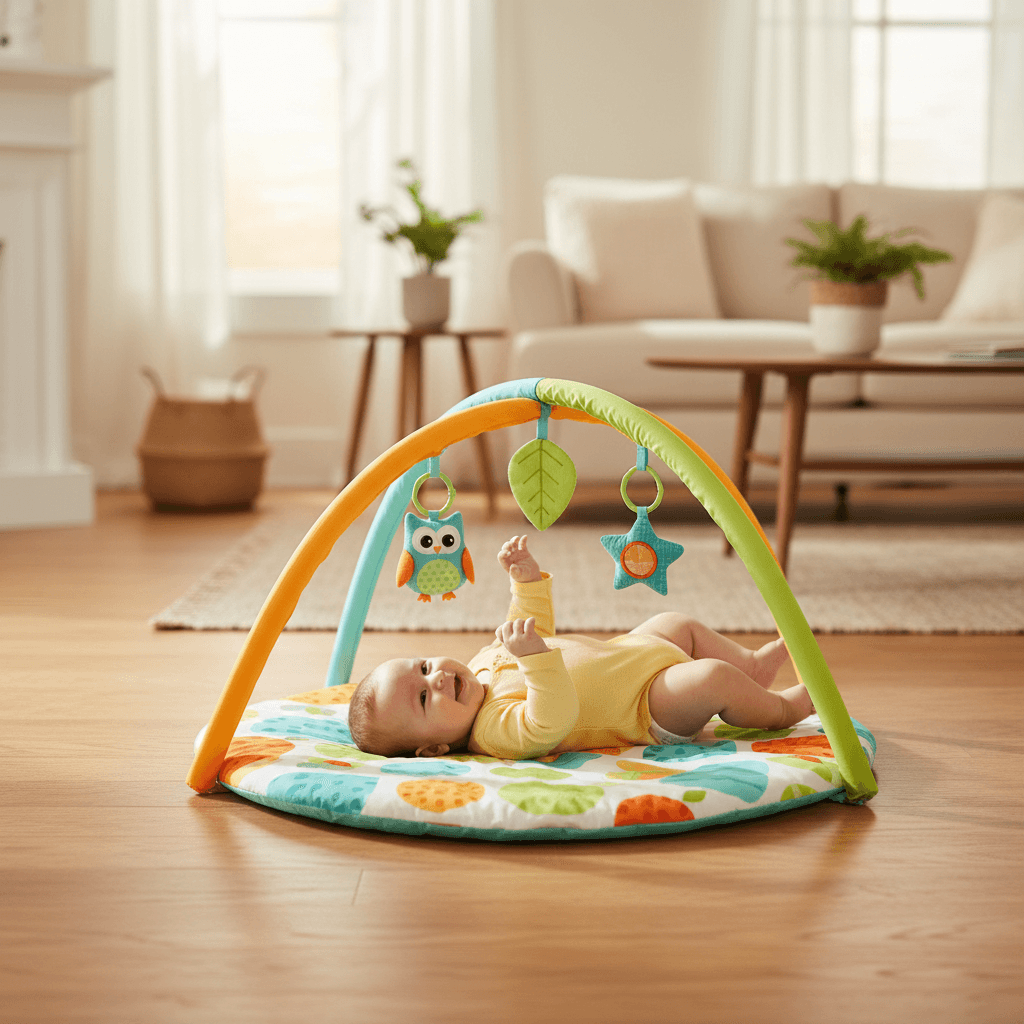
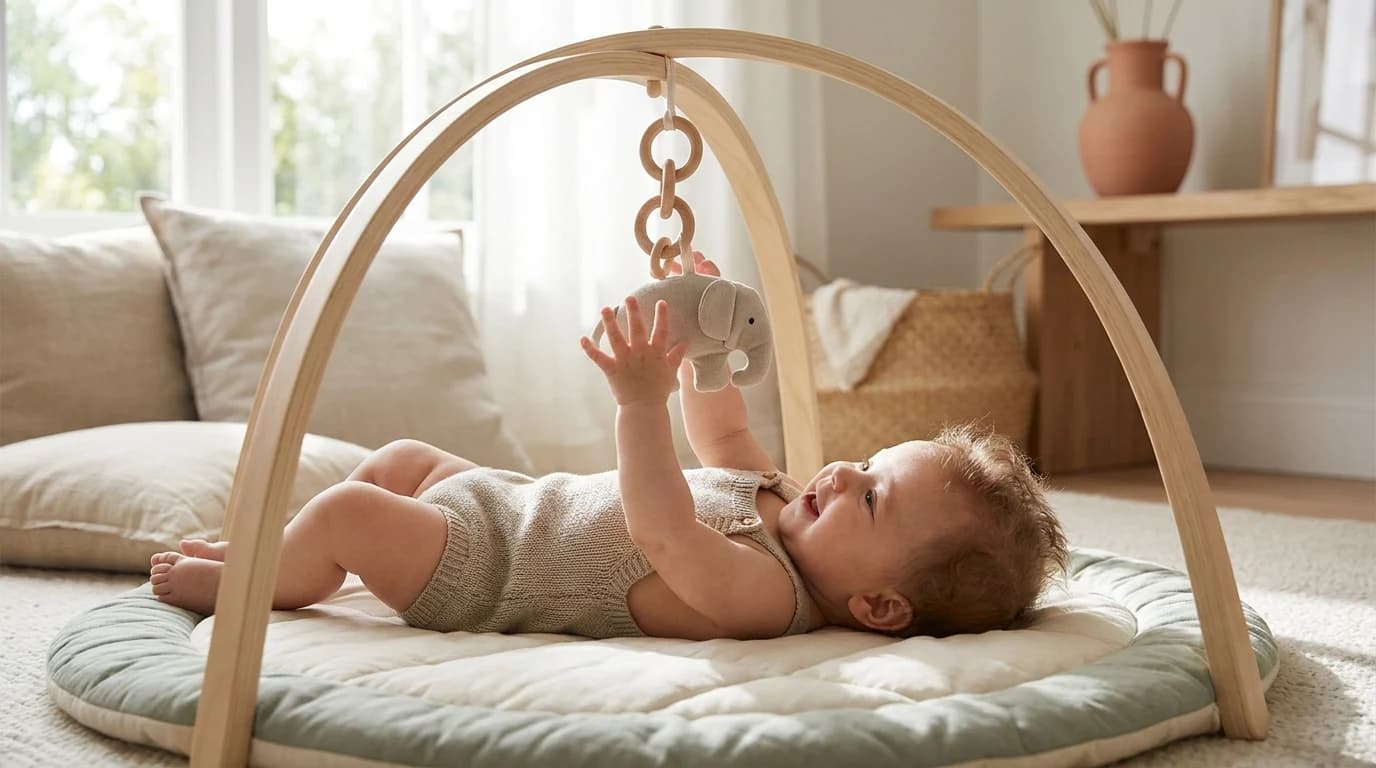
For the first half-year, the play gym matches what your baby is working on. On their back, your baby tracks and bats at the hanging toys, building vision and reaching. Flipped to their belly for tummy time, the same mat is where the real work happens.
The AAP recommends starting tummy timetummy timeSupervised awake time on the stomach — builds neck, back, and arm strength and prevents flat-head syndrome. Aim for a few minutes several times a day from day one. as a newborn, in short supervised sessions of a few minutes, two to three times a day, building up as your baby gets stronger. That floor work builds the neck, shoulder, and trunk strength your baby needs to sit, crawl, and eventually walk. A play gym does nothing a clean blanket cannot, but the overhead arch gives a young baby a reason to look up, reach, and push.
Shopping this category? See our play mats and activity gyms picks, our best play mats and activity gyms guide, and our tummy time tips for newborns.
Next: the stationary activity center (the no-wheels one)
A stationary activity center is the seat-ringed-with-toys product your baby stands or bounces in, and the word that matters is stationary: it stays put. These are fine to introduce once your baby has full head and neck control and can sit with support, usually around 4 to 6 months, and they buy you a few minutes of contained, hands-free time.
Be honest about what they are, though: a convenience product, not a development tool. Babies learn to stand and walk by working against the floor, not by being propped upright in a frame, so treat any center, jumper, or floor seat as a short-stretch break. We cover the seated options in our bouncers and swings guide and the upright ones in our walkers and activity centers guide.
Skip entirely: the mobile baby walker
This is where the names get dangerous. A wheeled "walker" and a "stationary activity center" can look almost identical in a thumbnail, and some listings blur the line with phrases like "activity center walker." The distinction is simple and absolute: if it has wheels and the baby rolls across the floor, it is a walker, and the AAP wants it banned.
The reason is not hand-wringing. From 1990 to 2014, an estimated 230,676 children under 15 months were treated in U.S. emergency departments for infant walker injuries, 90.6% of them head or neck injuries and 74.1% from falling down stairs, according to a study in the AAP journal Pediatrics. A baby in a walker can move more than 3 feet in one second, which is why the AAP says walkers are "never safe to use, even with an adult close by." That speed puts hot drinks, stove handles, pool edges, and the top of a staircase suddenly in reach. Walkers can also delay walking, the opposite of what the name promises.
Tougher standards helped: the ASTM F977 standard added a stair-fall stop in 1997, and CPSCCPSCThe US federal agency that issues product recalls and enforces safety standards on cribs, strollers, car seats, and other juvenile products. data shows walker ER injuries fell from about 25,700 in 1992 to about 2,600 in 2005, a roughly 90% drop. But "far fewer injuries" is not "safe," walkers have still been tied to dozens of deaths, and Canada banned their sale outright.
What most parents get wrong
The common assumption is that a "walker" or "activity center" helps a baby learn to walk faster, so it must be good for development. The research says the reverse: containers that hold a baby upright do not teach walking and can delay it, because babies build the strength and balance to walk by moving freely on the floor, not by sitting in a frame. The honest hierarchy is floor first, play gym for a reason to reach, stationary center only in short stretches, wheeled walker never.
The bottom line
Buy a play gym for the first six months as a tummy-time anchor and a reason for a young baby to reach. Add a wheels-free stationary activity center later only for short hands-free stretches. Skip the mobile baby walker completely, whatever the listing calls it. And remember every one of these is optional next to the thing that actually drives development: supervised time on the floor.
Is an activity gym the same as an activity center?
No. An activity gym (or activity mat) is a floor mat with hanging toys for a baby lying down, ideal from newborn to sitting. An activity center is an upright seat ringed with toys for an older baby with head and trunk control. They suit different ages and do different things.
Are activity center walkers safe?
If the product has wheels, it is a baby walker, and the AAP has called for a ban on those because of stair falls and other injuries. A stationary activity center without wheels is the safer choice. The word "walker" in a listing is the red flag; check for wheels.
What age is an activity center for?
Generally once a baby has full head and neck control and can sit with support, usually around 4 to 6 months. Confirm the manufacturer's stated minimums, and use it in short sessions rather than as long-term seating.
Does a baby actually need any of these?
No. Supervised floor and tummy time gives a baby everything a play gym does; the gym just adds a reason to reach and look up. None is required for healthy development.
Sources
Research Sources
Hilly Shore Inc.
Editorial teamIndependent product research team behind Cribworthy. Reviews are grounded in published AAP / CDC / NHTSA / CPSC pediatric guidance, JPMA / GREENGUARD GOLD / OEKO-TEX certification verification, and aggregated buyer sentiment.
115 products reviewed · 20 categories covered · cites AAP, CDC, NHTSA, CPSC, FDA, ACOG.
Safety claims are verified against published pediatric guidelines and CPSC databases. See our editorial standards.