Baby-Safe Cleaning Products: What to Actually Look For
Quick Answer
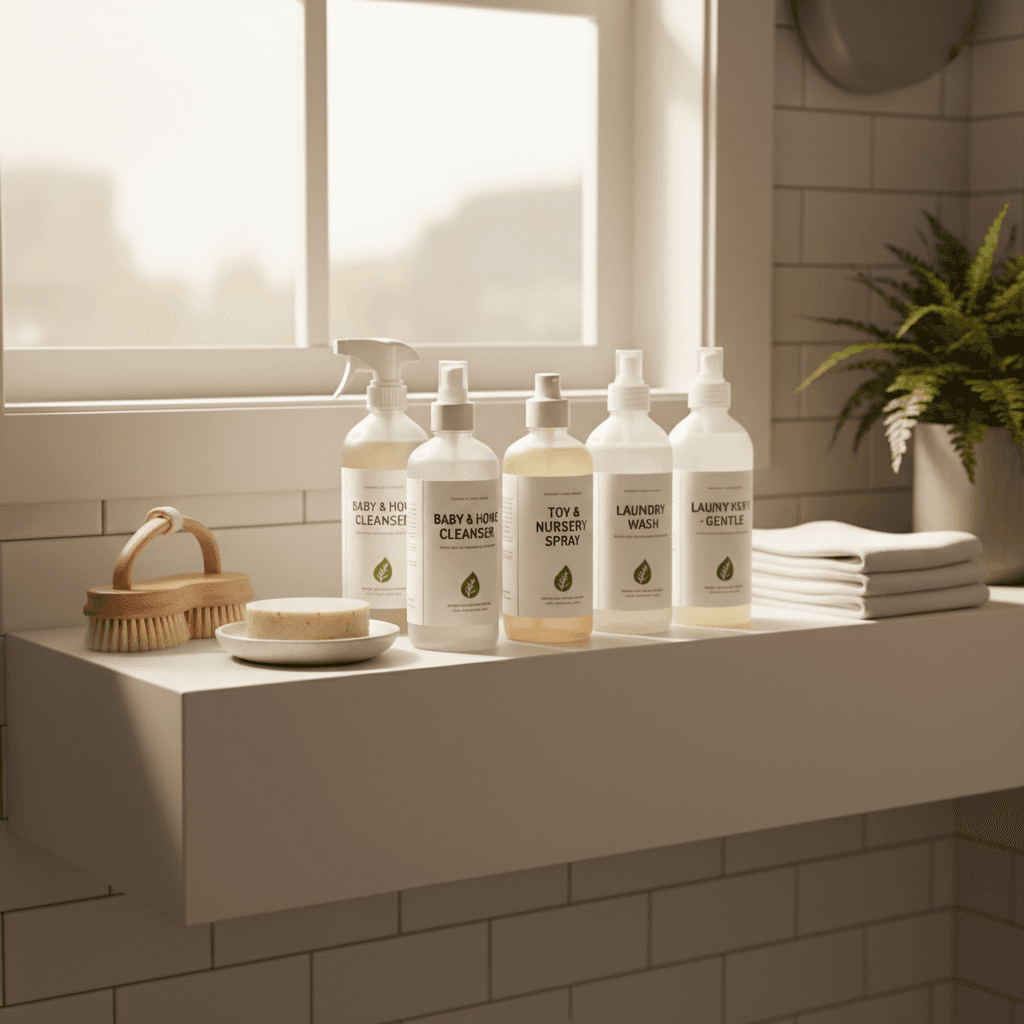
There is no legal definition of "baby-safe," so ignore the front of the bottle. Instead, look for the EPA Safer Choice label, which is the one mark where a government program has actually reviewed every ingredient in the product against strict human-health criteria. Skip products with added fragrance, quaternary ammonium "quats," or anything you would have to mix (bleach plus ammonia can release dangerous gases). Just as important as the product is how you use it: a 2020 Canadian birth-cohort study found infants in homes that used cleaning products most frequently had higher odds of wheeze and asthma by age 3, so clean less aggressively, use a damp cloth rather than soaking surfaces, and always open a window and clean while the baby is in another room.
Our Verdict
Ignore the word "baby-safe" and decide on three things: a verified EPA Safer Choice label, an ingredient list with no added fragrance or quats, and how you actually use it. The biggest, cheapest wins are ventilation and restraint: open a window, use the smallest amount that works, and clean while your baby is elsewhere. That controls the two real drivers of risk, the ingredients and the exposure, better than any label claim.
Key Takeaways
- ✓There is no legal definition of "baby-safe," so ignore the front of the bottle and read three things instead.
- ✓This is the assumption that costs parents the most, and it is wrong.
- ✓Avoiding these is not about fear — it is about removing the few inputs with the clearest downside.
- ✓If you want a single shortcut, this is it.
- ✓Notice that most of these cost nothing. The single highest-value change is ventilation plus restraint, not a pricier bottle.
As an Amazon Associate I earn from qualifying purchases. Product prices and availability are subject to change.
The phrase "baby-safe" is on a thousand bottles and means almost nothing on its own. There is no federal standard a cleaner has to meet before it can call itself gentle, natural, or baby-safe on the label. So when you are standing in the cleaning aisle (or comparing two sprays at 11 p.m.), the marketing is not your friend.
What actually matters is a short, checkable list: which ingredients to skip, which label you can trust, and how you use the product — because how often you clean turns out to matter as much as what you clean with. Here is the honest framework, grounded in EPA, pediatric, and respiratory-health guidance.
The short answer
There is no legal definition of "baby-safe," so ignore the front of the bottle and read three things instead. First, look for the EPA Safer Choice label — it is the one mark where a government program has actually reviewed every ingredient. Second, skip the high-risk ingredients (added fragrance, quaternary ammonium "quats," and anything you would have to mix). Third, and most overlooked: clean less aggressively and with the windows open, because research links frequent cleaning-product use in infancy to a higher chance of wheeze and asthma later — the frequency itself is part of the risk, not just the chemical.
Key takeaways
- "Natural" and "baby-safe" are marketing, not standards. No agency vets those words. Even natural fragrances like citrus can react indoors to form harmful air pollutants.
- One label is actually vetted: EPA Safer Choice. EPA reviews every ingredient in a product — regardless of how small the percentage — against strict human-health criteria.
- Frequency is a risk factor, not just the chemical. In a Canadian birth-cohort study, infants in homes that used cleaning products most often had measurably higher odds of recurrent wheeze and an asthma diagnosis by age 3.
- The deadliest mistake is mixing. Bleach plus ammonia (or other cleaners) can release gases that cause serious harm or death. Never combine products.
What most people get wrong: "natural means safe to breathe"
This is the assumption that costs parents the most, and it is wrong.
A product can be plant-derived and still irritate a baby's airway. The American Lung Association is explicit that "even natural fragrances such as citrus can react to produce dangerous pollutants indoors," and that the volatile organic compounds (VOCs) released by cleaning supplies "contribute to chronic respiratory problems, allergic reactions and headaches." Babies breathe faster than adults and spend their day low to the floor, where heavier vapors settle — so the air right after you clean is their air.
The frequency angle is the part almost no listing mentions. A 2020 study in the Canadian Medical Association Journal followed a birth cohort and found that infants living in homes with the highest frequency of cleaning-product use had higher odds of recurrent wheeze (adjusted odds ratio 1.35) and an asthma diagnosis (adjusted OR 1.37) by age three — but notably no increase in atopy (allergic sensitization). In plain terms: it behaved less like an allergy and more like the airway being repeatedly irritated. The researchers' own framing is that frequent early-life exposure "was associated with an increased risk for childhood wheeze and asthma."
So the upgrade is not just buying a greener spray. It is cleaning a little less reflexively, with more air.
The skip list: ingredients and claims to avoid
When two products look similar, this is the tiebreaker. Favor the one without these:
| Skip / be cautious | Why it matters around a baby |
|---|---|
| Added "fragrance" / "parfum" | Catch-all term that can hide dozens of VOCs; a leading source of cleaning-related airway irritation |
| Quaternary ammonium compounds ("quats," e.g. benzalkonium chloride) | Common in disinfecting sprays/wipes; linked to asthma and skin irritation |
| Anything requiring mixing | Bleach + ammonia (or vinegar with bleach) can create toxic gases |
| Vague claims: "natural," "green," "non-toxic," "baby-safe" | No agency verifies these words; treat them as zero information |
| Aerosol sprays in small rooms | Fine droplets stay airborne longer in a baby's breathing zone |
Avoiding these is not about fear — it is about removing the few inputs with the clearest downside.
The one label worth trusting: EPA Safer Choice
If you want a single shortcut, this is it. EPA's Safer Choice is a voluntary certification, and earning the label is not a rubber stamp: EPA states that "before a product can carry the Safer Choice label, EPA reviews all chemical ingredients, regardless of their percentage in the product," and "every ingredient must meet strict safety criteria for both human health and the environment, including carcinogenicity, reproductive" toxicity, and more. The program also checks that the product actually performs and that the packaging is reviewed. Roughly 2,000 products currently qualify, so it is not a rare unicorn — you can find an all-purpose cleaner, a dish soap, and a laundry detergent with the mark.
A green leaf on the bottle is decoration. The Safer Choice label is the closest thing to an independent referee.
How to actually clean safely (the part that matters most)
The product is only half of it. Pediatric and respiratory-health guidance converge on a simple protocol:
- Open a window first. Children's Hospital Los Angeles advises to "clean with windows open for ventilation" so a child is not breathing in airborne particles. The American Lung Association adds: never use cleaning products in a small, enclosed space.
- Never mix anything. Don't combine cleaners, and never mix bleach with an ammonia- or acid-containing product — the gases "can lead to chronic breathing problems and even death."
- Clean when the baby is elsewhere, then let the room air out before they are back on the floor.
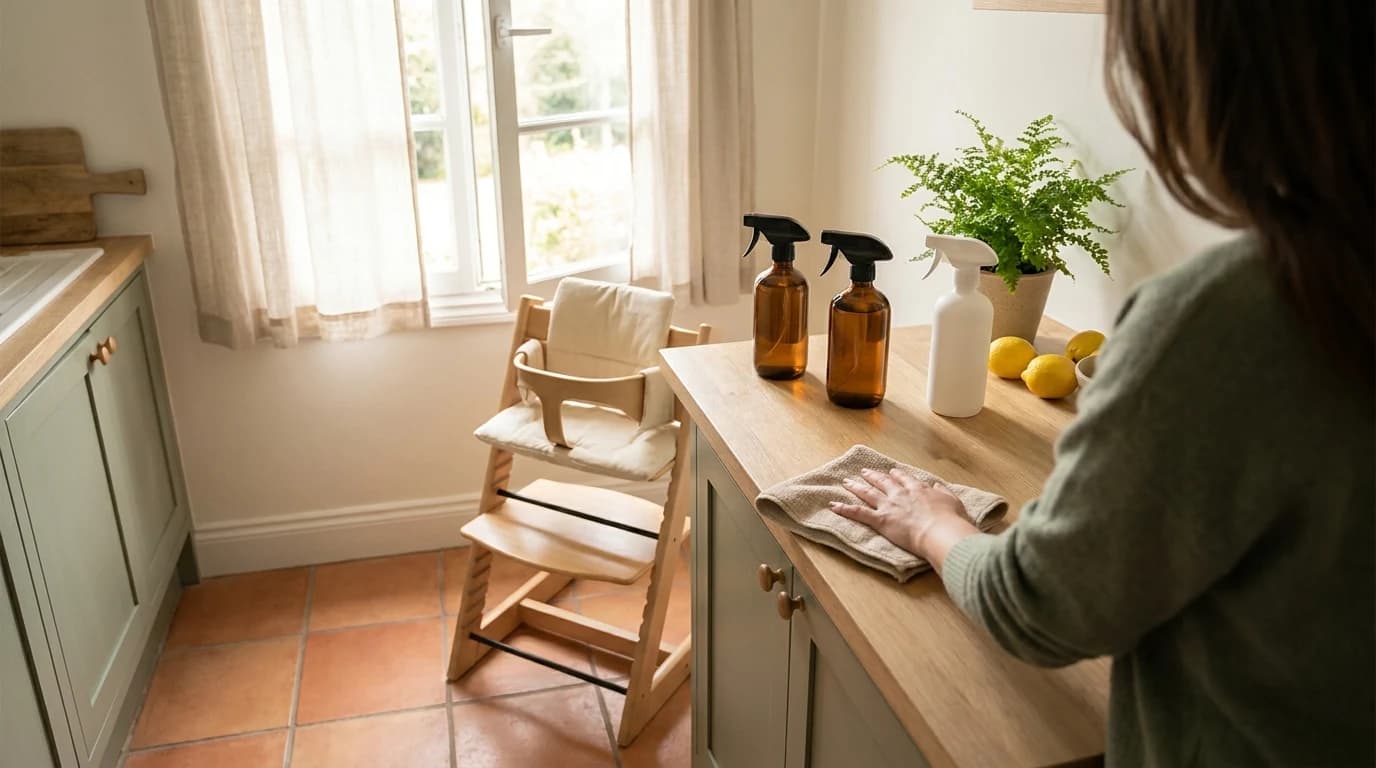
- Wipe down the surface, don't soak it. A damp microfiber cloth lifts most everyday mess; a heavier dose just means more residue and more vapor.
- Rinse anything that touches the mouth. Bottles, high-chair trays, and teething toys get a plain-water rinse after cleaning.
- Store it like it's dangerous — because it is. Keep products in their original packaging with labels intact, capped, and well out of reach. Never leave an open bottle unattended, and never tell a child a product "tastes like candy."
Notice that most of these cost nothing. The single highest-value change is ventilation plus restraint, not a pricier bottle.
So what should you buy and do?
Pick the cleaner with a Safer Choice label and no added fragrance, use the smallest amount that works, open a window, and clean when your baby is in another room. That combination beats any "baby-safe" claim on a label, because it controls the two things that actually drive risk: the ingredients and the exposure.
There is no single magic product — there is a sensible default plus good habits. Want specific picks across categories? See our researched baby-safe cleaning product roundup. And before crawling season, walk the house with our room-by-room baby-proofing checklist.
Sources
- Learn About the Safer Choice Label — US EPA
- Association of use of cleaning products with respiratory health in a Canadian birth cohort — CMAJ 2020 (PMC)
- Cleaning Supplies and Household Chemicals — American Lung Association
- Keep Your Child Safe from Household Cleaners and Chemicals — Children's Hospital Los Angeles
Research Sources
- Learn About the Safer Choice Label — US EPA
- Association of use of cleaning products with respiratory health in a Canadian birth cohort — CMAJ 2020 (PMC)
- Cleaning Supplies and Household Chemicals — American Lung Association
- Keep Your Child Safe from Household Cleaners and Chemicals — Children's Hospital Los Angeles
Hilly Shore Inc.
Editorial teamIndependent product research team behind Cribworthy. Reviews are grounded in published AAP / CDC / NHTSA / CPSC pediatric guidance, JPMA / GREENGUARD GOLD / OEKO-TEX certification verification, and aggregated buyer sentiment.
124 products reviewed · 22 categories covered · cites AAP, CDC, NHTSA, CPSC, FDA, ACOG.
Safety claims are verified against published pediatric guidelines and CPSC databases. See our editorial standards.