Baby Room Proofing Checklist (Room-by-Room, 2026)
Quick Answer
Work room by room, but proof the four deadliest hazards first: anchor all tall furniture and TVs, never leave a baby near water, switch to cordless window blinds, and lock away all chemicals and medications. Start the high-risk items by 4-5 months, before your baby is mobile.
Our Verdict
Proof the four high-risk hazards first — furniture tip-overs, water, window-covering cords, and locked-away poisons — before you spend a dollar on outlet covers.
Key Takeaways
- ✓Proof the four high-risk hazards first — furniture tip-overs, water, window-covering cords, and locked-away poisons — before you spend a dollar on outlet covers.
- ✓Most parents wait until the baby is already crawling. That's too late. Start the high-risk items (furniture anchoring, stair gates, locking chemicals away) before your baby is mobile — by around 4 ...
- ✓Before the room lists, know where the real risk is. These are the leading causes of serious home injury for young children — proof them first, everywhere they appear:
- ✓The room you'll trust them alone in. Get the sleep surface and anchoring right.
- ✓The room with the most furniture, the most cords, and the most floor time.
As an Amazon Associate I earn from qualifying purchases. Product prices and availability are subject to change.
Print this. Walk each room on your hands and knees, at your baby's eye level, and check off every line. The order is deliberate: it front-loads the hazards that actually injure and kill young children, then works down to the nice-to-haves.
When to start, by milestone
Most parents wait until the baby is already crawling. That's too late. Start the high-risk items (furniture anchoring, stair gates, locking chemicals away) before your baby is mobile — by around 4 to 5 months. Babies roll before they crawl, and once they move, things happen in seconds.
Use milestones as the trigger, not the calendar:
| Milestone | Typical window (CDC) | What it unlocks for them |
|---|---|---|
| Rolls / gets to sitting | ~6–9 months | Reaches sideways, grabs cords and small objects |
| Crawls / scoots | ~6–10 months | Floor-level outlets, under furniture, pet bowls, stairs |
| Pulls to stand, cruises along furniture | ~12 months | Tip-overs, tabletops, drawer pulls, window sills |
| Walks, climbs | ~12–18 months | Everything higher up — counters, dressers, toilet lids |
The CDC's revised milestone checklists list "pulls up to stand" and "walks holding on to furniture (cruising)" at the 1-year checkpoint — exactly why furniture tip-overs spike in the toddler years.
The four hazards that matter most
Before the room lists, know where the real risk is. These are the leading causes of serious home injury for young children — proof them first, everywhere they appear:
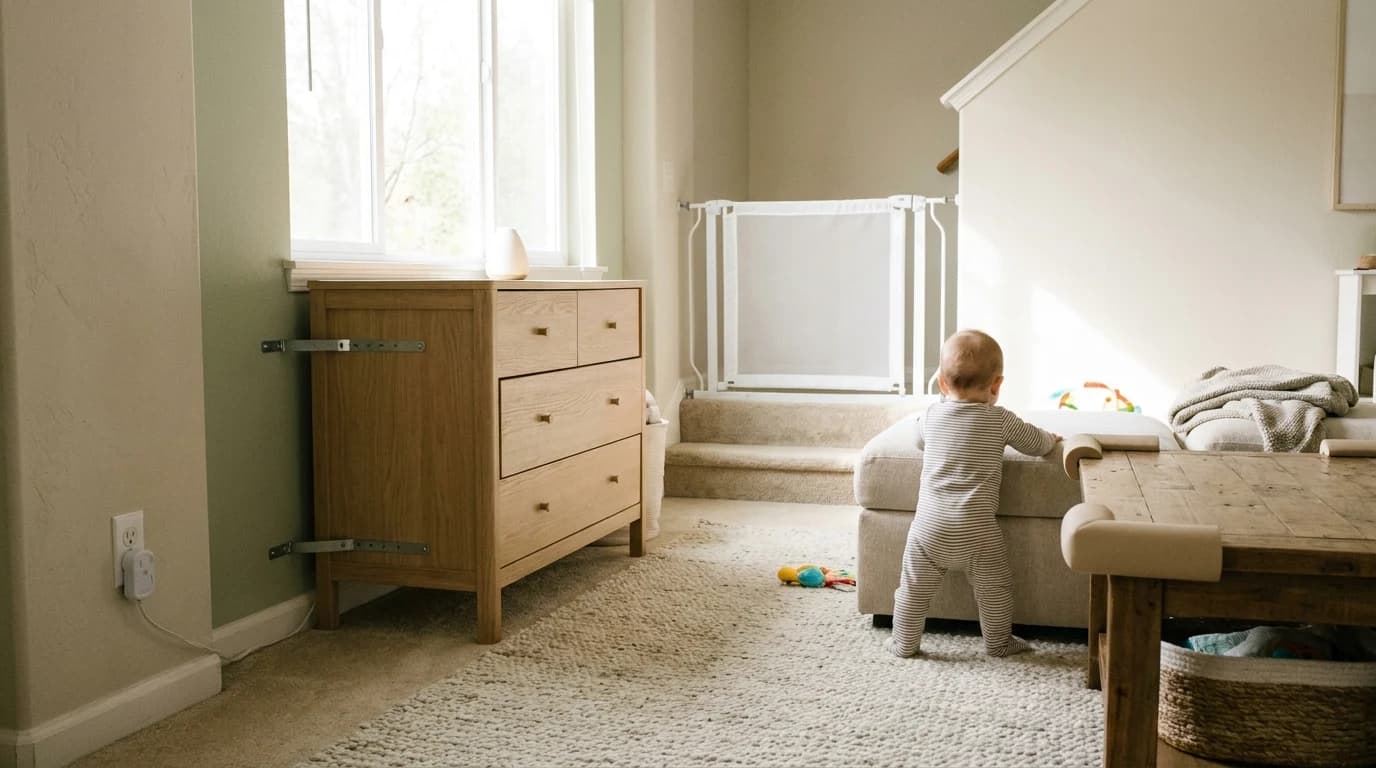
- Tip-overs (dressers, TVs, bookcases). A child is rushed to the ER for a furniture or TV tip-over at least once every hour in the U.S., and 77% of tip-over deaths from 2000–2019 were children under six. Anchor every tall or top-heavy piece to a wall stud.
- Drowning. Drowning is the leading cause of death in children ages 1–4, and a baby can drown in as little as one to two inches of water. Most happen during a lapse in supervision — never step away from the tub.
- Window-covering cords. On average about nine children under five die every year from strangling on window-blind cords, and in CPSCCPSCThe US federal agency that issues product recalls and enforces safety standards on cribs, strollers, car seats, and other juvenile products.'s incident data a child died in 48% of corded-blind incidents. Go cordless.
- Poisoning. Most child poisonings happen while a parent is home but not watching. Cleaning products, medications, and single-use laundry packets must be locked, not just placed up high.
What most people get wrong: Outlet covers and cabinet locks feel like "baby-proofing," so parents do them first — cheap and visible. But the items above (anchoring, water supervision, cordless blinds) are what the data actually links to death and serious injury. A covered outlet next to an un-anchored dresser is a false sense of safety. Do the heavy hazards first.
Nursery
The room you'll trust them alone in. Get the sleep surface and anchoring right.
- Anchor the dresser/changing unit to a wall stud with an anti-tip kit. This is the single most important item in the room.
- Crib meets safe-sleep rules: firm, flat mattress; fitted sheet only; no bumpers, pillows, blankets, or stuffed toys. (See our safe sleep environment guide.)
- Move the crib away from windows, window-covering cords, and wall hangings the baby can pull down.
- Switch to cordless blinds or use cord cleats mounted high and out of reach.
- Lower the crib mattress to its bottom setting once the baby can sit or pull up.
- Cover outlets and route the monitor/lamp cords behind furniture, not draped where a standing baby can grab them. (Mounting tips here.)
- Skip the changing-table strap as a false safety net — never walk away mid-change, strap or not.
Living room
The room with the most furniture, the most cords, and the most floor time.
- Anchor the TV and the stand/console it sits on. Both can come down together.
- Soft corner guards on the coffee table and any sharp-edged low furniture.
- Cordless window coverings here too — living rooms and bedrooms are where most cord strangulations happen.
- Tuck away charging cables, lamp cords, and floor-lamp bases that a cruising baby can pull.
- Anchor or remove tall bookcases; never store the heaviest items up high where a climbing toddler is headed.
- Secure the fireplace with a hearth gate and lock; pad sharp stone edges.
- Pick up small objects — coins, button batteries, magnets, pet kibble. Anything that fits through a toilet-paper tube is a choking risk.
- Lock low cabinets and media units; relocate houseplants that are toxic or tip easily.
Kitchen
The highest concentration of poisons, heat, and pinch points in the house.
- Lock the cabinet under the sink — this is where cleaning products and dishwasher pods live. Use latches that re-lock when the door closes.
- Store all chemicals in original packaging, up high and locked. Never decant into cups or bottles.
- Turn pot handles inward and cook on back burners. Add a stove knob cover or guard.
- Move single-use laundry/dishwasher packets out of sight and reach — they're concentrated and can burst into a child's mouth or eyes.
- Latch the oven and the trash can; add an appliance lock to the dishwasher and fridge if your baby is a puller.
- No tablecloths or dangling placemats a baby can yank, bringing dishes down.
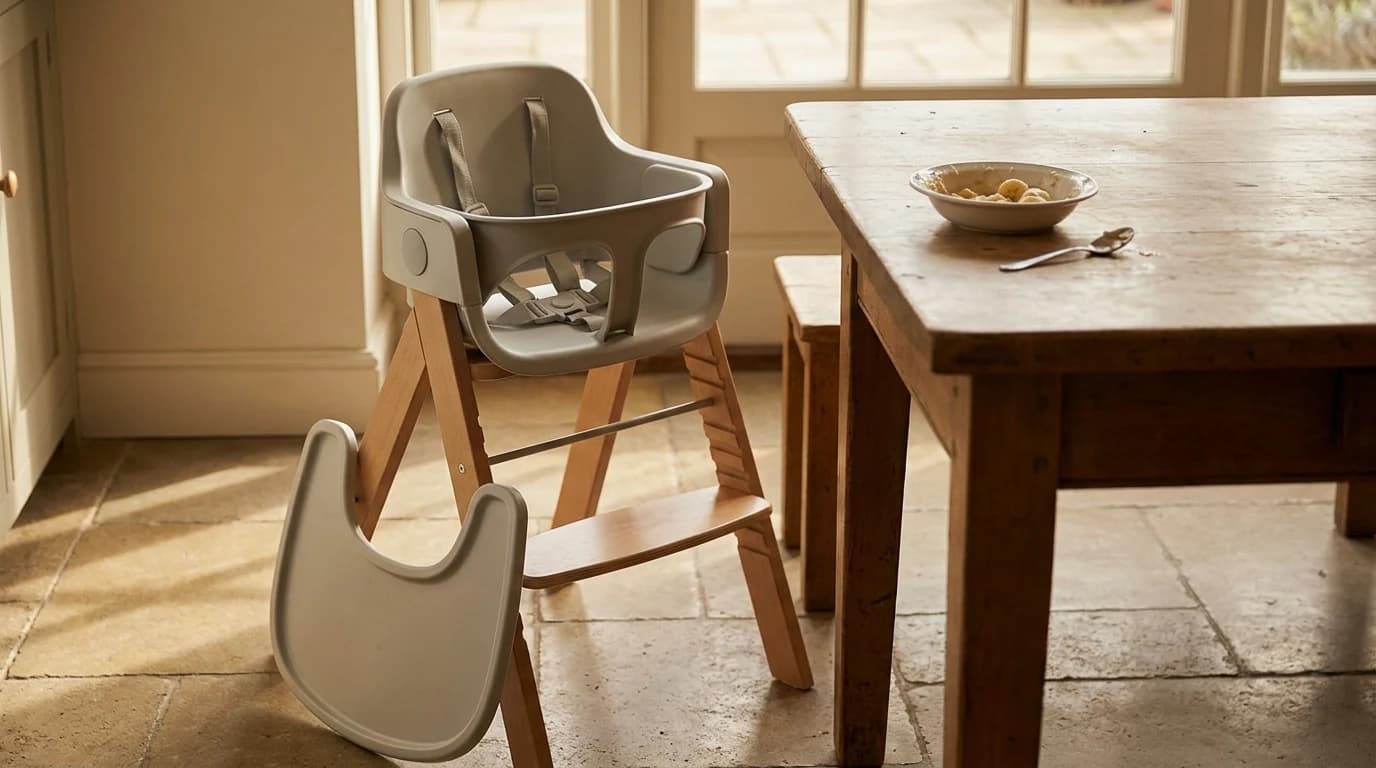
- Keep the high chair away from counters and walls the baby can push off from.
Bathroom
Small, but it holds the two deadliest hazards: standing water and medication.
- Never leave a baby alone in the tub, even for a second — keep a hand on them. Drowning is silent and fast, and an inch or two of water is enough.
- Empty the tub, buckets, and any standing water immediately after use.
- Use a toilet-lid lock and remove the bathtub drain plug when not in use so a baby can't fill the tub.
- Lock all medications and supplements, including vitamins and anything in a purse or nightstand. Save the Poison Help line: 1-800-222-1222.
- Set the water heater to 120°F or lower to prevent scald burns; test bathwater with your wrist.
- Latch the bathroom door or use a doorknob cover so it's closed when not in use.
- Unplug and store hair dryers, straighteners, and razors out of reach.
Stairs & transitions
The most common place a new walker takes a serious fall.
- Install hardware-mounted gates at the top and bottom of every staircase. At the top of stairs, never use a pressure-mounted gate — it can give way; it must be screwed into the wall or banister.
- Pressure-mounted gates are fine at the bottom and in doorways, where a failure won't mean a fall down stairs.
- Check banister gaps — if a baby's head can fit between rails (more than ~3.5 inches), add a banister guard or mesh.
- Gate off rooms you can't fully proof (home office, laundry, garage entry) rather than proofing every item in them.
- See our picks for baby gates for stairs and the broader baby gates & childproofing roundup.
The 10-minute "did I miss anything" sweep
Once the room lists are done, do this fast pass anywhere your baby plays:
- Get on the floor at their height and look for cords, outlets, gaps, and small objects you'd miss standing up.
- Tug-test every anchor — dresser, TV, bookcase, gate.
- Walk the house for water: tub, buckets, pet bowls, toilet.
- Scan for cords: blinds, chargers, lamp, monitor, kettle.
- Check for chokeables: anything that fits through a toilet-paper tube.
Honest caveat: proofing is a layer, not a substitute
The research is clear on one point gear marketing glosses over: no product replaces an adult's attention. Drowning-prevention guidance treats supervision as the primary layer and barriers as backup — never the reverse. Latches buy you seconds when you turn your back; they don't make it safe to turn your back. Buy the gear, anchor the furniture, go cordless — and still keep eyes on your mobile baby.
For the timing-and-order version of this checklist (what to do at 4 months vs. 9 months), see our baby proofing checklist starting at 4 months. For the gear itself, start with baby gates & childproofing.
Research Sources
- Childproofing Your Home — HealthyChildren.org (AAP)
- Preventing Furniture and TV Tip-Overs — HealthyChildren.org (AAP)
- Drowning Prevention for Curious Toddlers — HealthyChildren.org (AAP)
- Nearly Half of Incidents with Kids and Corded Window Coverings Resulted in Death — CPSC
- Milestones by 1 Year — CDC Learn the Signs. Act Early.
- Milestones by 9 Months — CDC Learn the Signs. Act Early.
Hilly Shore Inc.
Editorial teamIndependent product research team behind Cribworthy. Reviews are grounded in published AAP / CDC / NHTSA / CPSC pediatric guidance, JPMA / GREENGUARD GOLD / OEKO-TEX certification verification, and aggregated buyer sentiment.
115 products reviewed · 20 categories covered · cites AAP, CDC, NHTSA, CPSC, FDA, ACOG.
Safety claims are verified against published pediatric guidelines and CPSC databases. See our editorial standards.