How Many Bouncers and Swings Does a Baby Really Need?
Quick Answer
For most families the honest answer is one. You do not need a swing and a bouncer and a floor seat and a jumper — they all count as the same kind of "container" and draw from the same daily time budget. The average baby already spends almost six hours a day held still in devices, which pediatricians consider far too much. Pick one seated container your baby tolerates, add a single play mat for floor time, and stop there. A second unit is only justified for a specific, nameable reason, such as a swing on a second floor of the home.
Our Verdict
Buy one seated container your baby likes plus one play mat, and skip the duplicates until a real problem appears. Because every swing, bouncer, and seat draws from the same daily container-time budget, owning more gear tends to increase the time your baby spends held still — the opposite of what you want. And no container, however many you own, is ever a sleep surface: unsupervised sleep belongs on a firm, flat crib.
Key Takeaways
- ✓Buy one seated container your baby likes plus one play mat, and skip the duplicates until a real problem appears. Because every swing, bouncer, and seat draws from the same daily container-time budget, owning more gear tends to increase the time your baby spends held still — the opposite of what you want. And no container, however many you own, is ever a sleep surface: unsupervised sleep belongs on a firm, flat crib.
- ✓For most families, the honest answer is one. You do not need a swing and a bouncer and a floor seat and a jumper. Pick one seated "container" your baby actually tolerates, add a play mat for floor time, and stop there.
- ✓A "container" is anything that holds your baby in one position — swing, bouncer, car seat, stroller, jumper, exersaucer. They all count toward the same daily budget.
- ✓Parents tend to picture a "container" as one specific gadget, but pediatricians use the word for a whole category.
- ✓Here is the framework we use instead of a shopping list.
As an Amazon Associate I earn from qualifying purchases. Product prices and availability are subject to change.
Quick answer
For most families, the honest answer is one. You do not need a swing and a bouncer and a floor seat and a jumper. Pick one seated "container" your baby actually tolerates, add a play mat for floor time, and stop there. The reason is not budget minimalism, it is development: the American Academy of Pediatrics reports the average infant already spends almost six hours a day in devices that hold them still, and pediatricians consider that far too much. Buying a second container mostly buys your baby more time sitting still.
Key takeaways
- A "container" is anything that holds your baby in one position — swing, bouncer, car seat, stroller, jumper, exersaucer. They all count toward the same daily budget.
- Aim to keep total container time to necessary car travel plus about one hour a day, per pediatric guidance. Owning more containers makes that budget harder to hold, not easier.
- One seated container plus a floor mat covers almost every home. A second unit only earns its place for a specific, nameable reason — not "just in case."
- No container is a sleep surface. If your baby falls asleep in a swing or bouncer, the safe move is to transfer them to a firm, flat crib.
What actually counts as a "container"
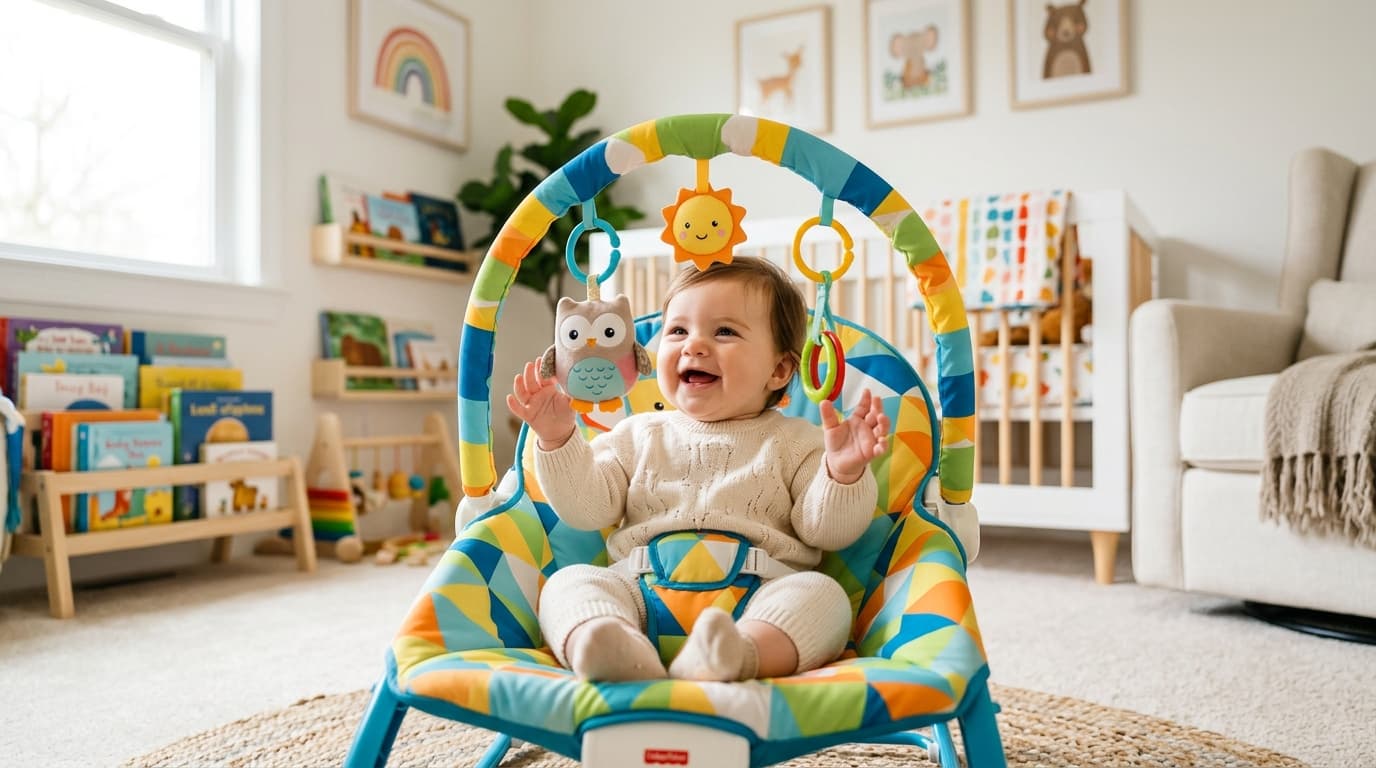
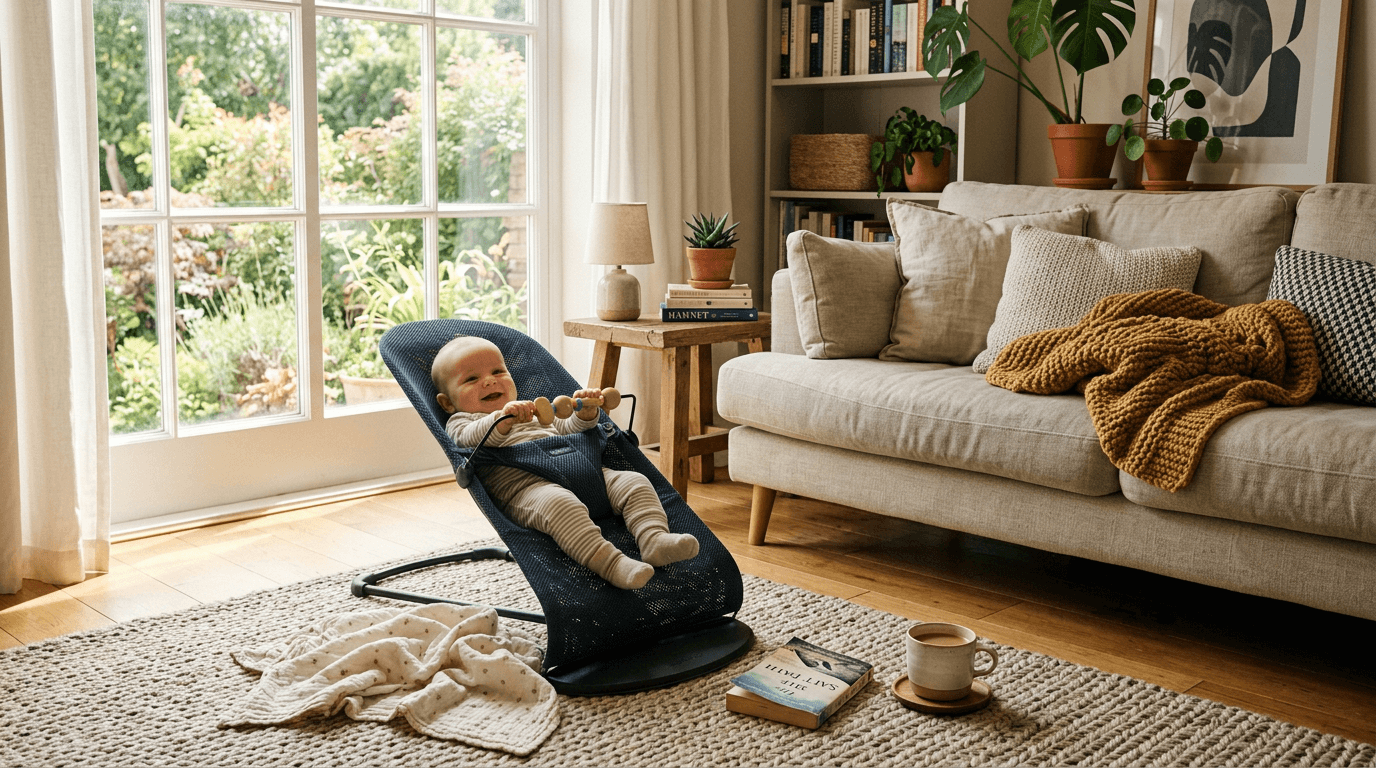
Parents tend to picture a "container" as one specific gadget, but pediatricians use the word for a whole category. A baby container is any device that keeps your baby in the same position without the freedom to move around: baby seats and floor chairs, car seats, strollers, swings, bouncers, jumpers, and exersaucers. Even products marketed as "learning" or "activity" seats count. Babies can do a little playing in them, but they learn best when they can move freely.
That definition is the whole game for the "how many do I need" question. If a swing, a bouncer, and a floor seat all count as the same kind of thing, then owning three of them does not give your baby three different experiences. It gives you three ways to park your baby in roughly the same position — and one shared daily time budget to spend across all of them.
The number that reframes everything: the AAP reports the average baby spends almost six hours a day in containers. Experts say that is far too much. Ideally, container time is limited to the car trips you genuinely need plus about one additional hour or less. Every extra device you buy makes that ceiling easier to blow through, not easier to respect.
The duplication decision matrix
Here is the framework we use instead of a shopping list. For each common piece of gear, the real question is not "is it nice?" but "does a second one solve a problem a floor mat and your arms cannot?" In almost every row, the answer is no.
| Gear | Do most families need more than one? | The only reason a second is justified |
|---|---|---|
| Swing / bouncer | No — pick one, not both | A genuine two-story home where carrying the unit up and down stairs daily is unsafe for you |
| Floor seat (sit-me-up type) | No | Rarely; a rolled towel or your lap does the same job for the few weeks it fits |
| Play mat / gym | One is plenty | Never — you do not duplicate floor space, you just move the mat |
| Jumper / exersaucer | Optional, and time-capped | Skip entirely if you already own a swing or bouncer; it is the same container category |
| High chair | One | A dedicated grandparent's house — buy the cheap second one there, not at home |
The pattern is deliberate. The one row where a duplicate is sometimes defensible — a swing or bouncer on a second floor — is about your back and safety, not your baby's development. Everything else collapses to "one, or none." If you find yourself justifying a second unit with "so I always have one nearby," that is usually a sign your baby is spending too long seated, not that you are under-equipped.
Why "just one" is the developmentally better answer
When a baby is held in a container, they cannot wiggle, reach across their midline, push up, or turn their head freely — the exact movements that build the strength for rolling, sitting, and crawling. Too much time confined is linked to a cluster pediatricians informally call container baby syndrome: a flat spot on the head (plagiocephaly), a head tilt from tight neck muscles (torticollis), and delays in motor and even speech development.
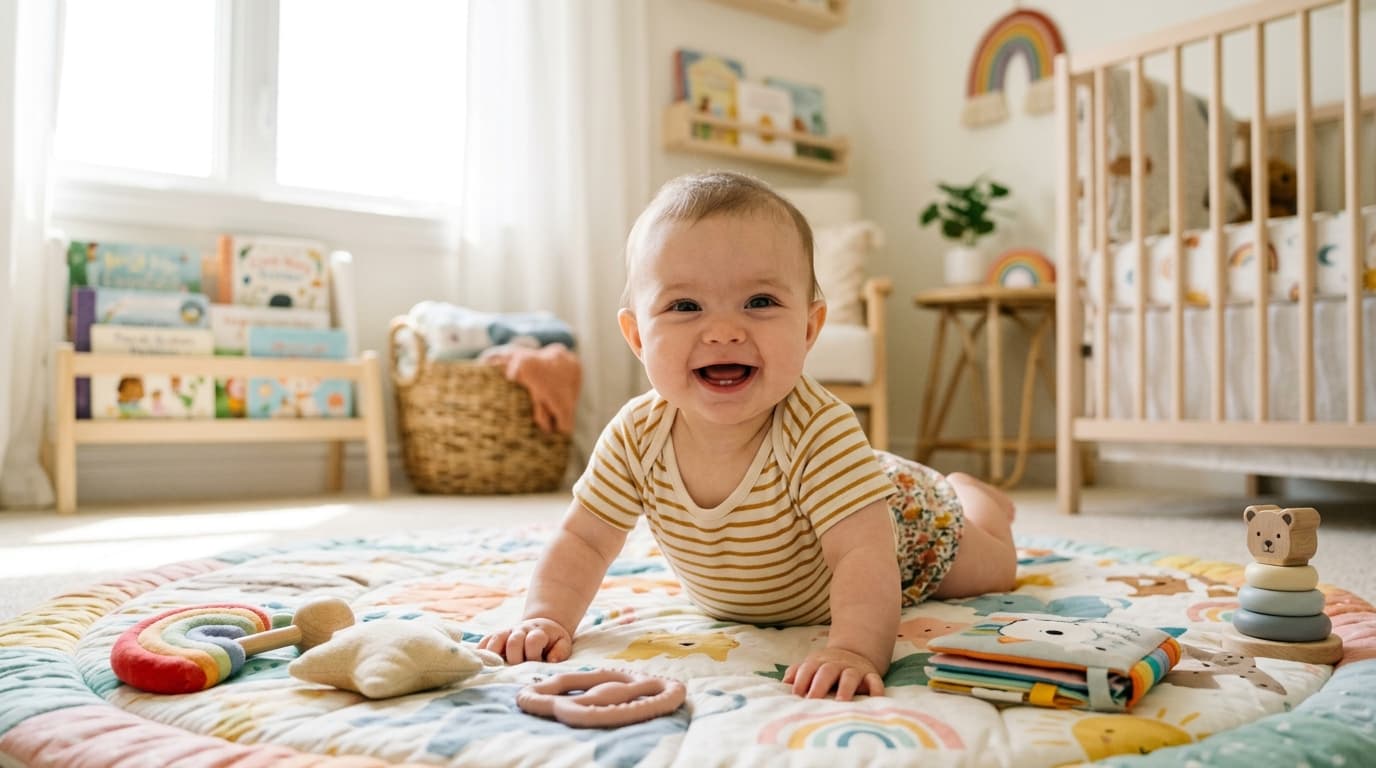
None of that means containers are dangerous in normal, moderate use — a swing that buys you ten minutes to eat lunch is a good tool. The point is that the second container does not add capability; it adds temptation to keep the baby seated. The developmental upgrade almost every home is missing is not more gear. It is more supervised time on the floor — tummy time and open-floor play on a single play mat or gym, where your baby does the "good work" of lifting their head and reaching.
What most people get wrong
The common assumption is that more baby gear equals more coverage — one device per room, a backup for every scenario. The research points the other way. Because every seated device draws from the same daily time budget, a bigger collection tends to increase total container time, which is the thing you actually want to minimize. The families whose babies get the most floor time are usually the ones who own the least seating, not the most.
If you are buying from a registry, this is also where the money leaks. A single bouncer or swing plus one play mat covers the first year for most homes; the second and third containers are the line items that quietly go unused, which is exactly why they top our most overrated registry items list.
The one hard rule no container can bend
Whatever you own, none of it is a place for your baby to sleep. The AAP is explicit: if your baby falls asleep in a car seat, stroller, swing, bouncer, or carrier, move them to a firm, flat sleep surface on their back as soon as you can. Sitting devices are not designed for unsupervised sleep, and inclined or soft surfaces raise the risk of suffocation. So even a family that decides to own two containers still needs exactly one dedicated, safe sleep space — a bare crib or bassinet — and that is the one "surface" it is always worth having.
The bottom line
Buy one seated container your baby likes, one play mat, and skip the rest until a real, nameable problem shows up. The goal for the first year is not a fuller nursery. It is a baby who spends less time held still and more time moving on the floor — which happens to be the cheaper path anyway.
Sources
Research Sources
Hilly Shore Inc.
Editorial teamIndependent product research team behind Cribworthy. Reviews are grounded in published AAP / CDC / NHTSA / CPSC pediatric guidance, JPMA / GREENGUARD GOLD / OEKO-TEX certification verification, and aggregated buyer sentiment.
115 products reviewed · 20 categories covered · cites AAP, CDC, NHTSA, CPSC, FDA, ACOG.
Safety claims are verified against published pediatric guidelines and CPSC databases. See our editorial standards.