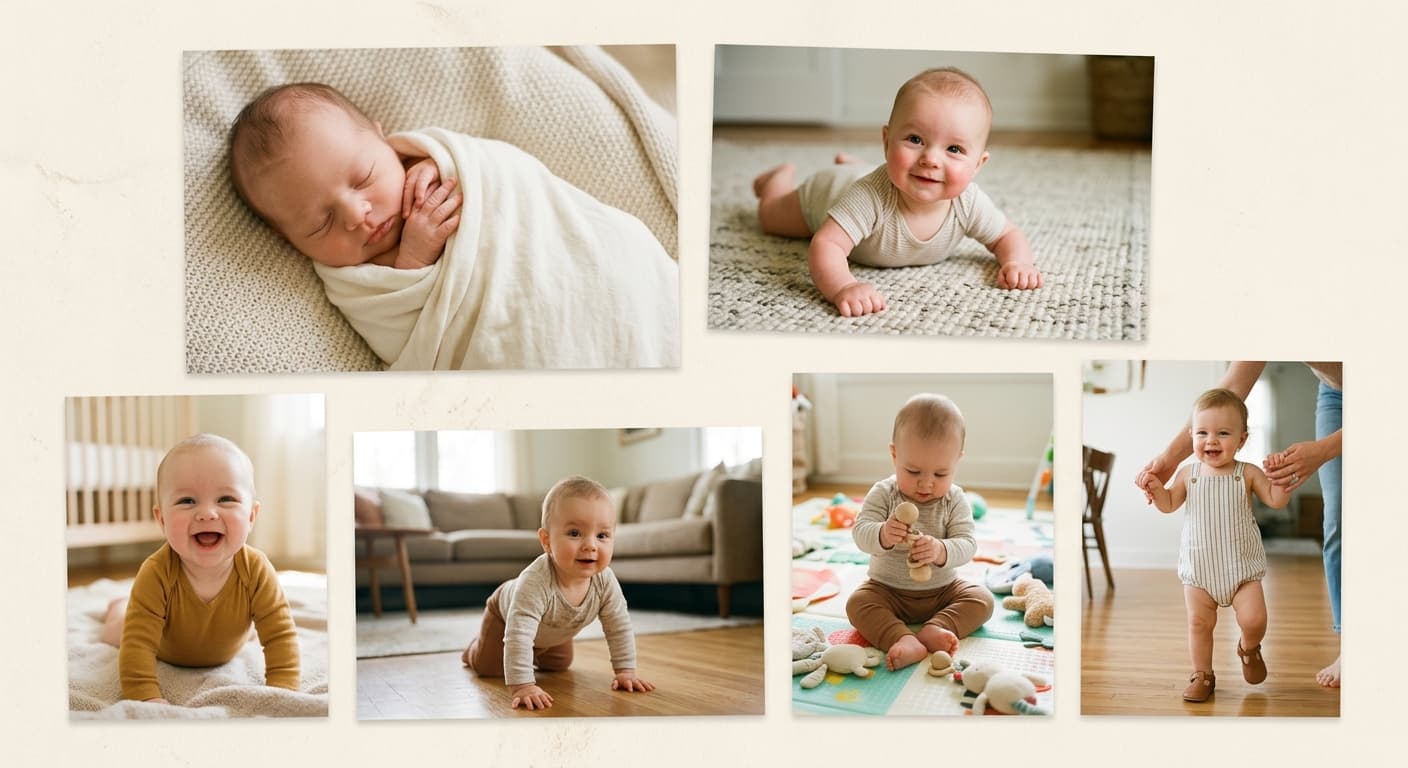
Month 12: First Birthday, Whole Milk, and the Toddler Transition
Quick Answer
Month 12 brings three switches: whole cow's milk in place of formula, open or straw cups in place of bottles, and a fresh baby-proofing pass now that your child climbs. Hold on to two naps — most one-year-olds are not ready to drop to one — and expect 11 to 12 hours overnight. Walking lands anywhere from 9 to 18 months, so later is still normal.
Our Verdict
Change the drink first and the vessel second, one feed at a time across two or three weeks, so you are not altering both on the same day. Retire the swaddle, the bottle warmer, and the infant tub; hold on to the high chair, carrier, and monitor well into year two. Keep the party small — the cake photograph is for you, not for a one-year-old.
Key Takeaways
- ✓Congratulations — you made it through year one. Month 12 is the official transition from baby to toddler, and with it comes some meaningful changes in feeding, sleep, and gear.
- ✓The internet will show you Pinterest-perfect Instagrammable first birthdays with custom smash cakes, themed backdrops, and 50 guests. Your baby will not remember any of this.
- ✓The 12-month regression (a minor one) may cause temporary sleep disruption. Ride it out.
- ✓Months 13-18 bring walking, language explosion, and the beginning of real toddler personality. It's exciting and exhausting. Your baby is now a little person with opinions.
- ✓Twelve months is a bittersweet milestone. Baby is becoming toddler, the needs are shifting, and gear you've relied on for a year is starting to be replaced. Celebrate it. You survived. You did great.
As an Amazon Associate I earn from qualifying purchases. Product prices and availability are subject to change.
Month 12: First Birthday, the Toddler Transition, and What Changes
Congratulations — you made it through year one. Month 12 is the official transition from baby to toddler, and with it comes some meaningful changes in feeding, sleep, and gear. Plus your first baby's first birthday party, which is a milestone in itself.
What's happening at 12 months
Physical milestones:
- Walking (or very close to it — wide age range: 9-18 months)
- Stands alone briefly
- Climbing (baby proof harder!)
- Using objects correctly (cup, brush, spoon)
- Putting things INTO containers (the first organizational skill)
- Possibly climbing out of the crib (time for crib safety review)
Communication:
- 1-3 recognizable words (including "dada", "mama")
- Waving, pointing
- Understanding 10-50+ simple words
- Following one-step instructions ("give me the ball")
- Shaking head "no"
Feeding:
- Eating many table foods with fingers
- Self-feeding with spoon (messy)
- Drinking from an open cup or straw (getting there)
Sleep:
- Most babies still on 2 naps — do NOT rush to 1 nap yet
- 11-12 hours at night with minimal wake-ups
- Consistent bedtime routine is well-established
The 12-month well visit
Your pediatrician will:
- Measure height, weight, head circumference (still tracking percentiles)
- Do a developmental assessment
- Administer MMR, varicella, Hib, and possibly other vaccines
- Discuss transitioning to whole milk
- Discuss weaning off the bottle
- Ask about walking progress
Questions to ask:
- When should we transition to whole milk?
- Are we weaning the bottle at the right pace?
- Any sleep adjustments at this age?
- Is our growth trajectory on track?
- What milestones should we watch for next?
The big transitions at 12 months
Transition 1: Whole milk
At 12 months, the AAP recommends transitioning from formula/breast milk to whole cow's milk (unless medical reasons dictate otherwise). For breastfeeding parents, you can continue breastfeeding as long as you want — the 12-month mark just means cow's milk is now an OK option.
How to transition:
- Start by mixing formula and whole milk (25% milk / 75% formula)
- Every few days, increase the ratio
- By 1-2 weeks, baby is on 100% whole milk
- Aim for ~16 oz of milk per day (not more — too much milk reduces iron absorption)
If breastfeeding and planning to continue, just offer whole milk as a complement during meals or as a transition to weaning on your own timeline.
Transition 2: Bottle weaning
Pediatricians recommend weaning off the bottle by 15-18 months (some say 12 months). Extended bottle use is associated with tooth decay and over-reliance on milk.
How to wean the bottle:
- Start offering milk in a sippy cup or straw cup at meals
- Replace one bottle feeding at a time with cup
- Keep the last bedtime bottle for last (often the hardest to give up)
- By 15-18 months, all milk is from a cup
Cup options:
- Open cup — best for oral development, messiest
- Straw cup — next best for oral development
- 360 cup (Munchkin Miracle 360) — OK but less developmentally ideal
- Sippy cup with spout — worst for oral development; use least
Some pediatricians specifically recommend against traditional spout sippy cups for this reason.
Transition 3: Crib safety review
If your baby is climbing or pulling up to a standing position in the crib, check:
- Mattress is at the lowest setting
- Nothing in the crib baby could use as a step (toys, large plush items)
- No bumper-style products (still banned)
- Sleep sack instead of loose blanket (prevents leg leverage for climbing)
Most babies transition from crib to toddler bed between 18 months and 3 years. Do NOT rush it. Cribs are safer for as long as baby tolerates them.
Transition 4: Gear to retire, gear to keep
Retire (mostly):
- Infant car seat (transition to convertible car seat around 12-18 months or when they hit the infant seat's limit — usually 30-35 lbs; the AAP says keep rear-facing in the convertible until its rear-facing height or weight limit)
- Swaddles (long gone)
- Bouncer/swing (outgrown)
- Changing table (optional — still useful for a while)
- Infant tub (transition to regular tub with non-slip mat)
Keep (still useful):
- Stroller (still needed for another 2-3 years)
- High chair (daily use for 1-2 more years)
- Baby monitor (until 2-3 years)
- Activity gym / play mat (some babies still like these up to 15-18 months)
- Pack 'n' play (travel and backup sleep for years)
New gear to consider:
- Convertible car seat (if not already transitioned) — Chicco OneFit, Graco 4Ever DLX, Nuna Rava all excellent; see our Graco 4Ever vs Chicco NextFit showdown
- Push toys (VTech Sit-to-Stand Learning Walker)
- Water play once it's warm out (see water table vs splash pad)
- First shoes (for outdoor walking, not indoors)
- Open cup / straw cup for bottle weaning
- Stroller upgrade if current one is too small (full-size strollers for 12+ months)
First birthday party (keeping it sane)
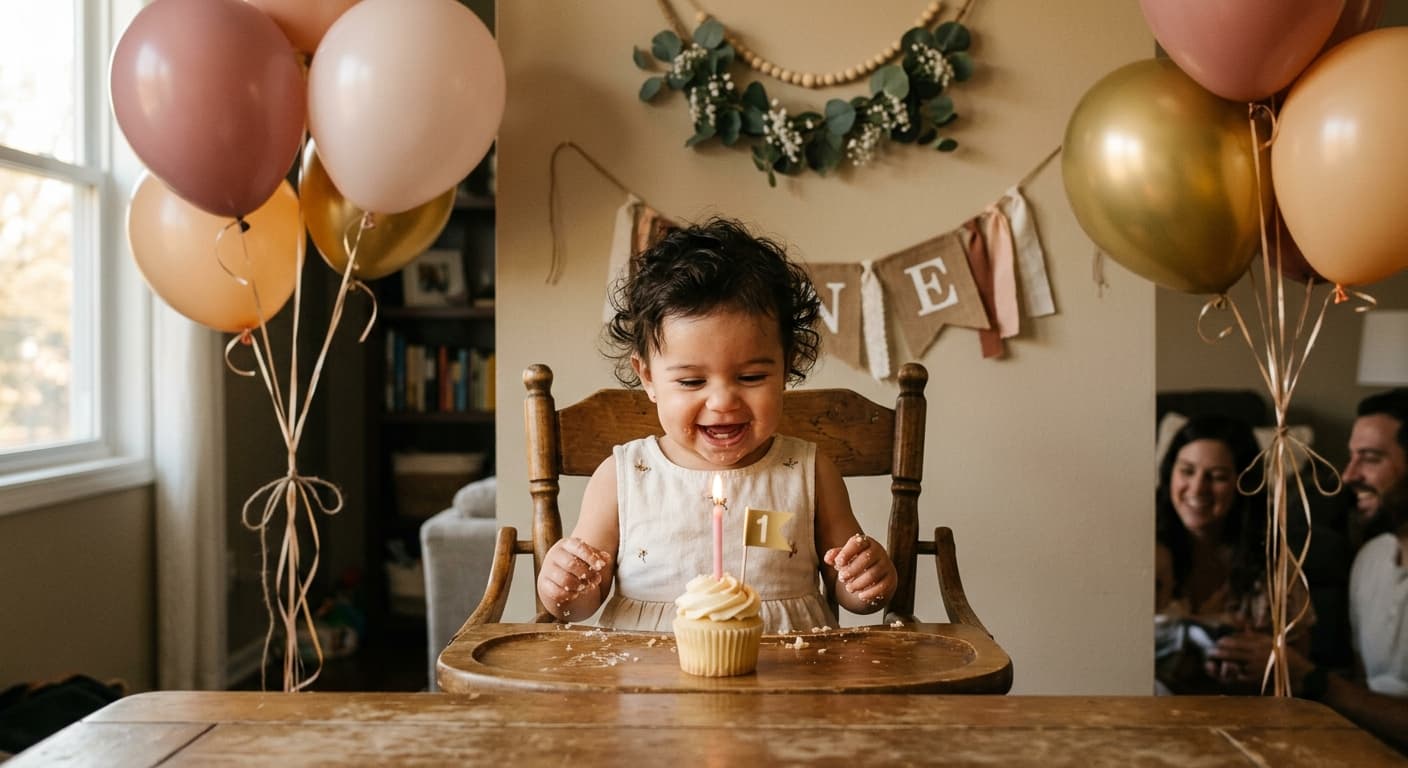
The internet will show you Pinterest-perfect Instagrammable first birthdays with custom smash cakes, themed backdrops, and 50 guests. Your baby will not remember any of this.
Honest first birthday wisdom:
- Your baby will probably be overwhelmed at a big party and cry
- A small gathering of 6-10 close family members is plenty
- Smash cakes are messy and your baby may hate it
- A cupcake is just as good as a custom cake
- First birthday photos: take some, but don't stress if baby isn't cooperative
- The birthday is really for YOU, the parents, for surviving year one
Realistic first birthday checklist:
- Small cake or cupcakes
- A few balloons (careful — choking hazard if popped)
- Outfit for photos (optional — pajamas are fine)
- Family present (bring a camera)
- Gift of something age-appropriate
Skip:
- Elaborate themes
- Pinterest food spreads
- Outdoor events in bad weather
- Long guest lists
- Expensive décor
If a first-birthday gift is on your list, a learning tower is one to plan for the next stage: the ones we compared are rated from 18 months or 2 years.
Sleep at 12 months
Typical schedule:
- 7:00 AM Wake
- 9:30 Nap 1 (30-60 min)
- 1:30 PM Nap 2 (90-150 min — the anchor nap)
- 7:00-7:30 PM Bedtime
The 12-month regression (a minor one) may cause temporary sleep disruption. Ride it out.
Don't drop to 1 nap yet. Most babies need 2 naps until 13-18 months. Signs you're ready to consider dropping to 1 nap:
- Baby consistently fights the second nap for 2+ weeks
- Falls asleep right around lunch time
- Morning nap is getting longer than afternoon nap
- No other sleep disruptions at the same time (illness, travel, etc.)
Month 12 to-dos
- 12-month well-child visit (MMR and varicella vaccines)
- Start whole milk transition
- Plan (reasonable) first birthday
- Transition to convertible car seat if not already
- Start bottle weaning process
- Lower crib mattress if you haven't
- Review baby-proofing (they're climbing now)
- Reflect and celebrate — you made it
Looking ahead to toddlerhood
Months 13-18 bring walking, language explosion, and the beginning of real toddler personality. It's exciting and exhausting. Your baby is now a little person with opinions.
Bottom line
Twelve months is a bittersweet milestone. Baby is becoming toddler, the needs are shifting, and gear you've relied on for a year is starting to be replaced. Celebrate it. You survived. You did great.
Related reading:
💬 Real Talk from Parents
Every toddler thinks bedtime is a suggestion, not a rule.
The bed rail is there for the parent's peace of mind, not the toddler's safety record.
Toddler beds are less about sleep and more about establishing boundaries.
The toddler bed transition sounds exciting until they discover they can get out.
The toddler bed rail saved us from 3am floor thuds. Get one that tucks under the mattress, not the kind that clamps on.
Paraphrased community consensus — not a direct quote.
Hilly Shore Inc.
Editorial teamIndependent product research team behind Cribworthy. Reviews are grounded in published AAP / CDC / NHTSA / CPSC pediatric guidance, JPMA / GREENGUARD GOLD / OEKO-TEX certification verification, and aggregated buyer sentiment.
122 products reviewed · 22 categories covered · cites AAP, CDC, NHTSA, CPSC, FDA, ACOG.
Safety claims are verified against published pediatric guidelines and CPSC databases. See our editorial standards.