The Complete Baby Sleep Guide 2026 (Every Stage)
Quick Answer
Infant sleep consolidates on a developmental timetable rather than a training schedule. Newborns wake every two to four hours, a permanent change in sleep cycles lands near four months, and longer overnight stretches usually appear somewhere between five and eight months. Every stage rests on the same foundation: back sleeping, a firm flat surface, a bare crib, and sharing your room. Consistency beats method choice.
Our Verdict
Fix the environment and a fixed wind-down before you consider any formal approach, whatever your child's age. Adopt a named method only after four to six months, and only when the waking costs your household more than it costs your baby. Refuse inclined sleepers, bumpers, positioners, and consumer vitals monitors outright, because none of them belong anywhere near an infant sleep surface.
Key Takeaways
- ✓If you're reading this at 2 AM while pacing with a tiny human who refuses to sleep, we see you. Baby sleep is the single biggest pain point of the first year — and one of the most misunderstood.
- ✓If your baby is under 4 months old and sleeping in unpredictable 2-4 hour stretches, yes.
- ✓We don't claim to have tested every sleep product ourselves. What we do is synthesize the best available research and owner data so you don't have to read 500 conflicting articles at 2 AM. Read our full methodology.
- ✓We researched hundreds of products across thousands of reviews. Here's our honest opinion on which categories of products are worth the investment and which are overhyped.
- ✓Baby sleep is hard. It's developmental, not behavioral, for most of the first 6 months.
As an Amazon Associate I earn from qualifying purchases. Product prices and availability are subject to change.
The Complete Baby Sleep Guide for 2026
If you're reading this at 2 AM while pacing with a tiny human who refuses to sleep, we see you. Baby sleep is the single biggest pain point of the first year — and one of the most misunderstood.
This guide is different from the dozens of "sleep tips" lists you've probably already read. It's a research-based, AAP-aligned walkthrough of what actually works at each stage of your baby's first 12 months, drawn from American Academy of Pediatrics guidelines, Sleep Foundation research, and thousands of verified parent reviews. No shame, no rigid methods, no judgment about how you feed or where your baby sleeps. Just honest information.
Quick answers to the questions you came here for
"Is what my baby is doing normal?" If your baby is under 4 months old and sleeping in unpredictable 2-4 hour stretches, yes. If your 5-month-old suddenly started waking every 45 minutes after sleeping great at 3 months, yes — that's the 4-month sleep regression. If your 8-month-old is pulling up in the crib at 2 AM, yes, that's developmental.
"When will my baby sleep through the night?" "Through the night" officially means 6 consecutive hours. Most babies can physically do this between 4-6 months; many take longer. Sleeping 10-12 hours straight without a wake-up is not typical until 9-12 months, and some babies take longer than that. All of this is normal.
"Is it safe to let my baby cry it out?" The AAP does not prohibit any specific sleep training method for babies over 4-6 months. Multiple peer-reviewed studies show no long-term harm from gradual methods. Your instincts matter too — if a method feels wrong, don't do it. We cover the actual research in our Ferber method vs gradual vs no-cry comparison.
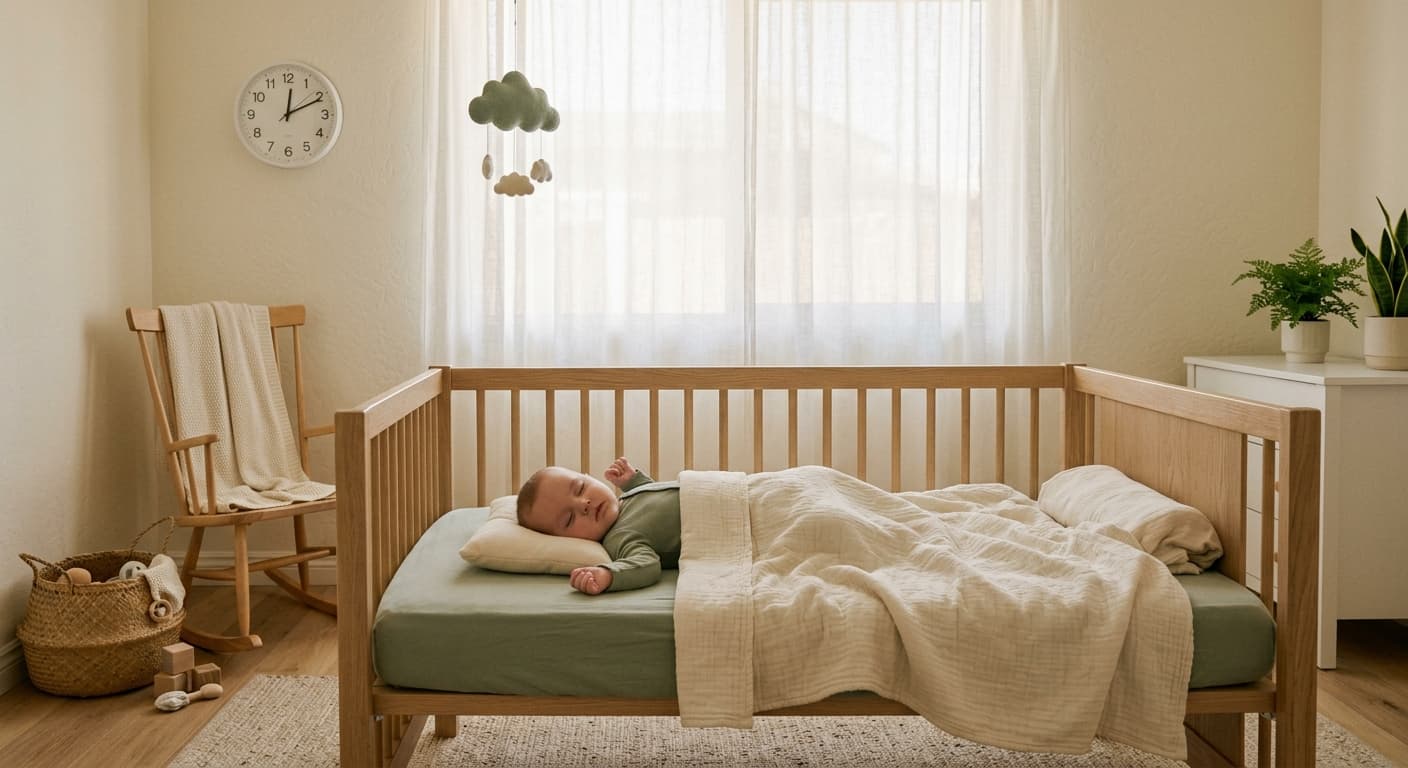
"What's the safest sleep environment?" Flat, firm mattress. Baby on their back. Nothing in the crib — no bumpers, no blankets, no pillows, no stuffed animals. The AAP recommends room-sharing (not bed-sharing) for at least the first 6 months, and its safe sleep guide for parents says room-sharing can lower SIDS risk by as much as 50%. We walk through the complete safe sleep setup in our Safe Sleep Environment AAP guide.
The research basis for this guide
Everything in this guide is cross-referenced against:
- American Academy of Pediatrics (AAP) current sleep safety guidelines (updated 2022)
- Sleep Foundation research articles on infant sleep patterns
- Peer-reviewed journals including JAMA Pediatrics, Pediatrics, and Journal of Clinical Sleep Medicine
- Huckleberry, Taking Cara Babies, and Happiest Baby expert content (cross-referenced, not copied)
- Thousands of verified parent reviews on specific products across Amazon, Target, and BuyBuyBaby
We don't claim to have tested every sleep product ourselves. What we do is synthesize the best available research and owner data so you don't have to read 500 conflicting articles at 2 AM. Read our full methodology.
Baby sleep at every stage: A month-by-month overview
Newborn: 0-2 months (the fog)
What's happening: Your newborn has no circadian rhythm, no concept of day or night, and will sleep 14-17 hours total across 8-10 short stretches. Most of it is light sleep. They will wake up. A lot. This is not a sleep problem — it's how newborns are built.
What helps:
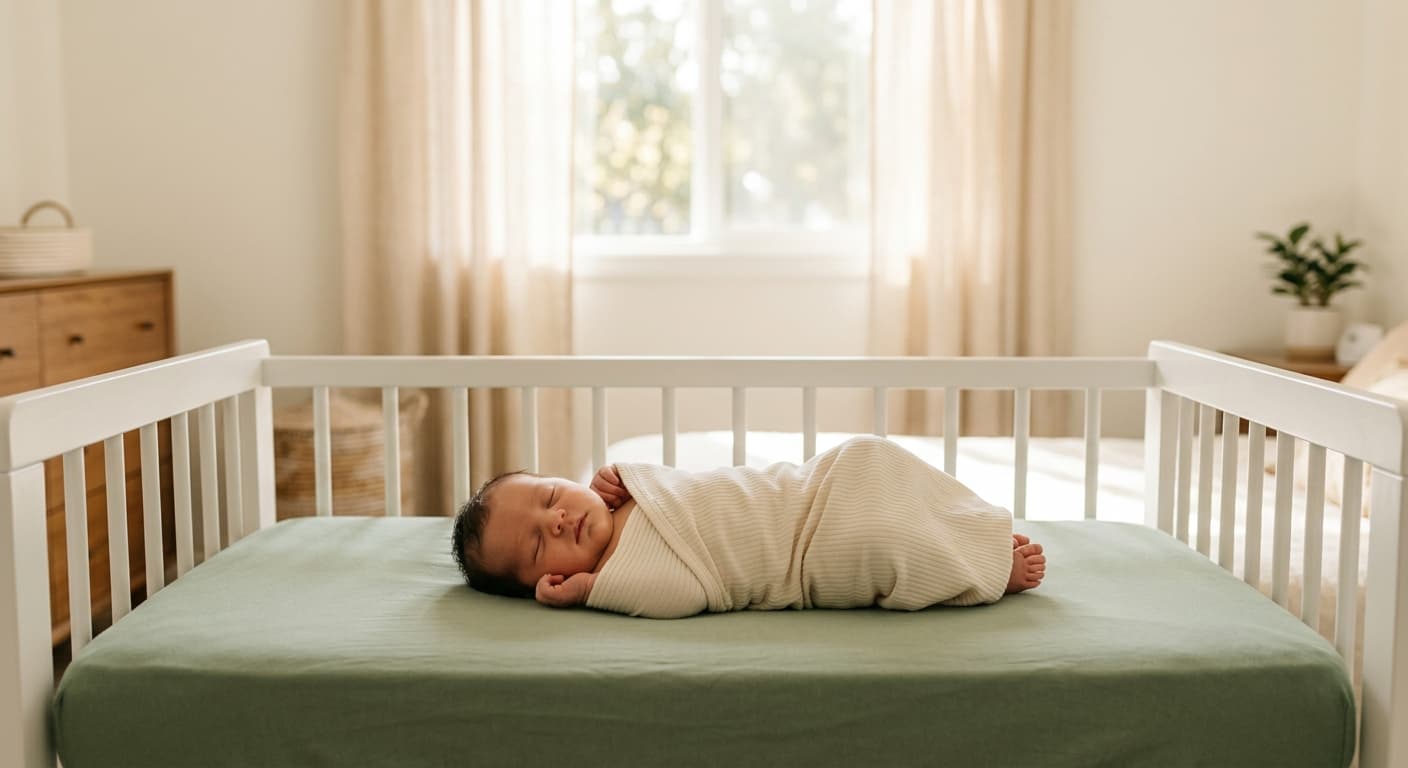
- Swaddling (until they start showing signs of rolling — typically 2-3 months)
- White noise at ~50 decibels (mimics the womb environment)
- Consistent "eat, play, sleep" cycles to begin teaching day/night
- Exposing baby to natural daylight in the morning
- Keeping nighttime feeds dark and boring (no eye contact, no playing)
Gear that actually helps:
- A bassinet or Newton-style crib mattress placed in your room (AAP recommends room-sharing)
- A good swaddle (Velcro or zipper styles are easier than muslin at 3 AM)
- A white noise machine (Hatch Rest, Yogasleep Dohm, or LectroFan — see our white noise showdown)
- A reliable baby monitor
What doesn't work yet: Sleep training. Strict schedules. Bedtime routines longer than 10 minutes. Your newborn is not being difficult — they're just a newborn.
Early infancy: 2-4 months (hope + crash)
What's happening: Around 6-10 weeks, many babies start having longer night stretches — 4, 5, sometimes 6 hours. Parents think they've cracked the code. Then around 3.5-4 months, everything falls apart. This is the infamous 4-month sleep regression and it's developmental, not behavioral.
What helps:
- A consistent bedtime routine (bath, book, boob/bottle, bed is the classic; for the book step, see our best books for newborns)
- An earlier bedtime than you'd expect (7:00-7:30 PM is developmentally ideal by 3 months)
- Starting to put baby down "drowsy but awake" so they begin learning independent sleep skills
- Dropping the swaddle around 2-3 months before rolling begins
- Room-darkening curtains (matters more than you think)
The 4-month regression: When your baby transitions from newborn sleep to adult-like sleep cycles, their wake-ups between cycles become more noticeable. Most babies come out of this in 2-6 weeks. Some parents use it as a window to teach independent sleep. Others ride it out. Both are valid. Our full 4-month sleep regression guide walks through both approaches honestly.
5-8 months (the window)
What's happening: By 4-6 months, most babies are developmentally capable of longer sleep stretches — 6-8 hours at night becomes possible. This is the window when many families consider sleep training if they want to.
What helps:
- A solid 2-3 nap schedule (see our nap schedules by age guide)
- Earlier bedtime (6:30-7:30 PM is normal at this age)
- Consistent wake-up time (anchors the circadian rhythm)
- A sleep sack (replaces the swaddle — stops baby from startling awake)
- If choosing to sleep train: any of the major methods (Ferber, gradual, chair method, no-cry) can work
The 6-month gear update: At this stage you're typically transitioning out of the bassinet into a full-size crib. See our bassinet vs crib transition guide for the how and when.
8-12 months (the separation anxiety phase)
What's happening: Around 8-10 months, babies hit two simultaneous milestones — separation anxiety and physical milestones (crawling, pulling up, cruising). Both disrupt sleep. This is the 8-month sleep regression and it's real, even for babies who were previously good sleepers.
What helps:
- Patience and consistency (tempting to intervene, often makes it worse)
- "Object permanence" peek-a-boo during the day (helps with separation anxiety)
- A lovey or transitional object (once baby is 12+ months per AAP safe sleep)
- Not dropping the morning nap too early — most babies still need 2 naps at 9-10 months
- Comforting but not creating new sleep associations you'll regret
Our 8-month sleep regression guide breaks this down in detail with survival tactics that actually work without teaching new habits that stick.
12-18 months (the toddler transition)
What's happening: The 12-month mark brings another regression for many babies. Walking milestones disrupt sleep. Night weaning becomes a real option. The shift from 2 naps to 1 nap happens somewhere between 13-18 months (not 12 — please don't rush this).
What helps:
- Gradual night weaning (if you're ready and breastfeeding)
- Introducing a comfort object
- Not dropping to 1 nap too early (sign you're ready: 2 naps starting to fight bedtime consistently for 2+ weeks)
- Continuing early bedtime (7:00-7:30 PM is still ideal)
The sleep products that are actually worth it
We researched hundreds of products across thousands of reviews. Here's our honest opinion on which categories of products are worth the investment and which are overhyped.
Worth every penny:
- A quality white noise machine — $25-70 range, works forever
- A good sleep sack — $25-45, you'll use 3-5 of them over the first year
- Blackout curtains — $30-100, single biggest bedroom improvement
- A reliable baby monitor with good audio — $50-300 depending on features
- A firm, breathable crib mattress — safety review here
Potentially worth it (depends on situation):
- SNOO bassinet — $1,695 new, $120/month rental. Research shows it extends sleep for some babies. Worth it for sleep-deprived parents who can afford it. See our SNOO vs alternatives comparison.
- Sock-based sleep monitor (Owlet Dream Sock) — $299. Great for anxious first-time parents. Not medically necessary for healthy full-term babies.
Often overhyped:
- Wipe warmers — Most babies don't care about cold wipes.
- Crib mobiles — Rarely used past 3 months.
- Special sleep aids that "guarantee" sleep — There are none. Don't buy these.
The sleep mistakes that keep parents up at night
-
Dropping the swaddle too late. Once baby can roll, swaddles become a suffocation risk. Switch to a transitional sleep sack (Merlin's Magic Sleepsuit or similar) at the first signs of rolling.
-
Keeping the room too bright. Even ambient light from a closet or hallway delays melatonin production. If you can read a book in the nursery, it's too bright.
-
Inconsistent bedtime. A baby whose bedtime shifts by more than 30 minutes night-to-night will have harder nights. Anchor the bedtime even if the wake-up varies.
-
Starting solids to "help baby sleep." Research shows this doesn't actually work and can create sleep associations around feeding that make things worse.
-
Rocking to sleep every night. This isn't wrong, but if you choose it, understand that baby will expect it at every wake-up. Parents who rock to drowsiness and transfer awake usually have easier nights.
-
Using a video monitor to watch every tiny movement. Some movement at night is normal. Staring at the monitor at 2 AM is a recipe for unnecessary intervention and sleep anxiety. Consider an audio-only monitor or putting the video monitor face-down and using sound only.
When to worry (and when not to)
Not worth worrying about:
- Occasional bad nights
- Brief fussing during sleep transitions
- Waking once or twice at night in the 4-12 month range
- Short naps (30-45 min) in the first 6 months
- Wanting to be held more during growth spurts
Worth mentioning to your pediatrician:
- Snoring or gasping for breath during sleep (can indicate sleep apnea)
- Extreme night wakings (every 30 minutes, all night, for 2+ weeks)
- Sudden major sleep changes with other symptoms (illness, reflux, rash)
- Consistent difficulty breathing during sleep
- Your own mental health — if sleep deprivation is affecting you severely, talk to your doctor. Maternal mental health matters enormously. Our guide to surviving newborn sleep deprivation has the strategies that help most.
Our most-read sleep articles
- The 4-Month Sleep Regression: Real Science and Real Solutions
- Safe Sleep Environment: The AAP Checklist
- SNOO vs Mamaroo vs Halo: Which Smart Bassinet Wins?
- How to Transition Out of the Swaddle
- Best Baby Monitors for 2026
- Best White Noise Machines for Babies
- The 8-Month Sleep Regression Survival Guide
- Ferber vs Gradual vs No-Cry: Honest Sleep Training Comparison
Bottom line
Baby sleep is hard. It's developmental, not behavioral, for most of the first 6 months. The best thing you can do is create a safe sleep environment (flat, firm, empty crib, room-sharing, on the back), establish a consistent bedtime routine, and be patient with the regressions. The research-backed products in our guides will help, but no product will make your baby "just sleep" — and anyone selling you that is lying.
You'll get through this. Every sleepless night is bringing you closer to the kid who eventually sleeps until 7 AM. We promise.
Next step: If you're specifically dealing with the 4-month sleep regression right now, read our full 4-month regression guide. If you're setting up a nursery from scratch, start with our safe sleep environment guide.
Frequently Asked Questions
When do babies start sleeping through the night?
Many manage 6+ hour stretches by 4–6 months, but it varies widely. Night wakings well into the first year are normal, not a problem to fix.
What is the 4-month sleep regression?
A permanent change in sleep cycles around 3–4 months that causes more night wakings. It's a developmental leap, not a setback — it passes in 2–6 weeks.
Do I need special products to get my baby sleeping?
No gadget replaces a consistent routine and a dark, cool room. A swaddle (newborn) and white noise are the two highest-value, lowest-risk helpers.
If your baby is sleeping safely, you're doing it right. Ignore anyone who says otherwise.
Paraphrased community consensus — not a direct quote.
Your next step
Ready to build the sleep space?
Research Sources
Hilly Shore Inc.
Editorial teamIndependent product research team behind Cribworthy. Reviews are grounded in published AAP / CDC / NHTSA / CPSC pediatric guidance, JPMA / GREENGUARD GOLD / OEKO-TEX certification verification, and aggregated buyer sentiment.
122 products reviewed · 22 categories covered · cites AAP, CDC, NHTSA, CPSC, FDA, ACOG.
Safety claims are verified against published pediatric guidelines and CPSC databases. See our editorial standards.