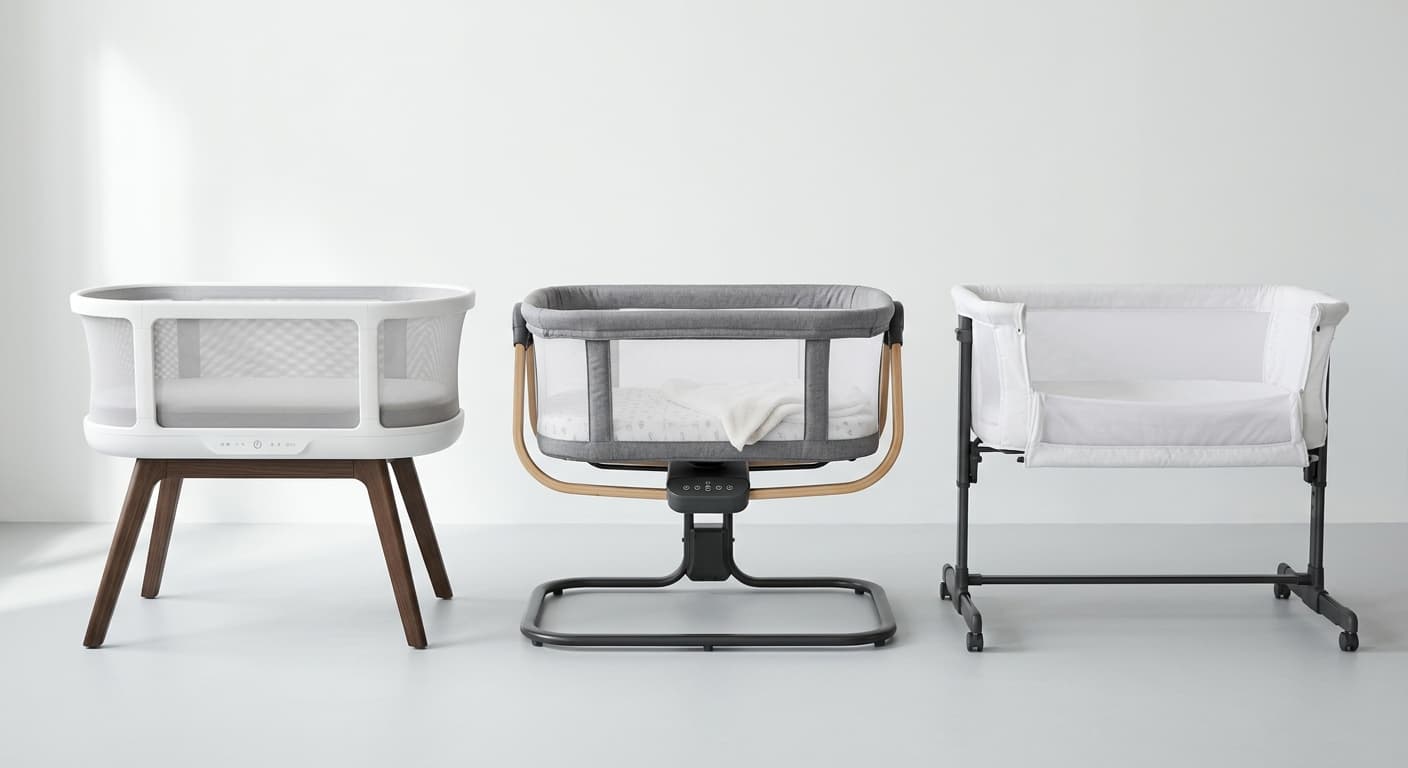
SNOO vs Mamaroo vs Halo: Which Smart Bassinet Is Worth It?
The Verdict
The SNOO is worth it only if you rent rather than buy, since it works for roughly six months and costs 1,995 dollars new or 159 dollars a month to rent. The Halo BassiNest is the sensible default at around 250 dollars, swiveling over the bed for night feeds with no motor at all. The MamaRoo Sleep sits in between and satisfies fewer families than either.
Our Verdict
Rent the SNOO for the newborn months if broken sleep is genuinely threatening your health and the monthly cost is manageable. Buy the Halo BassiNest if you are recovering from a cesarean or want easy bedside access without electronics. Skip the MamaRoo Sleep, which costs meaningfully more than the Halo without solving more. Remember all three are outgrown by about six months.
Swipe to compare every product.
| Comparison field | #1SNOO Smart Sleeper Bassinet Owner rating | #2HALO BassiNest Swivel Sleeper 3.0 Owner rating | #3UPPAbaby Mamaroo Smart Swing Owner rating |
|---|---|---|---|
| Verdict | Best Smart Sleeper | Best Non-Motorized Bedside Bassinet | Best for Awake-Time Soothing (not for sleep) |
| Price | ~$1,995View at Happiest Baby | List Price: | List Price: |
| Use Period | 0-6 months | — | — |
| Connectivity | WiFi + Bluetooth | — | Bluetooth app control |
| Sound Options | White noise auto-adjusts | — | — |
| Safety | Built-in swaddle clip | — | — |
| Type | — | Bedside swivel bassinet | — |
| Weight Limit | — | 20 lbs | 25 lbs |
| Bed Height Fit | — | Beds up to 30 inches (maker) | — |
| Power | — | None | — |
| Motions | — | — | 5 unique patterns |
| Speeds | — | — | 5 speed settings |
| Buyer sentiment | Sleep Time Quality Appearance Noise Durability Buyers praise sleep time, quality and appearance. Mixed feedback on value for money and functionality. Some flag noise and durability. Based on 272 user mentions | — | Quality Soothing Assembly Reliability Value for money Noise Buyers praise quality, soothing and assembly. Mixed feedback on swing and bluetooth connectivity. Some flag reliability and value for money. Based on 639 user mentions |
| Pros |
|
|
|
| Cons |
|
|
|
* Prices are approximate. Check the linked retailer for current pricing and availability.
Key Takeaways
- ✓See our full methodology for how we evaluate baby gear.
- ✓Price: $1,995 new or $159/month to rent, direct from Happiest Baby
- ✓What it is: A motorized bassinet with 5 different motions (car ride, kangaroo, tree swing, wave, rock-a-bye) and 4 sound options. Unlike the SNOO, it doesn't auto-respond to crying — you start the motion manually.
- ✓Price: around $250 for the current BassiNest Swivel Sleeper 3.0
- ✓Will SNOO "train" my baby to need motion to sleep?
As an Amazon Associate I earn from qualifying purchases. Product prices and availability are subject to change.
SNOO vs Mamaroo vs Halo: Which Smart Bassinet Is Worth It?
The SNOO is the most polarizing baby product on the market. Parents either swear it saved their sanity ("it paid for itself in the first month") or they think it's a $1,700 scam that their baby refused to use.
Here's an honest, research-based comparison of the three main smart bassinet options: SNOO, 4moms MamaRoo Sleep, and Halo BassiNest Swivel. We've synthesized hundreds of owner reviews, looked at the medical research, and laid out which one (if any) is worth your money based on your specific situation.
The TL;DR
| Product | Price | Who it's for | Who should skip |
|---|---|---|---|
| SNOO Smart Sleeper | $1,995 new / $159/mo rental | Sleep-deprived parents with budget, first-time parents, twins, babies with early reflux | Babies over 6 months (outgrown), parents on a tight budget, parents who prefer no tech |
| 4moms MamaRoo Sleep | Varies by retailer | Parents wanting a motion bassinet without the SNOO price tag | Parents wanting automation, babies who need restraint |
| Halo BassiNest Swivel | $250 | Most first-time parents, c-section recovery, bedside sleeping | Parents wanting motorized soothing |
How we compared them
We're not a product testing lab — we read reviews so you don't have to. For this comparison, we cross-referenced:
- Owner reviews at major retailers for each product
- What regulators and makers state, including the SNOO's FDA authorization
- Safety certifications (JPMA, FDA, CPSC)
- Long-term parent feedback from Reddit (r/beyondthebump, r/NewParents)
- Recall history from the CPSC database
See our full methodology for how we evaluate baby gear.
SNOO Smart Sleeper Bassinet: The Premium Option
Price: $1,995 new or $159/month to rent, direct from Happiest Baby
What it is: A smart bassinet from Dr. Harvey Karp (author of Happiest Baby on the Block) that automatically detects crying, responds with five progressively stronger levels of rocking motion and white noise, and uses a built-in swaddle-like wrap to keep baby on their back. Happiest Baby says it was the first baby bed granted FDA De Novo authorization, for its ability to keep sleeping babies on their backs.
What owners consistently say works
- Extends sleep for many babies by responding to early fussing before baby fully rouses. Results vary a lot from baby to baby, and independent evidence on sleep gains is thinner than the marketing suggests.
- Keeps baby on their back (AAP-compliant) via the patented swaddle. Reduces rolling risk.
- "Life-saving" for parents of colicky or reflux babies in the first 3 months.
- Holds resale value better than most baby gear — though secondhand buyers pay $19.99/month for the premium app features, including weaning mode.
- The app and data tracking give anxious first-time parents useful information.
What owners consistently say doesn't work
- Some babies reject it completely and it becomes a very expensive laundry hamper.
- Outgrown by 5-6 months (some babies earlier). The SNOO is a short-term investment by design.
- The restraint wrap is divisive. Some babies feel secure; others hate being restrained.
- Loud motor sounds can disturb lighter sleepers.
- Requires an app and Wi-Fi for optimal use (though it works without).
- No tactile or visual soothing — just motion and sound.
Is it worth $1,995?
Math it out honestly: if it adds even an hour of sleep a night for four months, that's about 120 hours of parent sleep. For some families that alone justifies the cost.
The rental option ($159/month) is often the smarter play:
- Happiest Baby puts the saving from a 6-month rental at $580+ versus buying new, after its fees
- No resale hassle after baby outgrows it
- Try it without the sunk-cost commitment
Buy new if: You plan to have 2+ kids and can reuse it, or you expect to sell it (high resale value). Rent if: First baby, uncertain about long-term parenthood plans, or tight on upfront cash. Skip if: Budget is very tight, or you're philosophically opposed to tech-driven parenting.
4moms MamaRoo Sleep: The Budget Alternative
Price: varies by retailer
What it is: A motorized bassinet with 5 different motions (car ride, kangaroo, tree swing, wave, rock-a-bye) and 4 sound options. Unlike the SNOO, it doesn't auto-respond to crying — you start the motion manually.
What owners consistently say works
- Variety of motions lets you find what your specific baby prefers
- Much cheaper than a new SNOO
- No swaddle/restraint — better for babies who hate being wrapped
- App-connected for convenience
- Attractive modern design
What owners consistently say doesn't work
- No auto-response to crying — you still wake up, start it manually
- Not as effective at extending sleep as SNOO, by owner accounts
- Short usage window — babies outgrow it around 5-6 months like the SNOO
- Motor noise is audible across the room
- Some babies find the motion jarring versus SNOO's smoother movements
- Lower resale value than SNOO
Is it worth it?
The honest answer: for most parents, no. It costs meaningfully more than a Halo without the auto-response that is the SNOO's whole point, and owner satisfaction runs lower than either. If you specifically want motorized soothing without the SNOO price, MamaRoo Sleep is a reasonable pick. But it doesn't offer the auto-response feature that makes SNOO actually reduce night wakings.
Buy if: You want a motion bassinet and don't want SNOO's auto-response. Skip if: You're doing the cost-benefit analysis honestly. Either go up to SNOO rental or down to a standard bassinet.
Halo BassiNest Swivel: The Non-Motorized Option
Price: around $250 for the current BassiNest Swivel Sleeper 3.0
What it is: A traditional bassinet with a 360-degree swivel and lowering wall so you can reach baby without getting out of bed. No motors, no smart features — just a well-designed bedside sleeper.
What owners consistently say works
- Excellent for C-section recovery — the swivel and lowering wall mean you don't have to sit up and twist to get baby
- True bedside sleeping — baby is right next to you at the same height
- Firm, flat sleep surface (AAP-compliant)
- Much cheaper than smart alternatives
- Used for longer — many babies use it until 5-6 months without issue
- Soothes anxious parents who want baby close
- Lower potential for failure — no motors or electronics to break
What owners consistently say doesn't work
- No motion or sound soothing — you do all the soothing yourself
- Larger footprint than a traditional bassinet
- Mesh walls are a design choice some parents dislike
- Weight limit is 20 lbs, and you stop sooner once baby can push up on hands and knees
- The lowering wall takes some practice to operate one-handed
- No app or tech features (which is either a pro or con depending on you)
Is it worth around $250?
Yes, for most first-time parents. The Halo BassiNest Swivel is the bassinet we'd recommend to a friend who asked "what should I get if I don't want to spend SNOO money." It's well-designed, genuinely useful, and doesn't promise magic sleep your baby won't deliver.
Buy if: You want true bedside sleeping, you're budget-conscious, you want something reliable. Skip if: You have severe sleep deprivation and need automated help (go SNOO rental instead).
Head-to-head comparison
Sleep improvement
SNOO: Many owners report longer stretches; some babies never settle in it MamaRoo Sleep: Modest improvement, no research backing, owner-dependent setup Halo BassiNest: No sleep improvement claims — it's a bedside bassinet, not a sleep aid
Safety
All three are sold as bassinets under the CPSC's mandatory bassinet standard. SNOO is the only one with FDA De Novo authorization. Each gives baby a separate, flat sleep surface, which is what the AAP asks for, when used as directed.
Space
SNOO: A compact bassinet footprint that fits next to a standard bed. MamaRoo Sleep: Similar footprint to SNOO. Halo BassiNest: Its base is wider because of the swivel mechanism, so measure beside your bed before you buy.
Longevity
SNOO: Rated for newborn to 6 months (25 lbs weight limit, graduation by 5-6 months typical) MamaRoo Sleep: Newborn to about 5 months Halo BassiNest: Newborn to 20 lbs, or until baby pushes up on hands and knees
All three are short-term. None are cribs.
Noise and motion for adjacent sleepers
SNOO: Audible motor when active, which is most of the night. Some partners find it disruptive; most get used to it. MamaRoo Sleep: Similar motor noise to SNOO. Halo BassiNest: Silent (no motor).
Resale value
SNOO: High, and the rental market keeps demand for used units steady. MamaRoo Sleep: Moderate. Halo BassiNest: Lower.
Which should you pick?
Use this decision guide:
- You're sleep-deprived and have budget → SNOO (rental preferred)
- You had a C-section and want easy bedside access → Halo BassiNest Swivel
- You want motorized soothing but not SNOO money → MamaRoo Sleep (but honestly, just rent the SNOO)
- You want reliable, simple, close-to-baby sleep → Halo BassiNest Swivel
- You're on a real budget → Skip all three. A standard bassinet for $60-150 is genuinely fine.
FAQ
Will SNOO "train" my baby to need motion to sleep? The SNOO has a "weaning" mode that gradually reduces motion as baby approaches graduation (a premium app feature, free for new buyers for 9 months and for renters). Owner reports suggest most babies transition to a crib without major difficulty if you use it.
Can I use SNOO if baby has reflux? Yes — it keeps baby flat (safe per AAP) while providing the swaddle and white noise that often help reflux babies. Do not tilt it or use incline inserts (not safe).
Is the Halo BassiNest safe for co-sleeping? It's a bedside sleeper, not a co-sleeper. Baby has their own flat, firm surface at bed-height. This is different from bed-sharing, which the AAP recommends against. Used as directed, it fits the AAP's room-share-without-bed-share advice.
Bottom line
There's no "best" smart bassinet — there's the right one for your situation. And honestly? A regular firm-and-flat bassinet from a trusted brand is a fully valid choice. Your baby's long-term sleep patterns won't be determined by which bassinet you picked. The AAP-compliant safe sleep environment matters more than any single product.
Related reading:
- The Complete Baby Sleep Guide
- Safe Sleep Environment: The AAP Checklist
- The 4-Month Sleep Regression
- Best Cribs and Bassinets for 2026
- Complete Baby Registry Guide
SNOO vs the MamaRoo swing: not the same job
Many parents searching "SNOO vs MamaRoo" mean the MamaRoo swing, not the MamaRoo Sleep bassinet. Those two products don't compete:
- The SNOO is a sleep space for nights and naps.
- A swing is for supervised awake time. The AAP's guidance is that swings, bouncers and car seats are not for routine sleep — if your baby dozes off in one, move them to a firm, flat surface as soon as practical. The same goes for a baby lounger or infant seat.
The swing lives on as the UPPAbaby Mamaroo Smart Swing (UPPAbaby acquired 4moms in 2024), with the same five motions the 4moms version was known for, at about $350. It buys you hands-free minutes to eat or shower; it is never where the baby sleeps. For cheaper daytime soothing, see our bouncers and swings guide.
Where to buy (2026 update)
- SNOO: sold and rented direct by Happiest Baby; the button above goes there.
- 4moms MamaRoo Sleep: availability new is patchy. If you're weighing one secondhand, check the CPSC recall database for the model first.
- More bassinet options: see our current picks in the best cribs & bassinets guide and best baby swings for colicky babies.
💬 Real Talk from Parents
You'll google 'baby sleep regression' at least once a month for the first year.
Sleep training is 50% technique and 50% parental willpower.
If your baby is sleeping safely, you're doing it right. Ignore anyone who says otherwise.
Paraphrased community consensus — not a direct quote.
Research Sources
- Bassinets and Cradles Business Guidance (16 CFR part 1218, ASTM F2194) - U.S. CPSC
- A Parent's Guide to Safe Sleep - HealthyChildren.org (AAP)
- Safe Sleep: Bare Is Best - U.S. Consumer Product Safety Commission
- Inclined Sleepers, Soft Nursing Pillows & Other Baby Products to Avoid - HealthyChildren.org (AAP)
- Everything You Need to Know About Renting a SNOO — Happiest Baby
- Happiest Baby App Premium Features and Pricing — Happiest Baby
Hilly Shore Inc.
Editorial teamIndependent product research team behind Cribworthy. Reviews are grounded in published AAP / CDC / NHTSA / CPSC pediatric guidance, JPMA / GREENGUARD GOLD / OEKO-TEX certification verification, and aggregated buyer sentiment.
122 products reviewed · 22 categories covered · cites AAP, CDC, NHTSA, CPSC, FDA, ACOG.
Safety claims are verified against published pediatric guidelines and CPSC databases. See our editorial standards.