Baby's First Year Month-by-Month: Complete 2026 Guide
Quick Answer
Expect four broad phases: survival and cluster feeding through month two, the tummy-time and rolling stretch from three to five, solids and sitting from six to eight, and cruising toward first steps from nine to twelve. Sleep consolidates as wake windows lengthen from about 45 minutes to roughly three hours. Genuinely new gear is only needed around months six and nine.
As an Amazon Associate I earn from qualifying purchases. Product prices and availability are subject to change.
Baby's First Year Month-by-Month: What You Actually Need Each Stage
The first year of parenting is intense, and every month brings a new developmental stage, new gear needs, and new worries. This month-by-month guide tells you what's happening with your baby, what you actually need to buy or change, and what you can safely ignore — all based on pediatric guidance and research.
Bookmark this and come back each month. Parenting is much less scary when you know what's coming.
The first year at a glance
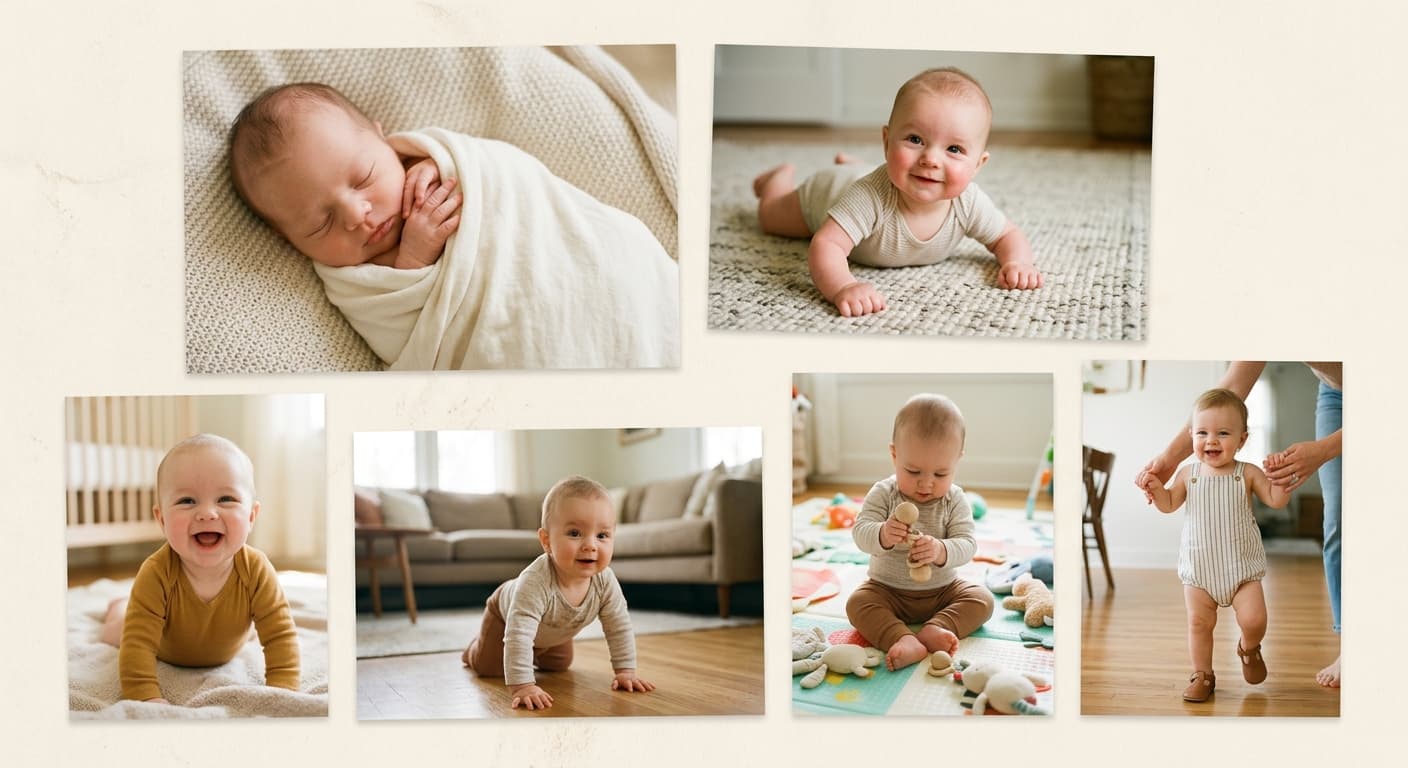
| Month | Key milestone | Sleep | Feeding | New gear |
|---|---|---|---|---|
| 1 | Survival | 14-17 hr / no schedule | Every 2-3 hr | Burp cloths, more swaddles |
| 2 | First smiles | 14-16 hr / still chaos | Cluster feeding | Soft rattles |
| 3 | Tummy time | 14-15 hr / 4 naps | Longer stretches | Activity gym |
| 4 | Sleep regression | 13-14 hr / disrupted | Potentially more | Arms-free sleep sack |
| 5 | Rolling over | 13-14 hr / 3-4 naps | Interest in food | Swaddle already off |
| 6 | Starting solids | 13-14 hr / 3 naps | First solids | High chair, bibs, spoons |
| 7 | Sitting up | 13-14 hr / 3 naps | More solids | Baby-proof start |
| 8 | Crawling | 13-14 hr / 2-3 naps | Finger foods | Baby gates |
| 9 | Pull to stand | 13-14 hr / 2 naps | Self-feeding | Corner guards, outlet covers |
| 10 | Cruising | 13-14 hr / 2 naps | Combination | Push toys |
| 11 | Early words | 13-14 hr / 2 naps | Variety | Board books |
| 12 | Walking / birthday | 12-14 hr / 1-2 naps | Whole milk transition | Toddler shoes, sippy cups |
The honest gear cost curve
Most parents spend roughly:
- Month 1-3: $100-150/month on consumables (diapers, wipes, formula if applicable)
- Month 4-6: $120-180/month (+ feeding gear setup)
- Month 7-9: $100-150/month (+ baby-proofing $100-300 one time)
- Month 10-12: $80-120/month + first birthday expenses
Total year 1 consumables: roughly $1,200-1,800 depending on feeding method and diaper brand choices. For a full itemized total that adds gear, health costs and childcare, try the first-year baby cost calculator.
Month by month: what to buy, what to watch
The table above is the overview. These are the six months where the shopping list or the safety rules actually change.
Month 1: the newborn survival kit
Most of what you need this month is consumable:
- Newborn diapers, unscented wipes and a barrier cream
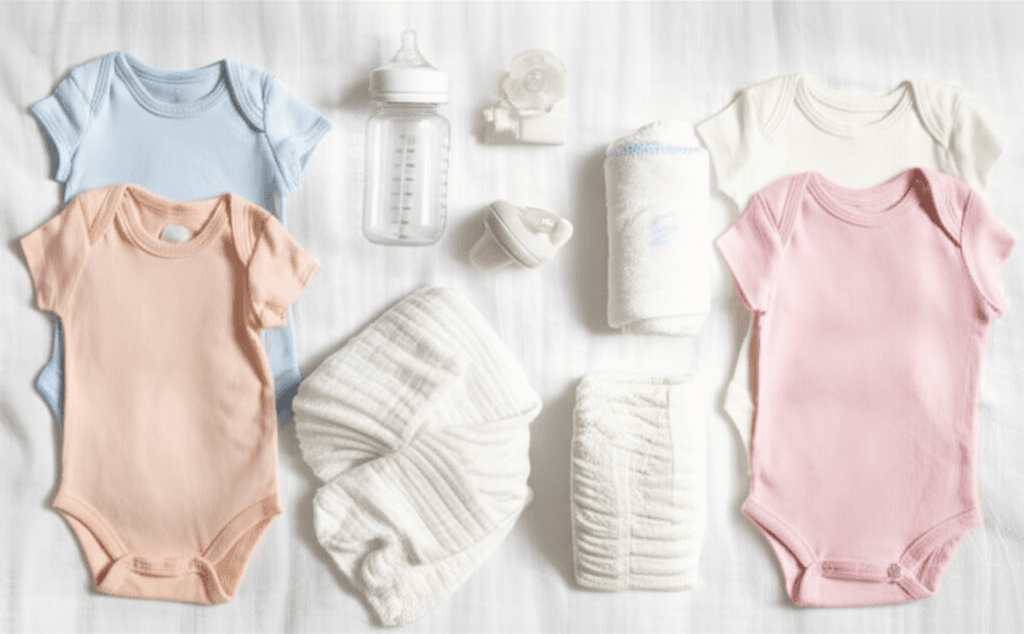
- Six to eight onesies or sleepers, two or three swaddles, and a stack of burp cloths
- A bassinet, bedside sleeper or crib with a fitted sheet and nothing else in it (the full rules are in our AAP safe sleep checklist)
- A rear-facing car seat, installed before the ride home (how to install it correctly)
- Feeding supplies for whichever route you take, and a baby thermometer
Skip for now: teething toys, solid-food gear, walkers and jumpers, a high chair, and stuffed animals in the sleep space.
When to call right away: the AAP says to call your child's doctor when a baby younger than 3 months has a temperature of 100.4°F (38.0°C) or higher.
Your recovery counts too. If low mood, anxiety or frightening thoughts don't lift, call your OB, midwife or a mental health provider. The National Maternal Mental Health Hotline takes calls and texts at 1-833-TLC-MAMA (1-833-852-6262), per the CDC. For the full first-month list, see the newborn essentials checklist and surviving the first two weeks.
Month 3: floor time and tummy time
The gear that earns its keep now supports play on the floor: a padded play mat or activity gym, an unbreakable mirror, and a few high-contrast board books. Our play mat and activity gym guide compares the options.
The AAP's tummy-time guidance is to start the day your baby comes home: 2 to 3 short sessions a day of 3 to 5 minutes, working up to 15 to 30 minutes a day by 7 weeks, and adding time as your baby shows they enjoy it. Tummy time is only for a baby who is awake and closely supervised.
If rolling looks close, buy an arms-free sleep sack now rather than another swaddle. One sleepsuit to check: on March 5, 2026, HALO Dream recalled about 45,000 Magic Sleepsuits (batch codes PO30592, PO30641 and PO30685, sold September 2025 through February 2026) because the zipper head can detach, a choking hazard. Stop using an affected suit and register for the refund or replacement.
Month 4: rolling and the sleep regression
Two things change at once: sleep gets lighter between cycles, and many babies start working on rolling.
- Swaddle off. The AAP says to stop swaddling as soon as your baby shows any signs of trying to roll over, which some babies do as early as 2 months. Switch to a sleep sack that leaves the arms free; here is how to make the switch.
- Blackout curtains for early mornings and daytime naps.
- A sound machine only if your home is noisy, kept across the room and turned down. In a 2014 Pediatrics study, all 14 infant sleep machines tested at maximum volume exceeded 50 dB at 30 cm, the recommended noise limit for hospital nurseries. Our white noise machine guide covers placement and picks.
- A wearable vitals monitor is not a SIDS safeguard. The AAP says not to use home cardiorespiratory monitors as a way to reduce the risk of SIDS, notes that some of these devices are wearable, and warns against letting them give you a false sense of security. Every safe sleep rule still applies with or without one.
For the regression itself, see the 4-month sleep regression guide and Ferber vs gradual sleep training.
Month 6: starting solids
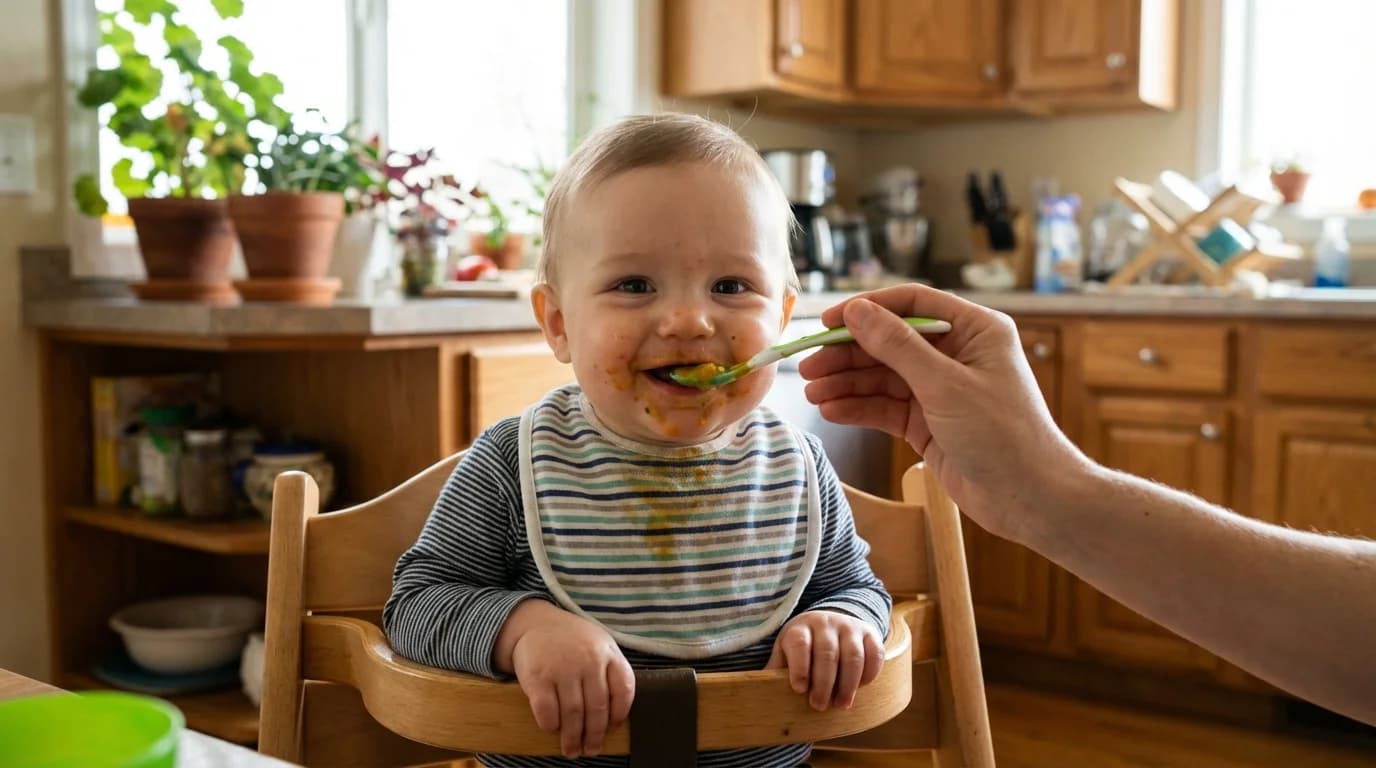
Solids start on readiness, not a birthday. The CDC puts it at about 6 months and says introducing foods before 4 months is not recommended. Readiness signs it lists include sitting up alone or with support, controlling the head and neck, opening the mouth when offered food, swallowing food rather than pushing it back out, and bringing objects to the mouth.
- Lead with iron and zinc. The AAP points to baby food made with meat, or iron-fortified cereal.
- Bring allergens in with other foods. The CDC says to introduce potentially allergenic foods when you introduce other foods. For peanut, the NIAID guidelines set the timing by risk: as early as 4 to 6 months for a baby with severe eczema, egg allergy or both (talk to your pediatrician first), and around 6 months with mild to moderate eczema.
- Two things wait for 12 months: honey, and cow's milk as a drink (CDC).
- Gear: a high chair you can wipe down, soft-tipped spoons, a suction bowl and a small open cup. The chairs are compared in our high chair guide.
Two guides go deeper. When to start solid foods covers timing, readiness and the first week, and baby-led weaning first foods covers what to serve and how to cut it, month by month from 6 to 9.
Month 9: the mobile baby
Baby-proof before your baby can reach a hazard, not after the first close call. Pulling up and cruising arrive at different ages, so treat nine months as a review point rather than a start date.
- Anchor furniture and TVs. The CPSC's Anchor It campaign says anchoring all furniture with drawers, doors and shelves to the wall prevents tip-over injuries and deaths.
- Stairs. At the top of stairs, use only a gate whose instructions allow that position, installed the way they say. The pressure-mounted Regalo Easy Step carries a maker warning never to use it at the top of stairs; it is a doorway gate. Stair options are compared in our baby gates for stairs guide.
- Window cords. The CPSC recommends cordless window coverings in all homes where children live or visit, and says not to place cribs, beds or furniture close to windows.
- Skip the wheeled walker. The AAP has called for a ban on baby walkers with wheels; a stationary activity center or a play yard are the alternatives it names.
The room-by-room version is our baby-proofing checklist.
Month 12: the toddler transitions
- Milk. Whole cow's milk can start at 12 months, unflavored and unsweetened, and never raw (CDC). Breastfeeding does not need to stop: the AAP supports continuing through the second birthday and for as long as parent and child want.
- Crib. Once your toddler can climb out of the crib, the AAP says it may be time for a big-kid bed. Our crib to toddler bed guide walks through the move.
- Car seat. The birthday changes nothing here. The AAP says to keep children rear-facing as long as possible, until they reach the highest weight or height their seat allows. Two convertible seats are compared in Graco 4Ever vs Chicco NextFit.
- Outdoor play. For warm-weather play once your toddler can pull up and stand, our water table vs splash pad comparison covers which suits this age.
Between well visits
The CDC's free milestone checklists and Milestone Tracker app show how your baby is developing. If a milestone is missed or something worries you, the CDC's advice is to talk with your child's doctor and ask about developmental screening rather than wait and see.
Universal first-year wisdom
Some things apply to the whole first year, regardless of stage:
- 1. Buy ahead one size, not three: Babies grow unpredictably. Don't stock up on 3-6 month clothes when baby is newborn — you'll end up with unused gear. To see which size your baby's weight and length fall in at each brand, use our baby clothes size finder.
- 2. Sleep trumps everything: Prioritize your own sleep however you can. A well-rested parent is a better parent than a perfectly-optimized one. If you want to try a sound for your own sleep, here is what the research says about brown noise.
- 3. Consistency beats optimization: A "meh" routine followed consistently beats a perfect routine followed randomly. This applies to sleep, feeding, and daily schedules.
- 4. Most baby products you buy will be used for 6 weeks: Adjust your spending expectations accordingly. A $200 activity gym used for 2 months costs $100/month. A $30 activity gym used for 2 months costs $15/month. For items with short use windows, go mid-range.
- 5. Your baby is not a project: You don't have to "optimize" their development with flash cards and sensory bins at 3 months old. Talk to them, make eye contact, go outside, and they will thrive.
- 6. Your mental health matters: Postpartum depression affects 1 in 7 women and is undertreated. If you're struggling, talk to your OB or a therapist. This is not weakness — it's biology.
Related guides
- The Complete Baby Sleep Guide
- The Complete Baby Registry Guide
- Safe Sleep Environment: AAP Checklist
- Newborn Essentials Checklist
- Surviving the First Two Weeks With a Newborn: Real Talk
- Self-Care for New Parents: Practical Ideas That Don't Require Spare Time
- How to Choose a Pediatrician Before Your Baby Arrives
- How to Take a Baby's Temperature (and When a Fever Is Urgent)
- Best Baby Thermometers: Fast, Accurate, and Easy to Use
Our Verdict
Shop in three waves rather than one. Wave one is a sleep space, feeding supplies, and a car seat; wave two lands near month six with a high chair and bibs; wave three is gates and outlet covers once your baby pulls to stand. Anything purchased ahead of its wave gets outgrown or resold. The car seat is the exception — it must be installed before discharge.
Key Takeaways
- ✓The first year of parenting is intense, and every month brings a new developmental stage, new gear needs, and new worries.
- ✓Total year 1 consumables: roughly $1,200-1,800 depending on feeding method and diaper brand choices. For a full itemized total that adds gear, health costs and childcare, try the first-year baby cost calculator.
- ✓The table above is the overview. These are the six months where the shopping list or the safety rules actually change.
Research Sources
- Back to Sleep, Tummy to Play - HealthyChildren.org (AAP)
- Fever: When to Call the Pediatrician - HealthyChildren.org (AAP)
- Depression During and After Pregnancy - CDC
- HALO Dream Recalls Magic Sleepsuits Due to Choking Hazard - CPSC
- Swaddling: Is It Safe for Your Baby? - HealthyChildren.org (AAP)
- A Parent's Guide to Safe Sleep - HealthyChildren.org (AAP)
- Infant sleep machines and hazardous sound pressure levels — Pediatrics, 2014 (PubMed)
- When, What, and How to Introduce Solid Foods - CDC
- Starting Solid Foods - HealthyChildren.org (AAP)
- Addendum Guidelines for the Prevention of Peanut Allergy - NIAID (PMC)
- Foods and Drinks to Avoid or Limit - CDC
- CPSC Anchor It! — New Federal Rule to Prevent Furniture Tip Overs (tip card, PDF)
- Regalo Easy Step Safety Gate warnings - Regalo
- Are Your Window Coverings Safe? - CPSC Safety Alert
- Baby Walkers: A Dangerous Choice - HealthyChildren.org (AAP)
- Cow's Milk and Milk Alternatives - CDC
- Continuing Breastfeeding Beyond the First Year - HealthyChildren.org (AAP)
- Big Kid Beds: When to Make the Switch - HealthyChildren.org (AAP)
- Car Seats: Information for Families - HealthyChildren.org (AAP)
- About Learn the Signs. Act Early. - CDC
Hilly Shore Inc.
Editorial teamIndependent product research team behind Cribworthy. Reviews are grounded in published AAP / CDC / NHTSA / CPSC pediatric guidance, JPMA / GREENGUARD GOLD / OEKO-TEX certification verification, and aggregated buyer sentiment.
128 products reviewed · 22 categories covered · cites AAP, CDC, NHTSA, CPSC, FDA, ACOG.
Safety claims are verified against published pediatric guidelines and CPSC databases. See our editorial standards.