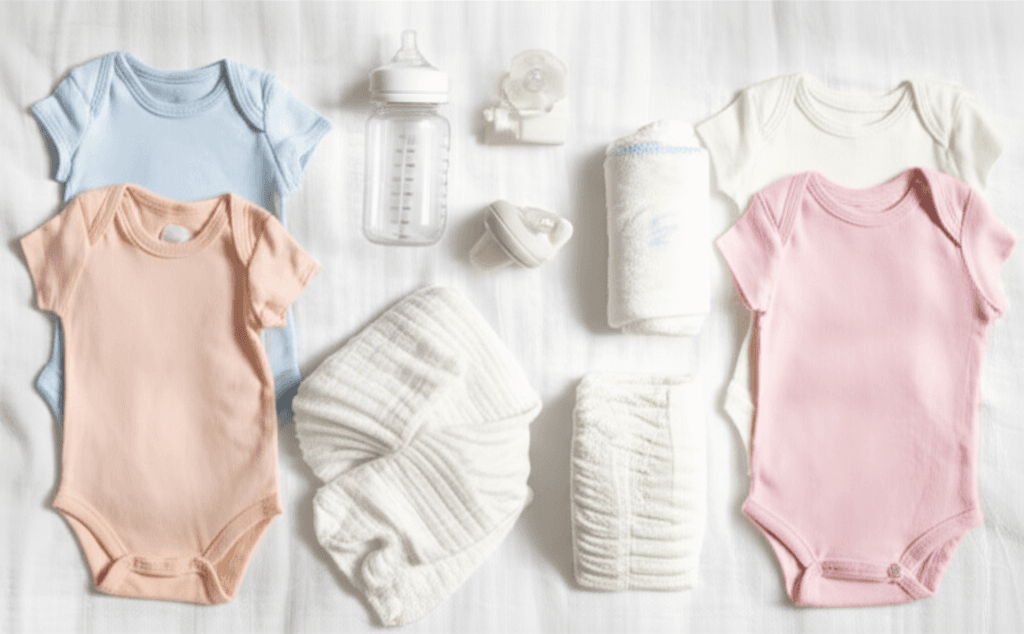
Month 1: The Newborn Survival Kit (What You Actually Need)
Quick Answer
Fifteen things, and most are consumables: diapers, wipes, barrier cream, six to eight sleepers, swaddles, burp cloths, a firm bare sleep surface, an installed car seat, feeding supplies for whichever route you take, and a thermometer. Expect feeds every two to three hours, 14 to 17 hours of scattered sleep, and a fussy evening stretch that peaks somewhere around week six.
Our Verdict
Nothing on this list needs to be premium, but two items need to be right: a bare, flat place to sleep and a car seat installed before you leave the hospital. Postpone the nursery styling, the activity center, and the bottle sterilizer. Treat your own recovery as a line item too — a mental-health check at week two is as scheduled a task as any appointment.
Key Takeaways
- ✓Welcome to parenthood. Month 1 is survival mode, and that's okay. This is not the time to be a perfect parent or have a spotless house.
- ✓Month 1 can be incredibly hard emotionally. The "baby blues" (tearfulness, mood swings, overwhelm) are normal and usually resolve by week 2-3.
- ✓Accept help aggressively. Meal trains, grocery delivery, "can I hold the baby while you shower" offers — say yes. This is not being needy. This is surviving.
- ✓Month 2 brings more alertness, the first social smiles, and the first hints of a routine emerging. We'll cover it in our Month 2 guide (coming soon).

As an Amazon Associate I earn from qualifying purchases. Product prices and availability are subject to change.
Month 1: The Newborn Survival Kit (Week 1-4)
Welcome to parenthood. Month 1 is survival mode, and that's okay. This is not the time to be a perfect parent or have a spotless house. This is the time to feed baby, change diapers, attempt sleep, and try to remember to drink water yourself.
Here's what you actually need, what's happening with your baby, and what you can totally ignore for now.
What's happening with your newborn
Physical development:
- Weight: typically 5-10 lbs at birth, loses up to 10% in first week, regains birthweight by week 2
- Sleeps 14-17 hours across 8-10 chunks
- Eats every 2-3 hours (or more frequently if cluster feeding)
- Can see about 8-12 inches in front of them — perfect for seeing your face during feeds
- Hearing is fully developed — they recognize your voice
- Responds to high-contrast black-and-white patterns
What to expect:
- Fussy evenings ("witching hour") around weeks 2-6
- Growth spurts around days 7-10 and weeks 3-6
- Umbilical cord stump falls off by 1-2 weeks
- First pediatrician visit typically days 3-5
The 15 absolute essentials for month 1
For baby
- Diapers (newborn size, about 8-12 per day = 60-90/week)
- Wipes (unscented, bulk — WaterWipes or Pampers Sensitive)
- Onesies (6-8, newborn size, short-sleeve for layering)
- Footed pajamas (3-4, for night sleeping)
- Swaddles (2-3, Halo Velcro or muslin)
- Burp cloths (8-10 — you cannot have enough)
- Sleep surface (bassinet, bedside sleeper, or bedside crib)
- Fitted sheets (2-3 for the sleep surface)
- White noise machine (our picks)
- Car seat (non-negotiable for the ride home)
For feeding (pick your path)
If breastfeeding:
- Nursing bras (2-3)
- Nursing pads (disposable or washable)
- Nipple cream (Lansinoh or Earth Mama)
- Boppy or My Brest Friend pillow
- Burp cloths (already on the list)
If formula feeding:
- Bottles (6-8, Dr. Brown's or Philips AVENT)
- Formula (Similac, Enfamil, or store brand equivalent)
- Bottle brush + drying rack
- Sterilizer (basic or fancy — both work)
For you (don't forget yourself)
- Postpartum recovery supplies — ice pads, witch hazel, mesh underwear (your hospital sends you home with some)
- Water bottle — you will be thirsty constantly
- Snacks by the bed/couch — breastfeeding AND middle-of-night needs
- Nursing-friendly clothes — or PJs you don't mind sleeping/nursing in
- Ear plugs for the other parent to alternate shifts when possible
What you DON'T need in month 1
Skip these — they collect dust in week 1:
- Teething toys (baby doesn't teethe for months)
- Solid food gear
- Stand-up walkers or jumpers
- High chair
- Expensive strollers (skip fancy travel use)
- Stuffed animals in the crib
- Sleep trainers / sleep books beyond basic AAP info
- Most toys — babies this age can't play (a few high-contrast board books for newborns are the exception)
- Photo props and costumes
Common month 1 mistakes
-
Buying too many newborn clothes. Babies outgrow newborn size in 3-4 weeks. Don't stock up.
-
Ignoring your own recovery. Postpartum recovery takes 6+ weeks minimum. Rest. Accept help. Do not start aggressive workouts yet.
-
Worrying about schedules. Your newborn will NOT follow a schedule. Don't try to create one yet.
-
Waking baby to feed. Most full-term healthy babies who are gaining weight can go 4-5 hours at night safely after the first 2-3 weeks. Talk to your pediatrician about your specific situation.
-
Comparing to other babies. Every baby is different. Other babies' "sleeping through the night" at 3 weeks is either an outlier or not literally true.
-
Skipping visitors entirely or accepting all visitors. Both extremes are hard. Find your middle ground based on your energy.
When to call the pediatrician
Call your pediatrician if:
- Fever of 100.4°F or higher (in a baby under 3 months, this is a medical emergency)
- Refusing to eat for multiple feedings
- No wet diapers for 6+ hours
- Yellow-tinted skin (jaundice beyond week 1)
- Excessive or unusual crying with no apparent cause
- Difficulty breathing
- Rash that looks serious
- Extreme lethargy
- Umbilical cord area looks red or oozing
Maternal mental health check-in
Month 1 can be incredibly hard emotionally. The "baby blues" (tearfulness, mood swings, overwhelm) are normal and usually resolve by week 2-3.
But if you're experiencing:
- Persistent sadness or hopelessness
- Inability to sleep even when baby sleeps
- Intrusive scary thoughts
- Feeling disconnected from your baby
- Panic attacks
- Thoughts of harming yourself or baby
Call your OB, midwife, or a mental health provider immediately. This is postpartum depression or anxiety and it's treatable. You are not weak. You are not a bad parent. Your brain is recovering from a massive biological event. Get help.
National Maternal Mental Health Hotline: 1-833-TLC-MAMA (1-833-852-6262) — free, confidential, 24/7.
Getting through month 1
Prioritize:
- Baby's basic needs (fed, clean, safe)
- Your recovery (sleep when you can, hydrate, eat)
- Bonding (skin-to-skin, talking to baby)
De-prioritize:
- A clean house
- Regular meals
- Returning to normal
- Other people's expectations
Accept help aggressively. Meal trains, grocery delivery, "can I hold the baby while you shower" offers — say yes. This is not being needy. This is surviving.
What's next: Month 2
Month 2 brings more alertness, the first social smiles, and the first hints of a routine emerging. We'll cover it in our Month 2 guide (coming soon).
Related reading:
Hilly Shore Inc.
Editorial teamIndependent product research team behind Cribworthy. Reviews are grounded in published AAP / CDC / NHTSA / CPSC pediatric guidance, JPMA / GREENGUARD GOLD / OEKO-TEX certification verification, and aggregated buyer sentiment.
122 products reviewed · 22 categories covered · cites AAP, CDC, NHTSA, CPSC, FDA, ACOG.
Safety claims are verified against published pediatric guidelines and CPSC databases. See our editorial standards.