Baby Won't Take a Bottle? A Calm Troubleshooting Guide
Quick Answer
Bottle refusal in a breastfed baby is common and almost always temporary. The fix is to change one variable at a time: have someone other than the nursing parent offer the bottle (ideally with that parent out of the room), pick a moment when the baby is calm and only mildly hungry rather than during a hunger meltdown, and use paced bottle feeding — baby upright, a slow-flow newborn teat, the bottle held near-horizontal so your baby sucks actively the way they do at the breast. Don't force it; keep sessions short and low-pressure and try again in a few days if needed. If your baby suddenly refuses every feeding method, has fewer wet diapers, a fever, or seems unwell, call your pediatrician.
Our Verdict
Bottle refusal is a solvable logistics problem, not a verdict on your baby or your milk supply. Offer the bottle from someone else, when your baby is calm and only mildly hungry, sitting upright, with a slow-flow teat held near-horizontal, and change just one variable at a time. Keep it short and low-pressure. And if your baby is nearing six months, consider skipping the bottle battle entirely — a cup may get you there with far less stress.
Key Takeaways
- ✓Bottle refusal is a solvable logistics problem, not a verdict on your baby or your milk supply. Offer the bottle from someone else, when your baby is calm and only mildly hungry, sitting upright, with a slow-flow teat held near-horizontal, and change just one variable at a time. Keep it short and low-pressure. And if your baby is nearing six months, consider skipping the bottle battle entirely — a cup may get you there with far less stress.
- ✓A breastfed baby refuses the bottle because it's the wrong skill, person, position, or moment — rarely all four at once. Change one variable at a time.
- ✓Most refusal is behavioral, but a baby who suddenly refuses *every* feeding method, refuses for a full day, has fewer wet diapers, a fever, or seems unwell is a different situation. Call your pedia...
- ✓The mistake almost everyone makes is changing five things at once in a panic — new bottle, new room, new person, new time, new temperature — so when something works you have no idea what. Treat it ...
- ✓Parents spend a fortune buying "the bottle that's most like the breast." The technique matters more than the product. The method to use is paced bottle feeding:

As an Amazon Associate I earn from qualifying purchases. Product prices and availability are subject to change.
You pumped, you warmed the bottle, you handed it over, and your baby clamped their lips shut and screamed. If you have a return-to-work date circled on the calendar, a refused bottle can feel like a crisis. It usually isn't one. Bottle refusal in a breastfed baby is common, almost always temporary, and it responds far better to small, patient experiments than to a tense standoff at feeding time.
This is a troubleshooting guide, not a "how to introduce a bottle" guide. If you're still deciding when to start, read Introducing a Bottle to a Breastfed Baby first. This post is for the baby who already says no.
Quick takeaways
- A breastfed baby refuses the bottle because it's the wrong skill, person, position, or moment — rarely all four at once. Change one variable at a time.
- The breastfeeding parent is often the worst person to offer it. The baby smells milk and waits for the breast. Have someone else try, ideally with you out of the room or the house.
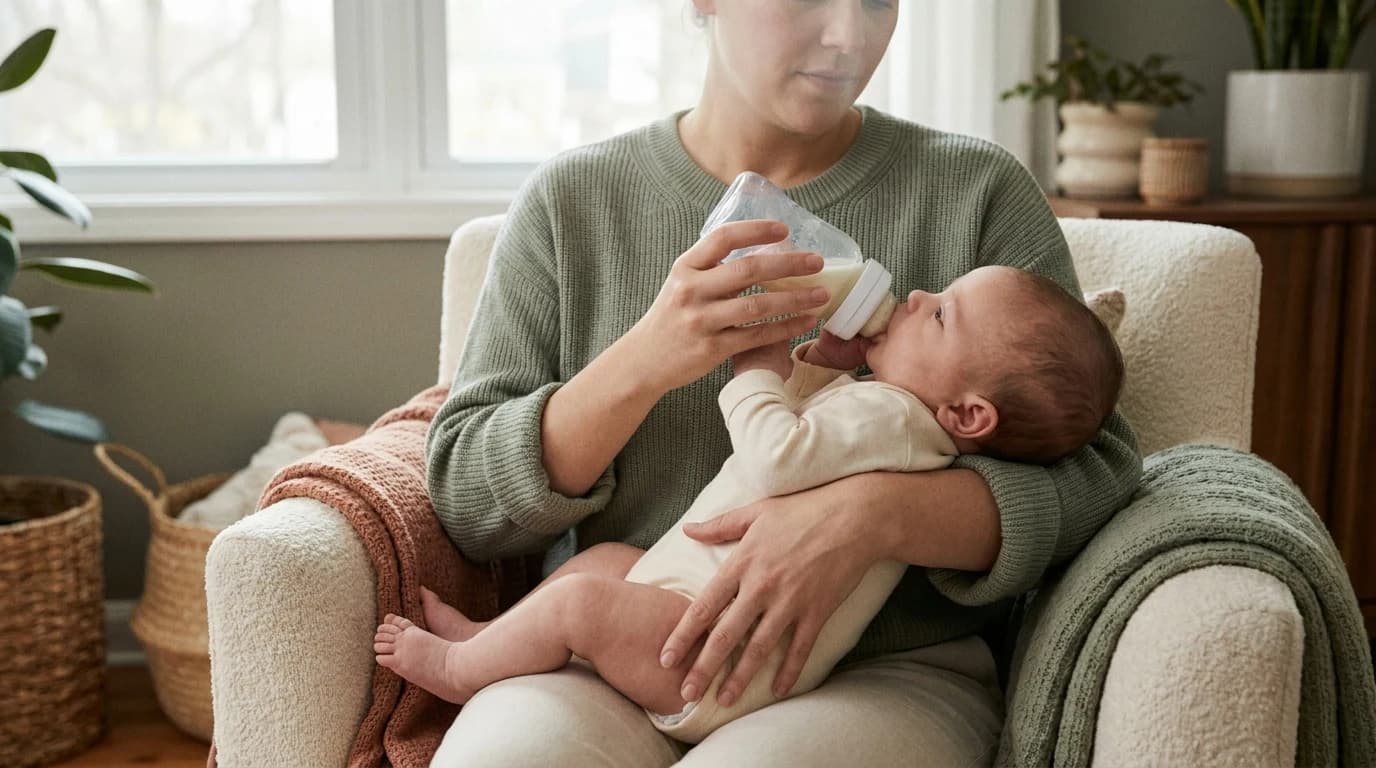
- Use paced bottle feeding with a slow-flow newborn teat. Hold the bottle near-horizontal so your baby has to suck actively, the way they do at the breast — a tipped-up bottle floods them and teaches refusal.
- Don't force it during a hunger meltdown. Offer the bottle when your baby is calm and only mildly hungry, almost as play. A starving, crying baby can't learn a new skill.
First, rule out a real problem
Most refusal is behavioral, but a baby who suddenly refuses every feeding method, refuses for a full day, has fewer wet diapers, a fever, or seems unwell is a different situation. Call your pediatrician rather than experimenting. Pain from teething, an ear infection, reflux, or thrush can all make sucking unpleasant. The tactics below assume an otherwise healthy, growing baby who simply won't accept the bottle itself.
Change one variable at a time
The mistake almost everyone makes is changing five things at once in a panic — new bottle, new room, new person, new time, new temperature — so when something works you have no idea what. Treat it like a calm experiment. Pick one lever, give it two or three tries across a day, then move to the next.
| Lever | Try this | Why it works |
|---|---|---|
| Who | Someone other than the nursing parent offers it — partner, grandparent, an experienced bottle-feeder. Limit to 2–3 feeders. | The baby associates the nursing parent with the breast and holds out for it. |
| Where the parent is | Have the nursing parent leave the room, or the house entirely. | Some babies will only take a bottle when they can't smell or hear the breastfeeding parent. |
| When | Offer when the baby is calm and only mildly hungry, even between feeds. Frame it as play, not a meal. | New skills need a rested, regulated baby — not a frantic one. |
| Position | Try upright facing out, propped on your shins face-to-face, or skin-to-skin in the nursing position. | Some babies want a position unlike nursing; others want one exactly like it. There's no universal answer. |
| Motion | Feed while gently walking, rocking, swaying, or bouncing. | Rhythmic movement soothes a reluctant baby into accepting the teat. |
| The teat | Try a softer or slower-flow ("newborn" or preemie) teat. Flow rate isn't standardized across brands. | A flow that's too fast or a teat that's too firm can make the bottle unpleasant. |
| Temperature | Warm the teat under running water, or cool it (teething babies sometimes prefer cold). Vary the milk temperature too. | Breastmilk from the breast is lukewarm; some babies want that, others want it cooler. |
A trick that helps when the feeder isn't the nursing parent: wrap the bottle in a piece of the breastfeeding parent's worn clothing so it carries their scent.
How you hold the bottle matters more than the brand
Parents spend a fortune buying "the bottle that's most like the breast." The technique matters more than the product. The method to use is paced bottle feeding:
- Sit your baby fairly upright, supported behind the neck and shoulders — not lying flat in the crook of your arm.
- Brush the teat across your baby's lips and wait for them to open wide and draw it in themselves, the way they root for the breast. Don't push it in.
- Keep the bottle close to horizontal, with just enough milk in the tip of the teat. Tip it up only as it empties. This makes your baby suck actively instead of having milk poured into them.
- Let it take time. A bottle should take roughly 15 to 20 minutes — there is no rush, and a fast feed usually means the flow is too quick.
- Watch for stress signals and pause when you see them: a wrinkled, frowning forehead; wide, alarmed eyes while gulping; "starfish hands" with fingers splayed; turning the head away; or suddenly conking out mid-feed. Tip the bottle down or take it away until your baby asks for more. If they don't ask, they're done.
Paced feedingpaced bottle feedingHolding the bottle nearly horizontal so baby has to actively suck, mimicking breastfeeding rhythm. Prevents over-feeding and the breast-to-bottle preference flip. does double duty: it makes the bottle feel less like a firehose, and it protects breastfeeding by keeping the bottle's flow closer to the breast's, so the switch back and forth stays smooth.
What most parents get wrong
Myth: if you don't introduce a bottle early, your baby will never take one. This drives a lot of anxious, premature bottle-pushing. According to La Leche League, a younger baby is only slightly more likely to accept a bottle than an older one — it's "not a strong effect." Most babies of any age will take a bottle eventually, often with a little coaxing. So introducing one early is no guarantee, and not having introduced one isn't a failure.
The flip side is genuinely reassuring: if your baby is approaching 6 months, they may not need a bottle at all. By then they'll be starting solids and can drink expressed milk or water from an open or straw cup — and pediatric guidance is to have all babies off bottles by around 12 months anyway, because of the effect on developing teeth. If your return-to-work date is past the 6-month mark, a cup may be a cleaner solution than winning the bottle war.
When the deadline is looming
The hardest version of this is a parent going back to work in a week with a baby who still won't take a bottle. A few things take the pressure off:
- A healthy, well-fed baby can comfortably go several hours without milk. Many "reverse-cycle" — they snack lightly during the day with the caregiver and nurse more in the evenings and overnight once you're home.
- Just because your baby usually nurses at 10 a.m. doesn't mean they'll demand milk at 10 a.m. when you're not there. They may prefer a cuddle, a walk in the stroller, or a nap.
- A confident, familiar caregiver who knows it's okay to do things differently from you often succeeds where the bottle-feed-exactly-like-mom approach fails.
If your baby is still refusing after genuine, patient effort, stop, regroup, and try again in a few days — and loop in your pediatrician or a lactation consultant if a feeding deadline is non-negotiable. The goal is a fed baby and a calm household, not a bottle won at any cost.
The bottom line
Bottle refusal is a solvable logistics problem, not a verdict on your baby or your supply. Offer it from someone else, when your baby is calm and only mildly hungry, in an upright position, with a slow-flow teat held near-horizontal, and change just one thing at a time. Keep sessions short and low-pressure. And if your baby is closing in on six months, ask yourself whether you need to win the bottle at all — a cup may get you there with far less stress.
Sources
Research Sources
Hilly Shore Inc.
Editorial teamIndependent product research team behind Cribworthy. Reviews are grounded in published AAP / CDC / NHTSA / CPSC pediatric guidance, JPMA / GREENGUARD GOLD / OEKO-TEX certification verification, and aggregated buyer sentiment.
115 products reviewed · 20 categories covered · cites AAP, CDC, NHTSA, CPSC, FDA, ACOG.
Safety claims are verified against published pediatric guidelines and CPSC databases. See our editorial standards.