Are Bottle-Feeding Pillows Safe? What the Recall Means
Quick Answer
Infant self-feeding pillows, also sold as bottle-propping or hands-free feeding cushions, are not safe and should not be used. In early 2026 the U.S. Consumer Product Safety Commission issued an urgent warning to stop using them and recalled four brands sold on Amazon, citing the risk of serious injury or death from aspiration and suffocation. The danger is built into the design: the pillow holds the bottle at a fixed angle so a reclined baby cannot pull away if they start to choke. Safe bottle feeding means holding your baby, keeping them semi-upright, and staying with them the entire feed. There is no safe way to use a product that feeds a baby without a person.
Our Verdict
Skip the whole bottle-pillow category. It is a CPSC-recalled hazard, and the danger is the function (propping a bottle for an unsupervised, reclined baby), not the brand. Hold your baby semi-upright, pace the feed, and burp. When you truly need a break, hand the baby and bottle to another adult, never to a pillow.
Key Takeaways
- ✓Skip the whole bottle-pillow category. It is a CPSC-recalled hazard, and the danger is the function (propping a bottle for an unsupervised, reclined baby), not the brand. Hold your baby semi-upright, pace the feed, and burp. When you truly need a break, hand the baby and bottle to another adult, never to a pillow.
- ✓Infant self-feeding pillows, also sold as bottle-propping pillows or "hands-free" feeding cushions, are not safe and should not be used. In early 2026 the U.S. Consumer Product Safety Commission (C...
- ✓This is a recalled hazard category, not a convenience product. The CPSC concluded there is no safe way to use infant self-feeding pillows and recalled four brands in 2026.
- ✓Infant self-feeding pillows are soft, plush products that rest around a baby's neck or upper body and clamp a bottle in place so a reclined baby can "feed themselves." Consumer Reports found them p...
- ✓This is not a few defective units. From both a medical and a safety view, the concept violates the basics of safe feeding. Three things go wrong at once.
As an Amazon Associate I earn from qualifying purchases. Product prices and availability are subject to change.
You searched for a "bottle-feeding pillow" because you are exhausted and want one free hand. That is an understandable wish. But the honest answer to whether these pillows are safe is no, and in early 2026 it stopped being a matter of opinion: federal regulators issued an urgent warning and recalled several of them. Here is what changed, why the design is the problem, and how to get the break you need without the risk.
Quick answer
Infant self-feeding pillows, also sold as bottle-propping pillows or "hands-free" feeding cushions, are not safe and should not be used. In early 2026 the U.S. Consumer Product Safety CommissionCPSCThe US federal agency that issues product recalls and enforces safety standards on cribs, strollers, car seats, and other juvenile products. (CPSC) issued an urgent warning telling parents to stop using them, and recalled four brands sold on Amazon, citing the risk of serious injury or death from aspiration and suffocation. The danger is built into the design: the pillow holds the bottle in place at a fixed angle so a reclined baby cannot pull away if they start to choke. Safe bottle feeding means holding your baby, keeping them semi-upright, and staying with them the whole time. There is no safe way to use a product that feeds a baby without a person.
Key takeaways
- This is a recalled hazard category, not a convenience product. The CPSC concluded there is no safe way to use infant self-feeding pillows and recalled four brands in 2026.
- The harm is the propping, not the brand. Any object that fixes a bottle in a baby's mouth, even a rolled blanket, carries the same choking, aspiration, and suffocation risk. A different pillow does not fix it.
- The real risks are choking, aspiration, suffocation, ear infections, and tooth decay. A baby cannot control milk flow from a fixed bottle, and pooled milk and a plush surface near the face do the rest.
- The fix costs nothing. Hold your baby semi-upright, pace the feed, and burp. For a true break, hand the baby and bottle to another adult, never to a pillow.
What a self-feeding pillow actually is
Infant self-feeding pillows are soft, plush products that rest around a baby's neck or upper body and clamp a bottle in place so a reclined baby can "feed themselves." Consumer Reports found them priced $14 to $40, mostly made overseas and sold by third-party sellers, which makes oversight harder. They are marketed at tired parents with words like "hands-free" and "self-feeding." Those words are the red flag. The Baby Safety Alliance, the trade group that certifies juvenile products, does not recommend them, saying feeding an infant requires active, direct supervision.
Why the design is the danger
This is not a few defective units. From both a medical and a safety view, the concept violates the basics of safe feeding. Three things go wrong at once.
| What the pillow does | Why it is dangerous |
|---|---|
| Fixes the bottle at a set angle | A baby cannot control milk flow, so milk keeps coming after they stop sucking. It can be inhaled into the airway (aspiration), causing choking or aspiration pneumonia. |
| Holds the bottle in place, hands-free | If the baby chokes, they cannot push the bottle away and no one is there to pull it. Choking during prop feeding can be silent. |
| Sits as plush material near the face | Soft fabric near the face, plus straps that keep the baby from turning away, raises suffocation risk. |
There are slower harms too. Because milk pools in the back of the mouth instead of being swallowed, prop feeding is linked to tooth decay and to ear infections, since pooled milk can irritate the eustachian tube. And feeding flat on the back raises aspiration risk on its own.
The safe-feeding decision matrix
When you are bleary-eyed at 3 a.m., it helps to have a clear yes or no. Use this.
| The situation | Verdict | Why |
|---|---|---|
| Any pillow, cushion, blanket, or toy used to hold the bottle for you | Never | Recalled hazard category; even a short prop is unsafe. |
| Leaving a baby alone with a bottle in a crib, car seat, or bouncer | Never | A baby should never be alone with a bottle. |
| Holding the baby yourself, semi-upright, staying with them | Yes | The standard: pace the feed and burp. |
| Handing the baby and bottle to another adult so you can rest | Yes | A person can respond to choking; a pillow cannot. |
| A nursing pillow that cushions YOUR arm while you hold the baby | Yes | The line is whether a person is doing the feeding. |
That last row is the distinction that matters. A regular nursing or feeding-support pillow that rests under your arm while you hold the baby and the bottle is a comfort tool for you. A "self-feeding" pillow that holds the bottle so you can step away is the recalled category. Same word, opposite safety profile.
How to actually feed hands-on (and get a break)
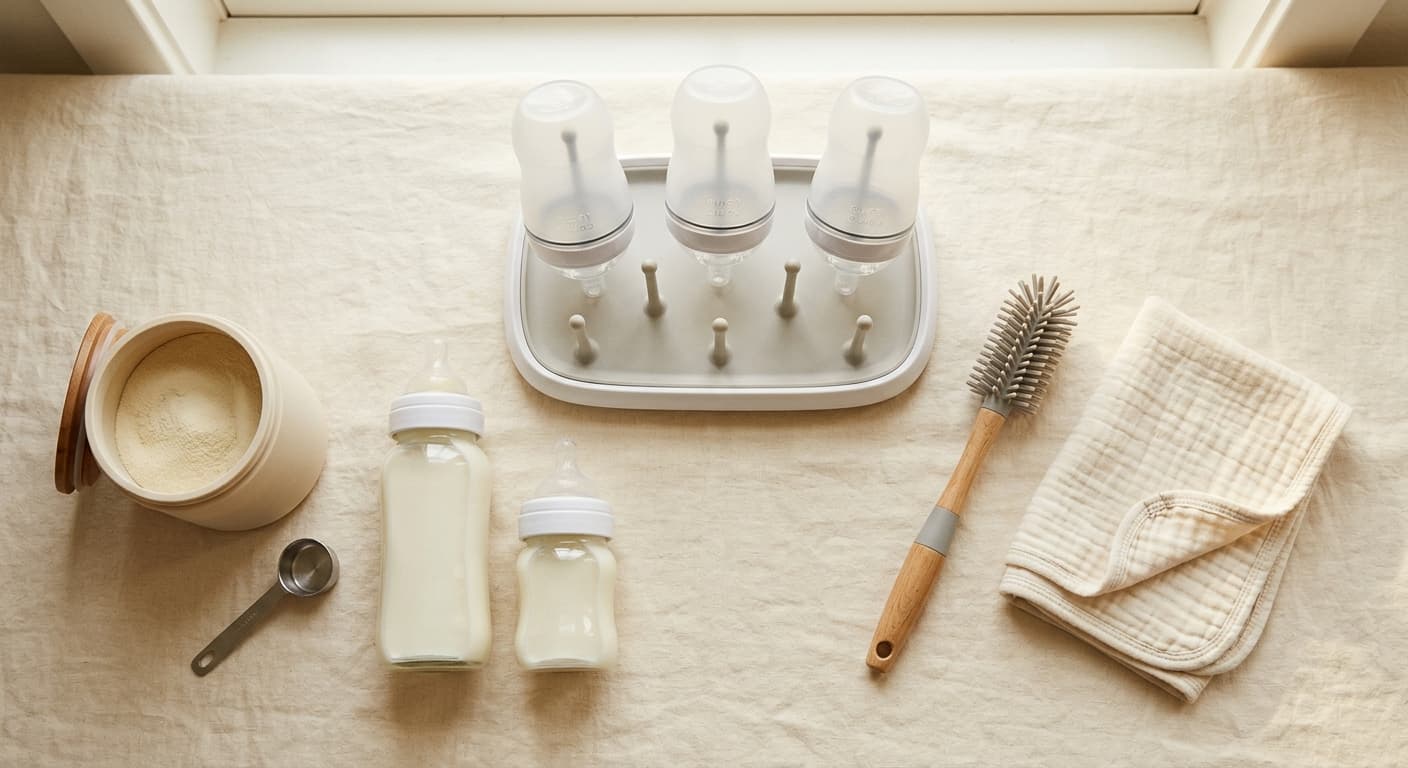
Safe bottle feeding needs no special gear, just a position and your attention. For the full routine, see our bottle-feeding essentials guide and how to introduce a bottle.
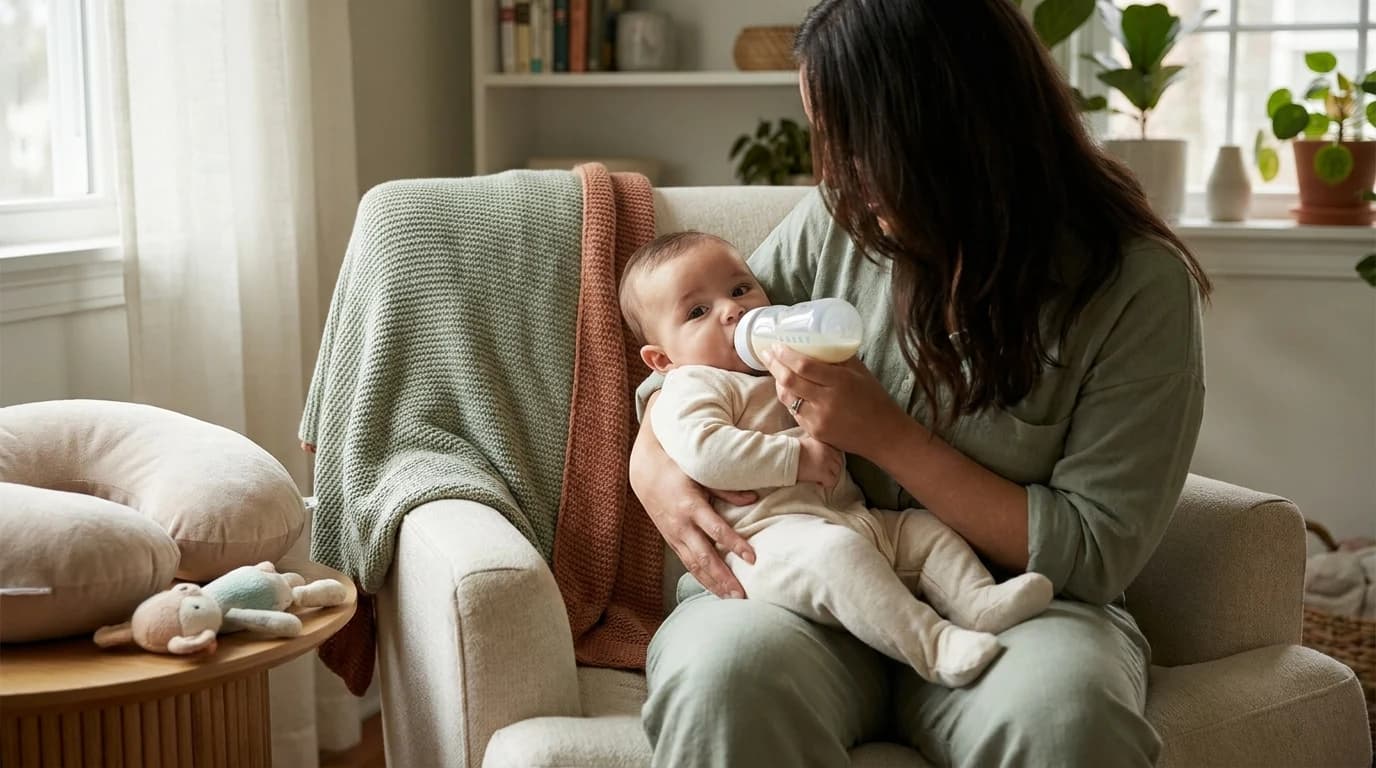
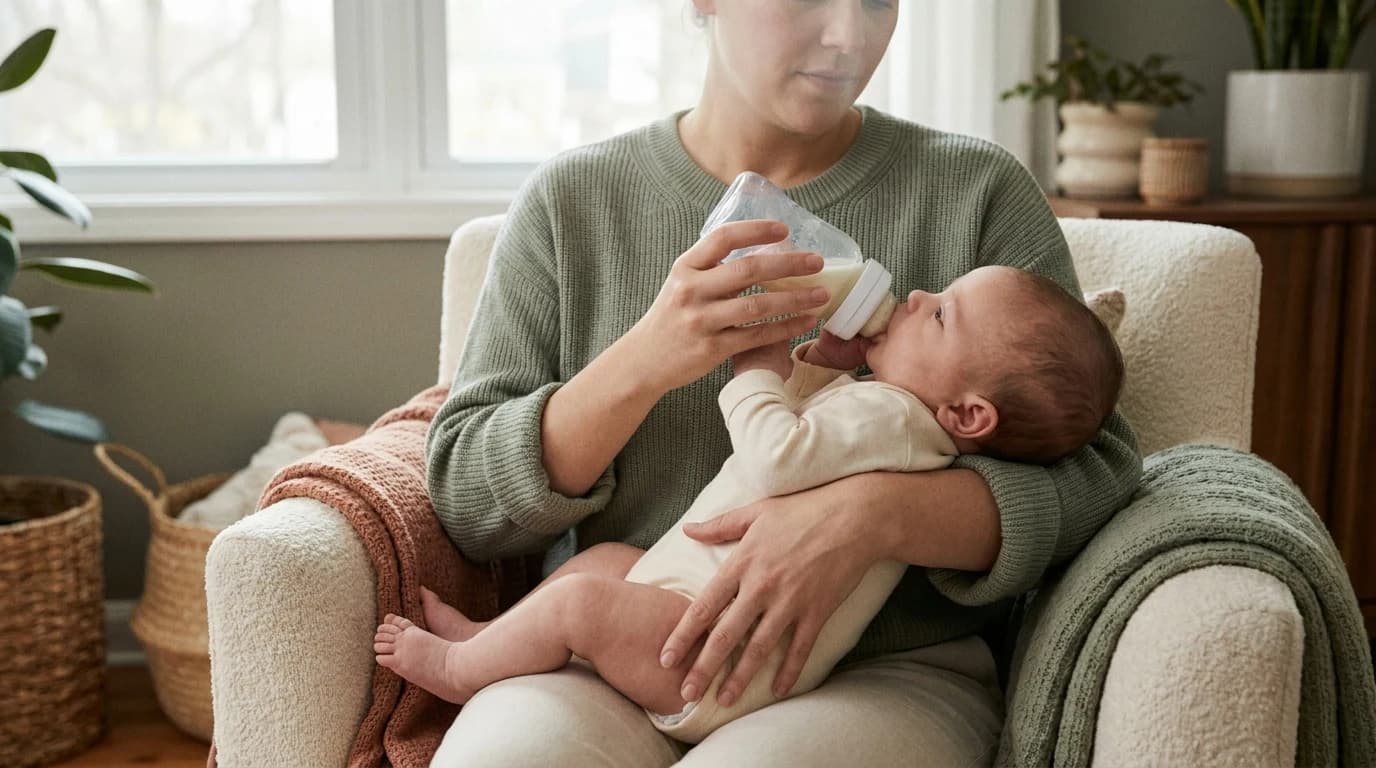
- Hold the baby semi-upright, head higher than the body, never flat on their back.
- Keep the bottle near-horizontal, tilted just enough to fill the nipple so the baby controls the pace (paced feedingpaced bottle feedingHolding the bottle nearly horizontal so baby has to actively suck, mimicking breastfeeding rhythm. Prevents over-feeding and the breast-to-bottle preference flip.).
- Pause and burp partway through and at the end.
- Stay present the entire feed, watching for coughing, gulping, or color changes.
- When you are truly spent, trade off, do not prop. The break should come from another set of hands.
If you already own one, the CPSC guidance is to stop using it and dispose of it. This is separate from soft infant loungers (which carry their own safe-sleep recall history), but the lesson is the same: plush, baby-shaped products that promise to do a caregiver's job tend to be the ones that get recalled.
What most parents get wrong
The assumption is that a recall is about one bad batch, so a "better" or pricier bottle pillow must be fine. The evidence does not support that. Consumer Reports tracked this category for over a year and found many similar designs still for sale after the recalls, and regulators, pediatricians, and safety advocates all agree there is no safe way to use any of them. The hazard is the function, not the label on the box. The second mistake is treating "hands-free" as a feature. On an infant feeding product, "hands-free" is the warning, not the selling point, because the whole point of being present is to respond if something goes wrong.
The bottom line
A bottle-feeding pillow solves the wrong problem. What makes feeding safe is a person who can react, and that is exactly what these products remove. Skip the whole category, hold your baby semi-upright, pace the feed, and when you need a break, get it from another adult. That version is both safe and actually restful.
Are bottle-feeding pillows safe to use?
No. In 2026 the CPSC issued an urgent warning to stop using infant self-feeding pillows and recalled four brands, citing the risk of serious injury or death from aspiration and suffocation. Pediatricians and product-safety groups agree there is no safe way to use them.
Why is propping a bottle dangerous if I only do it for a minute?
A baby cannot control milk flow from a fixed bottle or push it away if they choke, and choking during prop feeding can be silent. Even a brief prop carries real risk.
What is the safe way to bottle-feed a baby?
Hold the baby semi-upright with the head higher than the body, keep the bottle near-horizontal so the baby paces the feed, pause to burp, and stay with them the entire time. Never leave a baby alone with a bottle in a crib, car seat, or bouncer.
Sources
Your next step
Feeding hands-on the safe way? Get the bottles and support gear that make it easier.
Research Sources
Hilly Shore Inc.
Editorial teamIndependent product research team behind Cribworthy. Reviews are grounded in published AAP / CDC / NHTSA / CPSC pediatric guidance, JPMA / GREENGUARD GOLD / OEKO-TEX certification verification, and aggregated buyer sentiment.
115 products reviewed · 20 categories covered · cites AAP, CDC, NHTSA, CPSC, FDA, ACOG.
Safety claims are verified against published pediatric guidelines and CPSC databases. See our editorial standards.