Bottle Feeding Essentials: The Gear You Actually Need
Quick Answer
The real starter list is short: six to eight bottles, slow-flow nipples, a bottle brush, and a drying rack. Add a sterilizer only if you want the counter space back. Dr. Brown's Options+ suits gassy or refluxy babies, Philips AVENT Natural is easier to wash, and either works. Buy one brand in a small pack first, because your baby decides which nipple gets accepted.
Our Verdict
Start with a four-pack of one bottle brand rather than a full registry set, then commit once your baby shows a preference. Add a warmer only if you are handing off night feeds and want them fast. Give the formula pitcher, the wipe warmer, and the twelve-nipple variety kit a miss. Keep every part clean and dry between uses, and sanitize daily while your baby is under two months.
Key Takeaways
- ✓Whether you're formula feeding exclusively, doing combo feeding, or pumping and bottle-feeding breast milk, you need the same core bottle-feeding setup. This guide covers what you need and what to skip.
- ✓Mid-feed and after. Hold baby upright on your shoulder or sitting on your lap, pat gently, wait 1-2 minutes. Expect burps and sometimes spit-up.
- ✓Bottle feeding gear is simple. A few quality bottles, a drying rack, maybe a sterilizer, and you're set. Don't overbuy. Babies often have preferences — start small and expand based on what works.
As an Amazon Associate I earn from qualifying purchases. Product prices and availability are subject to change.
Bottle Feeding Essentials: Gear for Formula or Pumped Milk
Whether you're formula feeding exclusively, doing combo feeding, or pumping and bottle-feeding breast milk, you need the same core bottle-feeding setup. This guide covers what you need and what to skip.
The essentials
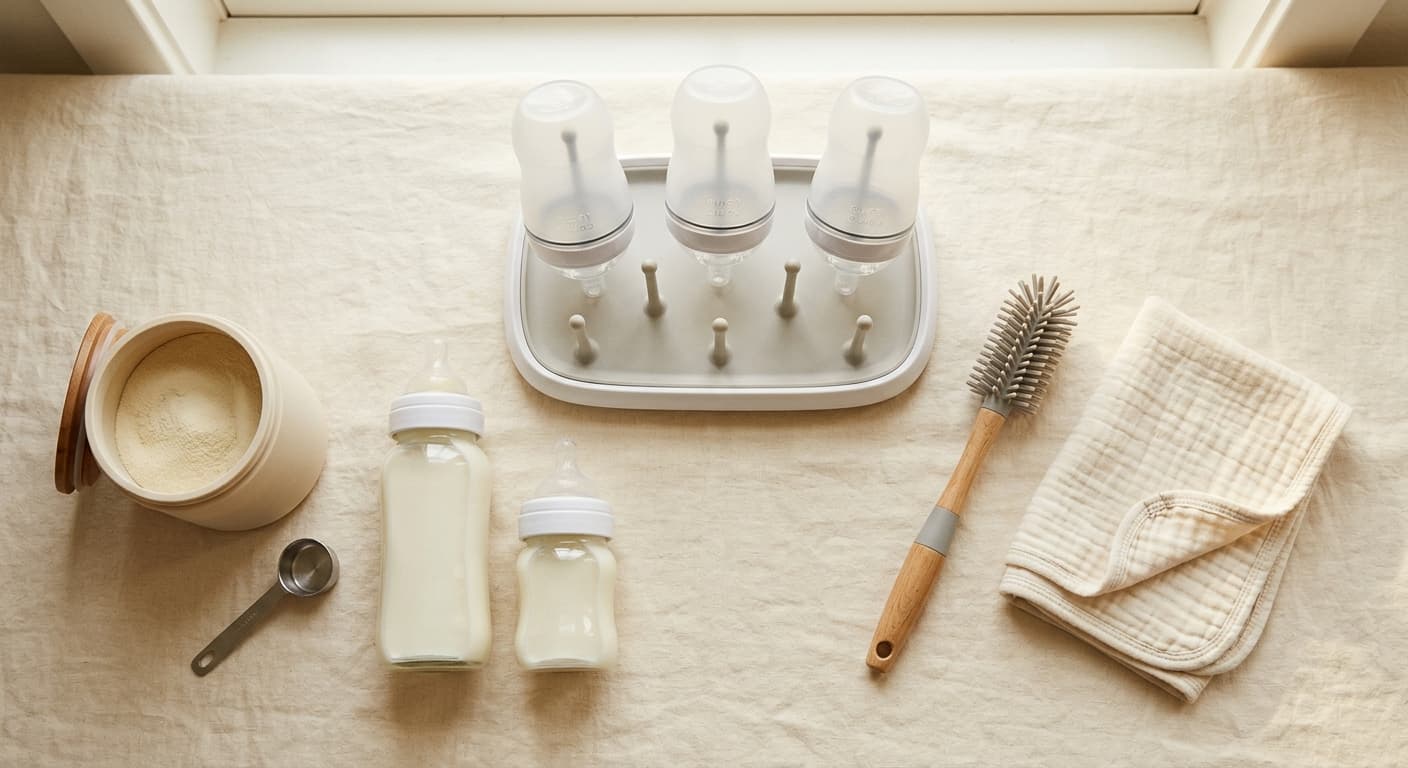
1. Bottles (6-8 to start)
How many: Start with 6-8 bottles. You'll want enough to not have to wash constantly but not so many they take over the counter.
Sizes: 4oz for newborns (weeks 0-8), 8oz for 2+ months. Most brands sell both.
Top bottle picks:
Dr. Brown's Options+ — The anti-colic champion. Internal vent system reduces air intake. Slightly more parts to wash but worth it if baby is gassy or swallows a lot of air.
- Price: $25-30 for a 4-pack
- Best for: Gassy babies who swallow air
Philips AVENT Natural — Wide-neck design, easy to clean, soft silicone nipple that mimics breast shape.
- Price: $20-25 for a 4-pack
- Best for: Combo feeding (breast + bottle)
Comotomo — Silicone body, very soft, mimics breast feel. Dishwasher-safe, bulk-friendly.
- Price: $25-30 for a 2-pack
- Best for: Breastfed babies transitioning to bottle
MAM Easy Start — Self-sterilizing in the microwave, anti-colic valve.
- Price: $15-20 for a 4-pack
- Best for: Parents who want minimal sterilizing fuss
Start with one brand and a few of another — babies can be picky about nipples. If they reject one, you have a backup.
2. Bottle brush + drying rack
Brush: Boon Grass Countertop Drying Rack is popular but basic OXO Tot works fine.
Drying rack: Boon Grass Countertop Drying Rack ($15) is the go-to. It holds bottles, pacifiers, pump parts, and anything else — all drying separately.
Cost: $20 total for brush + rack.
3. Sterilizer (optional but recommended)
Top picks:
Baby Brezza Sterilizer Dryer Advanced ($80) — Electric, sterilizes and dries in one cycle. Popular with parents who find it saves time.
Philips AVENT Premium Sterilizer ($60) — Electric, steam sterilizes in 6 minutes.
Microwave sterilizer bags ($10) — The budget option. Medela and Dr. Brown's both make them. Works fine for occasional sterilizing.
Honest take: After the first 4-6 weeks, many parents stop sterilizing daily and just run bottles through the dishwasher on hot. That's safe per most pediatric guidance.
4. Formula dispenser (OXO Tot Formula Dispenser, $15)
For on-the-go feeding. Holds 3 pre-measured formula portions so you just add water at destination.
5. Do you need a bottle warmer?
Not for your baby's sake. The CDC says infant formula does not need to be warmed before feeding, and that breast milk can be served room temperature or cold. If you do warm a bottle, warm running water or a bowl of warm water does the job; test a few drops on your wrist, and it should feel warm, not hot.
What not to do: microwave bottles. The CDC warns that microwaves heat unevenly and create hot spots that can burn a baby's mouth.
A warmer earns its counter space when your baby refuses cold milk and you warm several bottles a day, or when you feed away from a kitchen. One pick for each case:
| Warmer | Type | What the maker states |
|---|---|---|
| Dr. Brown's Deluxe Bottle Warmer and Sterilizer → | Plug-in, steam | Warming settings for bottle type, size and starting temperature; shuts off 60 seconds after a cycle; also warms food jars and sterilizes |
| Baby Brezza Superfast Portable Bottle Warmer → | Rechargeable travel cup | Holds 9 oz and warms 8 oz in about 3 minutes from room temperature; four temperature settings; up to eight 6 oz bottles per charge from room temperature. You warm the milk in its cup, then pour it into the bottle |
6. Formula (if formula feeding)
All FDA-approved US formulas meet the same nutritional standards. The brand differences are marketing, price, and specific ingredients.
Popular premium brands: Enfamil, Similac, Gerber Premium specialty: Bobbie (organic), Kendamil (grass-fed), HiPP (European) Store brands (same FDA standards, 30-50% less): Costco Kirkland, Target Up&Up, Walmart Parent's Choice, Aldi Little Journey
Which to pick:
- Start with a standard cow's milk-based formula (Enfamil Infant, Similac Advance, or store brand equivalent)
- If baby has issues (gas, reflux, rash), talk to pediatrician about alternatives
- Don't overthink brand — they all work
7. Pacifiers (4-6)
Not strictly feeding gear, but closely related. Pacifier use is associated with reduced SIDS risk per AAP.
Top picks:
- Philips AVENT Soothie ($10 for 2) — Hospital-standard, one-piece, very safe
- MAM Original ($10 for 2) — Orthodontic shape
- Nanobébé Flexy ($10 for 2) — Newer design, flexible
Tip: Have baby's preference tested. Some babies reject certain nipple shapes.
Nice-to-haves
Bottle drying rack ($15)
Boon Grass already listed above — it's basically universal.
Bottle warmer ($30-40)
See #5 above — optional.
Formula dispenser for diaper bag ($15)
Makes on-the-go feeds easier.
Things you don't need
Fancy bottle brands with no evidence
Many "premium" bottles with cute designs are just more expensive versions of standard bottles.
A dozen different nipple brands
Figure out what works, then buy more of that.
A sterilizer that promises to sterilize everything
Dishwashers work fine after the first 4-6 weeks.
Glass bottles (unless you want them)
They're fine but heavier and more breakable. Silicone or BPA-free plastic works the same for baby.
How to actually feed a bottle
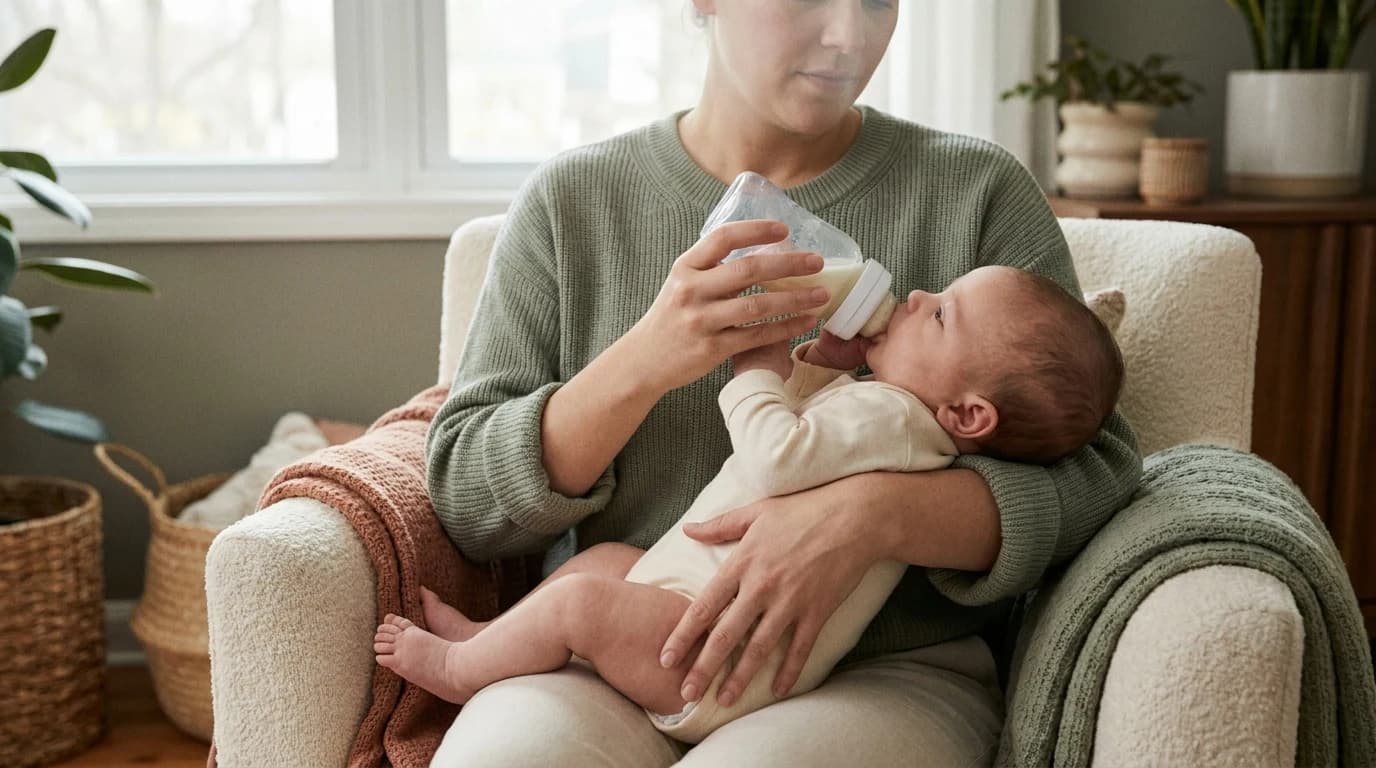
Positioning:
- Hold baby slightly upright (not flat)
- Cradle head in your elbow
- Tilt bottle just enough that the nipple is full of milk (not forcefully tilted)
- Let baby control the pace
Paced bottle feeding: For breastfed babies (or any baby), paced feeding mimics breastfeeding:
- Horizontal bottle position (baby sucks more actively)
- Pause every 1-2 minutes to let baby breathe
- Let baby decide when they're done
- Typically 15-20 minutes total per feed
Burping: Mid-feed and after. Hold baby upright on your shoulder or sitting on your lap, pat gently, wait 1-2 minutes. Expect burps and sometimes spit-up.
Bottle feeding mistakes
-
Propping bottles. Dangerous, with an aspiration and suffocation risk. See are bottle-feeding pillows safe for the 2026 recall and the safe way to feed.
-
Forcing baby to "finish." Babies regulate intake. Don't insist.
-
Moving to fast-flow nipples too quickly. A faster flow gives baby less chance to swallow and breathe between sucks. Paced feeding with a slow-flow nipple is what Minnesota WIC's handout says helps prevent overfeeding and spit-up. If spit-up is the worry, see our guide to bottles for reflux babies.
-
Reheating bottles in the microwave. Creates hot spots.
-
Leaving formula prepared at room temperature for 2+ hours. Toss it.
-
Not cleaning thoroughly. Formula residue leads to bacterial growth. Wash well.
-
Comparing formula amounts to other babies. Intake varies widely.
Bottle feeding schedule by age
Newborn (0-4 weeks):
- 1-3 oz per feed
- Every 2-3 hours
- 8-12 feeds per day
- Total: 16-24 oz/day
1-3 months:
- 3-5 oz per feed
- Every 3-4 hours
- 6-8 feeds per day
- Total: 24-32 oz/day
3-6 months:
- 5-7 oz per feed
- Every 3-4 hours during day
- 5-6 feeds per day
- Total: 28-32 oz/day
6-12 months:
- 6-8 oz per feed
- 4-5 feeds per day, supplemented with solids
- Total: 24-32 oz/day (decreasing as solids increase)
Bottom line
Bottle feeding gear is simple. A few quality bottles, a drying rack, maybe a sterilizer, and you're set. Don't overbuy. Babies often have preferences — start small and expand based on what works.
Related reading:
💬 Real Talk from Parents
Formula is not a failure. Fed is genuinely best.
Sterilizing bottles at 2 AM is a rite of passage nobody tells you about.
You'll develop strong opinions about bottle nipple flow rates, and that's okay.
The Dr. Brown's bottles are annoying to clean but genuinely reduce gas. Worth the extra parts for a gassy baby.
Paraphrased community consensus — not a direct quote.
Research Sources
- Bottle Feeding: How It's Done - HealthyChildren.org (AAP)
- How to Clean, Sanitize, and Store Infant Feeding Items - CDC
- Paced Bottle Feeding handout (PDF) - Minnesota Department of Health WIC
- Infant Formula Preparation and Storage — CDC
- Proper Handling and Storage of Human Milk — CDC
- Deluxe Baby Bottle Warmer and Sterilizer — Dr. Brown's
- Superfast Portable Bottle Warmer — Baby Brezza
Hilly Shore Inc.
Editorial teamIndependent product research team behind Cribworthy. Reviews are grounded in published AAP / CDC / NHTSA / CPSC pediatric guidance, JPMA / GREENGUARD GOLD / OEKO-TEX certification verification, and aggregated buyer sentiment.
122 products reviewed · 22 categories covered · cites AAP, CDC, NHTSA, CPSC, FDA, ACOG.
Safety claims are verified against published pediatric guidelines and CPSC databases. See our editorial standards.