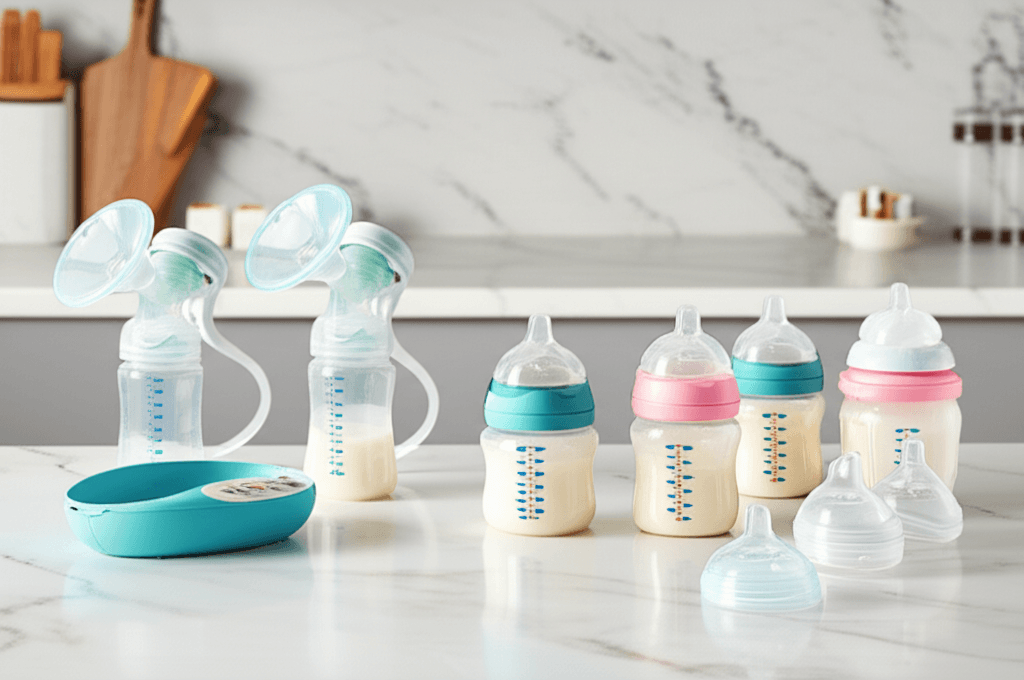
Best Bottles for Reflux Babies: What a Bottle Can and Can't Change
Quick Answer
No bottle treats reflux, and most spit-up is normal and improves with age. What a bottle can do is reduce swallowed air, which the AAP suggests trying for babies who gulp feeds. Look for a small bottle with a slow-flow nipple that feeds well held near horizontal for paced feeding, such as the Philips Avent Anti-Colic with AirFree Vent, about $19 for four. See a pediatrician first if there are red-flag signs.
Our Verdict
Treat the bottle as one small lever. A vented, slow-flow bottle can cut swallowed air and suits paced feeding, but smaller feeds, frequent burping and upright time after meals matter more. Red-flag signs such as forceful vomiting, blood or poor weight gain go to the pediatrician, not the bottle aisle.
Pick by your situation
| If your situation is… | Pick | Why |
|---|---|---|
| You want to try paced, upright feeding | Philips Avent Anti-Colic with AirFree Vent | Philips says the vent keeps the nipple full of milk even when the bottle is horizontal, and it comes in a 4-ounce size with a Flow 1 nipple. |
| Your pediatrician may suggest thickened feeds | Dr. Brown's Options+ Anti-Colic Narrow Bottle | Dr. Brown's sells a Y-cut nipple marketed for thicker liquids, so ask your pediatrician which nipple to use. |
| Your baby gulps even on slow nipples | MAM Easy Start Anti-Colic+ | An extra slow flow nipple on a vented base, in a small 4.5-ounce bottle. |
| Night feeds with warmed milk | Tommee Tippee Advanced Anti-Colic | A heat-sensing strip on the vent tube turns pink when the milk is too hot. |
Each pick is one of the products ranked below — this row is for shortcutting based on your situation, not a separate recommendation.
#1Philips Avent Anti-Colic with AirFree Vent 4.7 | #2Dr. Brown's Options+ Anti-Colic Narrow Bottle 4.8 | #3MAM Easy Start Anti-Colic+ 4.7 | #4Tommee Tippee Advanced Anti-Colic 4.6 | |
|---|---|---|---|---|
| Verdict | Best for paced, upright feeds | Best if thickened feeds come up | Slowest start | Best for night feeds |
| Price | ~$19.19Buy on Amazon | ~$20.37Buy on Amazon | ~$13.39Buy on Amazon | ~$25.00Buy on Amazon |
| Size | 4 oz | 8 oz | 4.5 oz | 5 oz |
| Bottles | 4 | — | 2 | 2 |
| Starting nipple | Flow 1 (0m+) | Level 1 slow flow | Extra slow flow | Slow flow |
| Vent | AirFree vent | Internal vent, removable | Vented base | Anti-colic tube |
| Pros |
|
|
|
|
| Cons |
|
|
|
|
* Prices are approximate. Check the linked retailer for current pricing and availability.
Key Takeaways
- ✓Treat the bottle as one small lever. A vented, slow-flow bottle can cut swallowed air and suits paced feeding, but smaller feeds, frequent burping and upright time after meals matter more. Red-flag signs such as forceful vomiting, blood or poor weight gain go to the pediatrician, not the bottle aisle.
- ✓Before any bottle, the medical picture. Spitting up is what doctors call gastroesophageal reflux, or GER, and in babies it is normal. The NIH's digestive-disease institute (NIDDK) describes regurgi...
- ✓The NIDDK lists signs that mean calling a doctor right away, because they can point to a problem other than reflux:
- ✓The guidance from the AAP, NIDDK and the UK's NICE names a handful of levers for a spitty baby. Only some of them run through the bottle:
- ✓Paced bottle feeding slows the flow so the baby can swallow and breathe between sucks. The Minnesota Department of Health's WIC program publishes a step-by-step handout, which says it helps prevent...
A special anti-reflux bottle will stop a baby spitting up.
Spitting up is normal in infants, and the NIDDK says most children no longer have symptoms by 12 to 14 months. The AAP's bottle advice is narrower: a different bottle may reduce the air a baby swallows.
Raising the head of the crib helps a baby with reflux sleep.
The AAP says elevating the head of the crib is not effective in reducing reflux and is not safe. Babies with reflux should still sleep on their backs on a flat surface.
As an Amazon Associate I earn from qualifying purchases. Product prices and availability are subject to change.
Start here: most spit-up is not a bottle problem
Before any bottle, the medical picture. Spitting up is what doctors call gastroesophageal reflux, or GER, and in babies it is normal. The NIH's digestive-disease institute (NIDDK) describes regurgitation and spitting up as normal in infants younger than one, reports that about 70 to 85 percent of infants have daily regurgitation by two months, and says most children no longer have symptoms by 12 to 14 months. The American Academy of Pediatrics calls these babies "happy spitters" and notes that GER usually begins at two to three weeks and peaks between four and five months.
GERD — the disease, with a "D" — is different: reflux that causes bothersome symptoms or complications. That is a diagnosis for your pediatrician, not a bottle aisle.
No bottle treats reflux or GERD. What a bottle can do is narrower, and the AAP says exactly what: for a baby who gulps feeds and seems gassy, "consider trying a different bottle to decrease your baby's ability to suck in air." This guide is about that job.
When it is not a bottle question
The NIDDK lists signs that mean calling a doctor right away, because they can point to a problem other than reflux:
- Crying more than usual or being extremely irritable.
- Failure to thrive — weighing less, or gaining less weight, than expected for age.
- Vomit that contains blood or looks like coffee grounds, or blood in the stool.
- Signs of dehydration, such as no wet diapers for 3 hours or more, or a lack of energy.
- Vomiting in large amounts, vomiting that is regularly forceful, or vomit that is green or yellow.
- Vomiting or regurgitation that begins before 2 weeks or after 6 months of age.
The AAP adds that spit-up turning into forceful vomiting after every feeding, or blood in spit-up, means calling your pediatrician right away.
Rule of thumb: if any sign on that list applies, the next step is the pediatrician, not a new bottle.
What a bottle can change, and what it can't
The guidance from the AAP, NIDDK and the UK's NICE names a handful of levers for a spitty baby. Only some of them run through the bottle:
| Lever named in the guidance | Can the bottle help? |
|---|---|
| Swallowed air during feeds | Yes — this is what vents and nipple design address |
| Overfeeding or feeding too fast | Partly — a slow-flow nipple and paced feeding slow the feed |
| Feeding position | Partly — a bottle that works near horizontal suits semi-upright feeding |
| Thickened feeds, only if your pediatrician advises | Only the nipple — thicker liquids need a nipple that passes them |
| A formula protein the baby doesn't tolerate | No — that is a formula conversation with your pediatrician |
| Sleep position | No — back to sleep on a flat surface, reflux or not |
The AAP's bottle-feeding basics puts the order plainly: more important than the type of bottle or nipple is how you position your baby — semi-upright, head in the crook of your arm, with the bottle held so milk covers the nipple and your baby isn't swallowing air.
Paced feeding: the technique the bottle has to support
Paced bottle feedingpaced bottle feedingHolding the bottle nearly horizontal so baby has to actively suck, mimicking breastfeeding rhythm. Prevents over-feeding and the breast-to-bottle preference flip. slows the flow so the baby can swallow and breathe between sucks. The Minnesota Department of Health's WIC program publishes a step-by-step handout, which says it helps prevent overfeeding and spit-up:
Paced bottle feeding, as the Minnesota WIC handout describes it
- Start with a small, 4-ounce bottle and a slow flow nipple.
- Hold your baby semi-upright in your lap, supporting the head and neck.
- Hold the bottle horizontal to the floor and let your baby start sucking on the empty nipple.
- Tip the bottle just enough to fill the nipple about halfway, for 3 to 5 swallows.
- Tip it down for a short break, leaving the nipple in your baby's mouth, then repeat until your baby shows fullness.
That technique is the real test for a reflux bottle: it has to come in a small size with a slow nipple, and it has to feed well when held close to horizontal. The two sources describe the tilt a little differently — the AAP says to keep milk covering the nipple, the WIC handout to fill it about halfway during each burst — and both are aiming at the same thing: milk in the nipple, not air.
Four bottles, judged on those jobs
Each of these is marketed as anti-colic, and the descriptions below are the manufacturers' own. Philips, MAM and Tommee Tippee also use the word "reflux" in their marketing; treat that as a claim about swallowed air, not a treatment.
| Bottle | Venting, as the maker describes it | Starting nipple | Size in this pack | Price |
|---|---|---|---|---|
| Philips Avent Anti-Colic with AirFree Vent | Vent keeps the nipple full of milk, even horizontal | Flow 1, 0m+ | 4 oz, 4 bottles | $19.19 |
| Dr. Brown's Options+ Anti-Colic Narrow Bottle | Internal vent for vacuum-free, consistent flow | Level 1 slow flow | 8 oz | $20.37 |
| MAM Easy Start Anti-Colic+ | Vented base | Extra slow flow | 4.5 oz, 2 bottles | $13.39 |
| Tommee Tippee Advanced Anti-Colic | Tube that draws air away from the milk | Slow flow | 5 oz, 2 bottles | $25.00 |
Prices were checked on September 23, 2026.
Worth knowing: "reflux" on a bottle box is a claim about swallowed air. None of these four is a treatment for reflux or GERD.
Best for upright, paced feeds: Philips Avent Anti-Colic with AirFree Vent
Buy on Amazon · $19.19 →Philips says the AirFree vent keeps the nipple full of milk rather than air, even when the bottle is horizontal — which is the angle paced feeding asks for. It comes in the 4-ounce size with a Flow 1 nipple, and Philips says the one-piece vent is easy to clean and the bottle can be used with or without it.
Best if thickened feeds may come up: Dr. Brown's Options+ Anti-Colic
Dr. Brown's describes its internal vent as giving vacuum-free feeding and a consistent flow, and the bottle ships with a Level 1 slow flow nipple. The reason it earns a place here is the nipple range: Dr. Brown's sells a Y-cut nipple it markets as ideal for thicker liquids, labeled for 9 months and up. The AAP says a pediatrician may recommend thickening a bottle-fed baby's formula, and to never add solids to the bottle unless your pediatrician advises it — if that happens, ask which nipple to use rather than cutting one yourself. For the Options+ as an everyday bottle, see our best baby bottles guide.
Slowest start: MAM Easy Start Anti-Colic+
Buy on Amazon · $13.39 →MAM pairs a vented base with an extra slow flow silicone nipple, and describes the combination as letting babies feed at their own pace while swallowing less air. MAM also says the bottle self-sterilizes in 3 minutes. At 4.5 ounces, it fits the small-bottle step of paced feeding.
Best for night feeds: Tommee Tippee Advanced Anti-Colic
Buy on Amazon · $25.00 →Tommee Tippee's vent is a tube that it says draws air away from the milk. The tube also carries a heat-sensing strip that turns pink when the milk is too hot — useful at 3 a.m. It is the most expensive per bottle of the four.
What else the guidance recommends

What the guidance says helps:
- Smaller, more frequent feeds. The AAP suggests this to avoid overfeeding, and NICE's reflux guideline includes it in its stepped approach for formula-fed babies with frequent regurgitation and marked distress.
- Burping more often, as the NIDDK puts it — during feeds as well as after, the AAP adds.
- Holding your baby upright for 20 to 30 minutes after a feed, if practical, with close supervision.
- Keeping play calm after meals and postponing tummy timetummy timeSupervised awake time on the stomach — builds neck, back, and arm strength and prevents flat-head syndrome. Aim for a few minutes several times a day from day one. for a while.
What the guidance warns against:
- Wedges, positioners or raising the head of the crib. The AAP says elevating the crib is not effective and not safe, and babies with reflux still sleep on their backs.
- Adding solids such as cereal to a bottle without your pediatrician's advice.
- Giving any reflux medicine unless a doctor tells you to.
Bottom line: a better bottle cuts swallowed air. Feed size, burping, position and time do more of the work.
If formula might be part of the picture, the AAP notes that a milk-protein allergy can cause symptoms similar to reflux and that your pediatrician may suggest a specialized formula. Our formula comparison and how to switch formula safely cover that conversation, and skip inclined sleepers explains why inclined products are off the table.
Do anti-colic bottles help with reflux?
They can reduce the air a baby swallows during a feed, which is the specific change the AAP suggests trying a different bottle for. They do not treat reflux or GERD, and normal spit-up usually improves with age regardless of the bottle.
What nipple flow is best for a baby who spits up a lot?
Paced-feeding guidance from Minnesota WIC starts with a slow flow nipple, which slows the feed. If your pediatrician recommends thickened feeds, ask which nipple to use, because thicker liquids need a nipple designed to pass them.
Should I keep my baby upright after a bottle?
The NIDDK suggests holding an infant upright for 20 to 30 minutes after feeding if practical, and the AAP adds that you should supervise closely during that time. For sleep, babies with reflux still go down flat on their backs.
Research Sources
- NIDDK, Definition & Facts for GER & GERD in Infants
- NIDDK, Symptoms & Causes of GER & GERD in Infants — signs to call a doctor right away
- NIDDK, Treatment for GER & GERD in Infants — burping and holding upright after feeds
- American Academy of Pediatrics (HealthyChildren.org), Why Babies Spit Up — trying a different bottle for swallowed air
- American Academy of Pediatrics (HealthyChildren.org), Gastroesophageal Reflux (GER) & Gastroesophageal Reflux Disease (GERD)
- American Academy of Pediatrics (HealthyChildren.org), What is the safest sleep solution for my baby with reflux?
- American Academy of Pediatrics (HealthyChildren.org), Bottle Feeding Basics — positioning matters more than bottle type
- NICE guideline NG1, Gastro-oesophageal reflux disease in children and young people — Recommendations
- Minnesota Department of Health WIC, Paced Bottle Feeding handout (PDF)
Hilly Shore Inc.
Editorial teamIndependent product research team behind Cribworthy. Reviews are grounded in published AAP / CDC / NHTSA / CPSC pediatric guidance, JPMA / GREENGUARD GOLD / OEKO-TEX certification verification, and aggregated buyer sentiment.
115 products reviewed · 20 categories covered · cites AAP, CDC, NHTSA, CPSC, FDA, ACOG.
Safety claims are verified against published pediatric guidelines and CPSC databases. See our editorial standards.