Best Breast Milk Storage Bags 2026: Matched to CDC Storage Rules
Quick Answer
Lansinoh Breastmilk Storage Bags, about $14 for 100, are the sensible default: presterilized, double-zippered and designed to freeze flat. NUK Seal n' Go costs least per bag. Whichever you buy, the CDC's rules matter more than the brand: freeze 2 to 4 ounces per bag, leave about an inch of headspace, and use frozen milk within about 6 months for best quality.
Our Verdict
Buy on per-bag price and the features you will use daily, not on capacity. A 6-ounce bag already holds the 2-to-4-ounce portion the CDC recommends. Date every bag, keep them out of the door, thaw the oldest first, and never refreeze.
Pick by your situation
| If your situation is… | Pick | Why |
|---|---|---|
| You want one box that covers everything | Lansinoh Breastmilk Storage Bags | Presterilized, double zipper, lays flat to freeze and stands in the fridge, at about 14 cents a bag. |
| You are building a large stash on a budget | NUK Seal n' Go Breast Milk Bags | The lowest price per bag of the five, with a double zipper seal and a presterilized top. |
| Milk goes to daycare | Dr. Brown's Breast Milk Storage Bags | A write-on label for the date and your baby's name, which the CDC asks for when milk goes to a childcare provider. |
| You pour bags into bottles one-handed | Medela Easy Pour Breast Milk Storage Bags | A separate side spout for pouring, and the largest 7-ounce capacity here. |
Each pick is one of the products ranked below — this row is for shortcutting based on your situation, not a separate recommendation.
#1Lansinoh Breastmilk Storage Bags 4.8 | #2NUK Seal n' Go Breast Milk Bags 4.6 | #3Dr. Brown's Breast Milk Storage Bags 4.7 | #4Medela Breast Milk Storage Bags 4.8 | #5Medela Easy Pour Breast Milk Storage Bags 4.8 | |
|---|---|---|---|---|---|
| Verdict | Best overall | Lowest cost per bag | Best for daycare | Best stand-up fridge bag | Best for one-handed pouring |
| Price | ~$14.44Buy on Amazon | ~$11.99Buy on Amazon | ~$17.12Buy on Amazon | ~$17.52Buy on Amazon | ~$19.49Buy on Amazon |
| Capacity | 6 oz | — | 6 oz | 6 oz | 7 oz |
| Count | 100 bags | 100 bags | 100 bags | 100 bags | 100 bags |
| Seal | Double zipper | Double zipper | Double zip | Double zipper | Double zipper |
| Stands upright | Yes | — | Yes | Yes | — |
| Pour spout | — | Yes | — | — | Yes |
| Pros |
|
|
|
|
|
| Cons |
|
|
|
|
|
* Prices are approximate. Check the linked retailer for current pricing and availability.
Key Takeaways
- ✓Buy on per-bag price and the features you will use daily, not on capacity. A 6-ounce bag already holds the 2-to-4-ounce portion the CDC recommends. Date every bag, keep them out of the door, thaw the oldest first, and never refreeze.
- ✓Every breast milk storage bag on the shelf promises roughly the same things: leak-resistant, presterilized, freezer-safe. That makes the box a poor place to start. The better starting point is the ...
- ✓The guidance is short and specific. Use "breast milk storage bags or clean, food-grade containers," with glass or plastic containers that have tight-fitting lids. And the one hard no: never store b...
- ✓Two of those rows carry most of the weight. Dating every bag is what makes the CDC's "first in, first out" thawing rule possible, and the 2-to-4-ounce portion size quietly settles the capacity ques...
- ✓The CDC's freezing advice is to store 2 to 4 ounces, or the amount offered at one feeding, and to leave about one inch at the top because milk expands as it freezes. A 6-ounce bag holds a 4-ounce p...
A bigger bag is better value.
The CDC recommends freezing 2 to 4 ounces, or one feeding's worth, per container. Since one bag is one feed, the per-bag price is what you actually pay, and extra capacity mostly goes unused.
Any zip-top freezer bag will do in a pinch.
The CDC says never to store breast milk in disposable bottle liners or plastic bags that are not intended for storing breast milk.
As an Amazon Associate I earn from qualifying purchases. Product prices and availability are subject to change.
Choose the bag backward from the storage rules
Every breast milk storage bag on the shelf promises roughly the same things: leak-resistant, presterilized, freezer-safe. That makes the box a poor place to start. The better starting point is the CDC's guidance on storing and preparing expressed breast milk, last reviewed in March 2026. It sets how long milk can sit in each place and how it should be frozen — and each of those rules lines up with one bag feature worth paying for.
We researched five 100-count bags against those rules, using only what each manufacturer states about its own product. The comparison table above has current prices; everything below explains how to choose between them.
What the CDC says about the bag itself
The guidance is short and specific. Use "breast milk storage bags or clean, food-grade containers," with glass or plastic containers that have tight-fitting lids. And the one hard no: never store breast milk in disposable bottle liners or plastic bags that are not intended for storing breast milk.
That rules out the sandwich-bag shortcut, and it rules in every bag in this guide. From there, the storage windows do the sorting:
- Room temperature (77°F or colder): up to 4 hours.
- Refrigerator: up to 4 days, stored away from the door.
- Freezer: about 6 months is best; up to 12 months is acceptable.
- Insulated cooler with frozen ice packs: up to 24 hours when traveling.
- Thawed in the refrigerator: use within 24 hours, counted from when it is completely thawed.
- Brought to room temperature or warmed: use within 2 hours, and never refreeze thawed milk.
Rule of thumb: the storage bag earns its keep in the freezer. For fridge milk you will use this week, the CDC is just as happy with a clean container that has a tight-fitting lid.
The storage rules, translated into bag features
| Where the milk is | CDC window | The bag feature that serves it |
|---|---|---|
| Fridge, back of the shelf | Up to 4 days, not in the door | A gusseted bottom so the bag stands upright |
| Freezer | About 6 months best, up to 12 acceptable | A write-on area for the date it was expressed |
| Freezing a portion | 2 to 4 ounces, about an inch of headspace | Room to spare in any 6-ounce bag |
| Cooler bag while traveling | Up to 24 hours with frozen ice packs | A double zipper |
| Thawed in the fridge | Use within 24 hours of fully thawed | Label space to add a thaw time |
| Warmed for a feed | Use within 2 hours | A pour spout for the transfer to a bottle |
Two of those rows carry most of the weight. Dating every bag is what makes the CDC's "first in, first out" thawing rule possible, and the 2-to-4-ounce portion size quietly settles the capacity question.
Capacity is the spec that matters least
The CDC's freezing advice is to store 2 to 4 ounces, or the amount offered at one feeding, and to leave about one inch at the top because milk expands as it freezes. A 6-ounce bag holds a 4-ounce portion with room left over. Capacity only starts to matter if a single feeding runs larger than a standard bag allows.
What does matter is that one bag is one feed. That turns the per-bag price into a per-feed price, which is the cleaner way to compare these five:
| Bag | Price for 100 | Per bag | Capacity (stated) |
|---|---|---|---|
| NUK Seal n' Go Breast Milk Bags | $11.99 | about 12¢ | — |
| Lansinoh Breastmilk Storage Bags | $14.44 | about 14¢ | 6 oz |
| Dr. Brown's Breast Milk Storage Bags | $17.12 | about 17¢ | 6 oz |
| Medela Breast Milk Storage Bags | $17.52 | about 18¢ | 6 oz |
| Medela Easy Pour Breast Milk Storage Bags | $19.49 | about 19¢ | 7 oz |
Prices were checked on September 23, 2026 and move often. The spread between the cheapest and dearest box is about $7.50 per 100 feeds — real money over a long pumping stretch, but small enough that a feature you will use every day is worth paying for.
Bottom line: compare bags per bag, not per ounce of capacity. The CDC's portion size means you will rarely fill the extra room.
The five bags, by the job they do best
The sensible default: Lansinoh Breastmilk Storage Bags
Buy on Amazon · $14.44 →Lansinoh states its bags are presterilized, made without BPA or BPS, and sealed with reinforced double seams on the side and bottom plus a double zipper. They are designed to lay flat in the freezer or stand in the fridge, and Lansinoh says you can pump straight into them with its pump-into-bag adapter, sold separately. At about 14 cents a bag it covers every row of the table above without charging for extras.
Lowest cost per feed: NUK Seal n' Go Breast Milk Bags
Buy on Amazon · $11.99 →NUK lists a double zipper seal, a rounded bottom to help prevent leaks from the corners, a pour spout, a presterilized tamper-evident top and an oxygen barrier, and marks the bags "do not microwave." It is the cheapest per bag here. The trade-off is information: the listing we checked did not state a per-bag capacity, so read the box before you rely on it for larger portions.
Best for daycare handoffs: Dr. Brown's Breast Milk Storage Bags
Buy on Amazon · $17.12 →Dr. Brown's describes double-layered material, a double zip closure and an extra-wide side seam, a gusseted bottom that stands upright, and a write-on label for the storage date and your baby's name. That last point matters because the CDC asks parents delivering milk to a childcare provider to clearly label the container with the child's name. Dr. Brown's also states the bags can be warmed in warm water and in bottle warmers designed for storage bags.
Best stand-up fridge bag: Medela Breast Milk Storage Bags
Buy on Amazon · $17.52 →Medela states its 6-ounce bags are hygienically pre-sealed, made from a double-layer material with a double zipper, and self-standing with a large write-on area. They are designed to lay flat for space-saving storage and quick thawing, and the box includes a resealable transport pouch. If you pump with Medela gear, our Spectra vs Medela comparison covers the pumps themselves.
Best for one-handed pouring: Medela Easy Pour Breast Milk Storage Bags
Buy on Amazon · $19.49 →The Easy Pour fills through a wide top and pours through a separate side spout, which Medela says works one-handed. It shares the double-layer, double-zipper build, adds a labeling area for date, time of day and amount, and arrives sanitized in a resealable pouch. At 7 ounces it is the largest bag here, and the most expensive per feed.
Quick pick: Lansinoh if you want one box that does everything, NUK if cost per feed leads, Dr. Brown's for daycare labels, and the Medela Easy Pour if you pour one-handed.
What actually protects a freezer stash
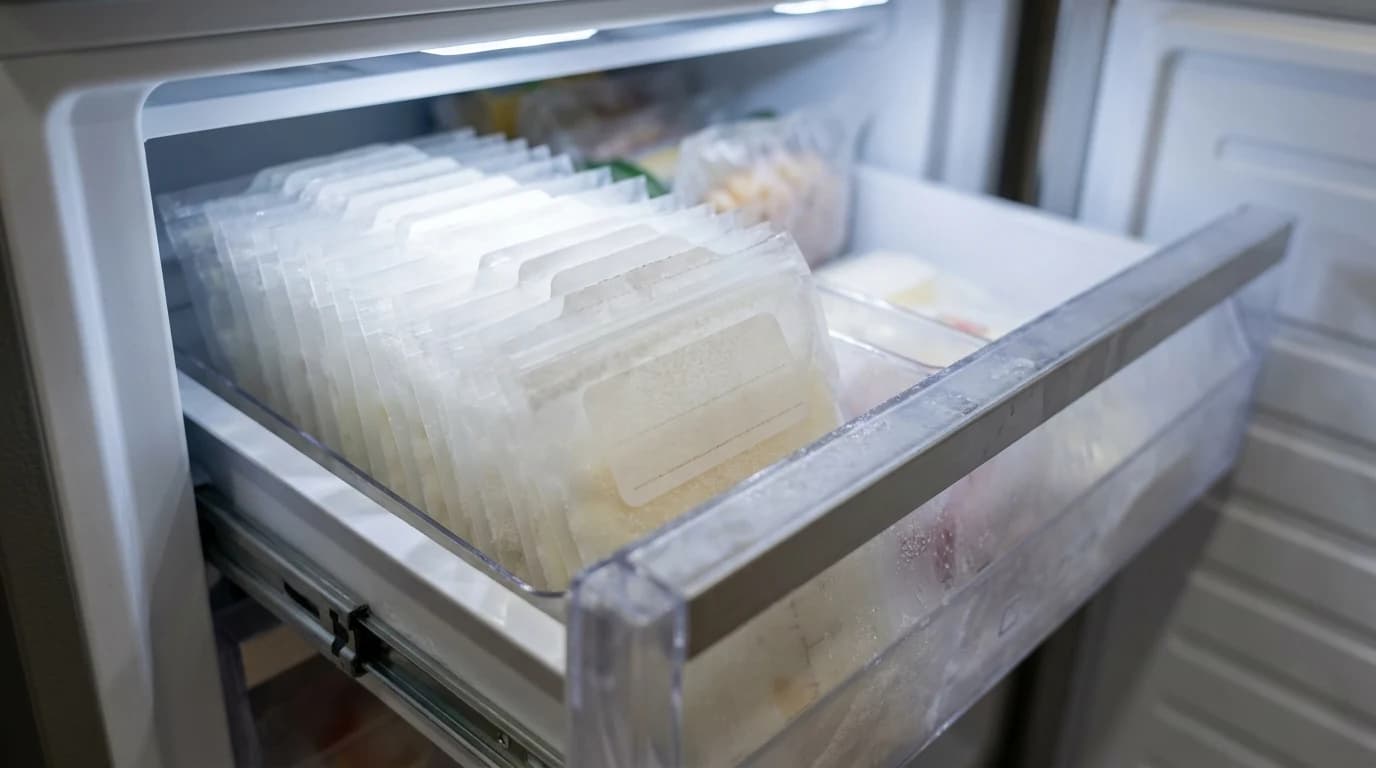
What the guidance says works:
- Freezing in 2- to 4-ounce portions, so less milk is wasted.
- Keeping bags out of the door of both the fridge and the freezer.
- Labeling every bag with the date it was expressed, then thawing the oldest first.
- Leaving about an inch at the top so the bag has room as the milk expands.
What people try that the guidance rules out:
- Refreezing thawed milk to save it — the CDC says never.
- Thawing or warming a bag in the microwave, which the CDC warns can create hot spots.
- Storing milk in bags that were not made for breast milk.
For thawing, the CDC lists three methods:
- In the refrigerator overnight.
- In a bowl of warm or lukewarm water.
- Under lukewarm running water.
Worth knowing: the 24-hour clock for fridge-thawed milk starts when the milk is completely thawed, not when you took it out of the freezer.
Where the bags fit with the rest of your pumping kit
Storage bags are the cheapest part of a pumping setup and the part you will restock most. Choose the pump first — our best breast pumps guide compares the main options, and the breast pumps and nursing category keeps the wider shortlist current. If you are building a freezer stash for a return to work, going back to work after baby covers the planning side.
How long can breast milk stay in a storage bag in the freezer?
The CDC puts it at about 6 months for best quality, with up to 12 months acceptable. Label each bag with the date it was expressed and thaw the oldest first.
Can you reuse breast milk storage bags?
The five bags here are sold as disposable. If you want reusable storage, the CDC's alternative is a clean, food-grade glass or plastic container with a tight-fitting lid.
How much milk should go in each bag?
The CDC suggests 2 to 4 ounces, or the amount offered at one feeding, with about an inch of space left at the top for expansion.
How do you thaw frozen breast milk from a bag?
In the refrigerator overnight, in warm or lukewarm water, or under lukewarm running water — never in the microwave. Use fridge-thawed milk within 24 hours of being fully thawed, and warmed milk within 2 hours.
Research Sources
Hilly Shore Inc.
Editorial teamIndependent product research team behind Cribworthy. Reviews are grounded in published AAP / CDC / NHTSA / CPSC pediatric guidance, JPMA / GREENGUARD GOLD / OEKO-TEX certification verification, and aggregated buyer sentiment.
115 products reviewed · 20 categories covered · cites AAP, CDC, NHTSA, CPSC, FDA, ACOG.
Safety claims are verified against published pediatric guidelines and CPSC databases. See our editorial standards.