Cradle Cap: How to Loosen It Safely, and When to Call
Quick Answer
Cradle cap is harmless, doesn't itch and usually clears on its own within a few months, so treatment is optional. To loosen it, massage in baby oil, mineral oil or petroleum jelly, wait, brush gently with a soft baby brush, then wash with a mild, fragrance-free baby shampoo about every other day. Never pick. Call the pediatrician if it bleeds, oozes, swells, smells or spreads beyond the scalp.
Our Verdict
Cradle cap needs patience more than products. Soften, brush and wash about every other day with a fragrance-free baby shampoo, skip dandruff shampoo and olive oil, and never pick. An itchy rash, or crusts that bleed, ooze or spread, is a reason to call the pediatrician rather than try something stronger.
Pick the move for what you see
| If your situation is… | Pick | Why |
|---|---|---|
| Light, thin flakes on the scalp | Mild fragrance-free baby shampoo about every other day, with a soft brush | The AAD and AAP both say washing about every other day helps most babies. |
| Thick, stuck-on yellow crust | Baby oil, mineral oil or petroleum jelly left on for hours or overnight, then brush and wash | The AAP and the Cleveland Clinic both suggest a long soak for tough scales. |
| Scales on the eyebrows, neck folds or diaper area | Mention it to the pediatrician | The Cleveland Clinic says the pediatrician may suggest special moisturizers or medicated creams when it spreads beyond the scalp. |
| Dry, red, itchy patches on the cheeks | Treat it as possible eczema and ask the pediatrician | The AAP says baby eczema is itchy and often on the cheeks, forehead and around the mouth, while cradle cap rarely itches. |
| Crusts that bleed, ooze, swell or smell | Stop loosening and call the pediatrician | The AAP and NHS list these as signs of infection or another condition. |
Each pick is one of the products ranked below — this row is for shortcutting based on your situation, not a separate recommendation.
#1Aquaphor Baby Healing Ointment 4.9 | #2Aveeno Baby Daily Moisture Lotion 4.8 | |
|---|---|---|
| Verdict | Petrolatum Softener for Tough Scales | Fragrance-Free Emollient Option |
| Price | ~$16.49Buy on Amazon | ~$12.62Buy on Amazon |
| Type | Ointment | Lotion |
| Base | Petrolatum | — |
| Key ingredient | — | Colloidal oatmeal |
| Pros |
|
|
| Cons |
|
|
* Prices are approximate. Check the linked retailer for current pricing and availability.
Key Takeaways
- ✓Cradle cap needs patience more than products. Soften, brush and wash about every other day with a fragrance-free baby shampoo, skip dandruff shampoo and olive oil, and never pick. An itchy rash, or crusts that bleed, ooze or spread, is a reason to call the pediatrician rather than try something stronger.
- ✓Cradle cap is infant seborrheic dermatitis on the scalp. The AAP's cradle cap guide says it usually starts between three weeks and two months after birth and is extremely common. Nobody knows the exact cause.
- ✓Both can start on a baby's head. The AAP's eczema guide says baby eczema usually begins on the scalp and face, so location alone won't settle it. The itch and the texture usually will.
- ✓The four sources agree on the order, even where they differ on the details.
- ✓Call if you notice any of these. Each comes from at least one of the four sources:
As an Amazon Associate I earn from qualifying purchases. Product prices and availability are subject to change.
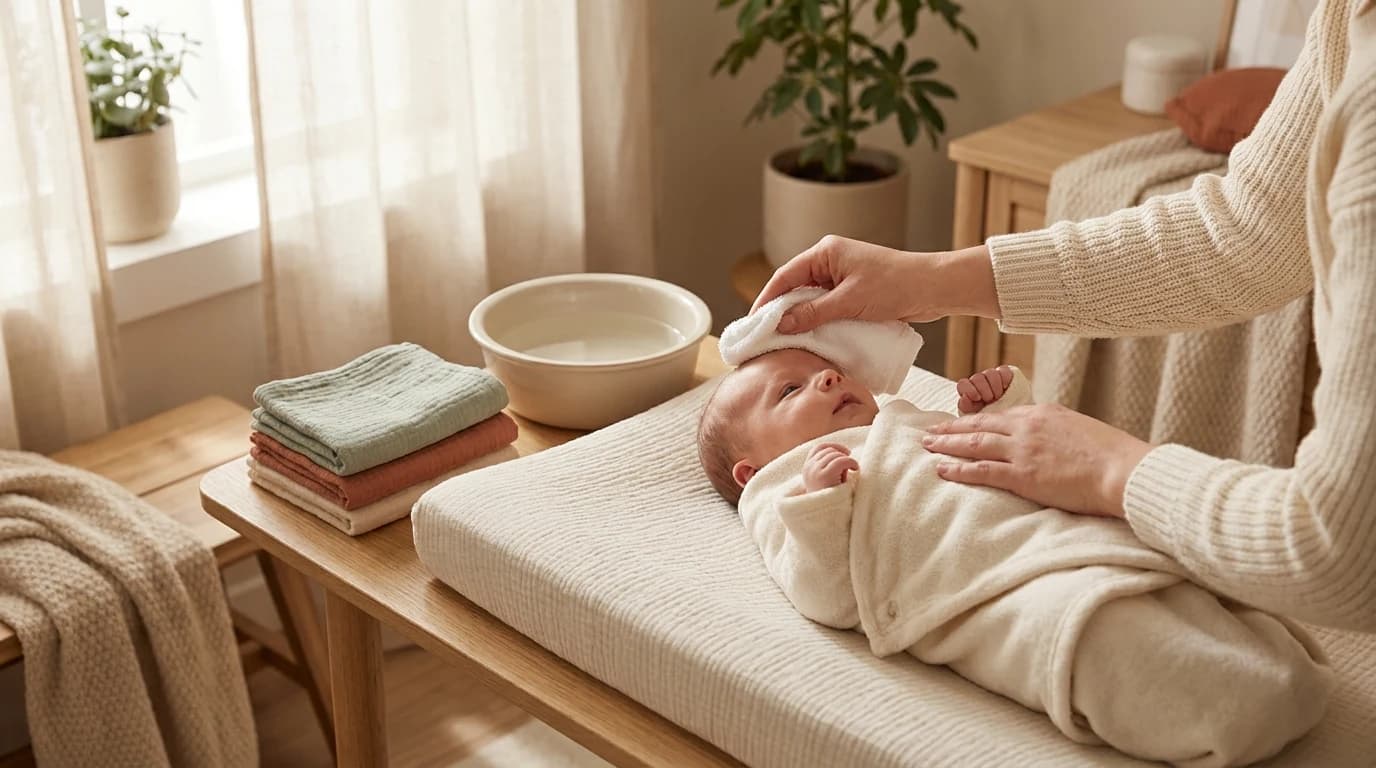
Cradle cap is harmless, it doesn't itch or hurt, and it clears up on its own, usually within a few months. You don't have to treat it. If you want the flakes gone sooner: soften the scales, wait, brush gently with a soft baby brush, then wash with a mild, fragrance-free baby shampoo. Never pick. That routine is the shared core of the American Academy of Dermatology's cradle cap tips, the AAP's HealthyChildren cradle cap guide and the NHS cradle cap page.
This is background for a conversation with your pediatrician, not a diagnosis.
What cradle cap actually is
Cradle cap is infant seborrheic dermatitis on the scalp. The AAP's cradle cap guide says it usually starts between three weeks and two months after birth and is extremely common. Nobody knows the exact cause. The AAP's two theories are a reaction to a yeast that lives on everyone's skin, or maternal hormones pushing the baby's oil glands into overdrive. It is not an allergy, an infection or a hygiene problem.
- What it looks like: white or yellow greasy scales on the scalp that can form a crust and flake off (NHS)
- On brown or black skin: the skin around the scales may look lighter or darker rather than pink or red (NHS)
- Where else it shows up: eyebrows, behind the ears, neck folds and the diaper area (Cleveland Clinic)
- How long it lasts: it tends to improve by six to 12 months (AAD), and the AAP says most cases have cleared by age 1
Worth knowing: Cradle cap isn't contagious. The Cleveland Clinic says babies who have it can still go to daycare and play dates.
Cradle cap vs baby eczema, side by side
Both can start on a baby's head. The AAP's eczema guide says baby eczema usually begins on the scalp and face, so location alone won't settle it. The itch and the texture usually will.
| Cradle cap | Baby eczema | |
|---|---|---|
| Itch | Not itchy or painful (NHS); rarely itchy (AAP) | Dry, red, itchy patches (AAP) |
| Texture | Greasy white or yellow scales that can crust (NHS) | Dry skin that can crack, crust or look scaly (NHS eczema page) |
| Where | Scalp first; sometimes eyebrows, ears, neck folds, diaper area (Cleveland Clinic) | Scalp and face, often cheeks, forehead and around the mouth; usually not the diaper area (AAP) |
| When | Usually starts three weeks to two months after birth (AAP) | About 60% of people with eczema develop it in their first year (AAD) |
| Course | Goes away on its own (AAD) | Flares and calmer spells (AAP, NHS) |
| Daily care | Wash, loosen, lift | Moisturize twice a day or as needed (AAD) |
If it itches, think eczema. A dry, red rash your baby rubs at needs a moisturizing routine, not scale removal: see our baby eczema soak-and-seal routine. The NHS adds that bleeding, leaking fluid or swelling on cradle cap could point to another condition, such as atopic eczema.
The loosen-and-lift routine
The four sources agree on the order, even where they differ on the details.
- Soften first. Massage a little oil or emollient into the scales. For tough scales, the AAP says to let it sit overnight; the Cleveland Clinic says several hours or overnight.
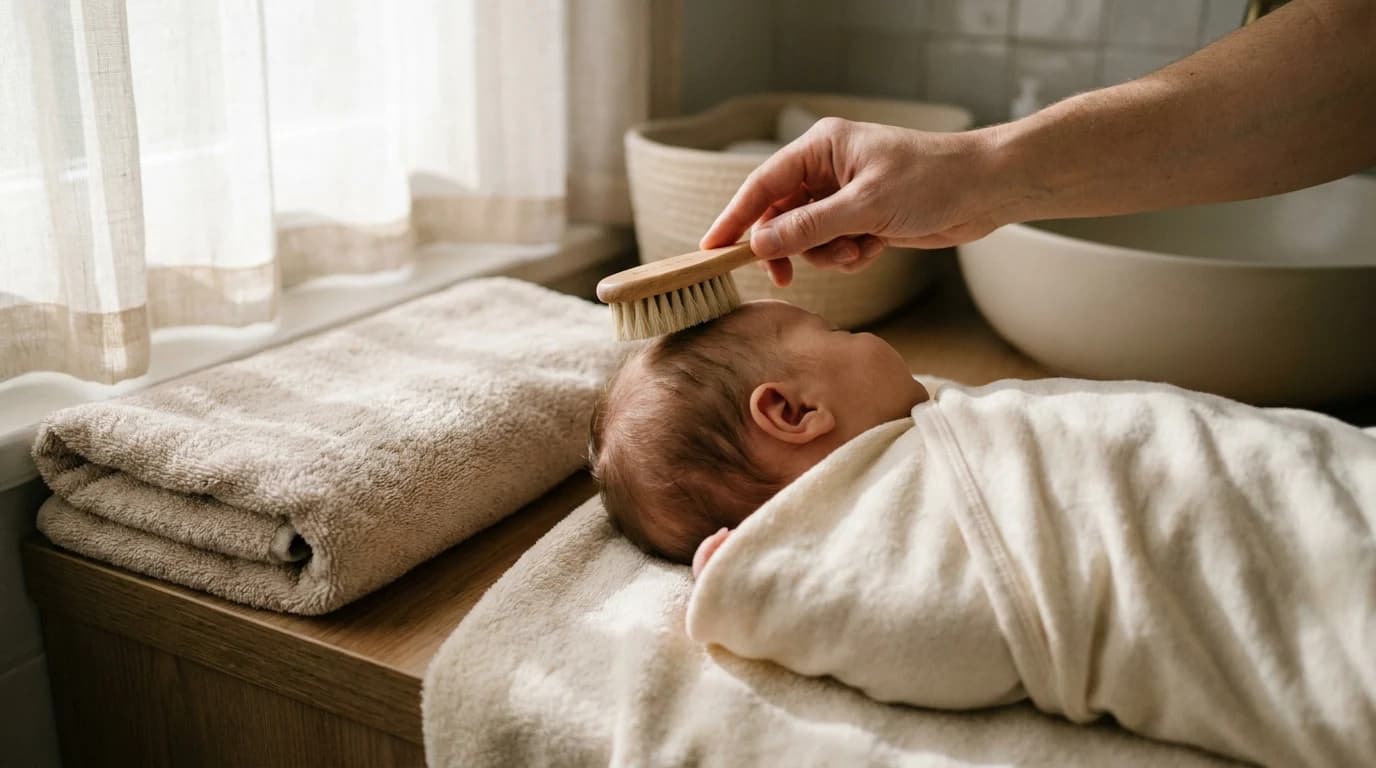
- Brush gently. A soft baby brush, a baby comb or your fingertips. The AAD suggests brushing during the bath. The Cleveland Clinic says nothing scratchy, including fingernails.
- Wash it out. Use a mild, fragrance-free baby shampoo, which is what the AAD recommends, and massage the scalp while you lather.
- Repeat about every other day. The AAD and AAP both say that frequency helps most babies. If your baby has eczema or another skin condition, ask how often to bathe.
- Keep washing once it clears. The AAP says frequent washing with a mild baby shampoo helps stop it coming back.
The stop rule: If a patch turns raw, bleeds or leaks fluid, stop loosening it and call the pediatrician. If a few weeks of the routine change nothing, the NHS says to see a doctor.
Some hair may come away with the scales. The NHS and the AAP both say it grows back. New to baths? Start with how to bathe a newborn.
Which oil? The authorities don't agree
Advice online contradicts itself here because the primary sources do too.
| Softener | AAD | AAP | NHS | Cleveland Clinic |
|---|---|---|---|---|
| Baby or mineral oil | Yes, a non-food oil such as baby oil | Mineral oil, yes | Not named | Yes |
| Petroleum jelly | Not named | Yes | Not named | Yes |
| Emollient (moisturizer) | Not named | Not named | Yes | Treats these softeners as emollients |
| Coconut oil | Prefers non-food oils | Yes | Yes | Not named |
| Olive oil | Prefers non-food oils | Not named | No, may not suit skin | Avoid |
| Peanut oil | Prefers non-food oils | Not named | No, allergy risk | Avoid |
The safe overlap: Baby oil, mineral oil and petroleum jelly are named by at least two of the four sources and warned against by none. Skip olive and peanut oil.
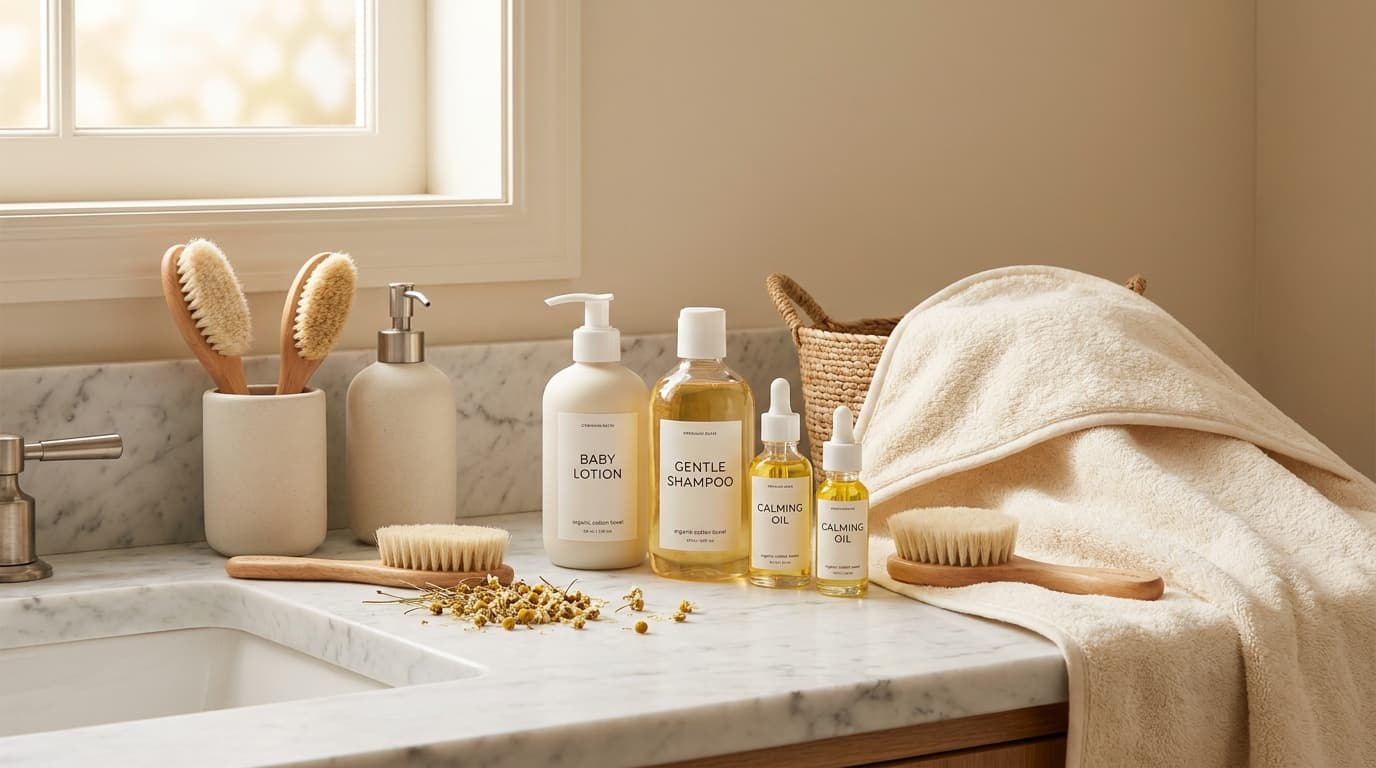
Already own a petrolatum ointment? Aquaphor Baby Healing Ointment → is the fragrance-free, petrolatum-based ointment in our baby skincare roundup, the closest match there to the petroleum-jelly row. For the NHS's emollient route, Aveeno Baby Daily Moisture Lotion → is the fragrance-free lotion from the same roundup. Use a thin layer and wash it out. Brushes and the rest of the bath kit are in our bath-time gear guide.
Do this, not that
| Do this | Not that |
|---|---|
| Mild, fragrance-free baby shampoo (AAD) | Dandruff shampoo, which the AAD says isn't recommended for children |
| A cradle cap shampoo if baby shampoo isn't enough, or ask your dermatologist (AAD) | Soap, adult shampoo or anything with fragrance or perfume (NHS) |
| Ask the pediatrician before any medicated shampoo (AAP) | Starting one on your own, since it may irritate the skin (AAP) |
| A soft brush or comb during the bath | Picking or scratching the crusts, which raises infection risk (AAP, NHS) |
When to call the pediatrician
Call if you notice any of these. Each comes from at least one of the four sources:
- Crusted or weepy patches, or pus bumps (AAP)
- Bleeding or oozing fluid from the scales (AAP, NHS, Cleveland Clinic)
- Swollen skin (AAP, NHS), or a scalp that feels hot to the touch (Cleveland Clinic)
- An odor from the rash (AAP, AAD, Cleveland Clinic)
- A rash spreading beyond the scalp, or covering the body (AAP, AAD, NHS)
- Pain, discomfort or an itch that disrupts your baby (AAP, AAD)
- No improvement after a few weeks of care (NHS) or a few months overall (Cleveland Clinic)
The AAP says a pediatrician may suggest an antifungal or hydrocortisone cream. That is their call to make after looking, not something to start from the pharmacy shelf.
Does cradle cap itch?
No. The NHS and the Cleveland Clinic both say it doesn't itch or hurt. An itchy rash points toward eczema instead.
How long does cradle cap last?
Weeks to months. The AAD says it tends to improve by six to 12 months, and the AAP notes some toddlers keep a little flaky buildup past their first birthday.
Can I use coconut oil on cradle cap?
The AAP and NHS both list it. The AAD prefers a non-food oil such as baby oil. If you are unsure, petroleum jelly or mineral oil avoids the disagreement.
Cradle cap means the baby isn't being washed enough.
The AAP says cradle cap doesn't happen from poor hygiene, and it isn't caused by an allergy or an infection. The exact cause is unknown.
Cradle cap has to be treated or it won't go away.
The AAD and the Cleveland Clinic both say it goes away on its own and that treatment is not necessary. At-home care may just speed things along.
Research Sources
- American Academy of Dermatology - How to treat cradle cap: 4 tips from dermatologists
- American Academy of Dermatology - Seborrheic dermatitis: diagnosis and treatment, including cradle cap
- American Academy of Dermatology - How to treat eczema in babies
- AAP HealthyChildren - What is Cradle Cap?
- AAP HealthyChildren - Eczema in Babies and Children: Symptoms and Causes
- NHS - Cradle cap
- NHS - Atopic eczema
- Cleveland Clinic - Cradle Cap (Seborrheic Dermatitis in Infants)
Hilly Shore Inc.
Editorial teamIndependent product research team behind Cribworthy. Reviews are grounded in published AAP / CDC / NHTSA / CPSC pediatric guidance, JPMA / GREENGUARD GOLD / OEKO-TEX certification verification, and aggregated buyer sentiment.
115 products reviewed · 20 categories covered · cites AAP, CDC, NHTSA, CPSC, FDA, ACOG.
Safety claims are verified against published pediatric guidelines and CPSC databases. See our editorial standards.