How to Bathe a Newborn (Less Often Than You Think)
Quick Answer
Newborns only need a bath two to three times a week. More than that can dry out their delicate skin, and frequent diaper-area wiping keeps them clean between baths. Until the umbilical cord stump falls off (usually one to two weeks), give sponge baths only, not tub baths. When you do move to the tub, use just two inches of warm water no hotter than about 100 degrees Fahrenheit, tested on the inside of your wrist, and never leave your baby alone in the water for even a second. Bathing should also be delayed in the hours right after birth, which is why hospitals now wait.
Our Verdict
A newborn needs far fewer baths than most parents expect: two or three a week, sponge baths only until the cord stump falls off, then short tub baths in two inches of warm water around 100 F. The bath is more a gentle ritual than a daily hygiene chore. The one rule with no flexibility is supervision: never leave your baby alone in or near the water, skip tip-prone bath seats, and cap your water heater at 120 F.
Key Takeaways
- ✓A newborn needs far fewer baths than most parents expect: two or three a week, sponge baths only until the cord stump falls off, then short tub baths in two inches of warm water around 100 F. The bath is more a gentle ritual than a daily hygiene chore. The one rule with no flexibility is supervision: never leave your baby alone in or near the water, skip tip-prone bath seats, and cap your water heater at 120 F.
- ✓Newborns only need a bath two to three times a week. More than that dries out their delicate skin, and frequent diaper-area wiping keeps them clean between baths. Until the umbilical cord stump fal...
- ✓Two or three baths a week is plenty for the whole first year. Overbathing strips natural oils and dries newborn skin.
- ✓The instinct to bathe a newborn daily is the most common bath mistake, and it works against you. A baby is not getting dirty the way an older kid does. The grime that does build up, mostly in skin ...
- ✓Until the umbilical cord stump dries up and falls off, your baby gets sponge baths, not tub baths. A sponge bath is a wash with a damp cloth, with your baby never going into the water. Keeping the ...
As an Amazon Associate I earn from qualifying purchases. Product prices and availability are subject to change.
The mental image most of us bring home is a nightly baby bath: warm water, tiny duck towel, a splashy routine. The actual guidance is almost the opposite. A newborn needs very few baths, the first one should wait, and for the first week or two you should not put your baby in water at all. Here is what pediatric guidance actually says, and how to do it safely.
Quick answer
Newborns only need a bath two to three times a week. More than that dries out their delicate skin, and frequent diaper-area wiping keeps them clean between baths. Until the umbilical cord stump falls off (usually one to two weeks), give sponge baths only, not tub baths. When you do move to the tub, use just two inches of warm water no hotter than about 100 degrees Fahrenheit, tested on the inside of your wrist, and never leave your baby alone in the water for even a second. Bathing is also delayed in the hours right after birth, which is why hospitals now wait.
Key takeaways
- Two or three baths a week is plenty for the whole first year. Overbathing strips natural oils and dries newborn skin.
- Sponge baths only until the cord stump falls off (about one to two weeks). Keeping it dry helps it heal.
- Two inches of warm water, around 100 F (38 C). Test it on the inside of your wrist, and set your water heater no higher than 120 F to prevent scald burns.
- Never step away, not even for a second. Most in-home child drownings happen in bathtubs, and more than half of those deaths are children under one. Skip plastic bath seats, which can tip.
Why less is more (the part most people get wrong)
The instinct to bathe a newborn daily is the most common bath mistake, and it works against you. A baby is not getting dirty the way an older kid does. The grime that does build up, mostly in skin folds and the diaper area, is handled by thorough wiping at diaper changes and the occasional spot-clean.
Daily full baths strip the skin's natural oils and leave it dry and irritated. The American Academy of Pediatrics is direct: three times a week during the first year may be enough, and your baby does not need much bathing at all if you keep the diaper area clean.
🎯 The thing most parents get wrong: treating the bath as a daily hygiene requirement. It is closer to a soothing ritual you do a couple of times a week. If your newborn protests, that is normal feedback, not a problem to push through.
The wait applies at the very start, too. Hospitals now routinely delay a newborn's first bath, often by 24 hours, because bathing too soon can chill the baby (hypothermia) and the stress can drop their blood sugar (hypoglycemia).
Sponge baths come first
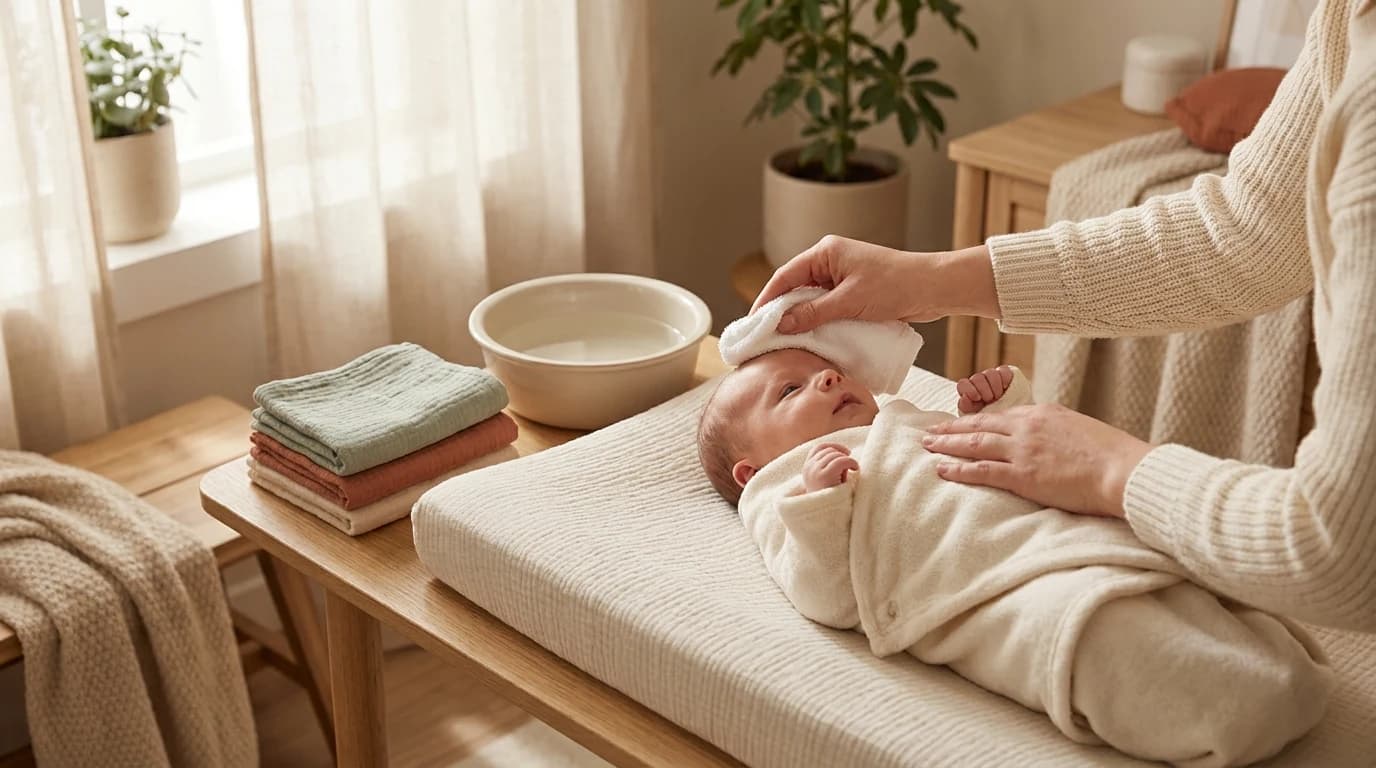
Until the umbilical cord stump dries up and falls off, your baby gets sponge baths, not tub baths. A sponge bath is a wash with a damp cloth, with your baby never going into the water. Keeping the stump dry is the reason, and it usually drops off within one to two weeks. If it lingers well past that, mention it to your pediatrician.
- Prep everything first. A basin of warm water, a soft washcloth, a dry towel, a clean diaper, and fresh clothes within arm's reach before you start.
- Pick a safe surface. A changing table, bed, or padded counter. If your baby is off the floor, keep one hand on them or use the safety strap. Babies wriggle.
- Wash clean to dirty. Start with the face using plain water, no soap near eyes or mouth. Work down the body, and save the diaper area for last.
- Keep them warm. Wrap your baby in the dry towel and uncover only the part you are washing. Hit the damp creases: under the arms, behind the ears, around the neck.
Moving to the tub
Once the cord area has healed, you can lower your baby into a small amount of water. Keep the first few real baths short. Some babies love it; others protest, and if yours does, go back to sponge baths for a week or two and try again.
| Step | What to do | Why it matters |
|---|---|---|
| Set the water | Two inches, warm not hot, about 100 F (38 C) | Babies feel temperature swings far more than adults |
| Test it | Inside of your wrist or elbow, never your hand | Hands misjudge "warm" |
| Lower them in | Feet first, one hand always supporting head and neck | Newborns have no head control |
| Wash sparingly | Mild, fragrance-free soap only where needed; rinse right away | Soap dries delicate skin |
| Get out | Wrap in a towel and dress quickly | Wet babies chill fast |
A safe infant tub helps: a hard plastic tub with a sloped, textured surface or sling so your baby cannot slide, made after October 2017 to meet current standards. A sink works too, but turn the faucet off before your baby is in the water, and never bathe a baby in running water, since the temperature can swing mid-bath and scald.
The non-negotiable safety rules
Bath safety is the one place with no flexibility, because the failure mode is drowning, and it happens fast and silently.
⚠️ Never leave your baby alone in or near bath water, not for a phone, not for a towel across the room, not for a few seconds. If you must step away, take the baby with you. Most child drownings inside the home occur in bathtubs, and more than half involve children under one.
- Skip bath seats and rings. They look like a third hand, but they tip easily, and a baby can slip under in the seconds it takes to reach for shampoo.
- Cap your water heater at 120 F. Hotter tap water can cause a serious burn in seconds. It is a one-time fix that protects every future bath.
What to skip
- Daily baths. Unnecessary, and hard on the skin.
- Lotions in the first month. Newborn skin usually is not mature enough; add a baby-specific lotion later if dryness shows up.
- Lots of soap and fragranced products. A little mild, neutral-pH cleanser on genuinely dirty spots is all you need.
- Pushing through a meltdown. Sponge baths are a fine fallback.
How often should I actually bathe my newborn?
Two to three times a week is enough for the whole first year. Wipe the diaper area at every change and spot-clean skin folds as needed; a full bath does not need to be daily.
When can my baby have a tub bath instead of a sponge bath?
Once the umbilical cord stump has fallen off and the area has healed, usually one to two weeks after birth. Until then, sponge baths only.
What water temperature is safe for a baby's bath?
Warm, not hot, around 100 F (38 C), just above body temperature. Test it on the inside of your wrist, and set your water heater to no more than 120 F.
Sources
Your next step
Bath routine down? Line up safe sleep and car travel next.
Research Sources
Hilly Shore Inc.
Editorial teamIndependent product research team behind Cribworthy. Reviews are grounded in published AAP / CDC / NHTSA / CPSC pediatric guidance, JPMA / GREENGUARD GOLD / OEKO-TEX certification verification, and aggregated buyer sentiment.
115 products reviewed · 20 categories covered · cites AAP, CDC, NHTSA, CPSC, FDA, ACOG.
Safety claims are verified against published pediatric guidelines and CPSC databases. See our editorial standards.