Gate-Checking a Car Seat: What a Bag Does and Doesn't Cover
Quick Answer
If your child has a ticket and the seat is labeled for aircraft use, install it on board. Otherwise gate-check it rather than checking it at the counter, put it in a bag to keep it clean and complete, and inspect it before you leave the airport. A bag is not a guarantee: Clek says it cannot promise against mishandling damage, and brand travel warranties only apply with the brand's own bag, registered before you fly.
Our Verdict
Treat a car seat bag as a carrying and cleanliness tool, not protection. The seat is safest from handling damage on board; when it has to be checked, gate-check it, inspect it on arrival, report damage to the airline and ask the seat maker before your child rides in it.
Key Takeaways
- ✓Every family flying with a car seat picks one of three routes. The handling and paperwork differ more than packing lists admit.
- ✓For toddlers there is a lighter option: the FAA lists a harness-type device certified for children up to 40 inches tall who weigh 22 to 44 pounds. It replaces the car seat on the plane only.
- ✓Most lap-infant families land here.
- ✓Two brands tie their own travel bag to warranty coverage for damage in transit. The conditions are where families get caught.
- ✓Nuna's advice suits any seat: inspect it immediately after handling and report damage to the carrier straight away. Do it before you leave the airport.
As an Amazon Associate I earn from qualifying purchases. Product prices and availability are subject to change.
A padded car seat bag is sold as protection. Read the fine print from brands that make both seats and bags and it mostly protects your claim, not your seat. We researched what the FAA, Britax, Clek, Nuna and UPPAbaby publish about flying with a car seat. None promises a bag makes checking safe, and the two warranty programs we found only pay out if you register before you fly and inspect on arrival. We have not tested any bag or seat; your manual comes first.
The three ways a car seat can fly
Every family flying with a car seat picks one of three routes. The handling and paperwork differ more than packing lists admit.
| Route | Who handles the seat | What you arrange | What the sources say |
|---|---|---|---|
| Installed on board in your child's own seat | You | A ticket for the child, and a window seat | The FAA calls an approved car seat the safest place for children under 2 |
| Gate-checked at the aircraft door | Ramp crew, briefly | A gate tag; ask your airline | Clek recommends gate checking over counter checking |
| Checked at the ticket counter | Baggage system, end to end | A bag tag; ask your airline | Britax suggests using the seat on board instead, to protect it from handling damage |
The table hides one honest point: a gate-check is still a check. The seat leaves your hands, rides in the hold and comes back through someone else's process.
Route one: put it on the plane
Buying the seat ends the bag question. The FAA's child safety sheet lists what to check first:
Before you plan to install it on board
- The label reads "This restraint is certified for use in motor vehicles and aircraft."
- It is not a booster, backless restraint or baby carrier; those are not allowed during taxi, take-off or landing.
- The airline has confirmed the seat suits the flight and your family sits together.
- You expect a window seat: never an exit row, never blocking an escape path.
For toddlers there is a lighter option: the FAA lists a harness-type device certified for children up to 40 inches tall who weigh 22 to 44 pounds. It replaces the car seat on the plane only. You still need a car seat at the other end.
Rule of thumb: a seat that rides on board arrives the way it left. That is the whole case for paying for the extra ticket.
Route two: gate-check, and what the bag really does
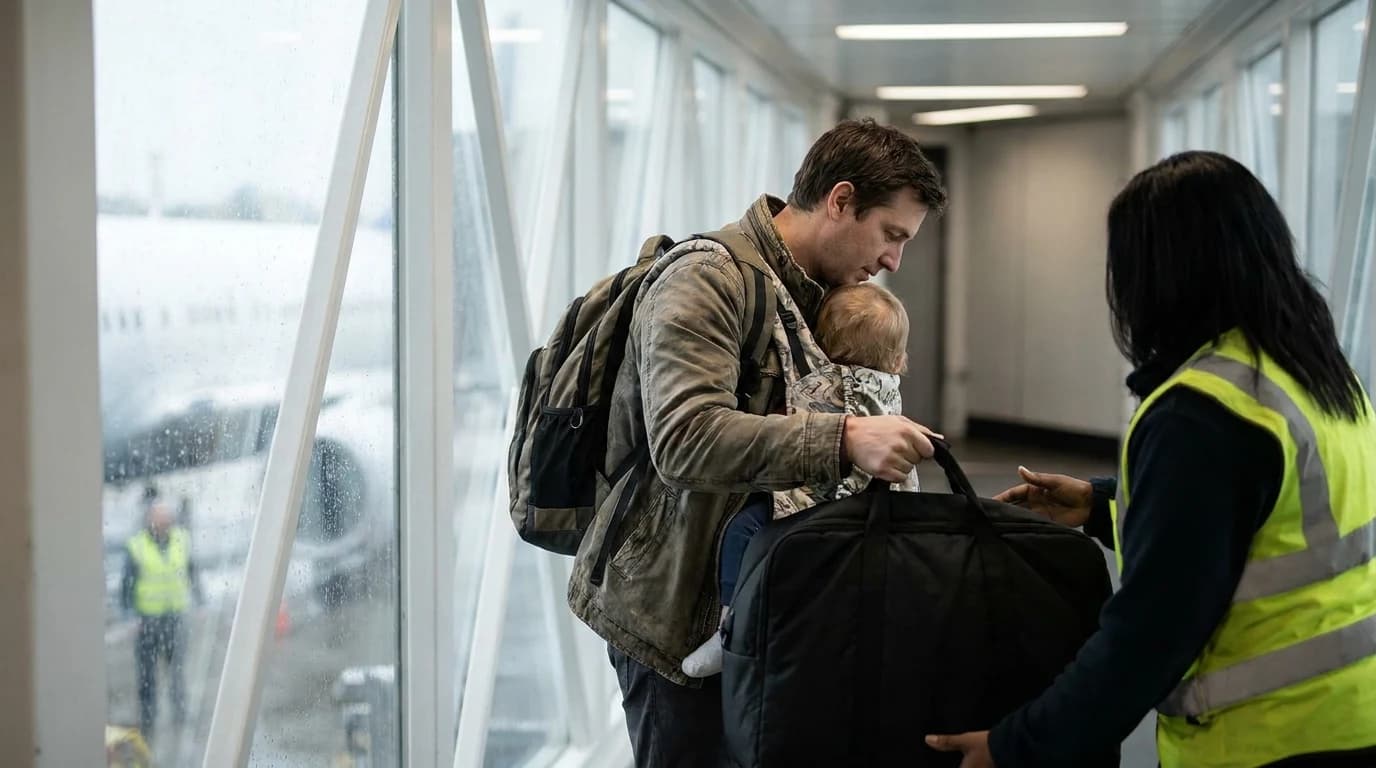
Most lap-infant families land here. Clek's wording is the clearest from any maker: its padded Weelee bag lets you check a seat "if need be", yet Clek still recommends gate checking and cannot guarantee against damage from mishandling. It also tells owners to read their airline's damaged-baggage policy first.
Padded bag: what it can and cannot do
Reasonable to expect
- Keeps straps, buckles and the cover out of grime
- Keeps loose parts and the base with the seat
- Gives you shoulder straps for the walk through the terminal
- Can satisfy a brand's travel-warranty terms, when it is that brand's own bag
Not something any maker promises
- That a dropped or crushed seat is undamaged inside it
- That a seat is safe to use without inspecting it
- That the airline will pay for damage
- That a lost seat will be replaced
A plain unpadded gate-check sack does the first three jobs and nothing more. If you want padding and backpack straps, we list the J.L. Childress Padded Backpack Car Seat Travel Bag → in our travel gear category. Treat it as a carrying and cleanliness tool, not a crash shell.
The part most packing lists skip: brand travel warranties
Two brands tie their own travel bag to warranty coverage for damage in transit. The conditions are where families get caught.
| Program | What it covers | Before you fly | After damage |
|---|---|---|---|
| Nuna Boarding Pass | Travel damage to a PIPA series seat and the bag, only when packed in the PIPA series travel bag; adds one year to the seat's warranty | Register the bag and seat before departure; both bought within 12 months of each other | Tell Nuna within 30 days; proof of travel and photos needed |
| UPPAbaby TravelSafe | Air-travel damage to gear in an UPPAbaby Travel Bag; for car seats, within the original warranty terms | Seat still under its original warranty; proof of purchase required | Contact UPPAbaby within 14 days of the trip; serial numbers, photos and travel dates |
UPPAbaby states it cannot replace gear the airline loses, and a generic bag inherits neither program. Our Nuna car seat guide shows which Nuna models are PIPA series.
- Before departure when Nuna says the bag and seat must be registered
- 30 days Nuna's window to report travel damage
- 14 days UPPAbaby's window after the trip to file a claim
Source: Nuna Boarding Pass and UPPAbaby TravelSafe terms, read 2026-10-29.
When it comes back: inspect before you buckle
Nuna's advice suits any seat: inspect it immediately after handling and report damage to the carrier straight away. Do it before you leave the airport.
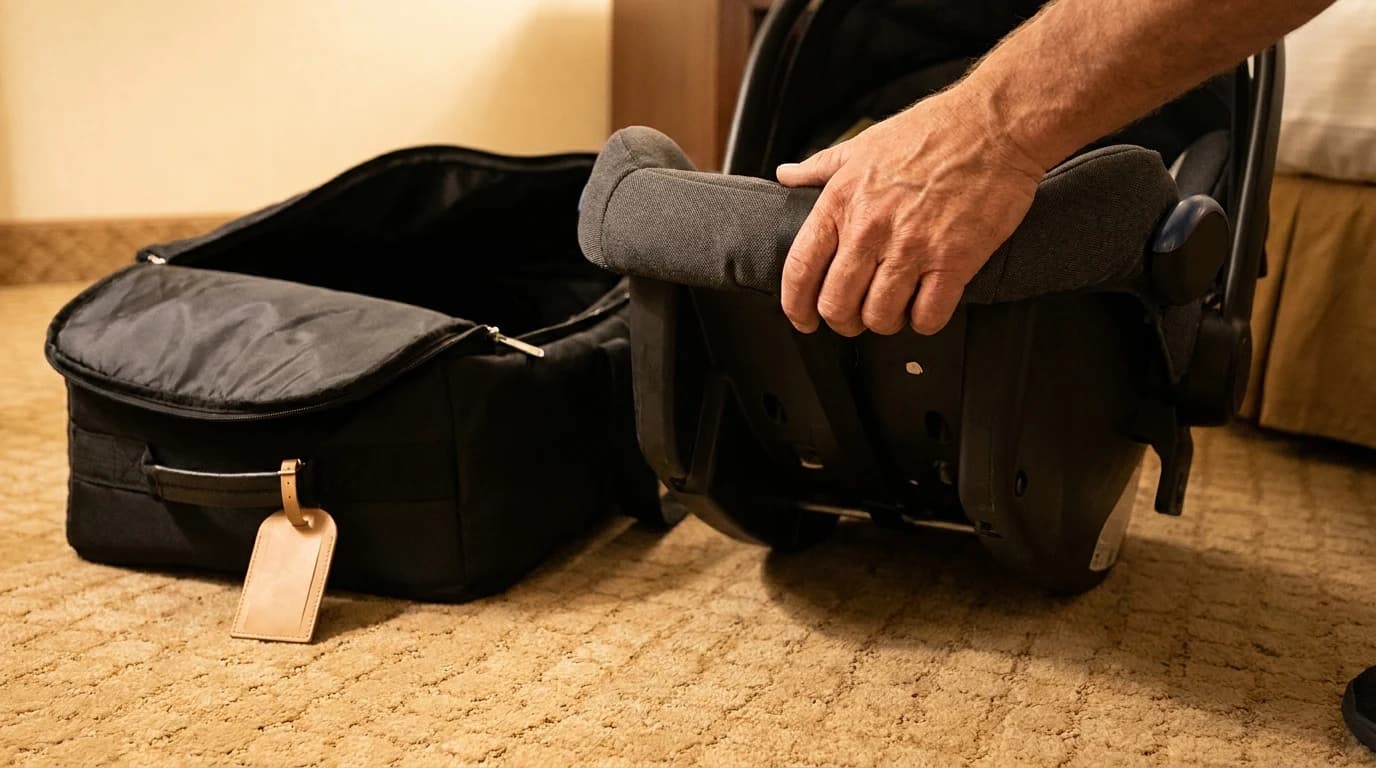
The arrival check, in order
- Remove the seat from the bag. Count every part you packed, including the base and inserts.
- Check the shell, base and handle for cracks, white stress marks or bent metal.
- Buckle and unbuckle the harness; confirm the adjuster tightens and releases as the manual describes.
- Photograph any damage, the bag tag and your boarding pass.
- Report it to the airline, then contact the seat maker.
Stop sign: if anything looks cracked, bent, missing or works differently than at home, do not use the seat until the manufacturer has told you what to do.
A failed check leaves you needing a seat on the spot, so plan a fallback. An unknown loaner is a gamble; see used car seats from strangers.
What we could not confirm
Forums repeat a line attributed to an industry group of car seat makers: a checked seat is not treated like a crashed one. We could not find the original statement, so we do not rely on it. The brand pages say something narrower: inspect, document, ask the maker.
Which route fits your trip
- Child has a ticket, seat is aircraft-certified: install it on board.
- Lap infant: gate-check it, bagged, then do the arrival check.
- Nuna PIPA series or UPPAbaby seat: use the brand's bag and register before you fly.
- Counter-checking anyway: pad it, photograph it at drop-off, inspect before your child rides.
For everything else, see our guide to traveling with a baby and the carry-on checklist.
Is it safe to gate-check a car seat?
Clek recommends gate checking over counter checking but cannot guarantee against mishandling damage. Bag it, inspect it on arrival and ask the manufacturer about anything that looks damaged.
Do I have to throw away a car seat after checking it?
None of the brand pages we read says so. Inspect it immediately; if you find damage or are unsure, ask the manufacturer before your child rides in it.
Can I use a car seat on the plane if I didn't buy my baby a seat?
The FAA suggests buying your child a ticket so you can use one. Otherwise ask the airline about an empty seat, or gate-check it.
Research Sources
Hilly Shore Inc.
Editorial teamIndependent product research team behind Cribworthy. Reviews are grounded in published AAP / CDC / NHTSA / CPSC pediatric guidance, JPMA / GREENGUARD GOLD / OEKO-TEX certification verification, and aggregated buyer sentiment.
130 products reviewed · 22 categories covered · cites AAP, CDC, NHTSA, CPSC, FDA, ACOG.
Safety claims are verified against published pediatric guidelines and CPSC databases. See our editorial standards.