How to Clear a Baby's Stuffy Nose: Saline, Suction, Mist
Quick Answer
Put plain saline drops in each nostril, gently suction them out with a bulb, and do it right before a feed or sleep. Run a cool-mist humidifier nearby, keep your baby flat on their back for sleep, and skip over-the-counter cold medicine. Call the pediatrician about trouble breathing, poor feeding, or any fever under 12 weeks.
Our Verdict
Saline before feeds does most of the useful work, and suction backs it up when mucus is truly in the way. Use cool mist, never warm, and never tilt the sleep surface. The cold will run its course on its own schedule, so your real job is watching breathing, feeding and fever.
Pick the move for the moment
| If your situation is… | Pick | Why |
|---|---|---|
| Baby keeps pulling off the breast or bottle | Saline, then suction, right before the feed | Seattle Children's says babies can't nurse or drink from a bottle unless the nose is open. |
| Crusty, dried mucus you can see | Saline first, then suction | Seattle Children's says suction alone can't remove dried or sticky mucus. |
| Older baby fights the bulb | Saline drops alone | The AAP says the bulb works best under 6 months, but saline drops still help after that. |
| Dry heated air at bedtime | A cool-mist humidifier out of reach | The FDA says cool mist eases congestion, and the AAP says to place it near the child but out of reach. |
| Fast breathing or wheezing after you clear the nose | Call or seek care now | Seattle Children's lists both as reasons to call now, and the FDA lists labored breathing. |
Each pick is one of the products ranked below — this row is for shortcutting based on your situation, not a separate recommendation.
Swipe to compare every product.
| Comparison field | #1Frida Baby 3-in-1 Cool Mist Humidifier Owner rating | #2Honeywell HCM350B Germ Free Cool Mist Humidifier Owner rating |
|---|---|---|
| Verdict | Best Overall | Best for Large Nurseries |
| Price | ~$43.49Buy on Amazon | ~$76.42Buy on Amazon |
| Type | Baby Humidifiers | — |
| Tank | — | 1.1 gallon |
| Tech | — | UV germ-killing, cool mist |
| Buyer sentiment | Quality Ease Of Cleaning Nightlight Ease Of Use Leakage Buyers praise quality, ease of cleaning, nightlight and ease of use. Mixed feedback on reliability. Some flag leakage. Based on 504 user mentions | Noise level Effectiveness Quality Humidity level Buyers praise noise level, effectiveness, quality and humidity level. Based on 1,763 user mentions |
| Pros |
|
|
| Cons |
|
|
* Prices are approximate. Check the linked retailer for current pricing and availability.
Key Takeaways
- ✓The sequence matters because Seattle Children's explains that suction alone can't remove dried or sticky mucus, and that babies can't nurse or drink from a bottle unless the nose is open.
- ✓If you're buying a humidifier, the Frida Baby 3-in-1 Cool Mist Humidifier is the pick in our baby humidifier guide because it has no heated setting. The Honeywell HCM350B suits larger nurseries.
- ✓Fever is a separate question: the AAP says to call your pediatrician before giving any fever medicine under age 2, and to call right away if a baby under three months has a fever.
- ✓Lifting the head of the crib feels like common sense for a blocked nose, but no page cited here supports it for sleep.
- ✓Clean the nose first, then reassess: Seattle Children's excludes trouble breathing that goes away after the nose is cleared.
As an Amazon Associate I earn from qualifying purchases. Product prices and availability are subject to change.
Loosen, suction, then feed: put plain saline drops in each nostril, gently suction them back out, and do it right before a feed or sleep. Add a cool-mist humidifier at night. Lay your baby flat on their back to sleep, skip drugstore cold medicine, and call the pediatrician about any trouble breathing or a young baby's fever.
This is background for a conversation with your pediatrician, not a diagnosis.
The routine, in order
The sequence matters because Seattle Children's explains that suction alone can't remove dried or sticky mucus, and that babies can't nurse or drink from a bottle unless the nose is open.
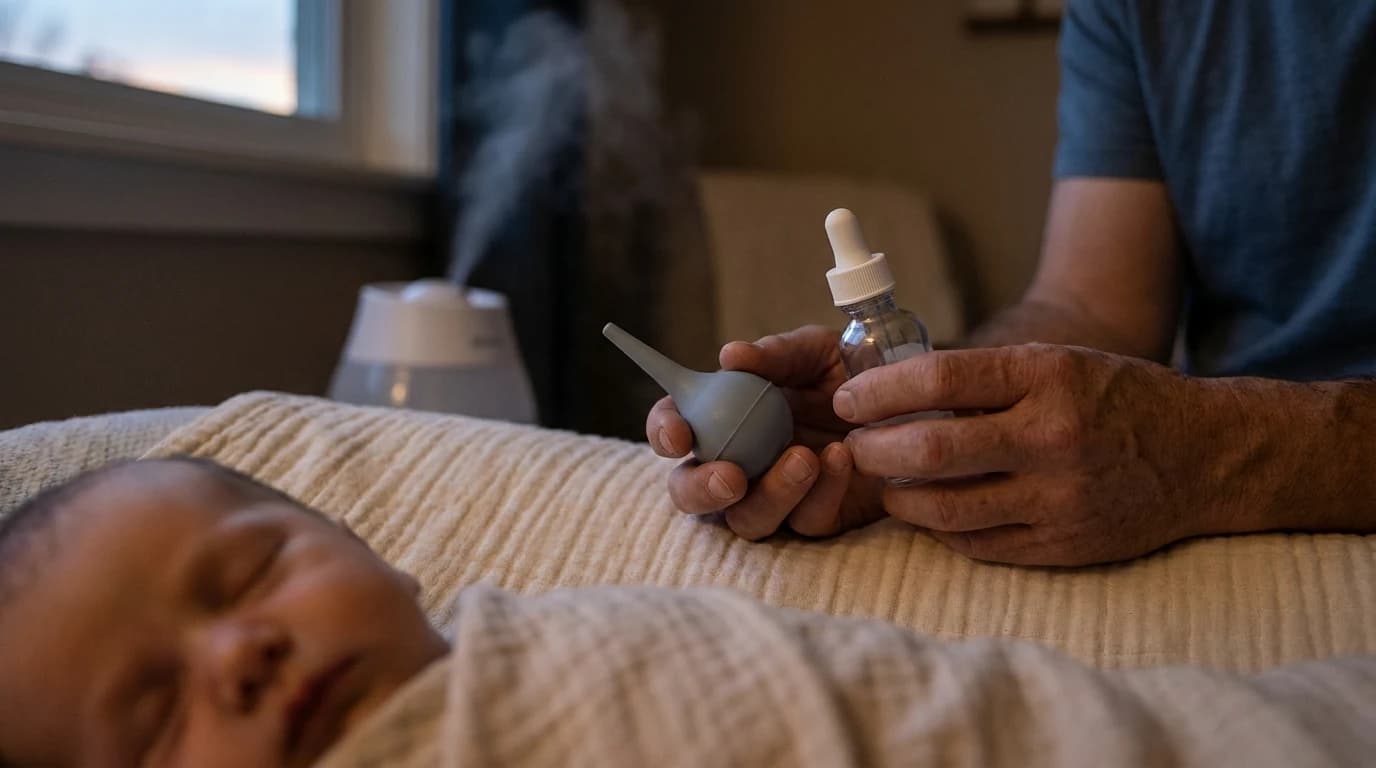
- Saline first. The AAP's cold-care guide says 1 to 2 drops or sprays per nostril. Use saline with no medicine in it.
- Suction second. Squeeze the bulb first, gently place the rubber tip in one nostril, then slowly let go, as the AAP describes. With a mouth-powered tube, Nationwide Children's says to hold it against the nostril's edge and never insert or force it.
- Feed right after. Nationwide Children's says to use the drops before feeding. Its suction sheet adds before naps and bedtime.
- Keep fluids coming. Seattle Children's says fluids keep a child hydrated and thin the mucus.
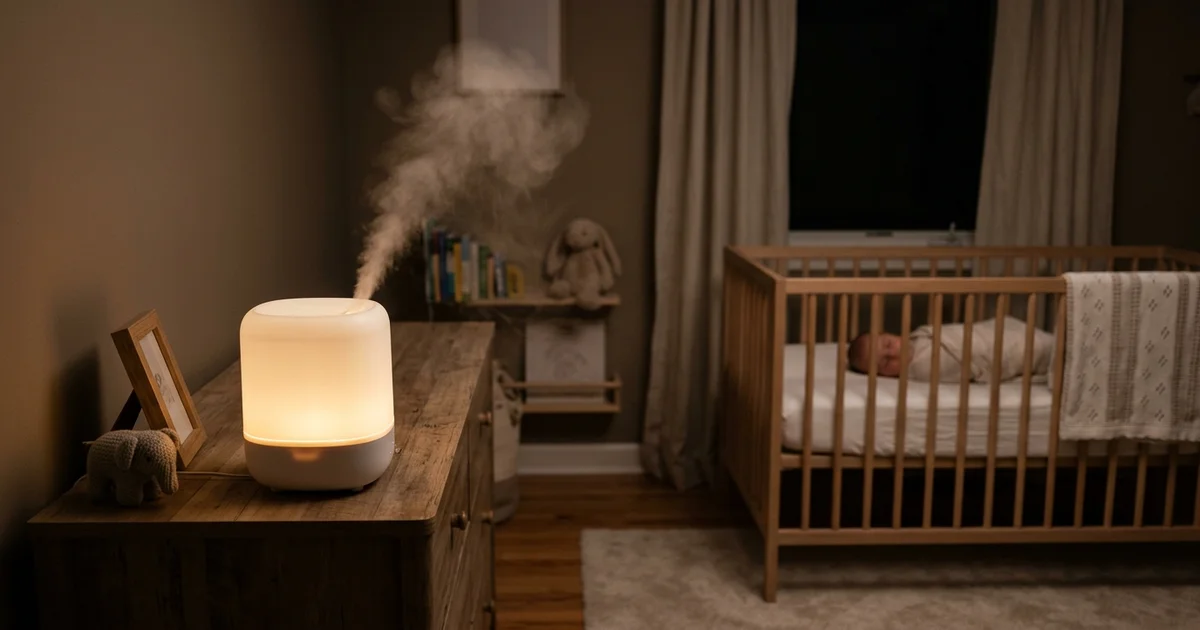
- Moisten the room. Place a cool-mist humidifier near the crib and out of reach, and clean it as the maker recommends, per the AAP.
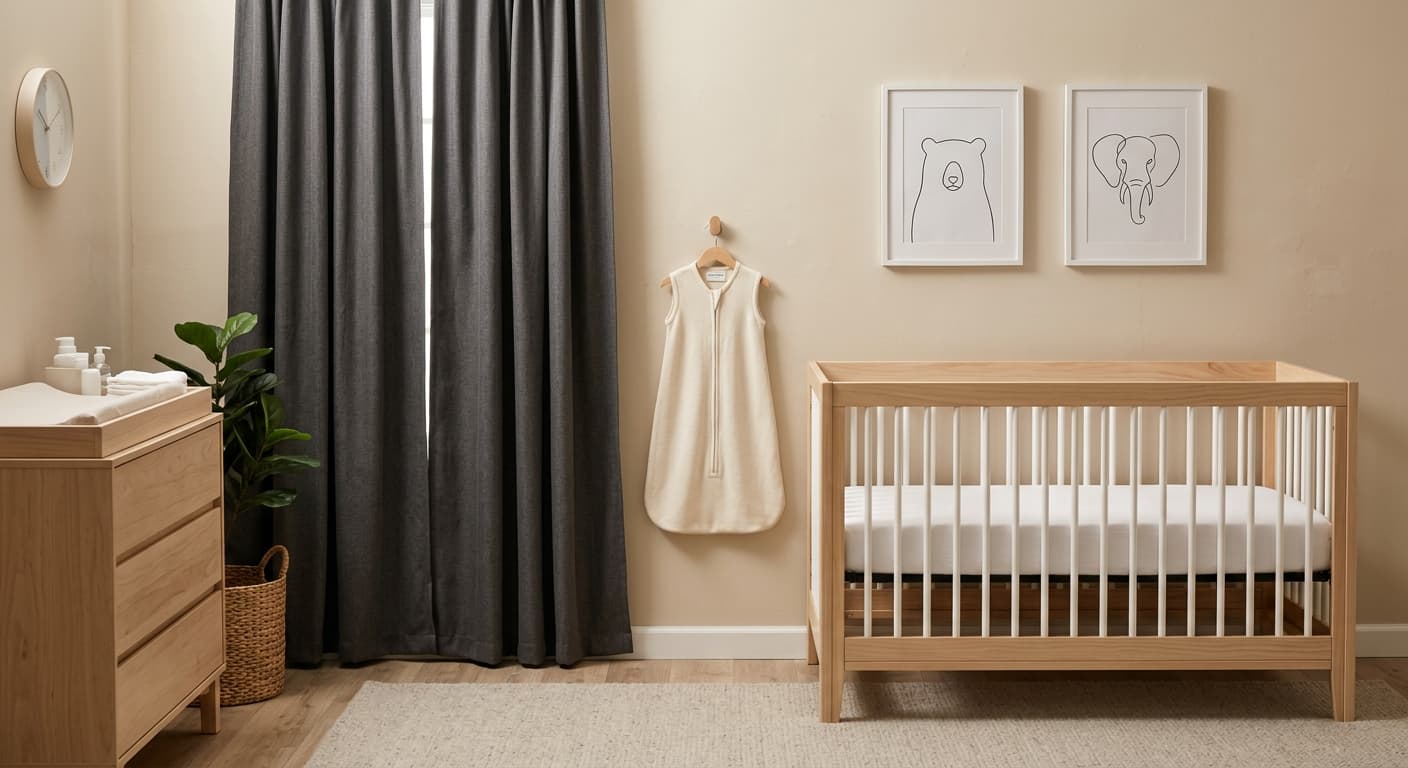
- Back to sleep, flat. The cold changes nothing about sleep position.
The honest expectation: none of this shortens the cold. Seattle Children's says no drug makes a cold go away sooner, a normal one lasts about 2 weeks, and nasal drainage can last 7 to 14 days. The goal is an easier feed and an easier night.
How often? Trusted sources give different numbers
Many guides skip this question, and pediatric sources don't fully agree. These limits count different things, so read them together.
| The question | What the source says | Source |
|---|---|---|
| How often to suction | Try to limit it to 2 to 3 times a day. More can leave the nose dry, sore and bleeding | CHKD |
| How often to do saline, under age 1 | No more than 4 times a day, or before every feeding | Seattle Children's |
| How many drops, under age 1 | 1 drop per nostril | Seattle Children's |
| How many drops, general | 1 to 2 drops or sprays per nostril | AAP, CHKD |
| When a bulb works best | Under 6 months. Older babies fight it, but saline still helps | AAP |
A cautious default: saline before feeds, as needed, with no more than about 4 rounds a day under age 1. Save suction for when mucus is actually in the way, because CHKD ties the sore, bleeding nose to overdoing suction, not saline. That reading is ours; ask your pediatrician if your baby needs more.
Do this, not this
| Do this | Not this | Why |
|---|---|---|
| Plain saline drops or spray | Nose drops containing medicine | The AAP says never to use nonprescription drops with medicine in them |
| Cool mist | A warm-mist humidifier | The FDA says warm mist can swell nasal passages and make breathing harder |
| The moist air of a warm shower | Hot steam close to your baby | Seattle Children's lists a warm shower. No source here recommends hot steam |
| One bulb per child, washed in soapy water and air dried | A shared or old bulb | CHKD says use a separate bulb per child and discard it after seven days |
| A flat, firm sleep surface | Propping the mattress or crib | The AAP says any surface inclined more than 10 degrees isn't safe for sleep |
If you're buying a humidifier, the Frida Baby 3-in-1 Cool Mist Humidifier → is the pick in our baby humidifier guide because it has no heated setting. The Honeywell HCM350B → suits larger nurseries. The AAP frames a humidifier as something that may help, so treat it as a support, not the fix.
Cold medicine: three ages, one clear answer for babies
Published age cutoffs differ, and every one of them covers a baby:
- The FDA: doesn't recommend OTC cough and cold medicine under age 2, citing possible serious and life-threatening side effects. It adds that makers voluntarily label these products not for use under 4.
- The AAP: should not be given under age 4.
- Seattle Children's: don't give them to young children, and says they are not approved under 6 years.
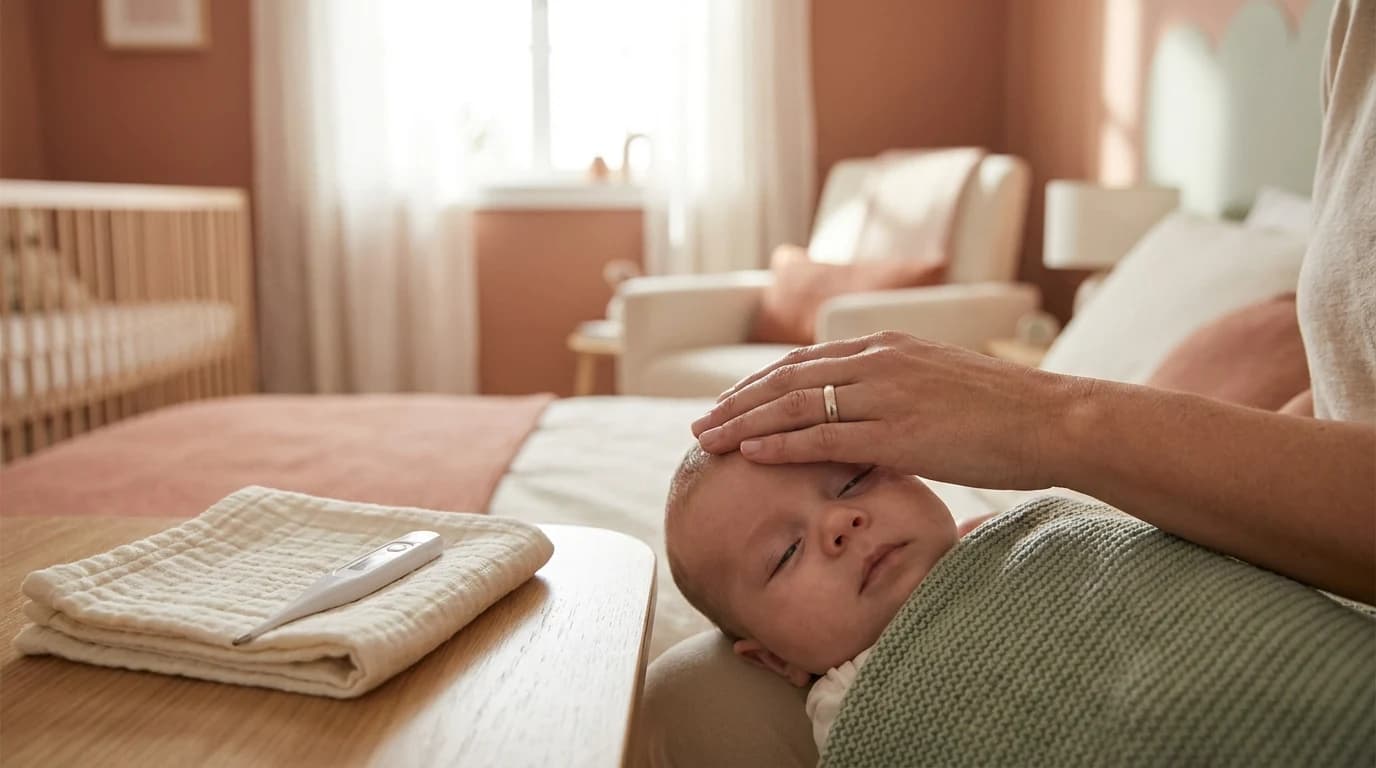
Fever is a separate question: the AAP says to call your pediatrician before giving any fever medicine under age 2, and to call right away if a baby under three months has a fever.
Why propping isn't the workaround
Lifting the head of the crib feels like common sense for a blocked nose, but no page cited here supports it for sleep. The AAP's safe-sleep guide says to place babies on their back on a surface with no incline, and to move a baby who dozes off in a car seat or swing to a firm sleep surface as soon as possible. It lists no exception for a cold. Holding your baby upright while awake is a different thing from sleeping them that way. Our AAP safe-sleep guide has the full setup.
When to call, by age and symptom
Clean the nose first, then reassess: Seattle Children's excludes trouble breathing that goes away after the nose is cleared.
| What you see | What to do | Source |
|---|---|---|
| Struggling for each breath, can barely cry | Call 911 | Seattle Children's |
| Bluish tint around lips or fingertips | Treat as an emergency. The AAP says this means not enough oxygen is reaching the blood | AAP |
| Trouble breathing that lasts after clearing the nose, wheezing, much faster breathing, nostrils widening, ribs showing | Call or seek care now | Seattle Children's, FDA |
| Any fever under 12 weeks | Call now, and give no fever medicine before your baby is seen | Seattle Children's |
| Fever of 102 F or higher at any age | Call the doctor | FDA |
| Drinking less, dry mouth, crying without tears, urinating less | Call the doctor | AAP |
| Any cold under 6 months, earache, fever past 3 days | Contact within 24 hours | Seattle Children's |
| Blocked nose still waking baby, discharge past 2 weeks | Call during office hours | Seattle Children's |
The FDA lists a lower line for the youngest babies: 100.4 F or higher at 2 months or younger. Wheezing and trouble feeding can also signal bronchiolitis, which RSV and other viruses cause, so don't write them off as congestion.
Quick questions
Can I put breast milk in my baby's nose?
Some parenting sites suggest it. None of the AAP, FDA or hospital pages cited here recommend it; they name saline.
Is vapor rub okay for a baby?
The AAP gives its mentholated rub directions for ages 2 and older, on top of the skin only.
Can I use honey for the cold?
Not under 12 months. The AAP warns honey can cause infant botulism.
Do I need a humidifier if my air isn't dry?
Seattle Children's frames it around dry air, because dry air thickens nasal mucus. If your home already holds moisture, saline matters more.
Steam or warm mist is the strongest fix for a blocked nose.
The FDA says not to use warm mist humidifiers because they can swell nasal passages and make breathing harder. Seattle Children's lists the moist air from a warm shower as an option, without hot steam.
More suction means a clearer nose.
CHKD advises trying to limit suction to two to three times a day, because more can leave the inside of the nose dry, sore and bleeding.
Tilting the crib helps a congested baby sleep safely.
The AAP says any surface inclined more than 10 degrees isn't safe for a baby to sleep on, and its safe-sleep guide lists no exception for a cold.
Research Sources
- U.S. FDA - When to give kids medicine for coughs and colds
- HealthyChildren.org (AAP) - How to care for your child's cold
- HealthyChildren.org (AAP) - Bronchiolitis in babies
- HealthyChildren.org (AAP) - A parent's guide to safe sleep
- Seattle Children's - Colds
- CHKD - Clearing your baby's congestion
- Nationwide Children's - Help for a child with a cold
- Nationwide Children's - Suctioning the nose with a human-powered tube
Hilly Shore Inc.
Editorial teamIndependent product research team behind Cribworthy. Reviews are grounded in published AAP / CDC / NHTSA / CPSC pediatric guidance, JPMA / GREENGUARD GOLD / OEKO-TEX certification verification, and aggregated buyer sentiment.
128 products reviewed · 22 categories covered · cites AAP, CDC, NHTSA, CPSC, FDA, ACOG.
Safety claims are verified against published pediatric guidelines and CPSC databases. See our editorial standards.