How to Prepare & Store Baby Formula: A Safety Guide
Quick Answer
For most healthy, full-term babies, mix powdered formula with water from a safe source, following the exact ratio on the container, and use it within two hours at room temperature or 24 hours in the fridge. Wash your hands, use clean and sanitized bottles, measure the water first and then add the powder, and never warm a bottle in the microwave. The stricter rules are for one group: babies under two months old, born premature, or with a weakened immune system. For those infants, prepare powdered formula with hot water at least 158 degrees Fahrenheit (70 Celsius) to kill any Cronobacter bacteria, or use sterile liquid formula instead. Throw out whatever the baby does not finish.
Our Verdict
Clean hands and bottles, measure the water first, respect the two-hour clock, and discard leftover formula. For newborns under two months, premature, or immune-compromised babies, add the 158 degree hot-water step or use sterile liquid formula. The brand on the can matters less than how you handle it. When in doubt about your water source or a young baby's symptoms, call your pediatrician.
Key Takeaways
- ✓Clean hands and bottles, measure the water first, respect the two-hour clock, and discard leftover formula. For newborns under two months, premature, or immune-compromised babies, add the 158 degree hot-water step or use sterile liquid formula. The brand on the can matters less than how you handle it. When in doubt about your water source or a young baby's symptoms, call your pediatrician.
- ✓For most healthy, full-term babies, you can mix powdered formula with water from a safe source, following the exact ratio on the container, and use it within two hours at room temperature or 24 hou...
- ✓Powdered formula is not sterile; liquid formula is. Powder can rarely carry germs like Cronobacter. Ready-to-feed and concentrate liquid formulas are sterilized in the can.
- ✓Cronobacter and other germs do not come only from the formula. They come from countertops, sinks, hands, and bottle parts. Before you open the can:
- ✓The mixing ratio on the container is a medical instruction, not a suggestion. Getting it wrong dilutes nutrition or overloads a newborn's kidneys.
As an Amazon Associate I earn from qualifying purchases. Product prices and availability are subject to change.
Mixing a bottle feels like the simplest part of feeding a baby, and it mostly is. But powdered infant formula is not sterile, and a few small habits — the water you use, the order you mix in, and how long a bottle sits out — are the difference between a routine feed and a rare but serious infection. This guide is the safety checklist behind the everyday bottle: what the CDC and FDA recommend, where the rules get stricter for newborns, and the mistakes that are easy to make on three hours of sleep. It is not about which brand is best — it is about handling whatever formula you chose so it stays safe from scoop to bottle.
Quick answer
For most healthy, full-term babies, you can mix powdered formula with water from a safe source, following the exact ratio on the container, and use it within two hours at room temperature or 24 hours in the fridge. Wash your hands, use clean and sanitized bottles, measure the water first and then add the powder, and never warm a bottle in the microwave. The stricter rules are for one group: babies under two months old, born premature, or with a weakened immune system. For those infants, prepare powdered formula with hot water at least 158 degrees Fahrenheit (70 Celsius) to kill any Cronobacter bacteria, or use sterile liquid formula instead. Throw out whatever the baby does not finish.
Key takeaways
- Powdered formula is not sterile; liquid formula is. Powder can rarely carry germs like Cronobacter. Ready-to-feed and concentrate liquid formulas are sterilized in the can.
- The two-hour clock is the one to memorize. Prepared formula left at room temperature should be used within two hours of mixing, and within one hour once your baby starts drinking.
- Higher-risk newborns get a hot-water step. Under two months, premature, or immune-compromised babies benefit from mixing with water at 158°F/70°C, per CDC and FDA.
- Always discard leftover formula. Saliva that enters the bottle during a feed lets bacteria grow, so a half-finished bottle is not a save-for-later bottle.
Step 1: Start clean
Cronobacter and other germs do not come only from the formula. They come from countertops, sinks, hands, and bottle parts. Before you open the can:
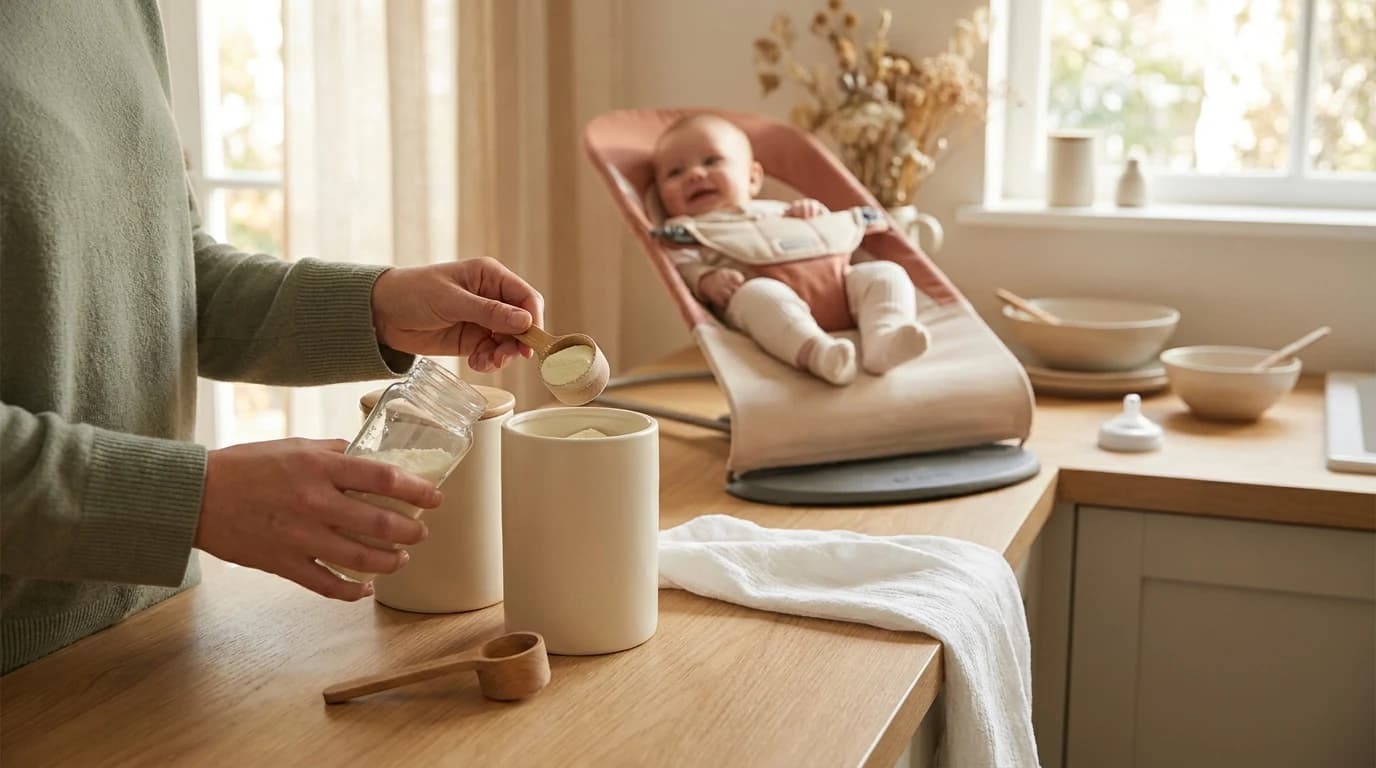
- Wash your hands with soap and water, and clean the surface where you will mix.
- Use a bottle that has been cleaned and sanitized. The CDC recommends sanitizing bottle parts (nipples, rings, caps, valves) daily for babies under two months, premature, or immune-compromised — in a dishwasher with a heated dry cycle, by boiling, by steaming, or with a sanitizing basin.
- Do not wash feeding parts directly in the sink. Germs in drains can contaminate them. Use a clean basin reserved for baby items, and let everything air-dry in a protected spot rather than with a dish towel.
Step 2: Mix it in the right order
The mixing ratio on the container is a medical instruction, not a suggestion. Getting it wrong dilutes nutrition or overloads a newborn's kidneys.
| Do this | Why it matters |
|---|---|
| Measure the water first, then add powder | Adding water to a fixed amount of powder changes the concentration |
| Use the exact scoops and ounces on the label | Too much water underfeeds; too little water can dehydrate baby |
| Use water from a safe source | If you are unsure about your tap water, check with your local health department |
| Use a level, dry scoop | A wet scoop introduces moisture (and germs) into the can |
Too much water can mean the formula does not meet your baby's nutritional needs. Too little water makes a baby's kidneys and digestive system work too hard and can cause dehydration. The ratio is not a place to improvise.
Step 3: Warming is optional — and microwaves are out
Formula does not need to be warmed at all; room temperature or even cool is fine. If your baby prefers it warm:
- Never use a microwave. Microwaves heat unevenly and create hot spots that can scald a baby's mouth and throat.
- Run the bottle under warm tap water instead, keeping water away from the nipple, then shake and test a few drops on your wrist before feeding.
Step 4: The storage clock
This is where most day-to-day mistakes happen. Prepared formula spoils faster than parents expect.
| Situation | Safe window |
|---|---|
| Freshly prepared, left at room temperature | Use within 2 hours |
| Bottle your baby has started drinking | Finish within 1 hour from start of feeding |
| Prepared but refrigerated within 2 hours | Use within 24 hours |
| Leftover formula in the bottle after a feed | Discard it — do not save |
| Opened can of powder | Use within about 1 month (check the label); store cool, dry, lid closed, not in the fridge |
| Unopened cans | Cool, dry, indoor place — never a hot car, garage, or outdoors |
A practical habit: write the open date on the lid of a new can, and the prep time on a piece of tape on a refrigerated bottle. It removes guesswork at 3 a.m.
When the rules get stricter: higher-risk babies
For most babies, mixing powder with safe tap water is fine. But the CDC and FDA single out one group for extra care: infants younger than two months, born premature, or with a weakened immune system. These babies are most vulnerable to Cronobacter, a rare bacterium that can cause sepsis or meningitis. For them, you have two safer paths:
- Use liquid formula if you can. Ready-to-feed and liquid concentrate are sterile, so they carry far less risk than powder.
- If you use powder, mix it with hot water at least 158°F/70°C. Boil safe water, let it cool to no lower than 158°F, mix the formula, then cool the bottle quickly under running water or in an ice bath before feeding.
Other powder habits matter more for this group too: check that cans are not dented, puffy, or rusted; keep the scoop dry and the lid closed; and sanitize feeding parts daily.
What the guidance does not say
A few widely repeated "rules" are stricter than the official advice — and a couple of real risks get overlooked.
- It does not say every parent must boil the water. For healthy, full-term babies with a safe water supply, the CDC says filtered or unfiltered safe tap water is fine. The 158°F hot-water step is specifically for the higher-risk group, not a universal requirement.
- It does not say you can microwave to save time. Warming is optional, but the microwave is genuinely off-limits because of hot spots — this is one place the guidance is firm.
- It does not say leftover formula is fine if it "looks okay." Once a baby has fed from a bottle, the two-saliva-meets-formula combination grows bacteria. Appearance is not a safety test; the clock is.
- It does not say warm-water-from-the-tap counts as the hot-water step. Tap "warm" is nowhere near 158°F. The Cronobacter-killing step requires genuinely hot, near-boiled water.
When to call your pediatrician
Safe preparation lowers risk; it does not eliminate it. Call your pediatrician promptly if a young baby — especially under two months — has a fever, poor feeding, excessive crying, very low energy, or unusual irritability, which can be early signs of a serious infection. If your water source is questionable (a private well, a boil-water advisory, or lead concerns), ask your pediatrician or local health department which water is safest for mixing before you change your routine.
The everyday version of all this is short: clean hands and bottles, measure water first, mind the two-hour clock, and toss the leftovers. For the newborn weeks, add the hot-water or liquid-formula step. None of it is complicated once it becomes habit — and habit is exactly what keeps it safe.
For more on the formula itself, our types of baby formula explained guide covers reading the label, and how to switch baby formula safely walks the transition between brands.
Sources
Research Sources
- Infant Formula Preparation and Storage — Centers for Disease Control and Prevention (CDC)
- Protect Your Baby from Cronobacter — CDC
- Help Prevent Cronobacter Illness: Prepare and Store Powdered Infant Formula Safely (PDF) — U.S. Food and Drug Administration (FDA)
- Formula Feeding — HealthyChildren.org (American Academy of Pediatrics)
Hilly Shore Inc.
Editorial teamIndependent product research team behind Cribworthy. Reviews are grounded in published AAP / CDC / NHTSA / CPSC pediatric guidance, JPMA / GREENGUARD GOLD / OEKO-TEX certification verification, and aggregated buyer sentiment.
115 products reviewed · 20 categories covered · cites AAP, CDC, NHTSA, CPSC, FDA, ACOG.
Safety claims are verified against published pediatric guidelines and CPSC databases. See our editorial standards.