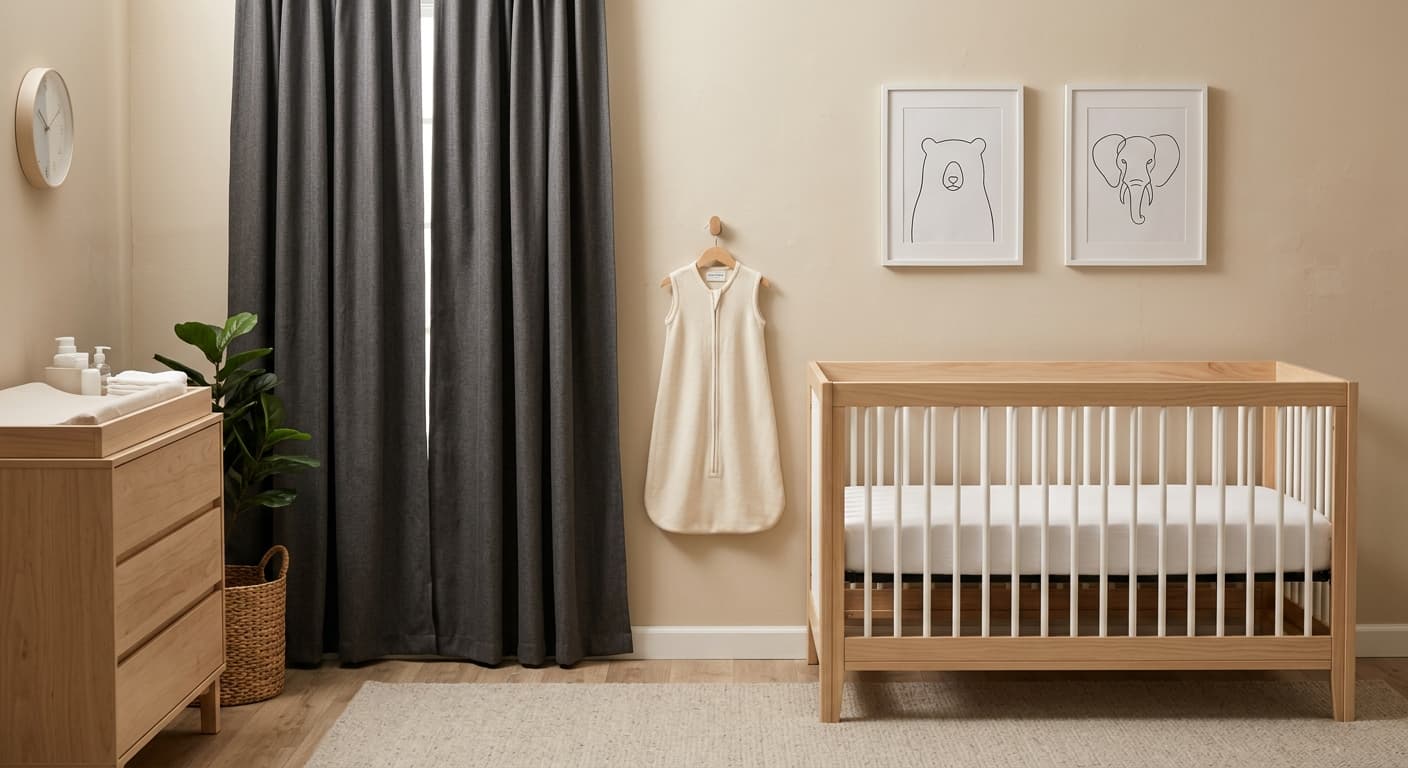
Sewing for the Nursery: What Is Worth Making Yourself
Quick Answer
Sew the things that live outside the crib and buy the things that go in it. Burp cloths, a pram blanket, nursery curtains and a changing pad cover are all forgiving first projects; a fitted crib sheet is the one where fit is the whole job. Measure your own mattress first, because CPSC defines a full-size crib as 52 3/8 in. plus or minus 5/8 in. by 28 in. plus or minus 5/8 in., so two compliant cribs can differ by more than an inch. On fabric, no federal flammability rule covers bedding at all, and OEKO-TEX STANDARD 100 Product Class 1 is the strictest of its four classes for babies and children up to three. Two things not to sew: crib bumpers, which have been a banned hazardous product in the US since November 12, 2022, and any loose blanket or quilt intended for inside the crib.
Our Verdict
Handmade earns its place on everything that lives outside the sleep space — burp cloths in volume, a pram blanket, curtains, an odd-sized changing pad cover. Inside the crib the calculation flips, because the failure modes there are the ones you cannot test for at home and the standards you would want to meet are not written for one-off items. Start with burp cloths, measure your own mattress before attempting a sheet, prewash everything, and let the quilt be a floor blanket.
Key Takeaways
- ✓"Standard crib size" is the phrase every pattern uses, and it is looser than it sounds.
- ✓Nursery sewing has a clean difficulty gradient, and it is worth climbing it in order rather than starting at the top.
- ✓There is less regulation here than most people assume, and knowing where it stops is the useful part.
- ✓Crib bumpers.
- ✓Rule of thumb: if the item's job is safety, buy it. If its job is charm, laundry volume, or a size nobody stocks, make it.
As an Amazon Associate I earn from qualifying purchases. Product prices and availability are subject to change.
Somewhere in the third trimester, a lot of people get the urge to make something for the baby. It is a good instinct with one bad failure mode: several of the projects that look easiest online — a quilt, a bumper, a nap blanket — are things a newborn will never actually be allowed to use.
The one-line version: Sew the things that live outside the crib, buy the things that go in it, and measure your own mattress before you cut anything.
The measurement that decides your crib sheet
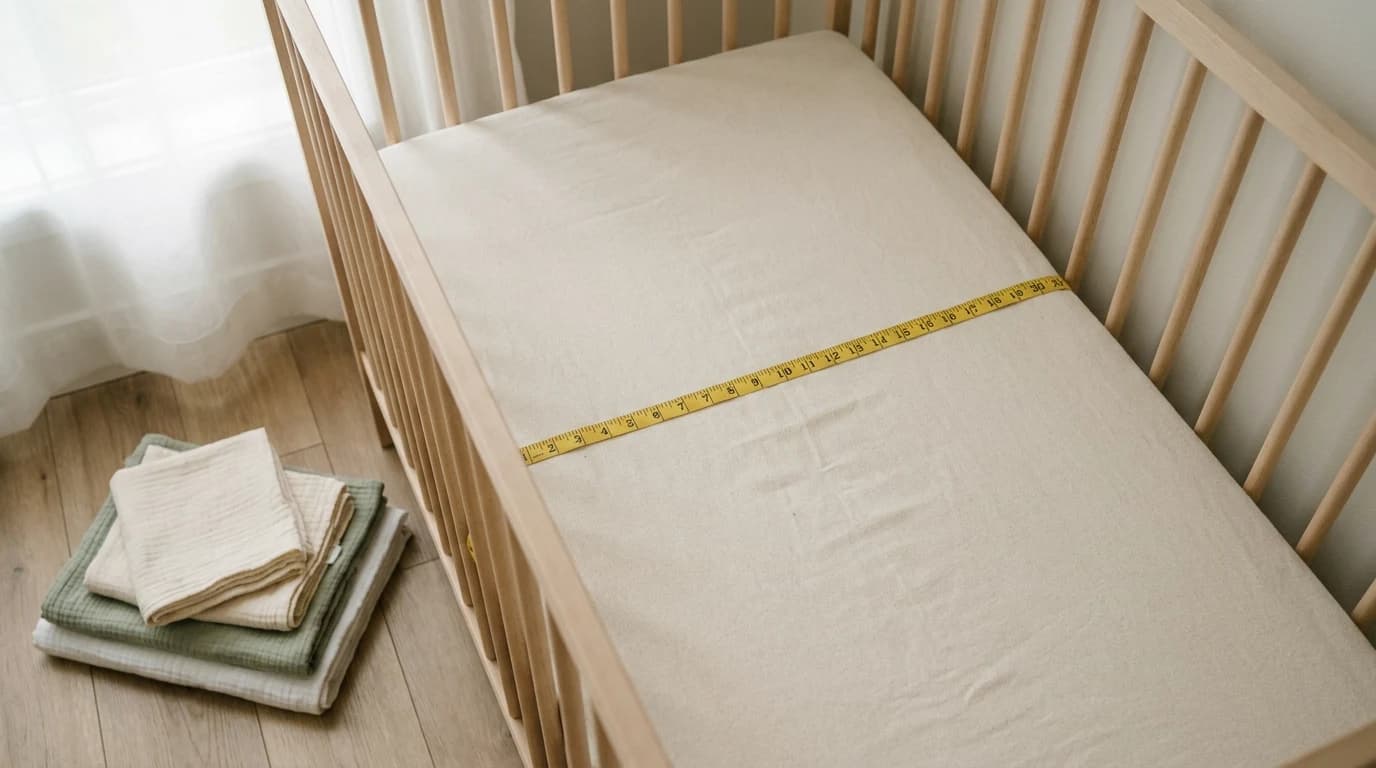
"Standard crib size" is the phrase every pattern uses, and it is looser than it sounds. CPSC defines a full-size crib as 52 3/8 in. plus or minus 5/8 in. by 28 in. plus or minus 5/8 in. That tolerance is written into the standard, not sloppy manufacturing — two fully compliant cribs can differ by an inch and a quarter in length, and again in width. Mattress thickness varies on top of that.
So a sheet cut to a generic "standard" number can land loose on your particular mattress. That matters more here than on an adult bed, because a fitted sheet that pops a corner becomes loose fabric in a sleep space that is meant to be otherwise bare.
Measure before you cut, every time:
- Length and width of the mattress itself, never the crib frame
- Height, from where the mattress sits to its top surface
- Then test the finished sheet: it should not release a corner when you pull it diagonally
Start with the projects that forgive you
Nursery sewing has a clean difficulty gradient, and it is worth climbing it in order rather than starting at the top.
| Project | How forgiving it is | The skill it teaches |
|---|---|---|
| Burp cloths | Straight lines, nothing has to fit, mistakes still get used | Even seam allowance |
| Cot or pram blanket | Rectangles and a border; no fit at all | Turning a clean corner |
| Nursery curtains | Long straight seams; blackout lining is the only wrinkle | Hemming at length |
| Changing pad cover | Elastic and curves, but low stakes if the fit is loose | Elastic casings |
| Crib sheet | Four corner seams plus elastic all round, and fit is the point | Fit under tension |
The order matters because a crib sheet is not technically hard — it is unforgiving. Everything a burp cloth teaches you, an even seam allowance and a casing that does not twist, is exactly what a sheet punishes you for not having yet.
The gear question, answered plainly
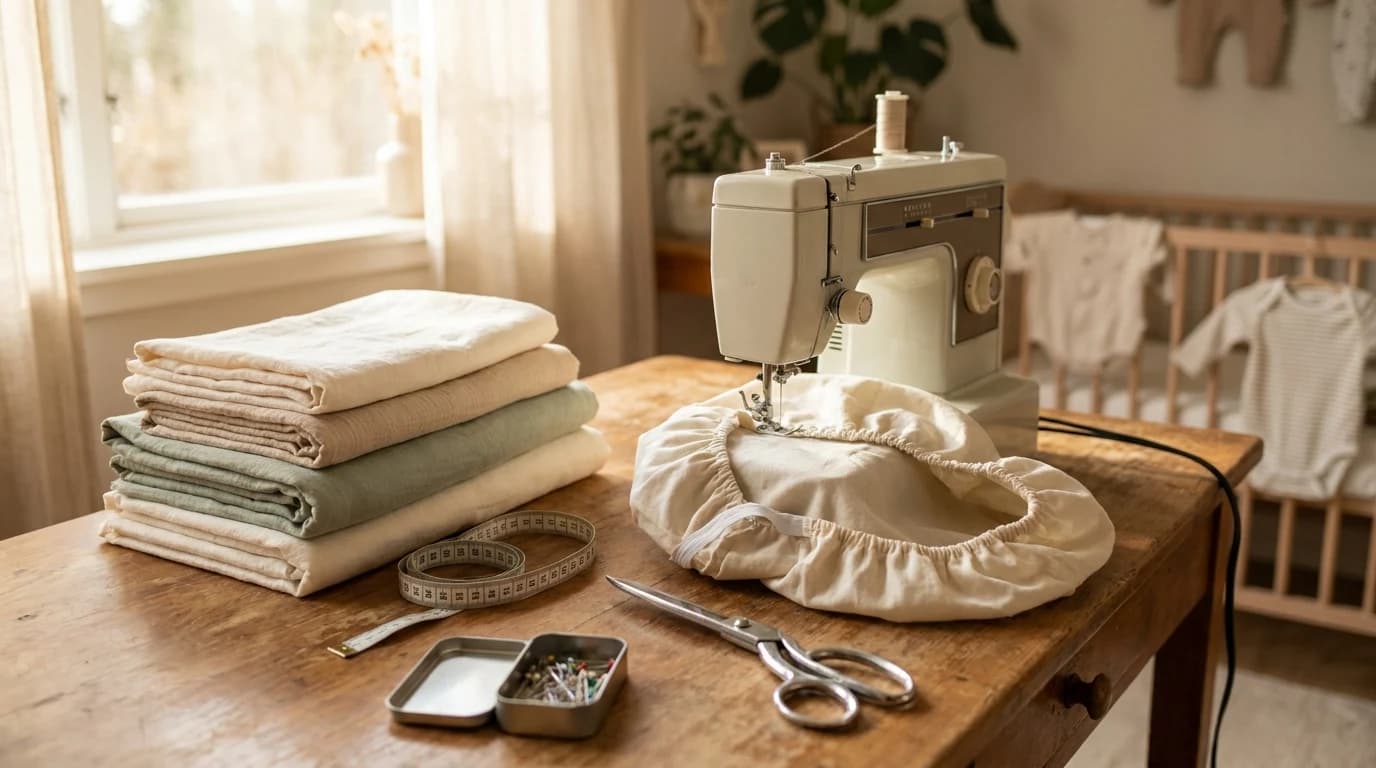
You do not need a machine to start. Burp cloths and a blanket border can be hand-sewn on the sofa. If you are outfitting from nothing, a five-item beginner sewing kit — thread, fabric scissors, a seam ripper, hand needles and pins — is the entire entry cost. Add a machine when the straight seams get long enough to be boring, which happens somewhere around the curtains.
What "baby-safe fabric" actually means
There is less regulation here than most people assume, and knowing where it stops is the useful part.
Children's sleepwear carries federal flammability standards, 16 CFR parts 1615 and 1616. Bedding does not. And inside sleepwear, garments meeting CPSC's "infant garment" definition are excepted from those tests anyway, though they still have to meet the general clothing textile standard at 16 CFR part 1610. No flammability rule is quietly doing work in the background of a homemade sheet or blanket. The fabric decision is entirely yours.
That puts the weight on the chemical side. OEKO-TEX STANDARD 100 tests finished textiles for harmful substances across four product classes, and Product Class 1 — babies and children up to three years — carries the strictest limits of the four. It is a label to look for on the bolt you buy, not a claim you can make about the item you finish.
A shortlist that keeps things simple:
- Cotton jersey or woven cotton for sheets — jersey eases into corners, woven holds its shape
- Cotton muslin for burp cloths and light blankets, which softens with every wash
- Prewash everything at the temperature you will really launder it at, in a detergent you have already vetted
Prewashing is not optional. Cotton shrinks, and a sheet that fit at the cutting table but not after the first hot wash is the most ordinary way a first attempt fails.
Two things not to sew
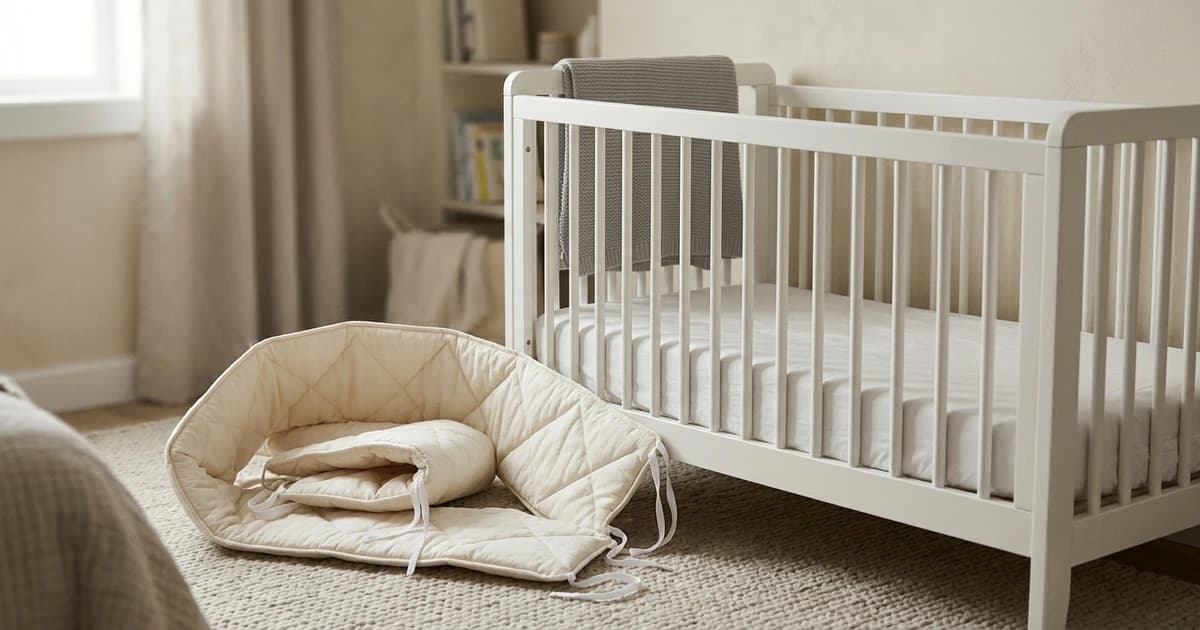
Crib bumpers. Under the Safe Sleep for Babies Act of 2021, crib bumpers are a banned hazardous product in the US as of November 12, 2022 — padded bumpers, supported and unsupported vinyl bumper guards, and vertical crib slat covers, regardless of when they were made. The ban applies to selling them, so nothing legally stops you sewing one for your own crib. The reason not to is the hazard the ban exists for.
Anything loose meant for inside the crib. Quilts, pillows and blankets are the classic handmade shower gift, and they belong on the play mat, over a stroller, or folded in a drawer until well past the first birthday. If the goal is warmth, a wearable sleep sack does the job the blanket was imagined for — and it is one of the sleep items worth buying rather than making.
When handmade actually beats store-bought
| Handmade wins when | Buying wins when |
|---|---|
| You want a specific fabric nobody sells as a sheet | The item's job is safety, not looks |
| You need an odd size — mini crib, bassinet, changing pad | You need it this week |
| Volume matters more than perfection, as with burp cloths | The failure mode involves a sleeping baby |
| The item is the gift, and the making is the point | You would be guessing at a standard you cannot verify |
Rule of thumb: if the item's job is safety, buy it. If its job is charm, laundry volume, or a size nobody stocks, make it.
What to budget, realistically
These are planning estimates for a first attempt, not stopwatch figures — real pace swings wildly with your machine and how much you unpick.
- Burp cloths: an evening for a batch of four to six
- Cot or pram blanket: an evening, most of it spent pressing
- Nursery curtains: a weekend afternoon, plus a second trip for fabric
- Crib sheet: an evening once you have done one, two if the elastic fights you
Double all of it if you are learning the machine at the same time. The realistic third-trimester plan is one finished item, not a nursery's worth of started ones — and the finished burp cloths will get more use than the quilt would have.
Research Sources
- CPSC Crib Mattresses business guidance — full-size crib dimensions and tolerances, 16 CFR part 1241
- CPSC Safe Sleep for Babies Act business guidance — crib bumper ban definition and November 12, 2022 effective date
- Federal Register — Ban of Crib Bumpers (CPSC final rule implementing the Safe Sleep for Babies Act)
- CPSC Children's Sleepwear Regulations — 16 CFR parts 1615/1616 scope and the infant garment exception
- OEKO-TEX STANDARD 100 — the four product classes and Product Class 1 for babies and children up to 3 years
- American Academy of Pediatrics (HealthyChildren.org) — A Parent's Guide to Safe Sleep
Hilly Shore Inc.
Editorial teamIndependent product research team behind Cribworthy. Reviews are grounded in published AAP / CDC / NHTSA / CPSC pediatric guidance, JPMA / GREENGUARD GOLD / OEKO-TEX certification verification, and aggregated buyer sentiment.
124 products reviewed · 22 categories covered · cites AAP, CDC, NHTSA, CPSC, FDA, ACOG.
Safety claims are verified against published pediatric guidelines and CPSC databases. See our editorial standards.