High-Contrast Cards for Newborns: What They Really Do
Quick Answer
Newborns look longer at high-contrast black-and-white patterns than at plain surfaces, a finding first published in 1963 and replicated since, because contrast sensitivity rather than colour is the binding constraint in the first months. That makes contrast cards a real tummy-time and attention tool for roughly the first three to five months. No trial shows they improve later cognition, and a printed sheet does the same job as a bought set.
Our Verdict
Buy contrast cards for hands-free tummy time, not for brain development. Hold them 8 to 12 inches out, expect the advantage to fade as contrast sensitivity climbs, and treat any set as a three-to-five-month product rather than something that grows with the child.
Pick by your situation
| If your situation is… | Pick | Why |
|---|---|---|
| Your baby is under about eight weeks and tummy time lasts two minutes | Wee Gallery High Contrast Cards for Baby - Original Animals | Stiff cards meant to stand on the mat, so the pattern stays at eye level without a spare hand holding it. |
| You want one purchase that stays useful past the newborn window | hahaland High Contrast Baby Flashcards (20 cards) | Ten black-and-white cards for the first weeks and ten with red, yellow and blue accents for later, so the set grows a little with your baby. |
| You would rather read to the baby than prop something up | "Look Look!" by Peter Linenthal | The same black-and-white cut-paper art in an 18-page board book you can hold at feeding distance. |
Each pick is one of the products ranked below — this row is for shortcutting based on your situation, not a separate recommendation.
Swipe to compare every product.
| Comparison field | #1Wee Gallery High Contrast Cards for Baby - Original Animals Owner rating | #2hahaland High Contrast Baby Flashcards (20 cards) | #3"Look Look!" by Peter Linenthal Owner rating |
|---|---|---|---|
| Verdict | Best for propped tummy time | Best across the 0-to-6-month span | Best high-contrast board book |
| Price | ~$19.49Buy on Amazon | ~$7.99Buy on Amazon | ~$7.99Buy on Amazon |
| Type | High-contrast cards | High-contrast cards | High-contrast board book |
| Format | 6 two-sided cards | 20 cards | 18 board pages |
| Size | 5 x 7 in | 6 x 6 in | 6.4 x 6.5 in |
| Buyer sentiment | — | — | Suitable for newborns Content Image quality Engaging Buyers praise suitable for newborns, content, image quality and engaging. Based on 1,582 user mentions |
| Pros |
|
|
|
| Cons |
|
|
|
* Prices are approximate. Check the linked retailer for current pricing and availability.
Key Takeaways
- ✓The useful number is a distance, not an acuity score. The American Academy of Pediatrics puts a newborn's best focal range at 8 to 12 inches — the gap between your eyes and theirs during a feed.
- ✓Colour is not the binding constraint. Contrast is.
- ✓Evidence limit: the closest thing to a trial is a NICU study of an early-intervention programme — parent training, massage and visual interaction — in 57 infants born at 25 to 29 weeks.
- ✓Johnson and colleagues replicated the finding that newborns track a slowly moving schematic face further than a scrambled version of the same features — and that the preference fades during the second month.
- ✓Want hands-free floor time instead? A gym does the propping — see our play mats and gyms guide. For the floor time itself, tummy time tips; for the rest of month one, newborn essentials.
As an Amazon Associate I earn from qualifying purchases. Product prices and availability are subject to change.
Black-and-white baby cards are sold on one promise: bold patterns build a baby's brain. Half of that is well-replicated science from the 1960s. The other half has never been tested in a healthy full-term baby.
What a newborn can actually see
The useful number is a distance, not an acuity score. The American Academy of Pediatrics puts a newborn's best focal range at 8 to 12 inches — the gap between your eyes and theirs during a feed. Past that, vision is blurry; what is reliably there from day one is light, shape, movement and faces.
Sharpness is measured in cycles per degree — how fine a striped pattern still gets a response. These climb fast, and differ depending on how you ask.
| Age | What the baby is doing | Measured grating acuity |
|---|---|---|
| 0–1 month | Light, shape, movement, faces; eyes may wander | ~20/125 by sweep-VEP; 4.5 cycles/degree average |
| 2–3 months | Wandering settles; tracks a moving target | 1.88 cycles/degree on a behavioural looking test |
| 4–6 months | Reaches and grasps; colour and depth fill in | Contrast sensitivity averaged 4.23 at 3 months |
| 8–13 months | Judges distance; pincer grip near 10 months | ~20 cycles/degree; adult-level by VEP at 8 months |
Rule of thumb: an infant acuity figure is a method plus a number, never a number alone. Electrode readings run far sharper than looking tests, and Norcia and Tyler noted their own one-month figures were three to five times higher than earlier work using different stimuli. A guide handing you one confident Snellen fraction has dropped the half that matters.
Why black and white, specifically
Colour is not the binding constraint. Contrast is.
In a normative study of 600 children, mean contrast sensitivity — the reciprocal of the faintest contrast a child can detect — was 4.23 at three months and 78.26 at twenty-four months, then flat at the test ceiling: a three-month-old needs a target roughly twenty times bolder before it registers.
Black ink on white board is about as bold as card gets. Fantz showed in 1963 that infants under five days old looked consistently longer at black-and-white patterns than at plain coloured surfaces — the original evidence that newborns perceive form, and still the whole argument for contrast cards.
Bottom line: the cards trade on contrast, not colour. As contrast sensitivity climbs, their edge over ordinary household objects shrinks toward nothing.
Do newborns really see only black and white?
No. The American Academy of Ophthalmology notes that bright colours and large shapes start attracting attention within a couple of weeks. A review of the infant colour literature found colour vision improves greatly across the first three months — and that infants' insensitivity to contrast is probably enough on its own to explain their poor colour vision.
The "babies see red first" line we could not trace to published work, and what is published cuts the other way: in a 2014 test of 216 babies, every infant passed a blue/yellow target while many of the younger ones failed the red/green one.
What the cards do, and what they don't
Supported by the evidence:
- They hold a young baby's gaze longer than a plain surface does.
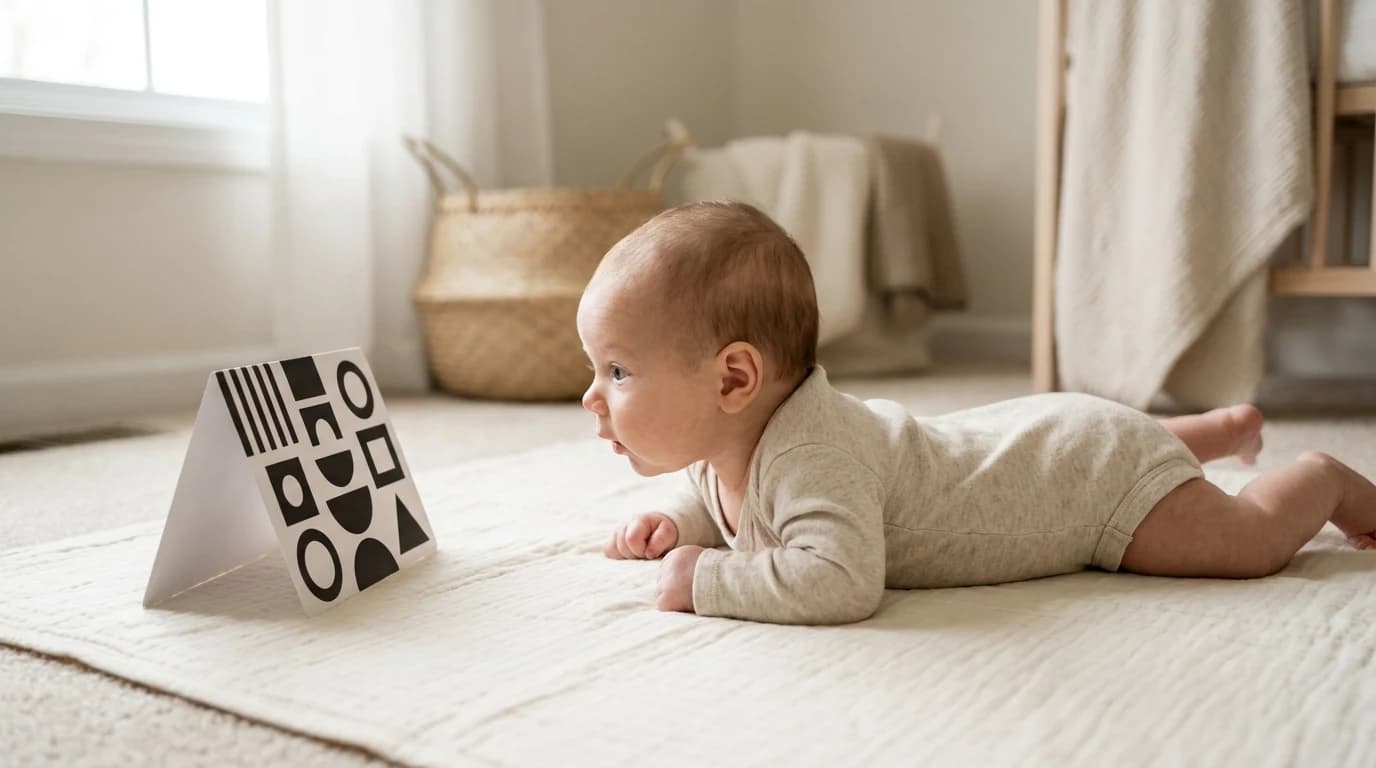
- They give tummy time a target that needs no parent's hand — the real case for owning any.
- They match what a newborn visual system is best at: high-contrast edges, close up.
Not supported by anything:
- Better cognition, language or IQ later. No trial has tested these cards in healthy full-term babies.
- A developmental window you can miss. Nothing describes cards as necessary.
Evidence limit: the closest thing to a trial is a NICU study of an early-intervention programme — parent training, massage and visual interaction — in 57 infants born at 25 to 29 weeks. 59% of that group scored top marks on all nine visual-function items at term-equivalent age, against 17% on standard care. A package, not a product; preterm babies, not term newborns; visual maturation, not intelligence.
In the first fortnight, the best card is a face
Johnson and colleagues replicated the finding that newborns track a slowly moving schematic face further than a scrambled version of the same features — and that the preference fades during the second month. The AAP arrives from the other side: by four months babies show extra interest in circular patterns like bull's-eyes and spirals, the shapes a face is made of.
So the honest case for buying cards is not stimulation. It is the propped-up minutes when nobody can hold a face ten inches away.

How to use them, by age
| Age | Pattern | Distance | Where it goes |
|---|---|---|---|
| 0–6 weeks | Bold stripes, checks, one strong shape | 8–12 in | Head of the tummy-time mat; beside the changing pad |
| 6–12 weeks | Same, moved slowly side to side | 8–12 in, then further | Crib-side, or held during a feed |
| 3–5 months | Circles, bull's-eyes, spirals | Arm's length and out | Clipped to a stroller; hung on a play gym |
| 5 months+ | Retire them | — | The room now out-competes the card |
Buy or print?
A contrast card is ink on board, and a printer makes the ink part for free. Black shapes on white paper taped to a box lid at eight inches does the same job for a two-week-old. What you buy is the board, not the pattern:
- Stock stiff enough to stand unaided, which is the point during tummy time
- A wipeable finish, rounded corners, and enough durability for a diaper bag
- Patterns already graded by age, so you are not guessing at complexity
Bottom line: print a sheet this week to find out whether your baby cares. Buy a set if you want it standing, wipeable and intact at ten weeks.
The three we would pick
- Wee Gallery High Contrast Cards for Baby - Original Animals → — six two-sided 5x7-inch cards on FSC-certified board, wipeable matte finish, rounded corners, meant to stand up during tummy time. Six is a small set — the recurring buyer complaint.
- hahaland High Contrast Baby Flashcards → — 20 large 6x6-inch cards on thick, wipe-clean board: ten in black and white, ten with red, yellow and blue accents, which hahaland pitches across 0–3 and 3–6 months. A set to hold up for your baby, not one to hand over.
- Look Look! by Peter Linenthal → — 18 board pages of black-and-white cut-paper art with a few words in red type, rated ages 0–3. The one to hold at feeding distance rather than prop, and the top pick in our best baby books for newborns.
Want hands-free floor time instead? A gym does the propping — see our play mats and gyms guide. For the floor time itself, tummy time tips; for the rest of month one, newborn essentials.
When do babies stop needing high-contrast cards?
There is no cut-off, only a fading advantage. By four to six months a baby is reaching, grasping and seeing colour and depth well enough that ordinary objects hold attention as well as a card does.
Do high-contrast cards help brain development?
No study shows that. Newborns do look longer at high-contrast patterns than at plain surfaces, but that is an attention finding, not a cognitive one — a tummy-time tool, not an intervention.
How far away should you hold a contrast card?
Start at 8 to 12 inches, the AAP's focal range for a newborn, and move further out as tracking arrives at two to three months. If a baby is not looking, the card is usually too far rather than too dull.
Should the cards be black and white, or black, white and red?
Either is fine, but the red is not doing the work the packaging implies. Contrast carries the effect, and the claim that red is the first colour a baby sees is one we could not trace to published research.
Newborns can only see black and white.
Newborns see light, shape, movement and faces from the early weeks, and the American Academy of Ophthalmology notes that bright colours and large shapes start attracting attention within a couple of weeks. The limiting factor is contrast: a review of the infant colour literature concluded that infants' general insensitivity to contrast is probably enough on its own to explain their poor colour vision.
High-contrast cards boost brain development.
No trial has tested high-contrast cards in healthy full-term babies. The nearest evidence is a randomised NICU trial of a whole early-intervention package in 57 very preterm infants, and its outcome was visual-function maturation at term-equivalent age, not cognition.
Research Sources
- American Academy of Pediatrics (HealthyChildren.org), Infant Vision Development: What Can Babies See? — the 8-to-12-inch newborn focal range
- American Academy of Ophthalmology, Vision Development: Newborn to 12 Months — light and dark patterns in the first weeks, depth and colour by five months
- Fantz RL, Pattern Vision in Newborn Infants (Science, 1963) — infants under five days old looked longer at black-and-white patterns than at plain coloured surfaces
- Norcia AM & Tyler CW, Spatial frequency sweep VEP: visual acuity during the first year of life (Vision Research, 1985) — 4.5 c/deg in the first month rising to about 20 c/deg at 8-13 months
- Salomao SR et al., Age norms for monocular grating acuity measured by sweep-VEP in the first three years of age (Arquivos Brasileiros de Oftalmologia, 2008) — 20/125 Snellen equivalent in the first month
- Elgohary AA et al., Age norms for grating acuity and contrast sensitivity measured by Lea tests in the first three years of life (International Journal of Ophthalmology, 2017) — contrast sensitivity 4.23 at 3 months, 78.26 at 24 months
- Brown AM, Development of visual sensitivity to light and color vision in human infants: a critical review (Vision Research, 1990) — contrast insensitivity explains infants' poor colour vision
- Mercer ME et al., A pseudoisochromatic test of color vision for human infants (Vision Research, 2014) — 216 infants; all passed blue/yellow, many younger infants failed red/green
- Johnson MH et al., Newborns' preferential tracking of face-like stimuli and its subsequent decline (Cognition, 1991)
- Fontana C et al., Effects of Early Intervention on Visual Function in Preterm Infants: A Randomized Controlled Trial (Frontiers in Pediatrics, 2020)
Hilly Shore Inc.
Editorial teamIndependent product research team behind Cribworthy. Reviews are grounded in published AAP / CDC / NHTSA / CPSC pediatric guidance, JPMA / GREENGUARD GOLD / OEKO-TEX certification verification, and aggregated buyer sentiment.
124 products reviewed · 22 categories covered · cites AAP, CDC, NHTSA, CPSC, FDA, ACOG.
Safety claims are verified against published pediatric guidelines and CPSC databases. See our editorial standards.